
Outward Pencil Rays: 4 Brilliant Center-to-Ring Games
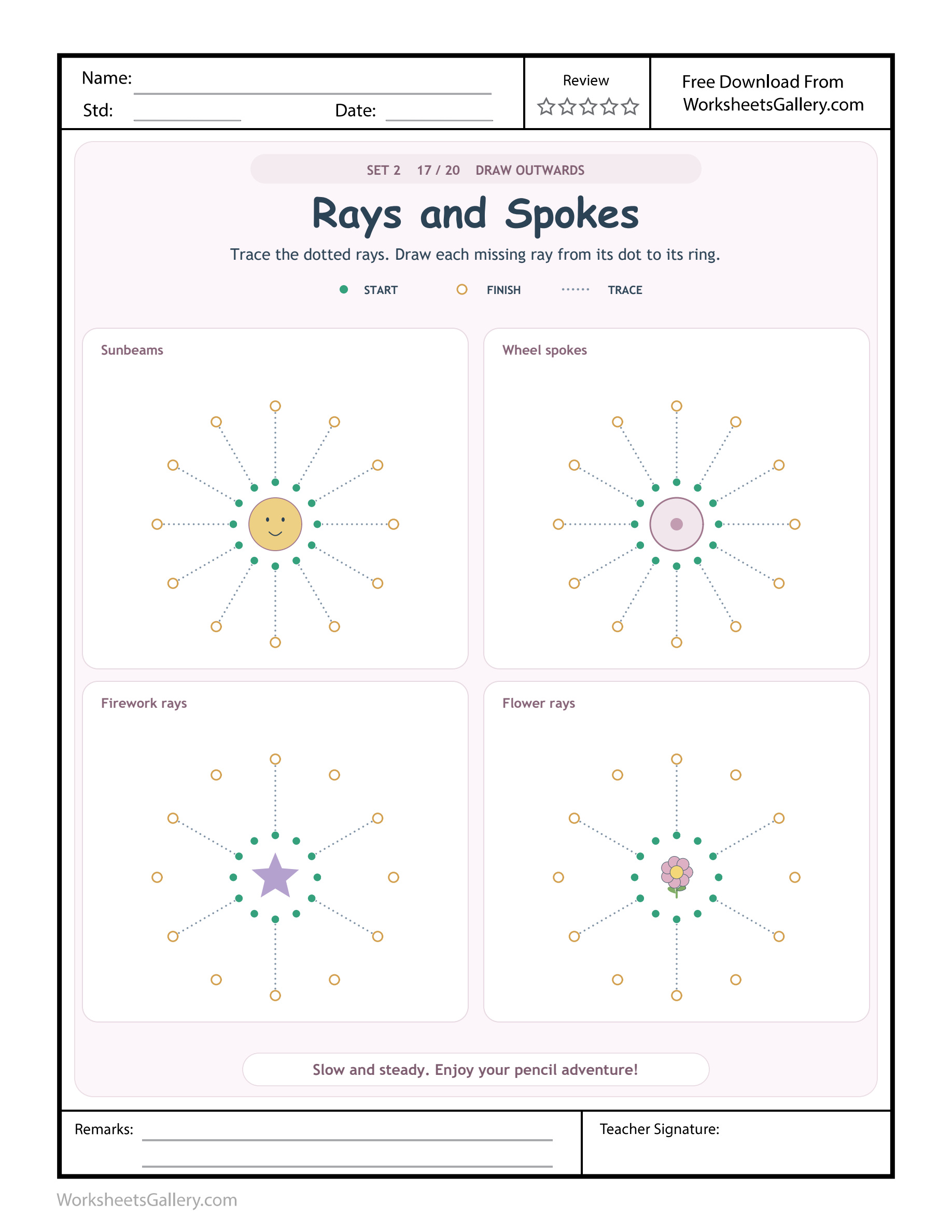
Outward rays belong with other directional choices. The sun, wheel, firework and flower tasks appear in the clean twenty-page pack. Choose its $4 purchase to receive the complete supplied collection.
One small picture can send pencil journeys in many directions. Outward Pencil Rays uses a sun, wheel, firework and flower as centres for short lines travelling toward surrounding rings. The Rays and Spokes worksheet gives children around three to six dotted rays to trace and missing rays to draw. Each begins at a green inner dot. Outward Pencil Rays makes direction the interesting choice: the next line may travel upward, sideways or diagonally, while its own start and finish still provide a clear, manageable journey from the inside toward the outside.
Outward Pencil Rays begins beside the centre picture
The coloured central picture is a reference, not the starting point for every stroke. Each ray begins at its own green dot near that picture and travels toward its corresponding outer ring. Outward Pencil Rays asks the child to locate those two markers before making the line.
The worksheet contains twelve ray positions in each of four panels. Some provide dotted guides and others leave the connection untraced. Outward Pencil Rays therefore combines following visible information with drawing a similar kind of short line independently. There is no need to finish all forty-eight positions in one sitting.
Trace a sunbeam, then inspect a missing one
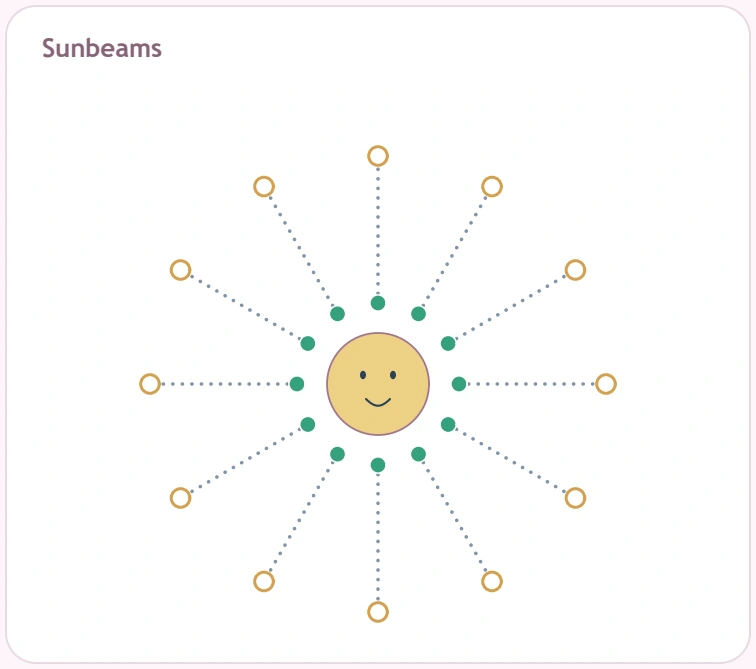
The sun panel gives the child a cheerful centre to look around. Outward Pencil Rays can begin with one dotted beam: find its green dot, locate the ring and follow the supplied guide. After that journey, lift before choosing another ray's beginning.
For a missing beam, the two endpoints remain available even though the line between them is absent. Outward Pencil Rays asks the child to draw that connection outward. Pointing to a start and its matching finish before drawing can make the independent task clearer without adding an adult-drawn dotted answer.
Hana notices that the next ray points elsewhere
Hana and her older brother choose the sun panel. After tracing an upward beam, Hana begins the next one with the same upward gesture. Her brother asks her to find that ray's outer ring first. Outward Pencil Rays gives them a new direction to inspect rather than a reason to call the whole panel wrong.
Hana points diagonally from the green dot toward its ring and rehearses above the paper. Outward Pencil Rays has connected the change in movement with visible endpoints. She draws one independent ray, then tells her brother where the sun is shining in her story. That single adjustment can be enough for the visit.
Six observations made around a shared centre
- Endpoint pairing: Outward Pencil Rays gives each short stroke an inner beginning and outer destination.
- Direction variety: the hand responds to several orientations around the same picture.
- Guide comparison: dotted and missing connections invite different levels of support.
- Short-stroke control: Outward Pencil Rays provides a small journey before the next deliberate lift.
- Location language: near, farther out, above and beside can describe visible positions.
- Self-checking: a child can compare a line's direction with the ring it was intended to reach.
Notice those particular relationships without requiring exact uniformity. A slightly uneven line can still show that a child located the correct pair and moved outward deliberately. The intended action matters alongside the final appearance.
Four Outward Pencil Rays panels share a direction rule
| Centre picture | Printed panel label | Shared route idea |
|---|---|---|
| Sun | Sunbeams | Move from an inner dot to an outer ring. |
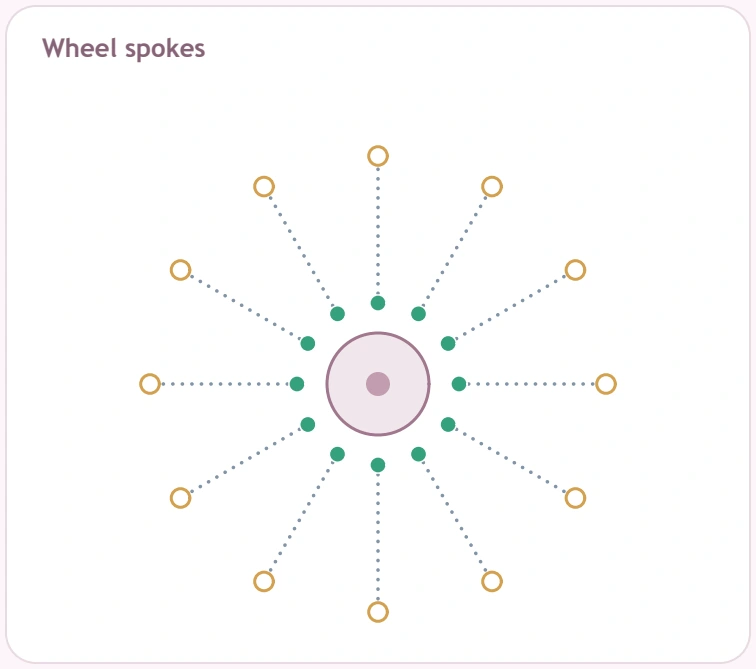
| Wheel | Wheel spokes | Inspect the direction of each separate connection. |
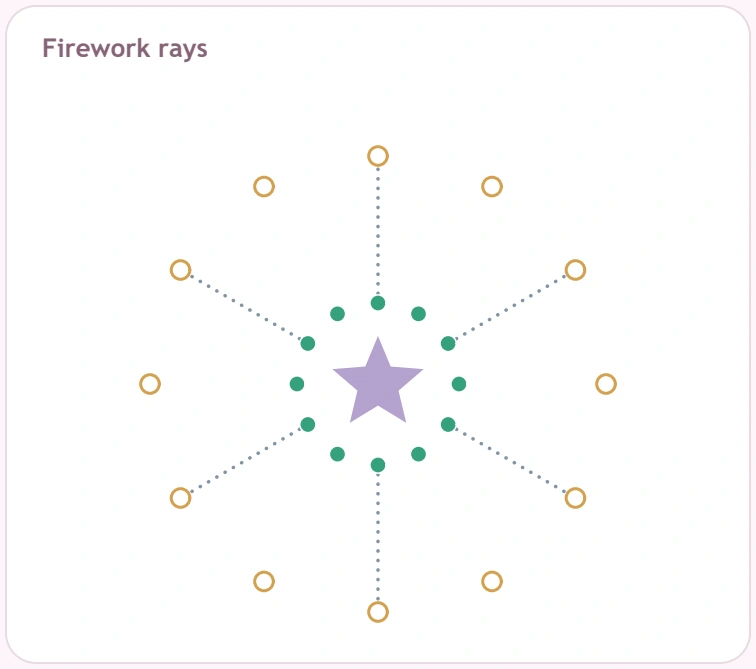
| Star | Firework rays | Trace guides and draw missing rays. |
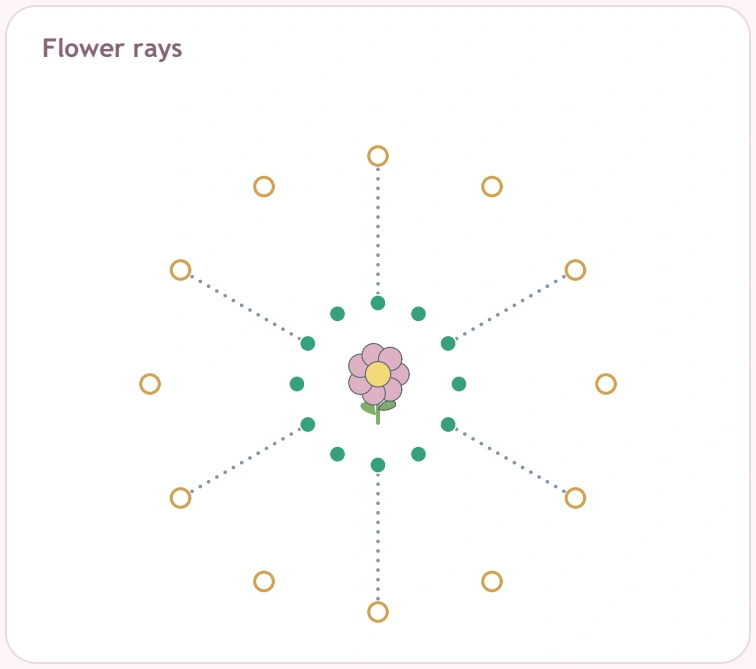
| Flower | Flower rays | Begin anew at each green marker. |
Outward Pencil Rays uses the pictures to give the arrangement meaning. They do not change the rule into colouring the centre or joining all outer rings together. Read the start-and-finish relationship for each chosen ray.
A wheel makes the shared arrangement easy to describe
The wheel panel presents spokes around its central circle. Outward Pencil Rays can prompt a child to notice that the routes spread around one centre while beginning at distinct green dots. An adult can point to two differently oriented spokes and ask how their directions compare.
Avoid calling every spoke “up” because the first one travelled upward. Outward Pencil Rays changes the required orientation as the selected position changes. A separate rain-line endpoint activity offers a more consistent direction when that would clarify the start-to-finish relationship before exploring the full radial arrangement.
Prepare a home turn with one matched pair
Choose a panel and locate one green dot with its corresponding ring. Keep the paper steady and the selected pair unobstructed. Outward Pencil Rays can begin with a finger showing the intended direction before a pencil is offered. A child can point to a dotted example nearby when comparing what a missing ray should do.
Use a comfortable tool whose line leaves the endpoint markers visible. Outward Pencil Rays becomes harder to inspect if a very broad mark covers several neighbouring dots. One guided ray and one independent connection can supply a complete small experience without turning the entire panel into a quota.
In a classroom, directions can be shown before named
A teacher invites children to select a ray and show its travel direction in the air. Some children say a direction word; others point. Outward Pencil Rays allows both responses. Each child can then use an individual sheet, with a partner helping locate the endpoint rather than moving the drawing hand.
After a short attempt, ask which green dot began the line and which ring received it. Outward Pencil Rays makes those references visible. Discussing a pair avoids ranking children by how many spokes they have finished. A child who carefully inspects one diagonal connection may have plenty to explain.
Firework rays change orientation around a star
The firework panel uses a star as its centre picture. Outward Pencil Rays still asks for individual outward connections, rather than tracing the star outline or drawing a spiral around it. Locate one missing ray and compare its likely direction with neighbouring dotted examples.
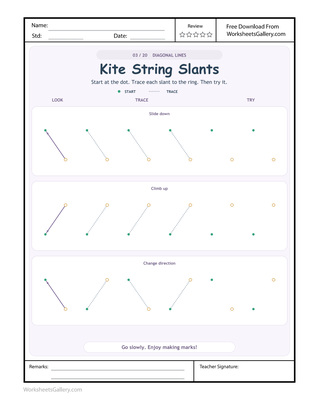
The kite slant-direction sheet provides another context for diagonal travel. Outward Pencil Rays brings several orientations together around a centre, so the child needs to inspect each pair anew instead of assuming a repeated slope for every stroke.
Four outward-movement games with finished props
Build a cord sun
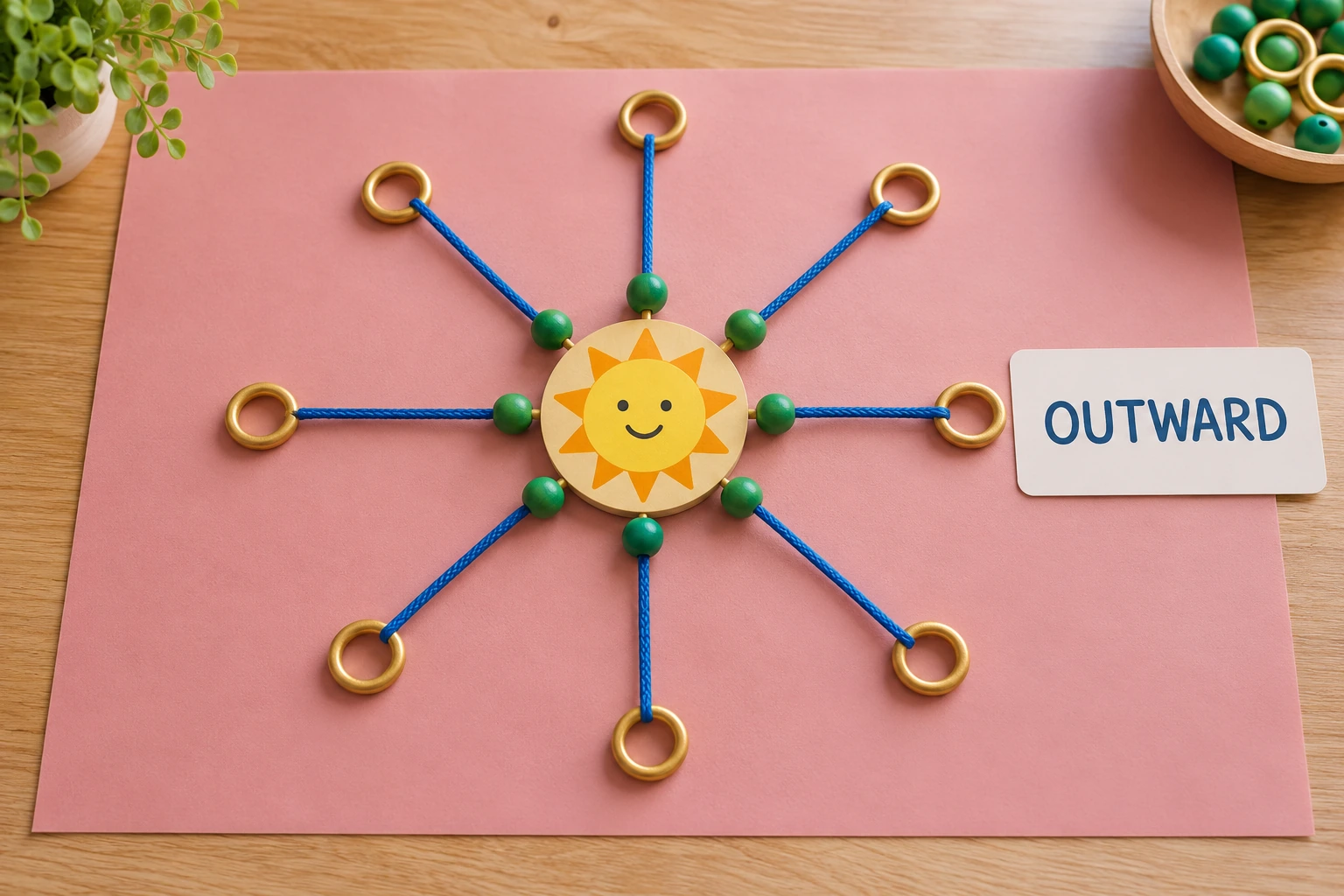
Place a completed central sun picture on a mat and arrange a few cords from named inner starts to outer rings. Outward Pencil Rays can follow when the child wants a smaller drawn task. The prop need not use twelve cords; explain that it is a separate demonstration of outward travel, not a replica of the printed panel.
Be the destination finder
One person points to an inner start on a separate completed radial display, while the other finds its outer destination. Swap roles and talk about how the direction changes. Outward Pencil Rays gives the same kind of pairing a pencil purpose, with each route considered independently.
Give a ray a spoken journey
Let a pretend beam describe going away from the centre toward its ring. The child can gesture while telling the story. Outward Pencil Rays offers visible examples afterward, but the spoken game can be enough. Keep the emphasis on the direction of travel rather than on a fixed speed or chant.
Curate two different directions
Display two completed example rays on separate labelled cards and ask a visitor how their directions differ. Outward Pencil Rays can supply a comparison if the child wants to point to their own work. The explanation may be a gesture, leaving formal directional vocabulary to develop through repeated meaningful use.
Flower rays keep separate starts visible
The flower panel contains the same kind of inner-dot and outer-ring arrangement. Outward Pencil Rays asks the child to begin at each chosen green marker, not repeatedly from the middle of the flower. Inspect a few pairs before drawing if the central picture is attracting all the attention.
The rocket direction-and-reset activity gives a third related movement comparison. Outward Pencil Rays uses a radial layout instead of rows, so explain the arrangement rather than assuming that a familiar start-to-finish gesture will transfer automatically.
✎ Common radial mix-ups have visible clues
Drawing inward from a ring, starting every line on the centre picture, or joining neighbouring outer rings changes the instruction. Outward Pencil Rays gives the adult distinct markers to revisit. Ask the child to identify one intended start before supplying a direction cue.
The reminder from the green dot, outward to its ring can be useful. Outward Pencil Rays does not need every missing line completed before a child's observation is heard. If a ray reaches a different ring, inspect that particular pairing together and leave room for a later new attempt.
Support three-to-six-year-old direction explorers
A few large cord routes can suit children who are not ready to inspect the compact radial markers. Others may enjoy a panel's guided and independent connections. Outward Pencil Rays allows adult-supported choices without making twelve completed rays a measure of age-level success.
Keep the whole selected panel visible and offer a comfortable drawing position. Outward Pencil Rays can be enlarged as a complete print when the markers need more viewing space. A child can also show direction through pointing, making a shared observation possible even when pencil interest is brief.
Return to a different position, not a bigger quota
Remember which direction the child found interesting. Another visit might compare an upward ray with a diagonal one or choose a different centre picture. Outward Pencil Rays can be revisited through one new pairing, rather than a demand to finish all unmarked positions at once.
For broader ideas, NAEYC offers family guidance on supporting writing. PBS Parents gathers literacy resources for age-four browsing. Outward Pencil Rays can accompany everyday pictures and pretend signs whose meanings give children a reason to make marks.
Save the clean radial activity page
The original branded worksheet remains the free sample. For the clean Outward Pencil Rays PDF, use the premium membership request with the account holding an eligible active plan. The protected file becomes available after the site's access check. Save it, open the page and inspect all four panels before printing.
The premium Outward Pencil Rays download retains its original radial guides. Watermark and advertising elements are absent; the site's name and domain have also been taken out. Print the full border so no outer rings are clipped. The package card connects to the separate $4 discovery collection. Each new ray deserves its own beginning.
Popular Worksheets
Printable resources families and teachers are downloading now.
 Free
 Free
 Free
 Free