
Robot Grid Repair: 3 Brilliant Missing-Tile Clues
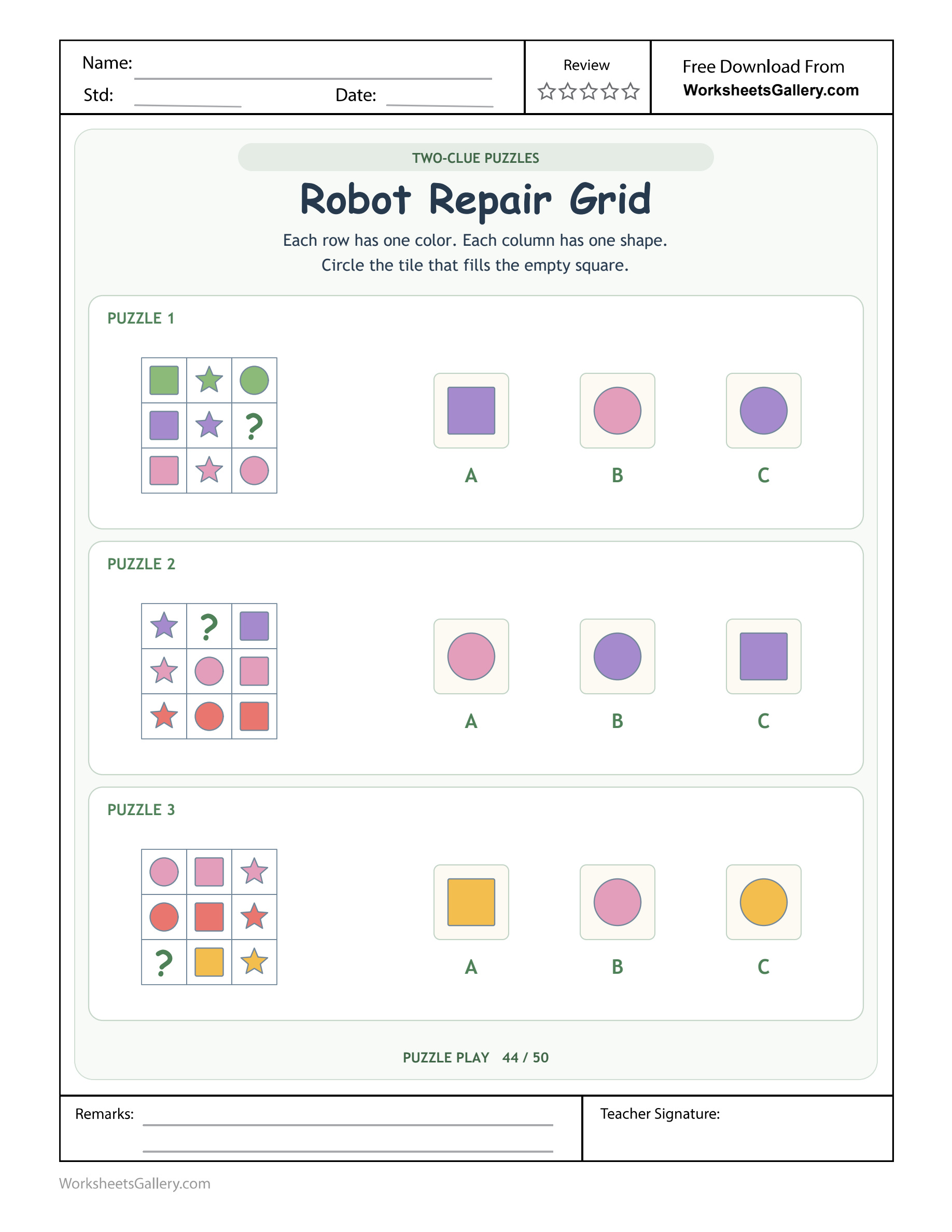
$5 · 25 supplied sheets: Robot Grid Repair. Treat colour and shape as independent constraints that meet at the empty grid position.
A robot theme frames a missing-tile reasoning task rather than a drawing of a robot body. Robot Grid Repair presents three colour-shape matrices and asks children to select the candidate fitting each gap. Read the row’s colour and the column’s shape separately, then combine them in one description. A child can point along both directions while an adult helps with vocabulary. The choice becomes convincing when it satisfies both visible rules. Use a partly correct option to discuss why one matching feature alone does not make a complete repair.
Robot Grid Repair: read the actual puzzle
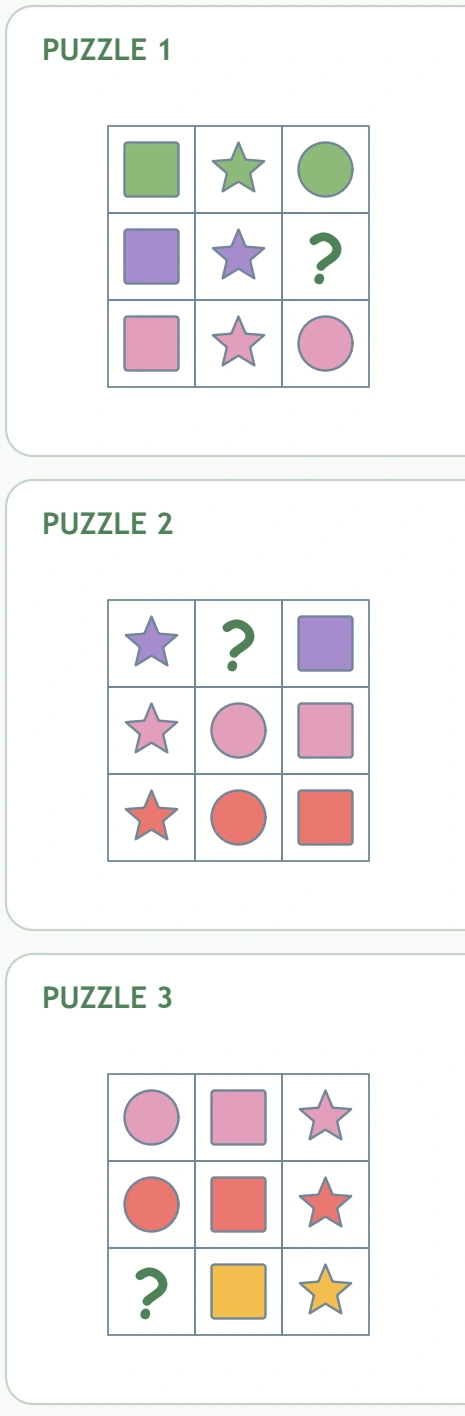
Robot Grid Repair: The page contains three independent three-by-three grids. Every row uses one colour and every column one shape. The theme supplies a repair story, while the evidence is carried by ordinary circles, stars and squares.
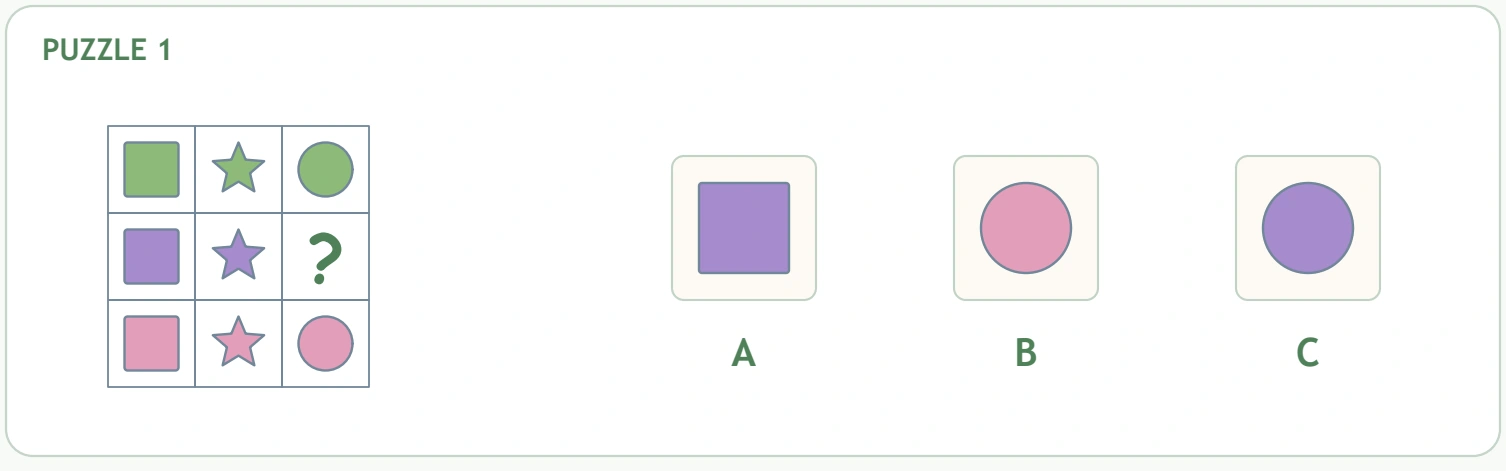
The first missing tile belongs to a purple row and a circle column. The offered purple square agrees with colour only, while the pink circle agrees with shape only. Compare both attributes before selecting the purple circle.
One-piece fit deserves a second look
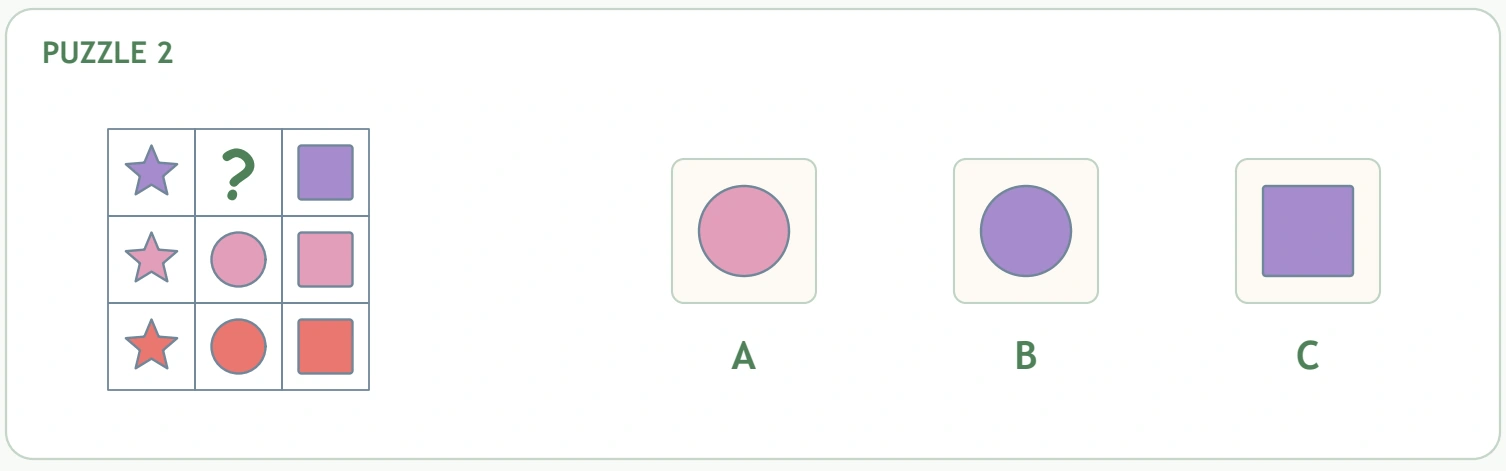
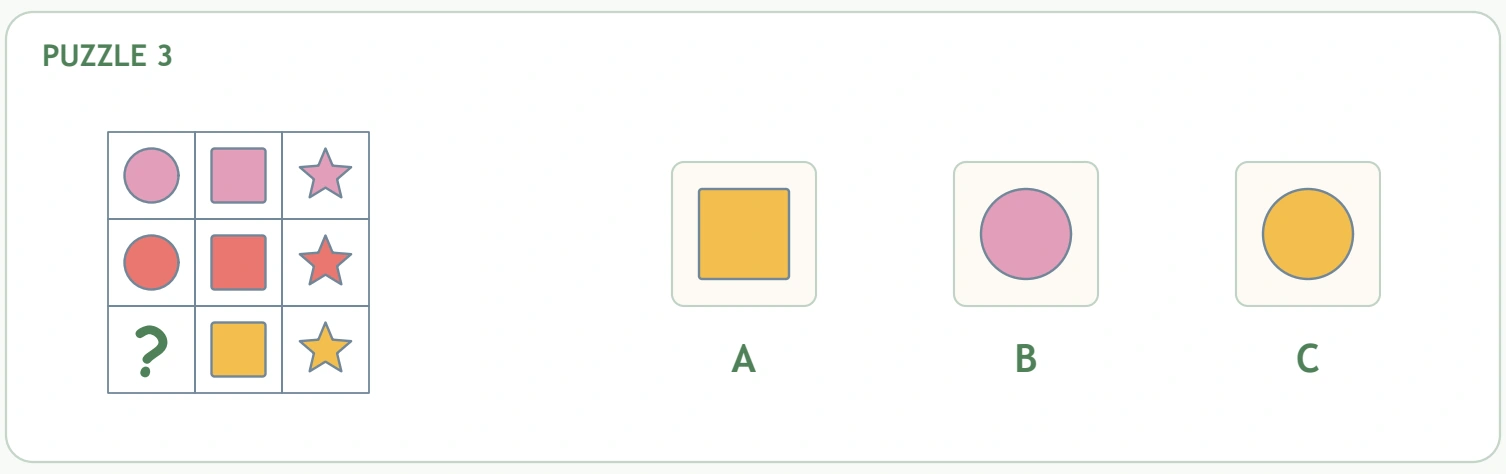
The second grid changes the column arrangement, and the third changes the missing colour. Re-establish the local rules in each matrix. A remembered answer location from an earlier puzzle is not evidence for the next one.
The child circles one pictured candidate per grid. A spoken colour-shape explanation can come before the mark, allowing an adult to distinguish uncertainty about the rules from a slip while selecting among the three options.
Revisit the one-piece fit difficulty
Assuming the theme requires drawing a robot introduces work the printed sheet does not request. Keep attention on the matrices. Another common shortcut is matching colour across a row while ignoring the shape relationship running through the same gap.
Return to Robot Grid Repair evidence by asking “Can this one part satisfy the two requirements?” Separate pencil execution from Enzo’s repair colour reasoning.
Distinctions behind one-piece fit
Repair colour — the Enzo discussion
A repair metaphor can make the puzzle engaging, but the success criterion stays precise. A part is suitable because its two attributes fit the matrix, not because it looks like something a real robot would need. Keep the story subordinate to the visible rule.
Repair shape — the Enzo discussion
Rows and columns provide independent information. Invite two short statements before the final choice: this row is purple, this column uses circles. Combining them avoids treating one property as a substitute for the other.
One-piece fit — the Enzo discussion
Selecting the correct colour-shape combination and recording its option are distinct stages. If a child says purple circle but circles a purple square, point back to the candidates and ask which one matches the spoken phrase before revisiting the underlying matrix.
Six observations from repair colour
Constraint combination — repair colour
Robot Grid Repair invites applying a row property and column property simultaneously. Notice Enzo’s constraint combination explanation: “Which colour must the repair piece have?”
Property vocabulary — repair shape
Robot Grid Repair invites describing a tile through both colour and shape. Notice Enzo’s property vocabulary explanation: “What shape is needed in this vertical line?”
Matrix scanning — one-piece fit
Robot Grid Repair invites finding relevant neighbours across two perpendicular directions. Notice Enzo’s matrix scanning explanation: “Can this one part satisfy the two requirements?”
Decoy resistance — option inspection
Robot Grid Repair invites rejecting an attractive candidate with just one correct feature. Notice Enzo’s decoy resistance explanation: “Why would this other repair fail?”
Explanation checking — repair colour
Robot Grid Repair invites testing a spoken requirement against the actual chosen option. Notice Enzo’s explanation checking explanation: “Which colour must the repair piece have?”
Selection precision — repair shape
Robot Grid Repair invites circling one complete repair candidate within its option set. Notice Enzo’s selection precision explanation: “What shape is needed in this vertical line?”
Four checkpoints for Robot Grid Repair
| Pause here | Inspect this clue |
|---|---|
| Repair colour | Identify the colour repeated across the missing tile’s row. |
| Repair shape | Read the shape repeated in the gap’s column. |
| One-piece fit | Combine both requirements in the same candidate. |
| Option inspection | Compare each offered tile rather than its letter alone. |
Repair colour — Enzo’s inspection
For Robot Grid Repair, ask “Which colour must the repair piece have?” Identify the colour repeated across the missing tile’s row.
Repair shape — Enzo’s inspection
For Robot Grid Repair, ask “What shape is needed in this vertical line?” Read the shape repeated in the gap’s column.
One-piece fit — Enzo’s inspection
For Robot Grid Repair, ask “Can this one part satisfy the two requirements?” Combine both requirements in the same candidate.
Option inspection — Enzo’s inspection
For Robot Grid Repair, ask “Why would this other repair fail?” Compare each offered tile rather than its letter alone.
Readiness for repair shape
Use large coloured circles, squares and stars for an oral rehearsal. The child can combine named attributes with physical pieces before making a smaller printed candidate selection.
Suggested Robot Grid Repair range: ages five to seven. Enzo’s readiness depends on constraint combination and interest in repair shape. Shorten this Robot Grid Repair visit when needed.
Another visit through selection precision
Invite a repair inspection on another day by offering a deliberately partial match. Let the child explain which requirement was missed and choose a corrected part from the same option set.
Revisit Robot Grid Repair through option inspection. Recognise explanations about option inspection from Enzo.
Imagine Enzo investigating at home
Enzo’s aunt plays repair technician with a purple square and a purple circle. Enzo follows the column to identify circles, then rejects the square despite its correct colour. They explain that colour agreement alone leaves the repair incomplete.
Try “Which colour must the repair piece have?” during this imagined Robot Grid Repair visit. Let Enzo explain repair colour before recording.
Eight closer readings of repair colour
The robot is a story frame
No robot body needs to be completed on this worksheet. The repair metaphor gives a role to the missing coloured shape, while the actual rule is the row-column matrix. Keeping the story and response requirement distinct prevents an adult from introducing drawing or colouring work the printed activity never requested. This Robot Grid Repair distinction supports constraint combination.
One inspection names the colour
Look across the gap’s row and name the shared hue. Keep that colour as a requirement, not a final answer. A candidate can agree with the row and still fail the vertical shape clue, so the colour inspector should pass information to a second inspection rather than immediately approve a repair.
Another inspection names the shape
Read the column through the empty position, comparing its completed entries. The required circle must still carry the row’s colour. Asking for a colour statement and a shape statement separately can make both pieces of evidence available before the child searches for their combination among the choices. This Robot Grid Repair distinction supports matrix scanning.
A purple square is only partly right
In the first grid, the purple square agrees with the row colour but not the circle column. Invite the child to explain that partial success without accepting the tile. Rejecting it through a specific violated rule is more informative than saying the piece simply looks wrong.
Inspect the chosen part itself
Option letters distinguish the three pictures but do not contain their attributes. Ask the child to name the actual selected colour and shape. A familiar answer letter from an earlier matrix cannot replace that inspection, even when two grids happen to need similar-looking repair parts. This Robot Grid Repair distinction supports explanation checking.
A changed gap changes where to look
A missing tile near the top may need evidence from below rather than above. Let the child follow the full column through the gap. The inspection path depends on position, while the underlying task remains finding one object that satisfies the row and column simultaneously.
Keep recording separate from repair logic
If the spoken requirement is correct but a different option is circled, return to the candidate pictures and match the phrase. The necessary support may concern locating the option or making a clear circle, not understanding why the matrix requires that particular combination of attributes. This Robot Grid Repair distinction supports constraint combination.
The child can audit a technician
Offer an adult’s deliberately partial repair on a separate complete model. The child can identify its correct property and its failed property, then request a replacement. This gives a concrete expert role while preserving the precise two-clue reasoning rather than turning the activity into arbitrary imaginative robot design.
Five play invitations after repair shape
Repair request ticket with Robot Grid Repair
Write a complete request such as PURPLE CIRCLE beside an independent part tray and let a partner find the matching object.
Colour inspector swap with Robot Grid Repair
Keep the requested shape fixed while changing the row colour in a small model; discuss which repair property must change.
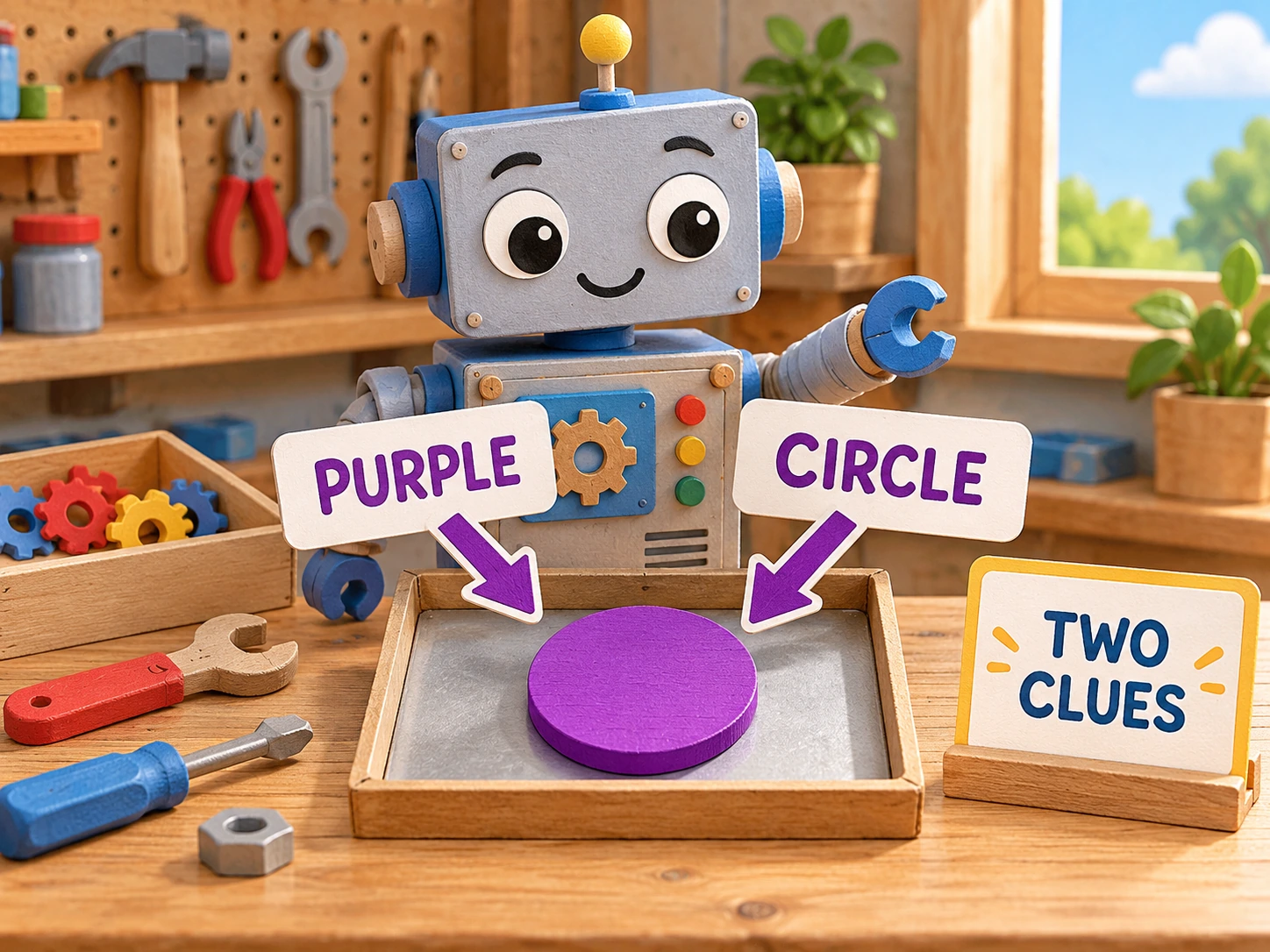
Shape inspector swap with Robot Grid Repair
Keep the colour requirement but change a model column from circles to squares, then choose the new combined part.
Reject the decoy with Robot Grid Repair
Offer two pieces that each satisfy only one requirement. Ask which further option is needed for a full repair.
Technician explanation with Robot Grid Repair
One player chooses a part and another checks its spoken colour-shape description against the grid before approving it.
Partners explore property vocabulary
A classroom repair desk assigns a colour inspector and a shape inspector. Each supplies a requirement, and a third partner chooses a part that satisfies both. The team checks the visible matrix before accepting the technician’s final circle.
A Robot Grid Repair classroom note can describe finding relevant neighbours across two perpendicular directions. Record the actual repair shape prompt, too.
Save and print Robot Grid Repair
Save the premium Robot Grid Repair PDF through membership access when your active plan qualifies. The clean file carries no domain wording, website watermark or advertisements. Its original-upload sample uses a separate download control. Inspect the three repair boards in portrait preview, keeping their row colours, column shapes and A/B/C choices complete on the paper.
Other choices beyond constraint combination
For Robot Grid Repair, the saved catalog suggests road-following after robot grid repair; aiming-and-stopping after robot grid repair; picture-recipe drawing after robot grid repair. Read each linked activity’s rule with Enzo; its repair colour response may differ.
For Enzo, browse NAEYC writing ideas alongside robot grid repair or PBS Parents activities beyond robot grid repair. Watch constraint combination with matrix scanning, then revisit repair colour.
Popular Worksheets
Printable resources families and teachers are downloading now.
 Free
 Free
 Free
 Free