
Patchwork Tile Logic: 3 Clever Two-Clue Decisions
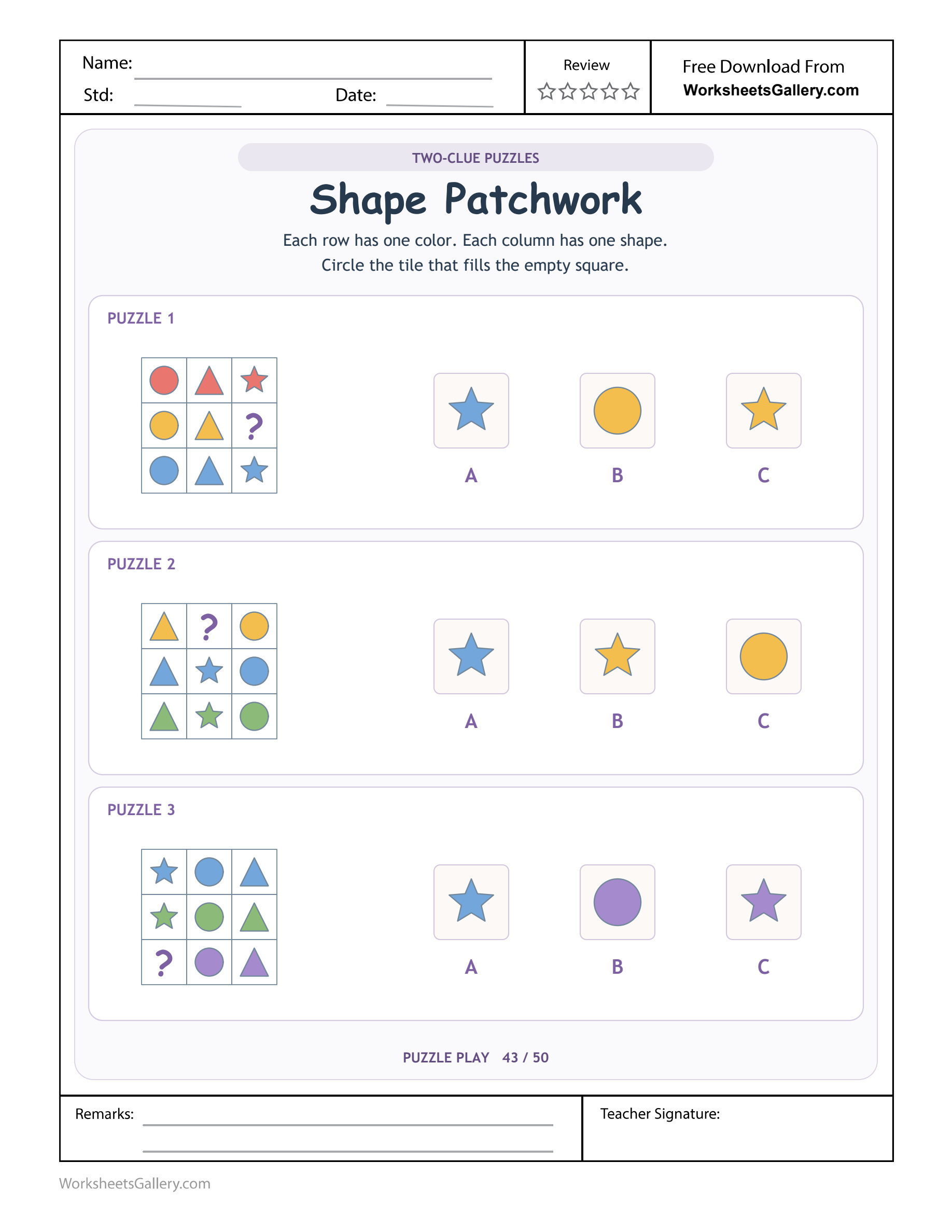
$5 · 25 supplied sheets: Patchwork Tile Logic. Intersect the row colour with the column shape to reject choices that satisfy only one clue.
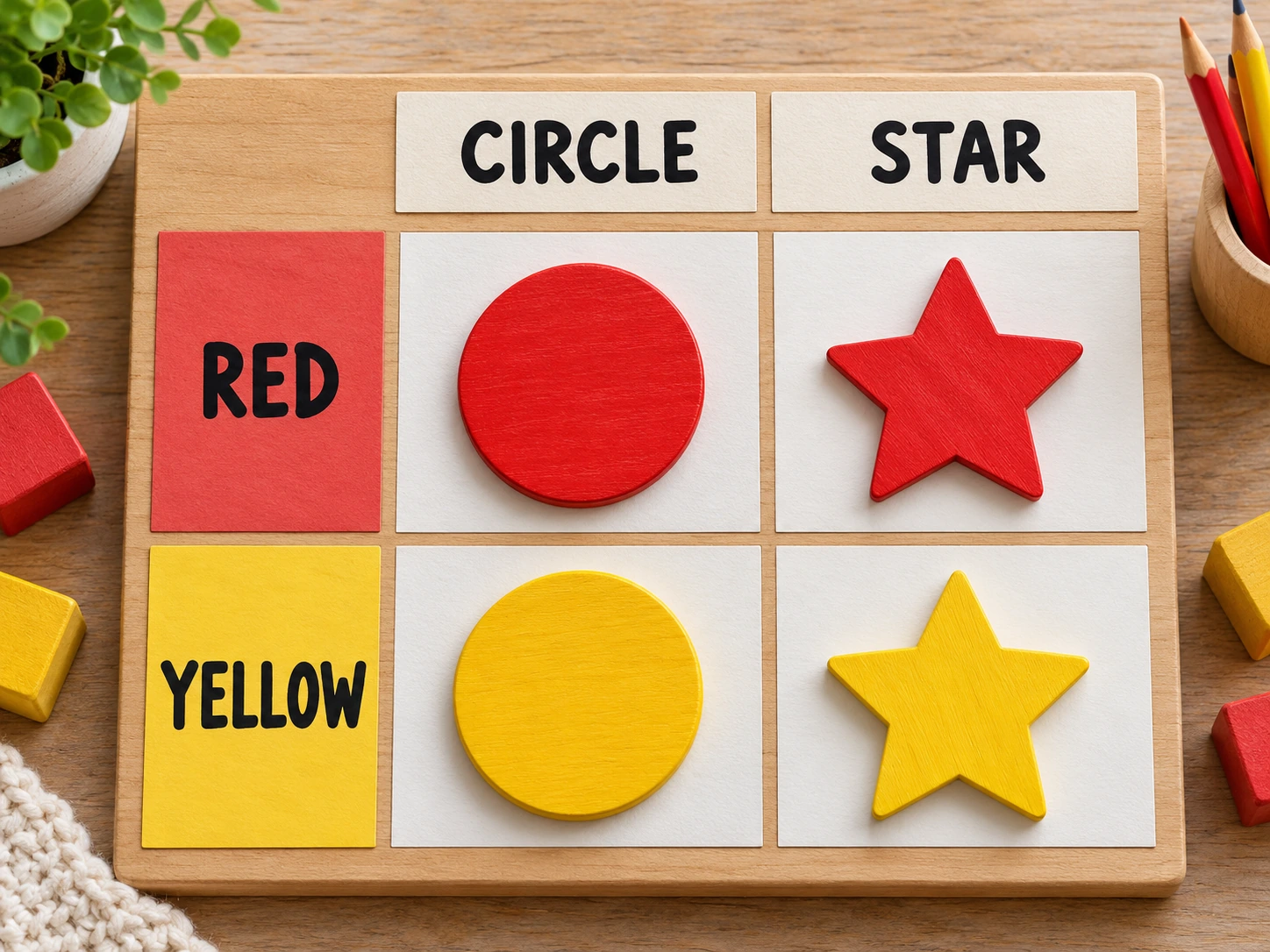
One empty square sits where a row colour and a column shape meet. Patchwork Tile Logic offers three small grids, each with three candidate tiles to compare. Children inspect the completed neighbours, identify both rules and circle the option satisfying their intersection. An adult can help name colours or shapes while the child decides which combination belongs in the gap. Begin with one grid and explain why a tempting partial match fails. A complete reason includes both properties, rather than selecting a favourite colour or copying only the nearest tile.
Patchwork Tile Logic: read the actual puzzle
Patchwork Tile Logic: Each puzzle uses a three-by-three matrix. A row keeps one colour while a column keeps one shape. The empty square therefore has two constraints, which must agree within the same candidate tile.
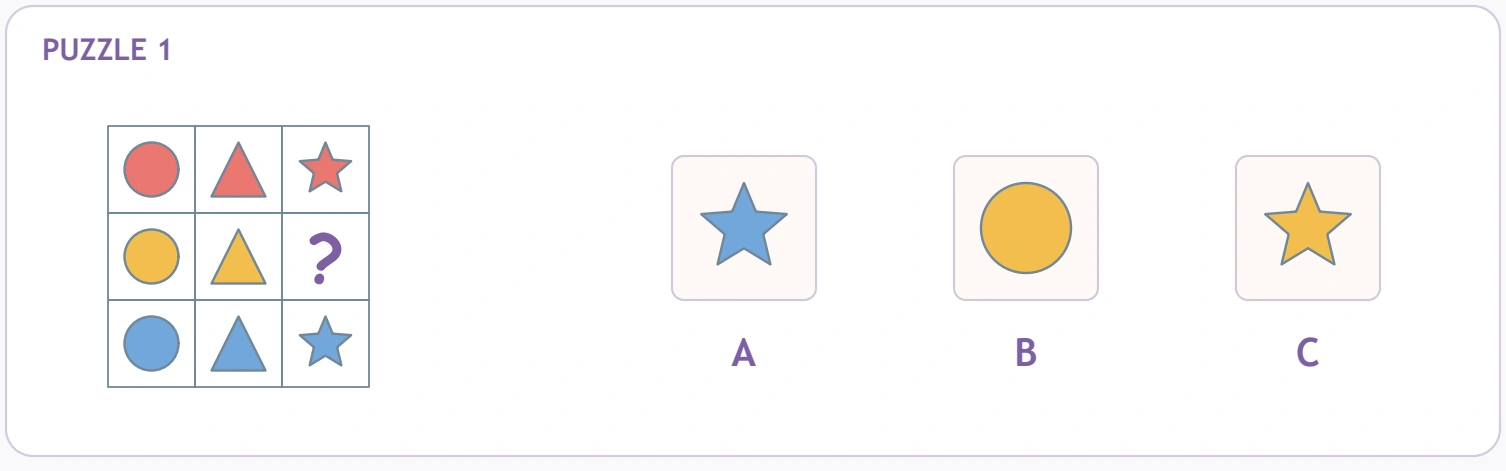
In the first grid the gap lies in the yellow row and star column. A yellow circle matches the row but fails the column. A blue star matches the column but fails the row. Only the combined yellow star satisfies both.
Combined candidate deserves a second look
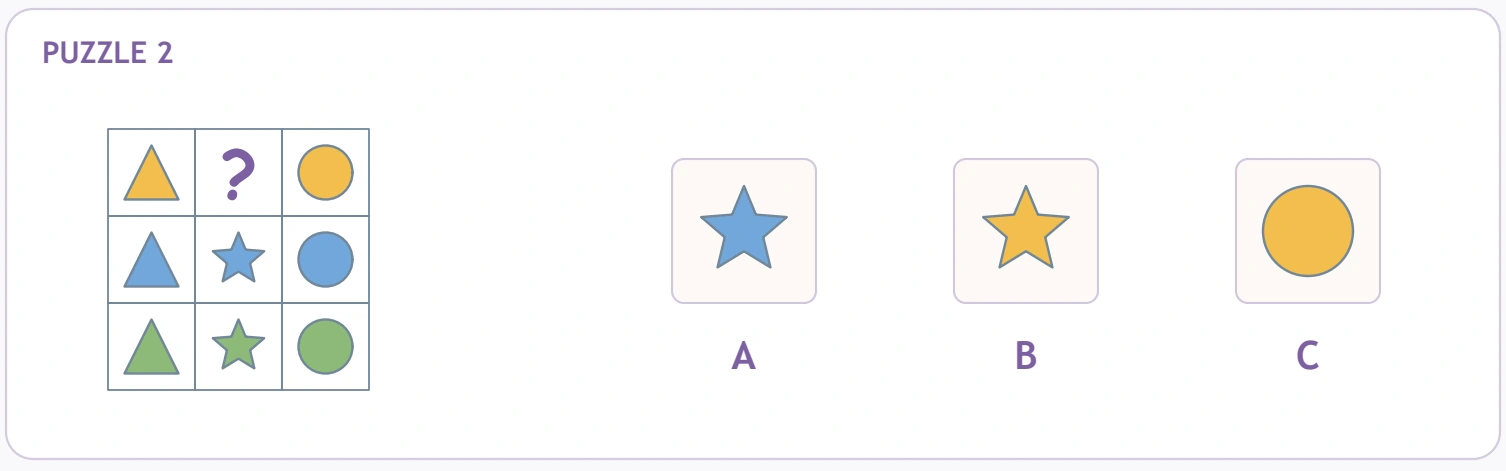
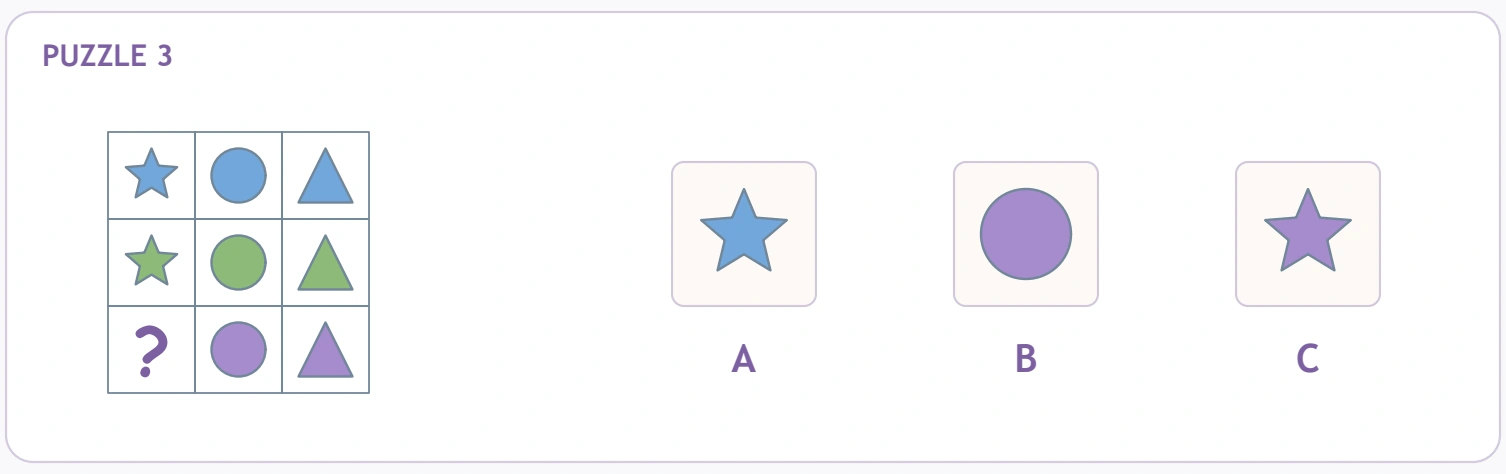
The next grids change which position is missing and how the columns are arranged. Inspect the current row and column afresh. Remembering that a previous choice was a star does not replace finding the evidence in this grid.
Circle the A, B or C candidate tile that fills the gap conceptually. The sheet does not ask the child to cut out pieces, draw in the matrix or colour every row; those would be separately announced extension activities.
Revisit the combined candidate difficulty
Copying the nearest tile preserves only one relationship and may violate the other. Ask for a separate colour statement and shape statement. If those are correct but the wrong candidate is circled, check the final option comparison rather than reteaching the whole grid.
Return to Patchwork Tile Logic evidence by asking “Does this tile fit both clues at once?” Separate pencil execution from Tula’s row property reasoning.
Readiness for column property
Large shape pieces can make the two attributes easier to discuss. Read colour words aloud if needed, and allow the child to select a physical colour-shape combination before indicating its printed counterpart.
Suggested Patchwork Tile Logic range: ages five to seven. Tula’s readiness depends on attribute separation and interest in column property. Shorten this Patchwork Tile Logic visit when needed.
Six observations from row property
Attribute separation — row property
Patchwork Tile Logic invites considering colour and shape as independent properties. Notice Tula’s attribute separation explanation: “What colour does this row require?”
Intersection reasoning — column property
Patchwork Tile Logic invites combining two constraints at one grid position. Notice Tula’s intersection reasoning explanation: “Which shape belongs in this column?”
Visual rule finding — combined candidate
Patchwork Tile Logic invites using completed neighbours as evidence for the missing tile. Notice Tula’s visual rule finding explanation: “Does this tile fit both clues at once?”
Alternative evaluation — partial-match rejection
Patchwork Tile Logic invites rejecting an option that satisfies only part of the rule. Notice Tula’s alternative evaluation explanation: “Which clue does this other tile break?”
Precise description — row property
Patchwork Tile Logic invites naming a required colour-shape combination clearly. Notice Tula’s precise description explanation: “What colour does this row require?”
Intentional selection — column property
Patchwork Tile Logic invites circling one candidate after checking the complete requirement. Notice Tula’s intentional selection explanation: “Which shape belongs in this column?”
Distinctions behind combined candidate
Row property — the Tula discussion
Two properties can be named correctly without being combined in one object. Ask for a single phrase such as yellow star, then locate that exact combination among the choices. This bridges separate observations and the final candidate decision.
Column property — the Tula discussion
A different missing position may require looking below as well as above, or left as well as right. Use whichever completed neighbours establish the row and column. The gap’s location changes the inspection path without changing the two-clue principle.
Combined candidate — the Tula discussion
An option letter is merely a way of distinguishing candidates. The evidence concerns the pictured tile’s attributes, not whether A, B or C was correct previously. Explain the colour and shape before naming its position in the choices.
Another visit through intentional selection
Ask the child to prove why a partly matching alternative is wrong on a later visit. Rejecting a plausible choice adds a different reasoning job to finding the correct tile.
Revisit Patchwork Tile Logic through partial-match rejection. Recognise explanations about partial-match rejection from Tula.
Imagine Tula investigating at home
Tula’s grandmother offers a yellow circle and a blue star beside the first grid. Tula notices that each is partly right. They point along the row and down the column, then find the third candidate that meets both requirements.
Try “What colour does this row require?” during this imagined Patchwork Tile Logic visit. Let Tula explain row property before recording.
Eight closer readings of row property
Read across for one property
Use completed neighbours in the missing tile’s row to establish colour. Say the shared colour before inspecting the options. An adult can help with the vocabulary while leaving the child to find the consistent visual property, ensuring the row clue comes from the grid rather than a favourite candidate. This Patchwork Tile Logic distinction supports attribute separation.
Read vertically for another property
Inspect the missing position’s column to identify its shape. Depending on the gap’s location, useful evidence may lie above or below. The direction of inspection changes, but the relationship remains vertical. Keep that shape requirement available while considering the colour found across the row.
Combine the descriptions into one tile
Ask for a single colour-shape phrase before selecting a candidate. Saying yellow and star separately is a useful beginning, but the chosen object must carry both. A yellow circle and a blue star each preserve only one part of the requirement; neither completes the intersection. This Patchwork Tile Logic distinction supports visual rule finding.
Explain the attractive decoy
A partly matching option is valuable evidence for discussion. Ask which clue it satisfies and which it breaks. This question can reveal more reasoning than an immediate correct circle, because the child must keep both requirements in mind while analysing why one plausible candidate is insufficient.
Do not copy the nearest neighbour
The tile next to a gap often shares its row colour but not its column shape. Copying it duplicates a local appearance while missing the second constraint. Point along both directions and compare their information before treating any neighbouring tile as a complete model for the missing position. This Patchwork Tile Logic distinction supports precise description.
Re-establish the next matrix
The three puzzles place gaps differently and rearrange the shapes. Begin each with its current row and column rather than carrying over a previous option letter. The same kind of reasoning applies, while the local visual evidence must still be gathered afresh from this particular grid.
A spoken answer can check a circle
After the child describes a required tile, compare that phrase with the marked candidate. A mismatch between speech and circle may be an option-selection slip. Returning to the three pictures can clarify it without implying that the child failed to understand the two underlying rules. This Patchwork Tile Logic distinction supports attribute separation.
Make a complete model first
For off-page play, build a small fully populated colour-by-shape grid before removing a piece. Let the child inspect how each row and column behaves. The model makes the missing-tile task a question about preserving relationships rather than guessing which decorative piece looks nicest in an empty space.
Four checkpoints for Patchwork Tile Logic
| Pause here | Inspect this clue |
|---|---|
| Row property | Read the colour shared by completed tiles across the gap’s row. |
| Column property | Inspect the shape repeated above or below the gap. |
| Combined candidate | Test the same option against both properties. |
| Partial-match rejection | Explain why each tempting alternative fails one rule. |
Row property — Tula’s inspection
For Patchwork Tile Logic, ask “What colour does this row require?” Read the colour shared by completed tiles across the gap’s row.
Column property — Tula’s inspection
For Patchwork Tile Logic, ask “Which shape belongs in this column?” Inspect the shape repeated above or below the gap.
Combined candidate — Tula’s inspection
For Patchwork Tile Logic, ask “Does this tile fit both clues at once?” Test the same option against both properties.
Partial-match rejection — Tula’s inspection
For Patchwork Tile Logic, ask “Which clue does this other tile break?” Explain why each tempting alternative fails one rule.
Five play invitations after column property
Two-clue shop with Patchwork Tile Logic
Request a large tile using a colour clue and a shape clue. A shopkeeper must supply one object satisfying both.
Partly right counter with Patchwork Tile Logic
Offer an option with the right colour but wrong shape. Explain exactly which clue it respects and which it breaks.
Row reporter with Patchwork Tile Logic
Build a small complete attribute grid and let one player describe its row property while another names its columns.
Missing-position designer with Patchwork Tile Logic
Remove a tile from a separate complete model, keeping enough neighbours to establish both requirements.
Candidate judge with Patchwork Tile Logic
Invent three choices for a homemade gap and have a partner justify rejecting each partial match before selecting the full match.
Partners explore intersection reasoning
One partner reports the row colour while another reports the column shape. A third child must combine their two statements into one tile description before anyone circles an option. The reporting jobs change on the next matrix.
A Patchwork Tile Logic classroom note can describe using completed neighbours as evidence for the missing tile. Record the actual column property prompt, too.
Save and print Patchwork Tile Logic
For Patchwork Tile Logic, the clean member printable preserves three tile boards and their lettered options. Its premium access requires an eligible active plan. Website watermark, domain text and advertising do not appear in that PDF; the original sample remains distinct. Check the bottom choices and all row and column clues inside the portrait print boundaries.
Other choices beyond attribute separation
For Patchwork Tile Logic, the saved catalog suggests road-following after patchwork tile logic; aiming-and-stopping after patchwork tile logic; picture-recipe drawing after patchwork tile logic. Read each linked activity’s rule with Tula; its row property response may differ.
For Tula, browse NAEYC writing ideas alongside patchwork tile logic or PBS Parents activities beyond patchwork tile logic. Watch attribute separation with visual rule finding, then revisit row property.
Popular Worksheets
Printable resources families and teachers are downloading now.
 Free
 Free
 Free
 Free