
Shape Twin Comparisons: 6 Brilliant Order Checks
$5 · 25 supplied sheets: Shape Twin Comparisons. Check each position in a shape trio rather than treating a shared inventory as an exact match.
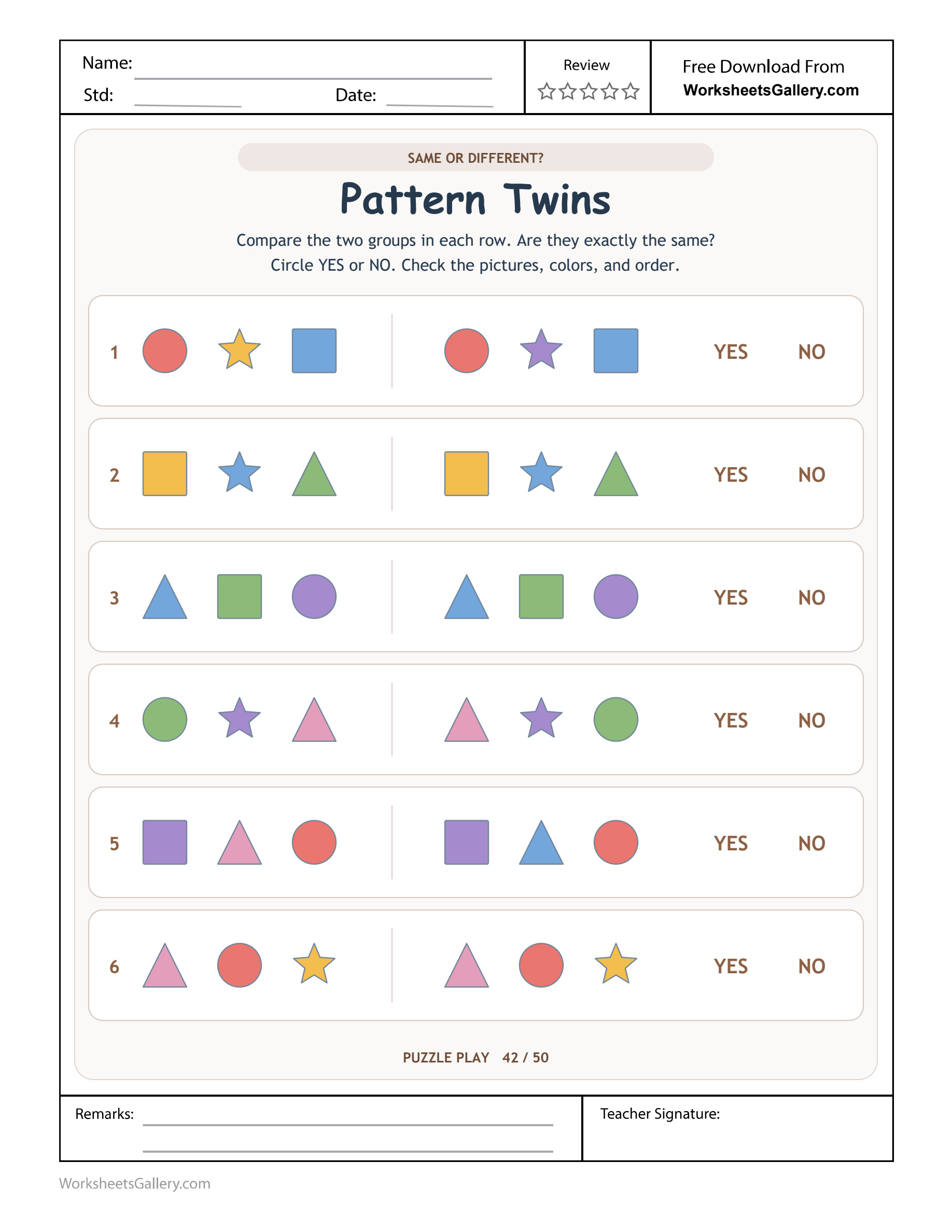
Three shapes can share their colours and still stand in a different order. Shape Twin Comparisons asks children to inspect six pairs of coloured trios and decide whether they match exactly. Compare corresponding positions, checking shape identity and colour as well as arrangement. The printed YES and NO words record the result; the activity is not asking for the next shape in a repeat. Begin with a pair that looks approachable, let your child explain one visible feature and use a second comparison before accepting a quick first impression.
Shape Twin Comparisons: read the actual puzzle
Shape Twin Comparisons: The six rows compare completed groups, not unfinished patterns. Read the question as a same-or-different decision. There is no missing fourth position to predict and no need to extend any trio beyond its three printed shapes.
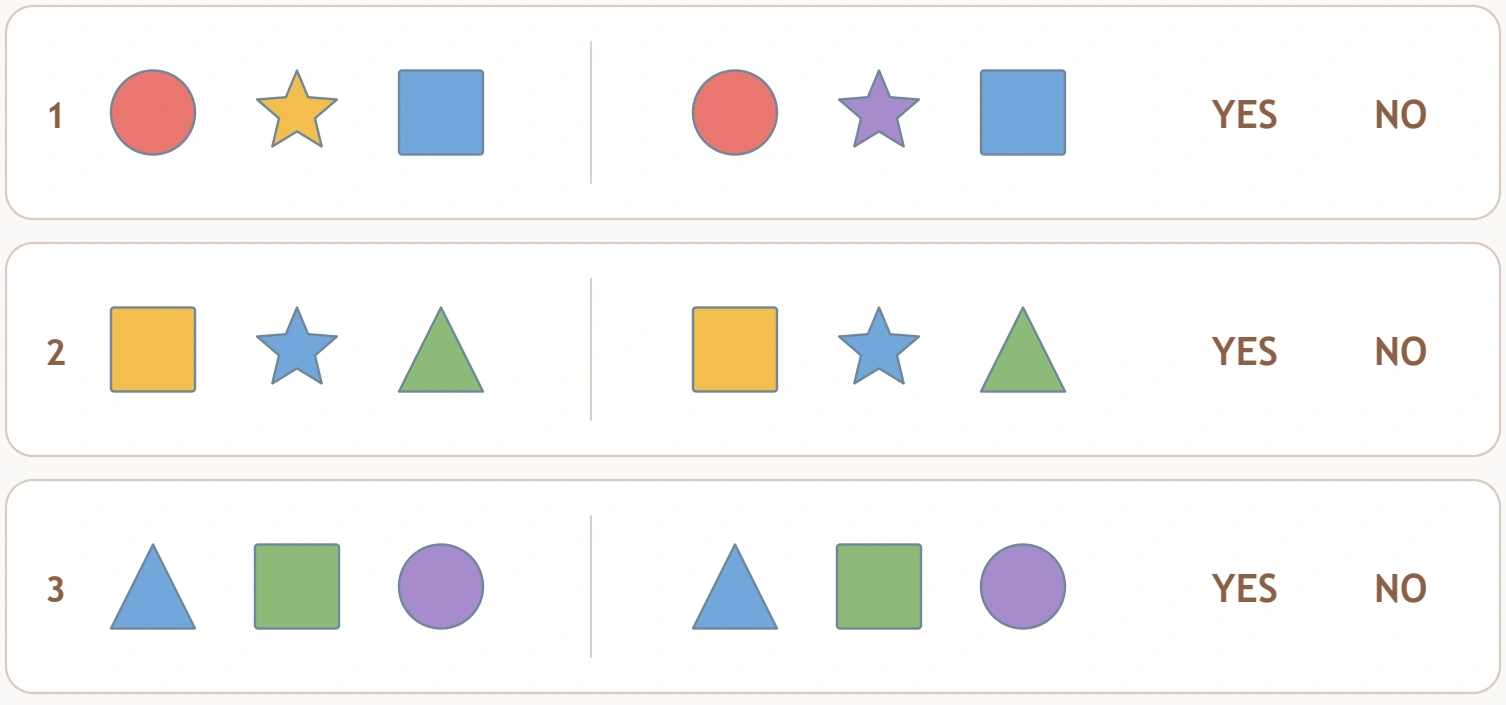
In the first row the middle star changes colour while the outer circle and square agree. A child who checks only shape names could miss the difference. Keep both colour and position in the comparison.
Outer positions deserves a second look
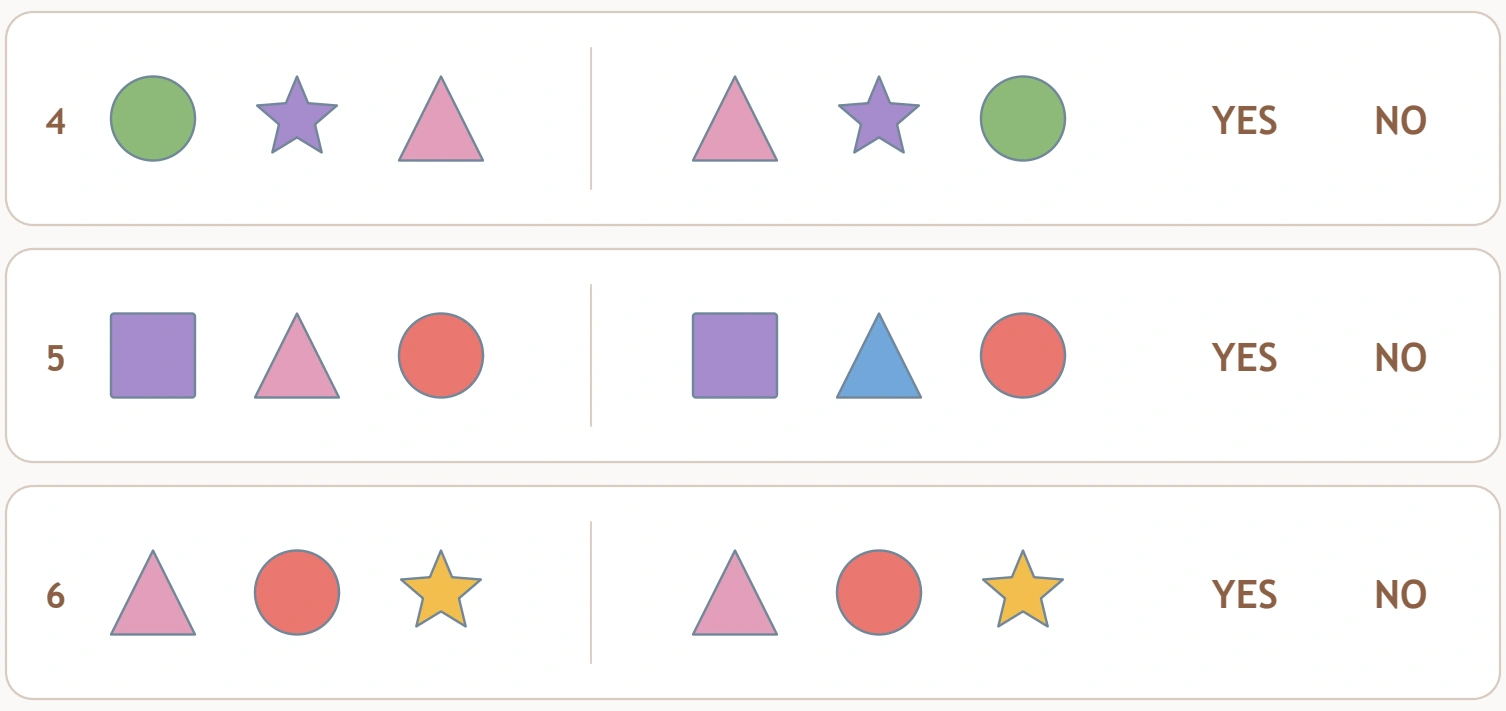
The fourth row has the same three coloured shapes but reverses its outer positions. The shared middle star is an anchor for looking across the pair, not proof that the entire group matches.
Some pairs really are identical. After checking all three positions and their properties, circle YES when everything agrees. Point to the relevant feature before circling NO when a colour or arrangement differs.
Eight closer readings of finished groups
The trios are already complete
A child accustomed to continuing patterns may look for a missing fourth shape. Point to both finished groups and the response words. The activity asks whether the groups match exactly; it does not ask which shape should appear next. Announcing that purpose avoids mixing two valid but different puzzle rules. This Shape Twin Comparisons distinction supports multi-feature checking.
Keep positions aligned
Point from the first shape on the left to the first on the right, then compare the middle and final positions. This direct pairing makes order visible. Listing all shapes found somewhere in each group would miss a reversal even when both lists contain identical names and colours.
A colour change preserves shape
The first row’s stars share their outline but differ in hue. Acknowledge that the child correctly recognised stars, then inspect the colour requirement. Exact correspondence combines those observations rather than treating one correct feature as permission to ignore another visible difference. This Shape Twin Comparisons distinction supports colour discrimination.
Outer shapes can exchange places
The fourth row retains its centre star while its circle and triangle swap ends. Compare the two outer slots separately and name which shape occupies each. This shows why an unchanged middle position is useful for alignment but insufficient as proof of a complete match.
Confirm the truly matching pairs
Some rows support YES. Encourage a child to inspect and defend those agreements rather than searching indefinitely for a nonexistent change. A justified matching verdict can be as thoughtful as finding a difference, especially when all three positions and their colours have been checked. This Shape Twin Comparisons distinction supports reason giving.
Keep the response words usable
Read YES and NO aloud if the child understands the comparison but does not yet recognise the written choices. Pointing to a word can precede drawing its circle. The record should communicate the intended judgement without requiring independent word reading to demonstrate the visual reasoning.
Invent one controlled change
With separate large shapes, alter colour while preserving order, then alter order while preserving colours. Announce each comparison as a new model. Changing one property at a time makes the distinction inspectable and gives the child language for explaining what prevented an exact match. This Shape Twin Comparisons distinction supports multi-feature checking.
Describe the evidence precisely
Invite descriptions such as first circle, middle star or final triangle instead of accepting only same or different. A precise position phrase helps another person verify the claim. It also makes it easier to identify whether disagreement concerns shape, colour or the arrangement of the trio.
Another visit through response control
A later visit can focus on explaining an unchanged pair. Allow the child to challenge an adult’s invented difference, using the complete trio as evidence for a justified YES.
Revisit Shape Twin Comparisons through exact verdict. Recognise explanations about exact verdict from Kavi.
Five play invitations after colour correspondence
Outer-shape exchange with Shape Twin Comparisons
Make two identical trios, swap the first and last positions in one, and compare the full arrangements.
Colour-only twin test with Shape Twin Comparisons
Keep shape order constant while changing one hue. Ask which property prevents an exact match.
Middle anchor with Shape Twin Comparisons
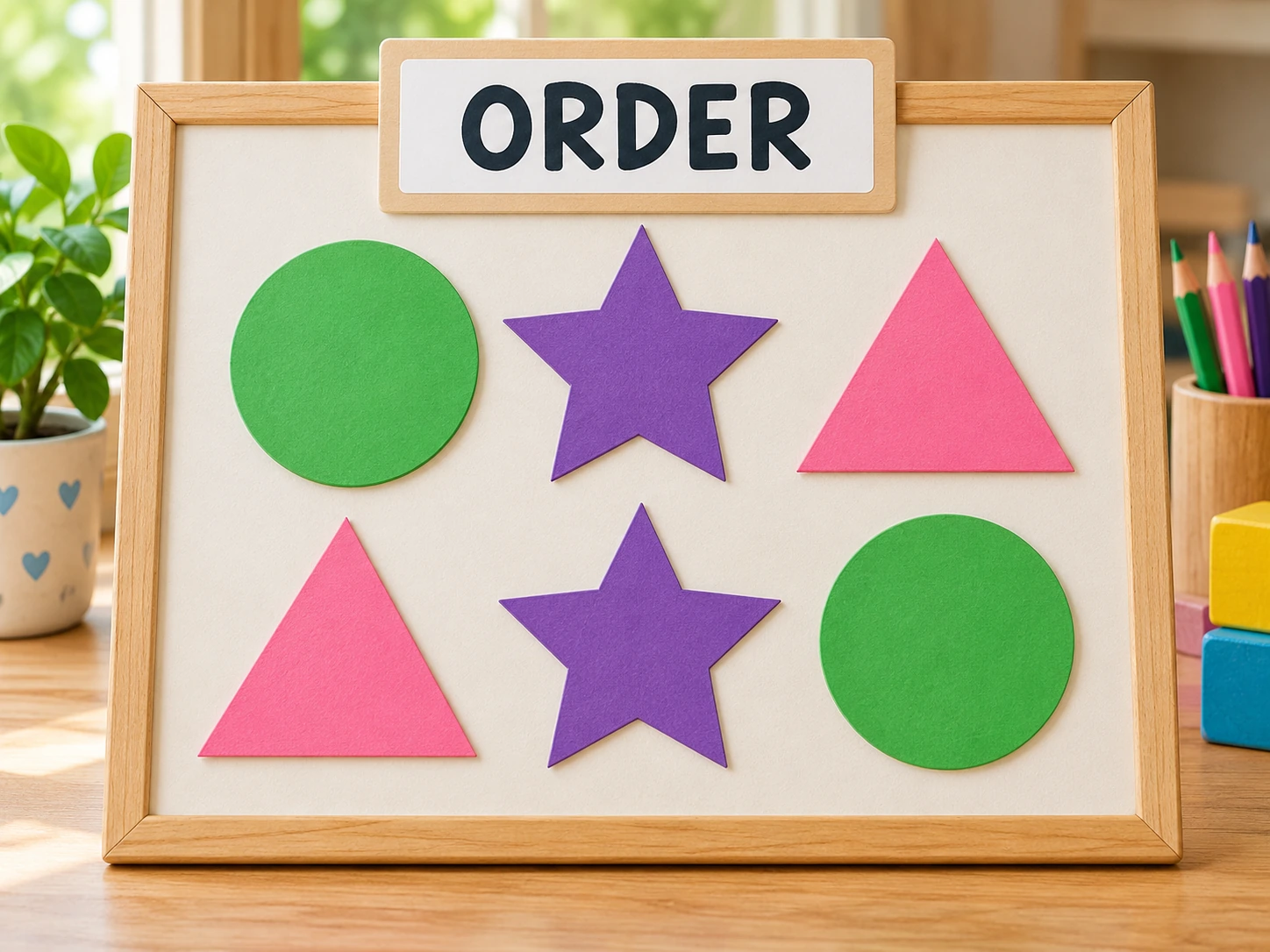
Use an unchanged centre shape to align a comparison, then inspect both outer positions before deciding.
Describe before building with Shape Twin Comparisons
One player describes an ordered trio with colours; a partner builds it and both check the result against the model.
Honest YES challenge with Shape Twin Comparisons
Build a fully matching pair and ask a partner to defend YES through all three corresponding positions.
Revisit the outer positions difficulty
The title can tempt an adult to ask what comes next, turning a comparison into a different task. Return to the complete paired groups and response words. Also avoid accepting “same shapes” when the printed rule includes colour and order.
Return to Shape Twin Comparisons evidence by asking “Is the same shape still at this end?” Separate pencil execution from Kavi’s finished groups reasoning.
Four checkpoints for Shape Twin Comparisons
| Pause here | Inspect this clue |
|---|---|
| Finished groups | Compare the two completed trios in the current row. |
| Colour correspondence | Check colour at each matching shape position. |
| Outer positions | Inspect the first and last slots separately. |
| Exact verdict | Select one response word after checking the trio. |
Finished groups — Kavi’s inspection
For Shape Twin Comparisons, ask “Are we comparing groups or predicting another shape?” Compare the two completed trios in the current row.
Colour correspondence — Kavi’s inspection
For Shape Twin Comparisons, ask “Does the star keep its colour here?” Check colour at each matching shape position.
Outer positions — Kavi’s inspection
For Shape Twin Comparisons, ask “Is the same shape still at this end?” Inspect the first and last slots separately.
Exact verdict — Kavi’s inspection
For Shape Twin Comparisons, ask “Which comparison makes YES or NO convincing?” Select one response word after checking the trio.
Distinctions behind outer positions
Finished groups — the Kavi discussion
The word pattern has different uses across learning activities. Here the printed question concerns exact correspondence between finished groups. Naming that purpose explicitly prevents a child from importing a repeat-extension rule from a different worksheet.
Colour correspondence — the Kavi discussion
A reversed arrangement can preserve every object and every colour. That makes it useful for discussing order as a separate property. Compare each end in place rather than merely listing the shapes that appear somewhere in both groups.
Outer positions — the Kavi discussion
Check the scope of a child’s explanation. “The stars match” can be true without proving the groups identical. Acknowledge the observation, then ask what still needs to be inspected before the whole-trio verdict is justified.
Six observations from finished groups
Multi-feature checking — finished groups
Shape Twin Comparisons invites considering colour, shape and order within one judgement. Notice Kavi’s multi-feature checking explanation: “Are we comparing groups or predicting another shape?”
Ordinal language — colour correspondence
Shape Twin Comparisons invites describing first, middle and last positions accurately. Notice Kavi’s ordinal language explanation: “Does the star keep its colour here?”
Colour discrimination — outer positions
Shape Twin Comparisons invites recognising a changed hue without inventing a new shape. Notice Kavi’s colour discrimination explanation: “Is the same shape still at this end?”
Arrangement awareness — exact verdict
Shape Twin Comparisons invites distinguishing the same set from the same ordered trio. Notice Kavi’s arrangement awareness explanation: “Which comparison makes YES or NO convincing?”
Reason giving — finished groups
Shape Twin Comparisons invites pointing to a concrete mismatch or complete agreement. Notice Kavi’s reason giving explanation: “Are we comparing groups or predicting another shape?”
Response control — colour correspondence
Shape Twin Comparisons invites marking one chosen word without obscuring its alternative. Notice Kavi’s response control explanation: “Does the star keep its colour here?”
Imagine Kavi investigating at home
Kavi’s teaching assistant lays a green circle, purple star and pink triangle beside a reordered copy. Kavi names the same shapes on both sides, then traces the outer positions. They use those positions to explain why the groups are not exact twins.
Try “Are we comparing groups or predicting another shape?” during this imagined Shape Twin Comparisons visit. Let Kavi explain finished groups before recording.
Readiness for colour correspondence
Offer large coloured shape tokens to model one comparison. Keep the model visible while checking the drawing, and let the child indicate YES or NO before managing a small circle.
Suggested Shape Twin Comparisons range: ages four to six. Kavi’s readiness depends on multi-feature checking and interest in colour correspondence. Shorten this Shape Twin Comparisons visit when needed.
Partners explore ordinal language
Partners each inspect one end of a printed trio and report to a shared checker. Then both examine the middle. The class discusses why a matching star cannot settle a question about three positions by itself.
A Shape Twin Comparisons classroom note can describe recognising a changed hue without inventing a new shape. Record the actual colour correspondence prompt, too.
Save and print Shape Twin Comparisons
The premium Shape Twin Comparisons edition retains six finished groups for exact comparison. Eligible members on an active plan can download this clean PDF with website watermark and domain removed, without embedded advertisements. An original-upload sample is a separate choice. Before printing, inspect both groups and the YES/NO words in every row of the saved portrait sheet.
Other choices beyond multi-feature checking
For Shape Twin Comparisons, the saved catalog suggests road-following after shape twin comparisons; aiming-and-stopping after shape twin comparisons; picture-recipe drawing after shape twin comparisons. Read each linked activity’s rule with Kavi; its finished groups response may differ.
For Kavi, browse NAEYC writing ideas alongside shape twin comparisons or PBS Parents activities beyond shape twin comparisons. Watch multi-feature checking with colour discrimination, then revisit finished groups.
Popular Worksheets
Printable resources families and teachers are downloading now.
 Free
 Free
 Free
 Free