
Puzzle Explorer Collection: 25 Brilliant New Challenges
Selma asks for a puzzle, then hesitates between a map and a secret message. That small decision is the starting point for Puzzle Explorer Collection: twenty-five supplied sheets numbered 26–50, gathered into one clean PDF costing $5 USD. A teacher can choose a short picture task, a letter search or a more demanding clue discussion without asking Selma to complete the entire selection. This page explains the actual puzzle families, the limits of the collection and ways to match one sheet to the kind of thinking a child wants to try today.
Puzzle Explorer Collection: read the actual puzzle
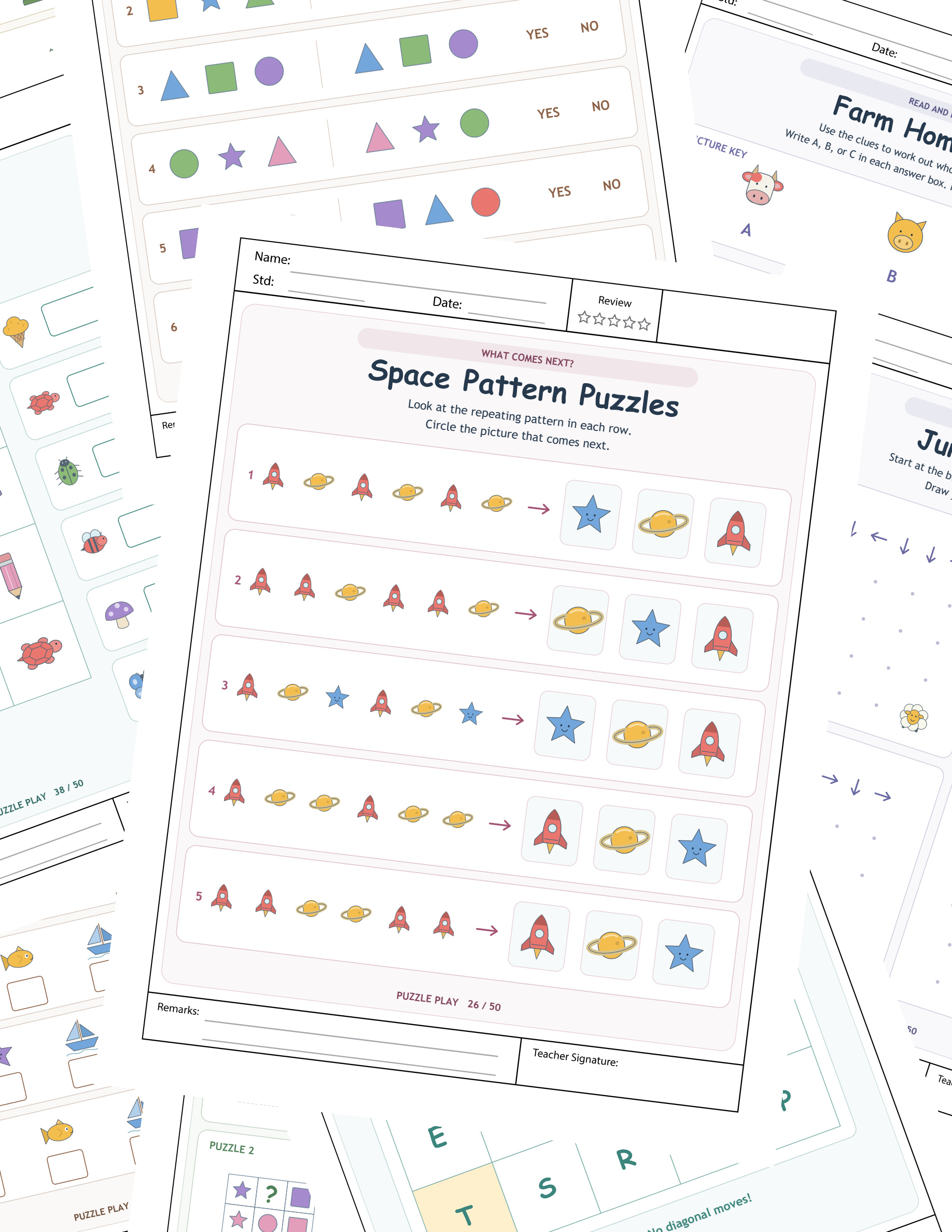
Puzzle Explorer Collection: The paid download combines twenty-five distinct source pages in their numbered order. It begins with Space Pattern Puzzles and ends with Space Station Changes. Neither the first twenty-five Puzzle Play sheets nor a newly invented answer booklet is included. The preview collage shows real clean pages from this second selection, with the complete space-pattern page placed in front.
Several tasks look similar at a glance but ask different questions. Space patterns require predicting the next picture; Shape Twin Comparisons asks whether two completed groups agree exactly. Category puzzles alternate between finding one outsider and circling every member. Read the printed instruction before borrowing a method from a neighbouring page.
Response location deserves a second look
The letter tasks also differ. Robot and pirate ciphers supply small picture-to-letter keys. Farm and beach searches hide whole printed words in eight-by-eight fields. The Alphabet Adventure Trail runs from A to T through side-touching cells, so it is neither a word hunt nor a complete A-to-Z handwriting sheet.
A clean collection changes the convenience of storing and printing, not the amount of adult support each task needs. Map references, negative clues and coordinate headings may call for spoken modelling. Dot pictures and sorting can offer a lighter starting point. Select a page because its demand fits today’s learner rather than treating its position in the file as a difficulty rank.
Keep Puzzle Explorer Collection available. Choose Puzzle Explorer Collection thoughtfully.
Eight closer readings of instruction family
Five repeats are not five identical rules
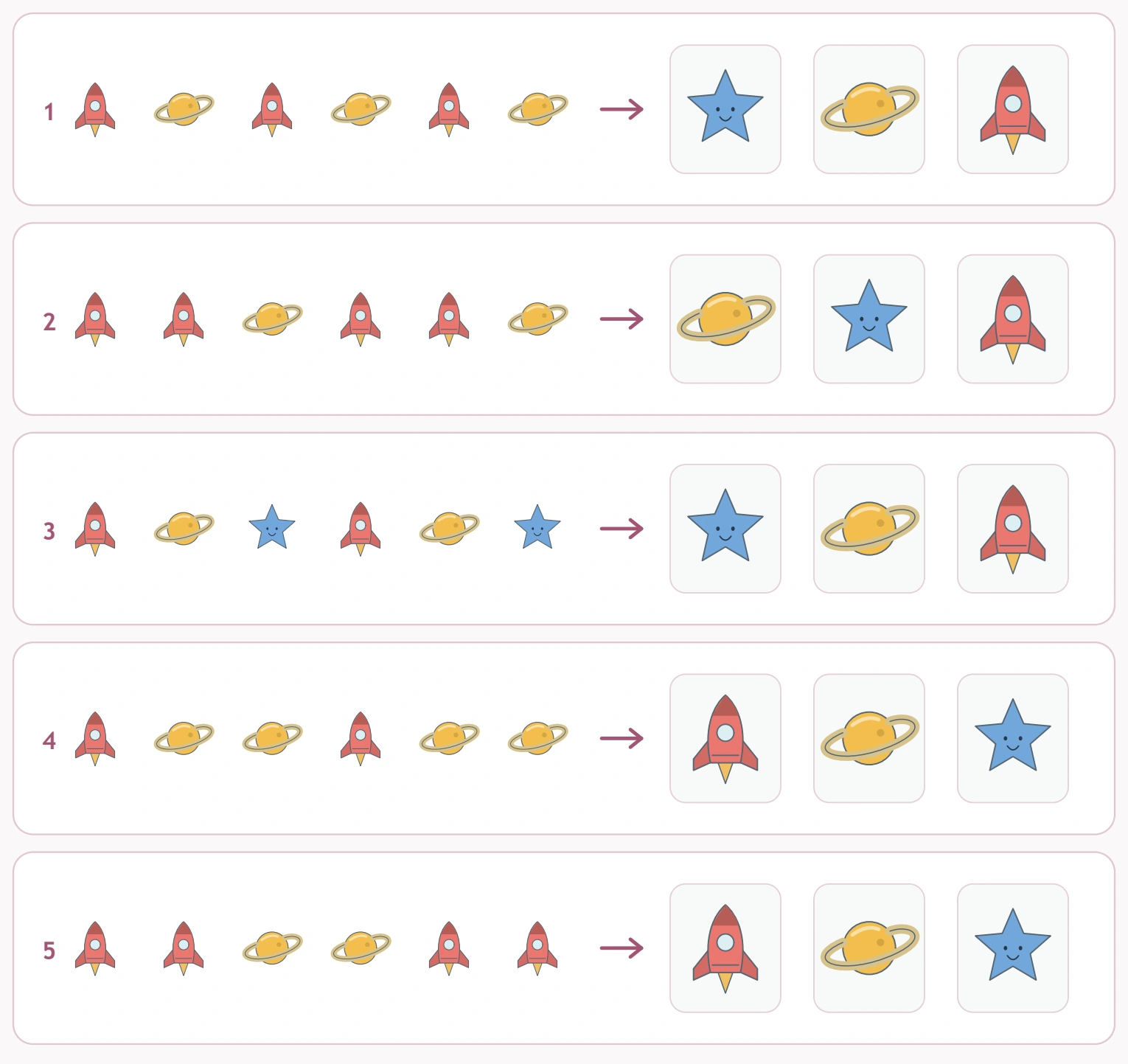
The opening space sheet contains AB, AAB, ABC, ABB and AABB arrangements. Four next-picture answers happen to be rockets; the last is a planet. That repeated answer should not replace inspection of the repeating unit. Let the child describe where one unit ends before transferring attention to another row. This Puzzle Explorer Collection distinction supports flexible task selection.
Two small ciphers have different keys
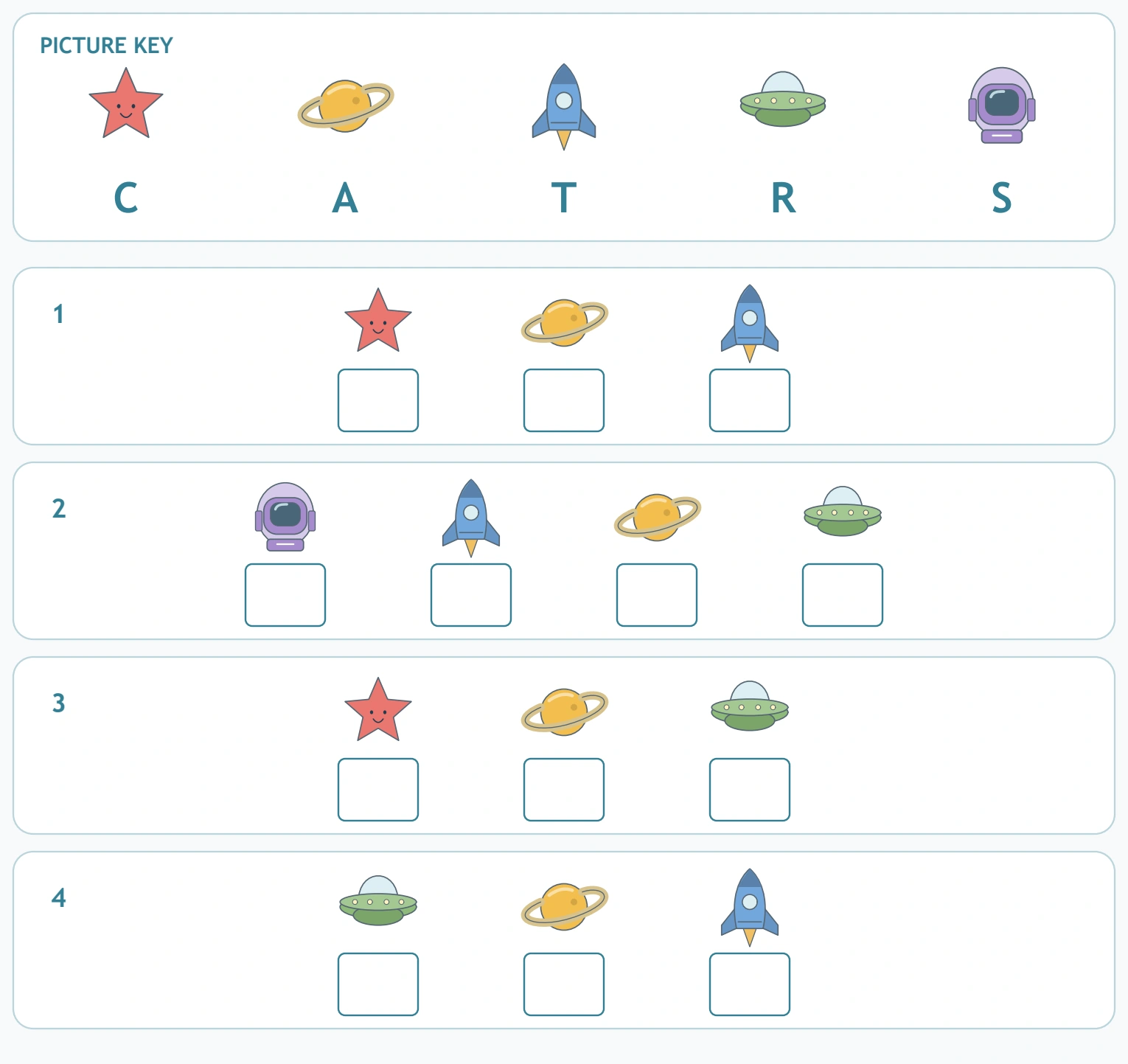
The robot key decodes CAT, STAR, CAR and RAT. The pirate key produces SEA, TEAM, MAT and SEAT. Store each explanation beside its own printed key: a picture meaning learned on one page does not automatically apply to a different symbol system. Consult the visible mapping before supplying a letter.
Search directions need their own introduction
The farm and beach word hunts use rightward and downward placements within eight-by-eight letter fields. Show the starting letter, check the following letters in order and stop at the end of the printed word. Spotting the first letter alone is a candidate location, not a completed discovery. This Puzzle Explorer Collection distinction supports evidence language.
A map answer combines two references
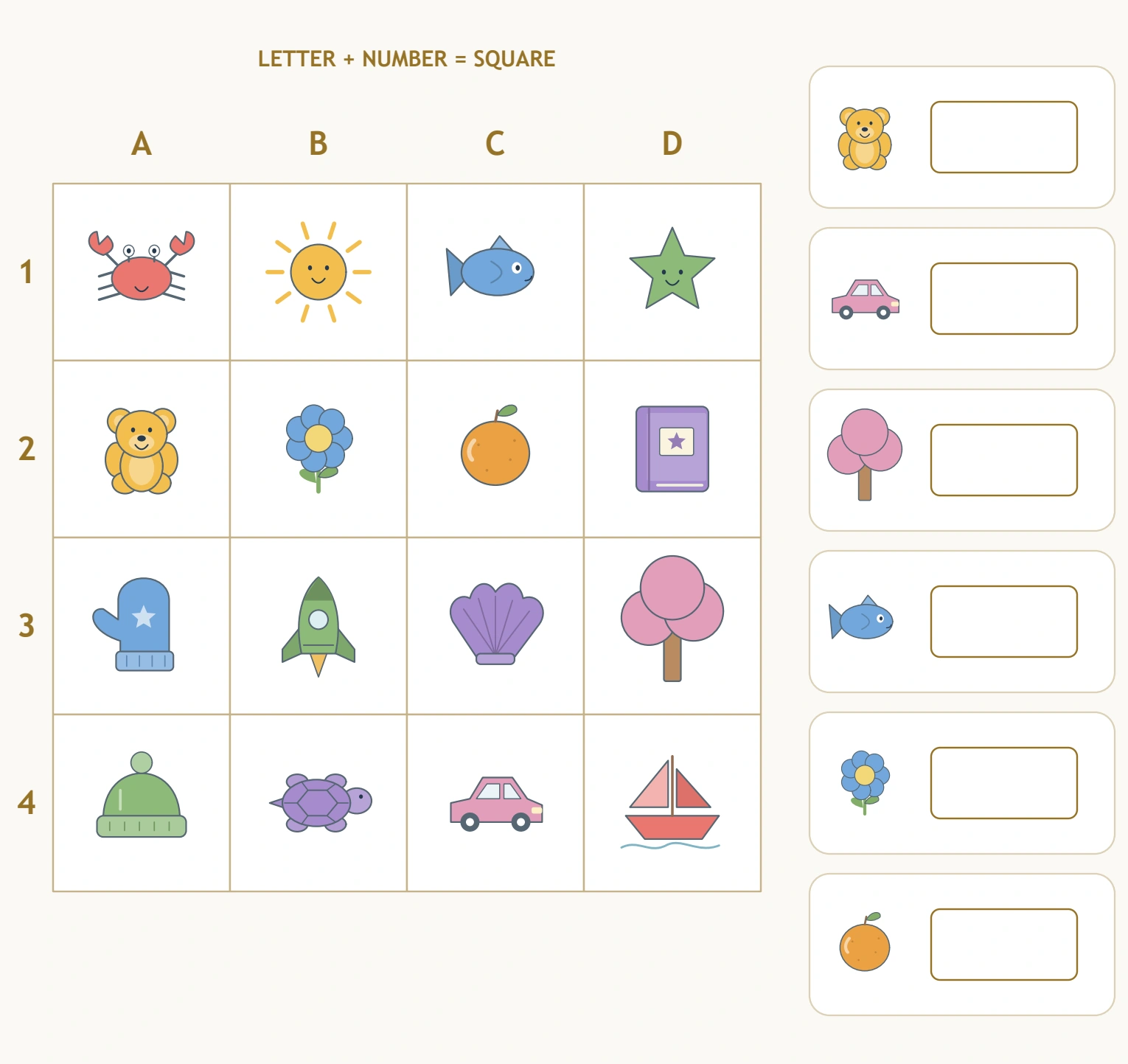
Treasure and park pages use columns A–D with rows numbered one to four from the top. An address depends on both headings. Practise tracing one column and one row to their intersection before asking for six written tickets. Reading support can preserve the coordinate problem while reducing unrelated writing effort.
A route is a sequence of single movements
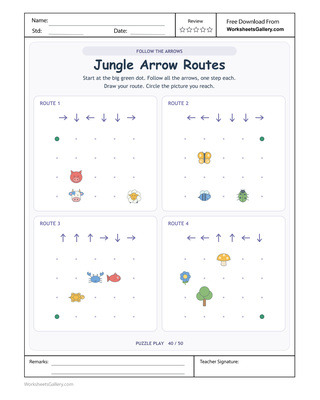
Delivery and jungle worksheets each present four short routes. Their arrow strips must be followed one movement at a time from the green start. Naming a familiar destination picture does not establish that the stated route reaches it. A movable counter makes an omitted or doubled instruction easier to notice. This Puzzle Explorer Collection distinction supports print organisation.
Tile boards need intersecting evidence
The patchwork and robot-repair pages combine a row colour with a column shape. A tile matching just one feature is insufficient. Discuss the intersection before looking at the lettered choices, then check the selected option against both rules. The robot theme supplies context rather than a request to draw a robot.
Two trails end at different labels
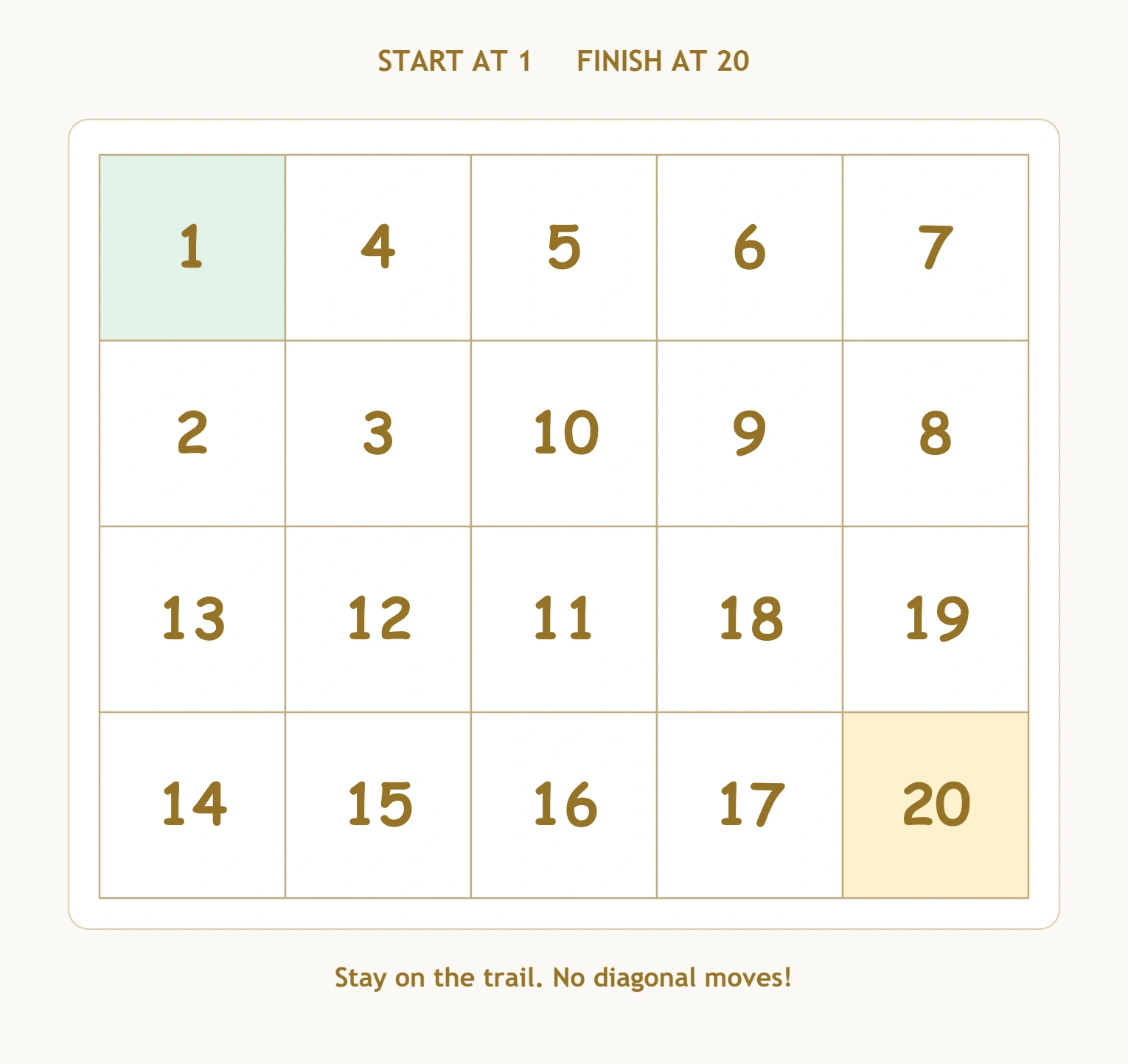
The number trail follows one through twenty; the alphabet trail follows A through T. Both use shared edges rather than diagonal jumps. Avoid describing the second sheet as a full alphabet exercise: U, V, W, X, Y and Z are outside its printed path. A finger trace can precede pencil recording. This Puzzle Explorer Collection distinction supports flexible task selection.
Six changes mean six locations
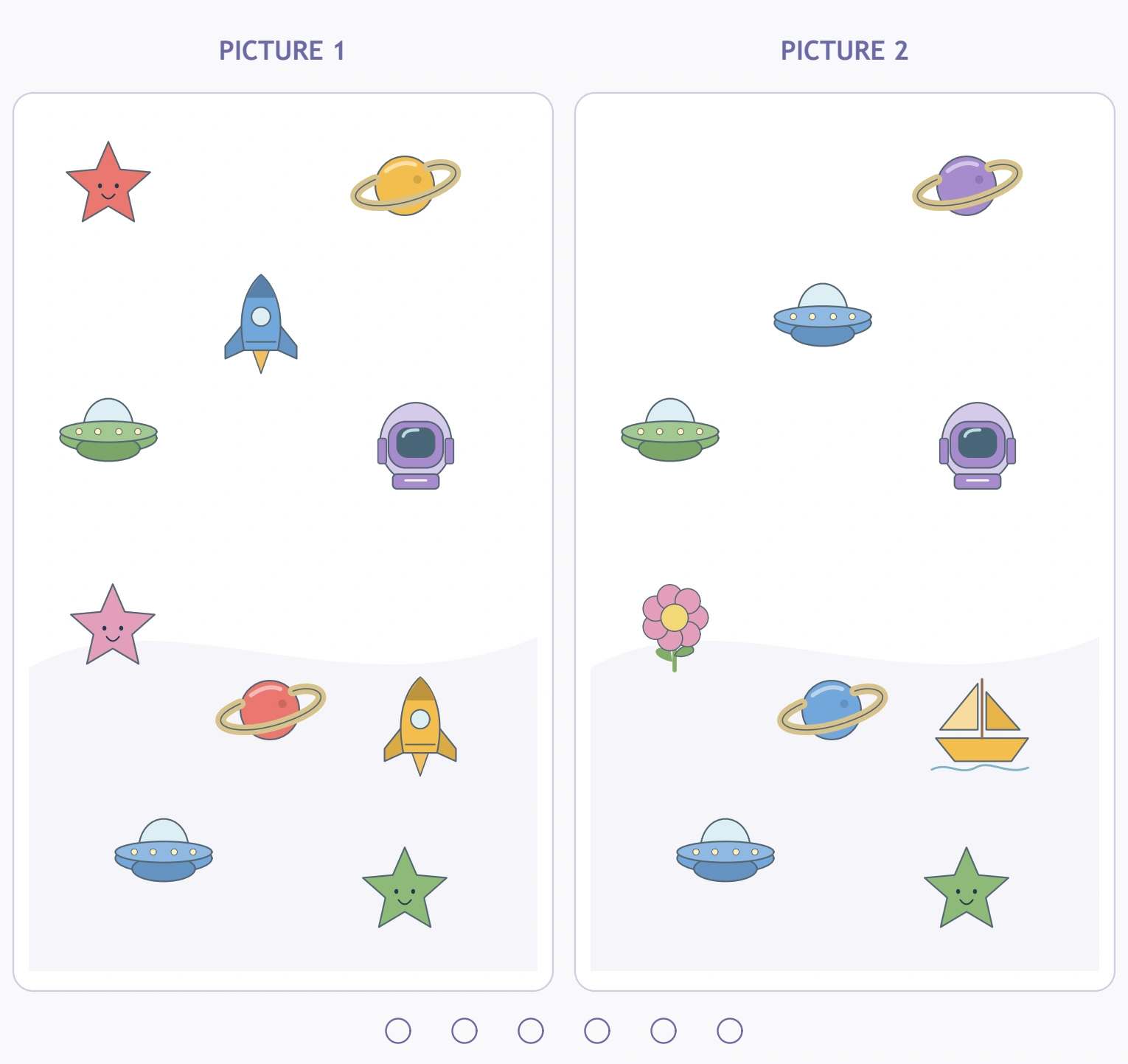
Each final comparison asks for six changed places on the right scene. A replacement counts as one location even though an old object disappears and a new one appears. The missing picnic cloud still needs a right-scene location marker. Count the supported places after comparison, rather than counting every object name spoken.
Four checkpoints for Puzzle Explorer Collection
| Pause here | Inspect this clue |
|---|---|
| Instruction family | Identify whether this sheet asks for a continuation, an exact match, a route or a category decision. |
| Evidence boundary | Find the key, row label, address heading or arrow strip that controls the answer. |
| Response location | Check whether the child circles a word, marks a picture, writes a letter or draws a route. |
| Collection scope | Count twenty-five PDF pages and confirm that their source labels run from 26 to 50. |
Instruction family — Selma’s inspection
For Puzzle Explorer Collection, ask “What action does this particular instruction request?” Identify whether this sheet asks for a continuation, an exact match, a route or a category decision.
Evidence boundary — Selma’s inspection
For Puzzle Explorer Collection, ask “Which printed clue decides this choice?” Find the key, row label, address heading or arrow strip that controls the answer.
Response location — Selma’s inspection
For Puzzle Explorer Collection, ask “Where should your reason become a pencil mark?” Check whether the child circles a word, marks a picture, writes a letter or draws a route.
Collection scope — Selma’s inspection
For Puzzle Explorer Collection, ask “Does this saved collection contain the second selection?” Count twenty-five PDF pages and confirm that their source labels run from 26 to 50.
Readiness for evidence boundary
The selection spans adult-supported preschool and early primary experiences, roughly ages four to seven, with substantial differences between tasks. A child can point while an adult reads a negative sentence, move a counter while hearing one arrow or dictate a map address before writing. Keep the printed rule intact while reducing the extra language or pencil demand. Offer an easier family when the current one stops being useful.
Suggested Puzzle Explorer Collection range: ages four to six. Selma’s readiness depends on flexible task selection and interest in evidence boundary. Shorten this Puzzle Explorer Collection visit when needed.
Partners explore rule discrimination
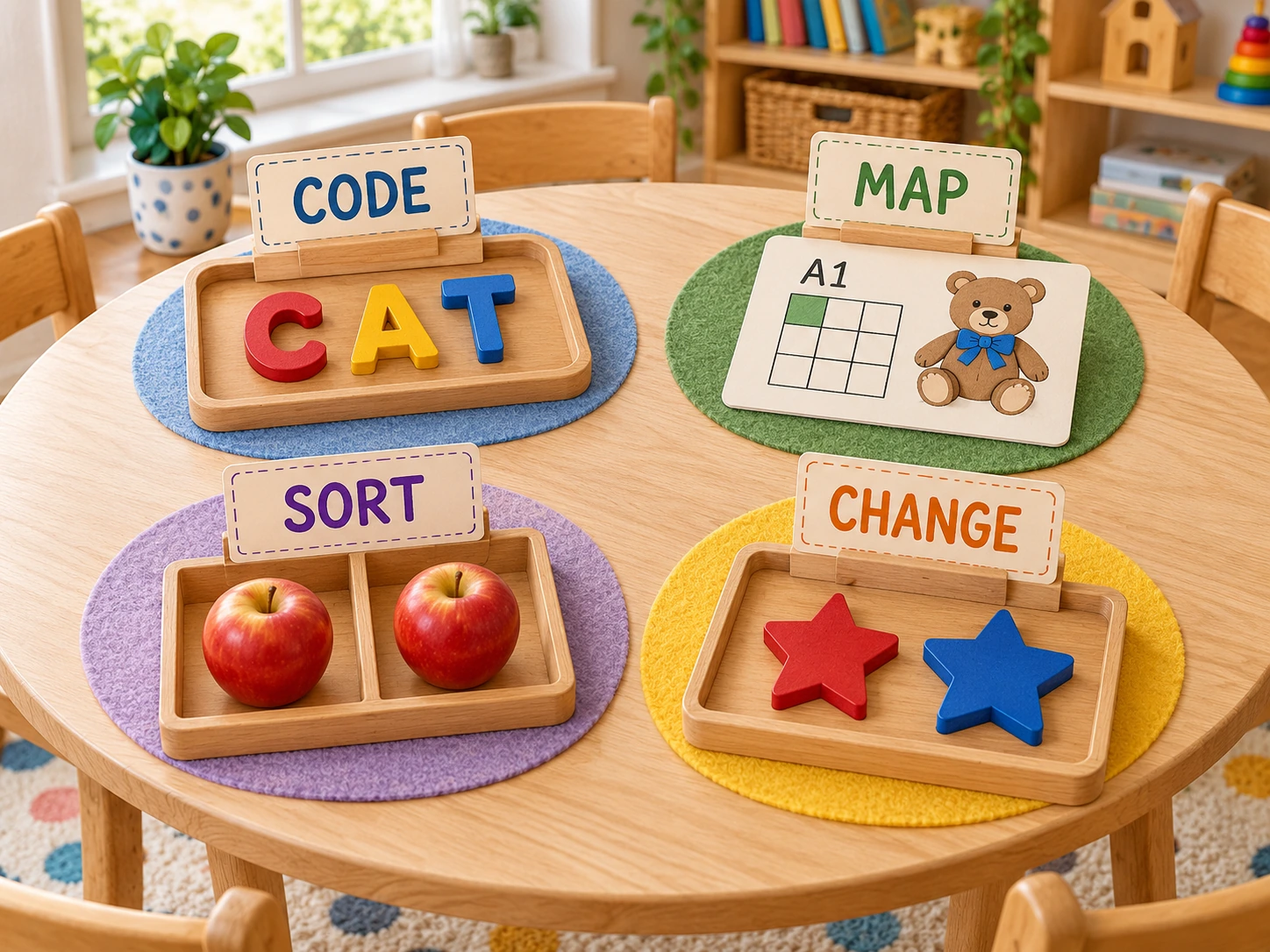
In an imagined classroom, the teacher prepares three stations: a coded message with a visible key, a map with address tickets and a picture-sorting panel. Partners explain the instruction at their chosen station before marking. A listener checks the stated evidence, then they exchange roles. The teacher records whether each pair used the correct kind of clue instead of comparing how quickly different stations were finished.
A Puzzle Explorer Collection classroom note can describe naming the key symbol, coordinate or shared picture feature that supports a decision. Record the actual evidence boundary prompt, too.
Imagine Selma investigating at home
Imagine Selma choosing a farm task at the kitchen table. The adult offers Farm Barn Reasoning and Farm Word Searching, explains their different instructions and lets her select one. On the barn page, Selma talks through the negative clue with animal tokens before writing a letter. The word-search page stays available for a later visit; choosing one page does not create an obligation to finish both.
Try “What action does this particular instruction request?” during this imagined Puzzle Explorer Collection visit. Let Selma explain instruction family before recording.
Distinctions behind response location
Instruction family — the Selma discussion
A combined PDF is a storage format, not a prescribed sequence of lessons. The source numbers identify pages, while the printed instructions identify the reasoning operation. Start with a sorting panel or a dot picture if that suits the child; return to a cipher or a negative clue when the needed language and attention are available.
Evidence boundary — the Selma discussion
Some activities require more than visual matching. A code key must be consulted consistently, a word hunt requires letter order and a coordinate ticket combines two headings. Adult reading support can make these tasks accessible without changing their answers. Pointing, explaining and writing are separate observations worth recording separately.
Response location — the Selma discussion
The purchase supplies clean printable tasks rather than an assessment norm or a promise of reading readiness. Twenty-five pages provide choice across puzzle types; they do not establish a required completion target. Use the child’s explanation and willingness to continue to select the next activity, and consult the actual printed clue whenever a preview alone seems ambiguous.
Five play invitations after evidence boundary
Clue baskets with Puzzle Explorer Collection
Sort household tokens beside four handwritten labels: KEY, MAP, GROUP and ROUTE. Explain which kind of evidence each label represents, then choose a matching printed task. The game organises adult choices; it is not an additional page inside the purchased file.
One instruction swap with Puzzle Explorer Collection
Show two short arrangements of blocks. First ask whether they are identical; next ask what would continue one arrangement. Discuss how changing the instruction changes the required response even when the materials stay on the table.
Address messenger with Puzzle Explorer Collection
Make a small two-by-two table and place a toy in one square. One partner speaks its column and row; the other points to the square. Keep this demonstration separate from the collection’s four-by-four treasure and park maps.
Arrow narrator with Puzzle Explorer Collection
Place a counter on a homemade grid and offer two direction cards. The narrator names one movement while the listener moves once. Reverse roles after checking the endpoint, then decide whether one of the four-route source pages would be a suitable next step.
Evidence museum with Puzzle Explorer Collection
Keep one completed response from a selected session and invite the child to explain it beside its controlling clue. Display the explanation as their current account, including any uncertainty. A reasoned correction can be as interesting to revisit as an initially correct answer.
Revisit the response location difficulty
A child who has just completed a next-picture row may try extending the finished groups on a twin-comparison page. Cover the previous task, read the new YES/NO instruction aloud and compare the pictured positions one by one. Likewise, an outsider hunt should not become a circle-all-members task. Treat a borrowed rule as a prompt to reread, not as proof that the child cannot reason.
Return to Puzzle Explorer Collection evidence by asking “Where should your reason become a pencil mark?” Separate pencil execution from Selma’s instruction family reasoning.
Six observations from instruction family
Flexible task selection — instruction family
Puzzle Explorer Collection invites choosing an exact-comparison activity when a longer written response would be tiring. Notice Selma’s flexible task selection explanation: “What action does this particular instruction request?”
Rule discrimination — evidence boundary
Puzzle Explorer Collection invites explaining why an outsider row needs one rejection while a sorting panel needs four accepted members. Notice Selma’s rule discrimination explanation: “Which printed clue decides this choice?”
Evidence language — response location
Puzzle Explorer Collection invites naming the key symbol, coordinate or shared picture feature that supports a decision. Notice Selma’s evidence language explanation: “Where should your reason become a pencil mark?”
Planning awareness — collection scope
Puzzle Explorer Collection invites pausing before a route and checking one movement at a time. Notice Selma’s planning awareness explanation: “Does this saved collection contain the second selection?”
Print organisation — instruction family
Puzzle Explorer Collection invites keeping a reusable source file while selecting only the pages wanted for a session. Notice Selma’s print organisation explanation: “What action does this particular instruction request?”
Reflective choice — evidence boundary
Puzzle Explorer Collection invites describing which puzzle family felt inviting and which clue needed another demonstration. Notice Selma’s reflective choice explanation: “Which printed clue decides this choice?”
Another visit through reflective choice
On another visit, Selma selects a comparison page and tells the teacher why it feels different from her earlier barn problem. Reuse the clean source file to print a fresh sheet only when helpful. Ask what evidence she noticed sooner this time, then let her choose whether to revisit a familiar family or sample a new one. Progress can be a clearer explanation rather than a larger pile of completed paper.
Revisit Puzzle Explorer Collection through collection scope. Recognise explanations about collection scope from Selma.
Save and print Puzzle Explorer Collection
Purchase Puzzle Explorer Collection for $5 USD to obtain one clean, twenty-five-page PDF. This paid collection contains the supplied Puzzle Play sheets numbered 26–50; the earlier 01–25 set is separate. Domain text, website watermark and embedded advertisements are absent. Save the purchased file, inspect the page thumbnails, then print selected portrait pages at a size that preserves their complete borders. Membership access alone does not unlock this paid collection.
Other choices beyond flexible task selection
For Puzzle Explorer Collection, the saved catalog suggests road-following after puzzle explorer collection; aiming-and-stopping after puzzle explorer collection; picture-recipe drawing after puzzle explorer collection. Read each linked activity’s rule with Selma; its instruction family response may differ.
For Selma, browse NAEYC writing ideas alongside puzzle explorer collection or PBS Parents activities beyond puzzle explorer collection. Watch flexible task selection with evidence language, then revisit instruction family.
Popular Worksheets
Printable resources families and teachers are downloading now.
 Free
 Free
 Free
 Free