
Picnic Fruit Patterns: 5 Clever Next-Picture Choices
Continue the picnic patterns with a new puzzle choice. All 25 submitted sheets are included in the $5 clean collection PDF. Keep these repeating fruit units with the other provided activities, then switch to a different thinking task whenever interest changes.
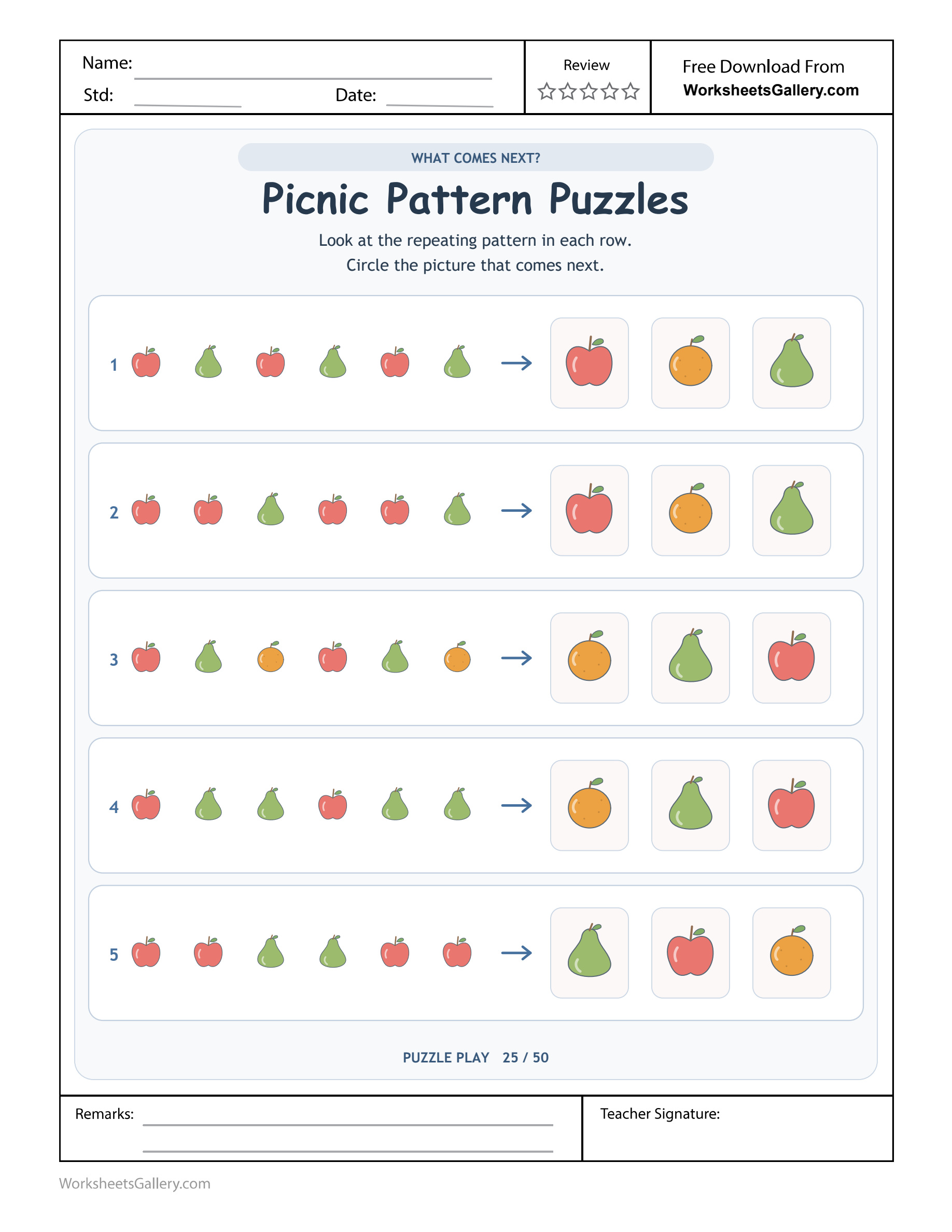
Apple-pear alternation is only the first picnic rule on this sheet. Picnic Fruit Patterns offers five fruit rows with changing repeat units, so the last visible picture cannot supply every answer by itself. Children identify the group that repeats, predict what follows and circle one of three choices. Some rows begin another unit after six pictures; the paired-fruit row stops partway through its next unit. Say or tap the complete group before choosing, and let a partner explain why identical next answers can come from different patterns.
Picnic Fruit Patterns: the rule on this particular sheet
Five rows each show six fruit pictures, an arrow and three possible next pictures. Circle the next fruit in each row. The visible fruits are apple, pear and orange, but their repeating units change between rows.
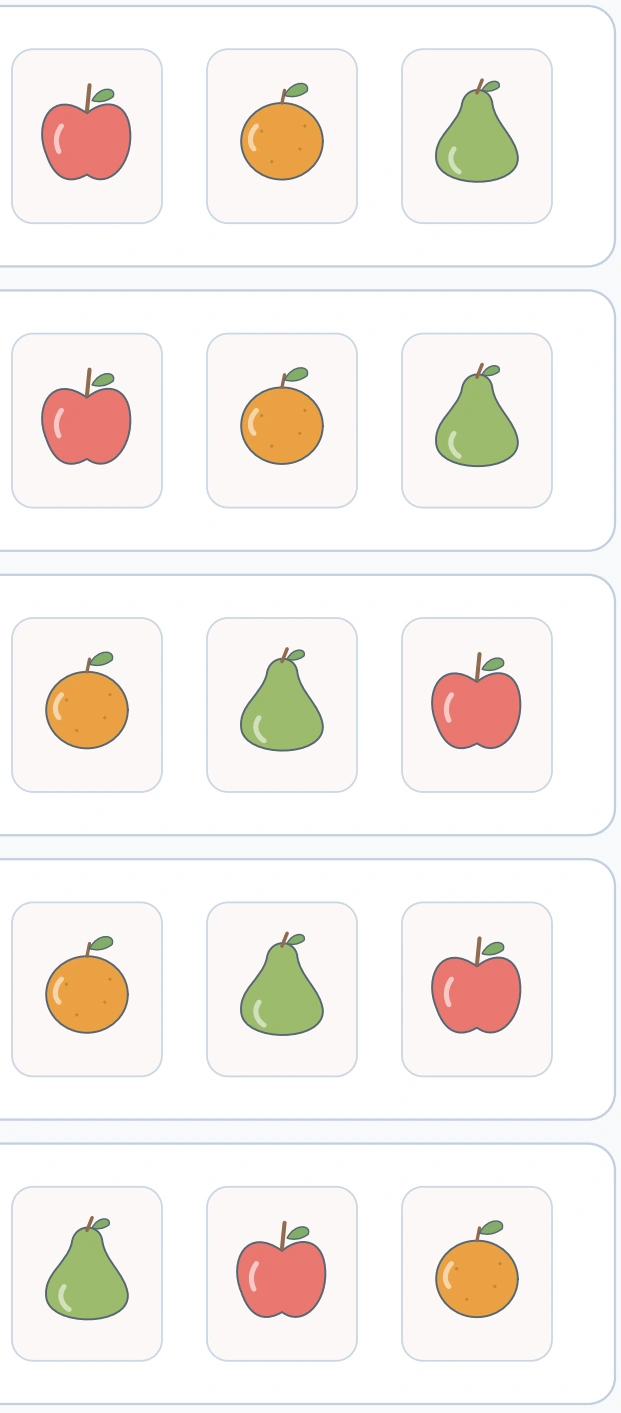
Row 1 alternates apple and pear, an AB unit. Row 2 repeats apple-apple-pear, an AAB unit. Their next fruit is apple in both cases, but the reasons depend on different groupings.

What three-part rows reveals
Row 3 uses apple-pear-orange, an ABC repeat, and row 4 uses apple-pear-pear, an ABB repeat. Both next pictures are apple because a new complete unit begins after the six shown fruits.
Row 5 shows apple-apple-pear-pear-apple-apple, continuing an AABB unit. The next fruit is pear. Do not assume every row alternates or that all next answers must match the first four.
A practical Picnic Fruit Patterns sequence
Alternating row with Benji
Begin Picnic Fruit Patterns: alternating row. AB apple-pear repeats, so row 1 continues with apple. Ask Benji, “Which whole group keeps coming back?” The aunt and Benji can inspect alternating row together.
Double-apple row with Benji
Next inspect Picnic Fruit Patterns: double-apple row. AAB repeats, making apple the next choice in row 2. Ask Benji, “How are these two rules different?” The aunt and Benji can inspect double-apple row together.
Three-part rows with Benji
Then confirm Picnic Fruit Patterns: three-part rows. ABC and ABB each restart with apple in rows 3 and 4. Ask Benji, “Where are we inside the repeated group?” The aunt and Benji can inspect three-part rows together.
Paired-fruit row with Benji
Finally record Picnic Fruit Patterns: paired-fruit row. AABB continues with pear after the final two apples in row 5. Ask Benji, “Can you say the whole repeat together?” The aunt and Benji can inspect paired-fruit row together.
Picnic Fruit Patterns adult reference
| Printed clue | Source check |
|---|---|
| Alternating row | AB apple-pear repeats, so row 1 continues with apple. |
| Double-apple row | AAB repeats, making apple the next choice in row 2. |
| Three-part rows | ABC and ABB each restart with apple in rows 3 and 4. |
| Paired-fruit row | AABB continues with pear after the final two apples in row 5. |

Say the complete unit before predicting
A child who notices only the last fruit may apply alternation to every row. Group the visible sequence into its shortest recurring unit and say that unit aloud. Apple-apple-pear differs from apple-pear-pear even though both use the same two fruit identities. The next choice follows a position within the unit, not simply a habit of changing fruit after every picture.
Classroom partners inspect double-apple row
Partners describe a row’s repeating unit before revealing the three choices. One child taps the unit rhythm and the other predicts the next fruit, then they compare their prediction with the available printed options. For a Picnic Fruit Patterns partner visit, comparing structures is this picnic fruit patterns partnership focus.

The same next fruit can have different reasons
Rows 1 through 4 all continue with apple, but AB, AAB, ABC and ABB explain those outcomes differently. Ask the child to describe the unit for two rows that share the answer. This makes the reasoning visible and prevents a string of correct apple circles from concealing the assumption that every row follows the first row’s rule.
Picnic Fruit Patterns: three-part rows mistakes
Looking only at the last fruit can hide the unit, especially in AAB, ABB and AABB rows. Inspect enough of the sequence to find a repeated group. The final row ends partway through an AABB unit, so its next picture is pear. Invite Benji to discuss three-part rows with the aunt.
6 observations in Picnic Fruit Patterns
Finding a repeat unit: Which whole group keeps coming back
Here, a short group can explain a longer fruit sequence. The prompt “Which whole group keeps coming back?” gives Benji a way to explain finding a repeat unit to the aunt.
Comparing structures: How are these two rules different
Here, AB differs from AAB even when a next answer agrees. The prompt “How are these two rules different?” gives Benji a way to explain comparing structures to the aunt.
Predicting from evidence: Where are we inside the repeated group
Here, the next fruit follows the unit position. The prompt “Where are we inside the repeated group?” gives Benji a way to explain predicting from evidence to the aunt.
Rhythm language: Can you say the whole repeat together
In Picnic Fruit Patterns, spoken or tapped groupings can make the unit audible. The prompt “Can you say the whole repeat together?” gives Benji a way to explain rhythm language to the aunt.
Checking a candidate: Which choice continues our rule
In Picnic Fruit Patterns, the predicted fruit can be compared with printed options. The prompt “Which choice continues our rule?” gives Benji a way to explain checking a candidate to the aunt.
Flexible reasoning: Does the old answer still fit this unit
In this patterns activity, the fifth row requires a different next fruit. The prompt “Does the old answer still fit this unit?” gives Benji a way to explain flexible reasoning to the aunt.
Five play invitations after the patterns page
Pack an AAB picnic
Lay apple-apple-pear picture tokens twice on a cloth. Say the three-part unit together, then choose the fruit that begins another repeat. After this this printable play round, ask the aunt which clue Benji chose to explain.
Clap two different fruit rhythms
Tap an AB rhythm and an AAB rhythm while naming the corresponding fruits. Discuss why identical next answers can arise from different repeating groups. Let Benji demonstrate this example before another the activity visit; ask the aunt to listen for Benji’s reasoning.
Popular Worksheets
Printable resources families and teachers are downloading now.
 Free
 Free
 Free
 Free