
Space Pattern Choices: 5 Brilliant Launch Decisions
$5 · 25 supplied sheets: Space Pattern Choices. Find a complete repeating unit before choosing the next rocket, planet or star.
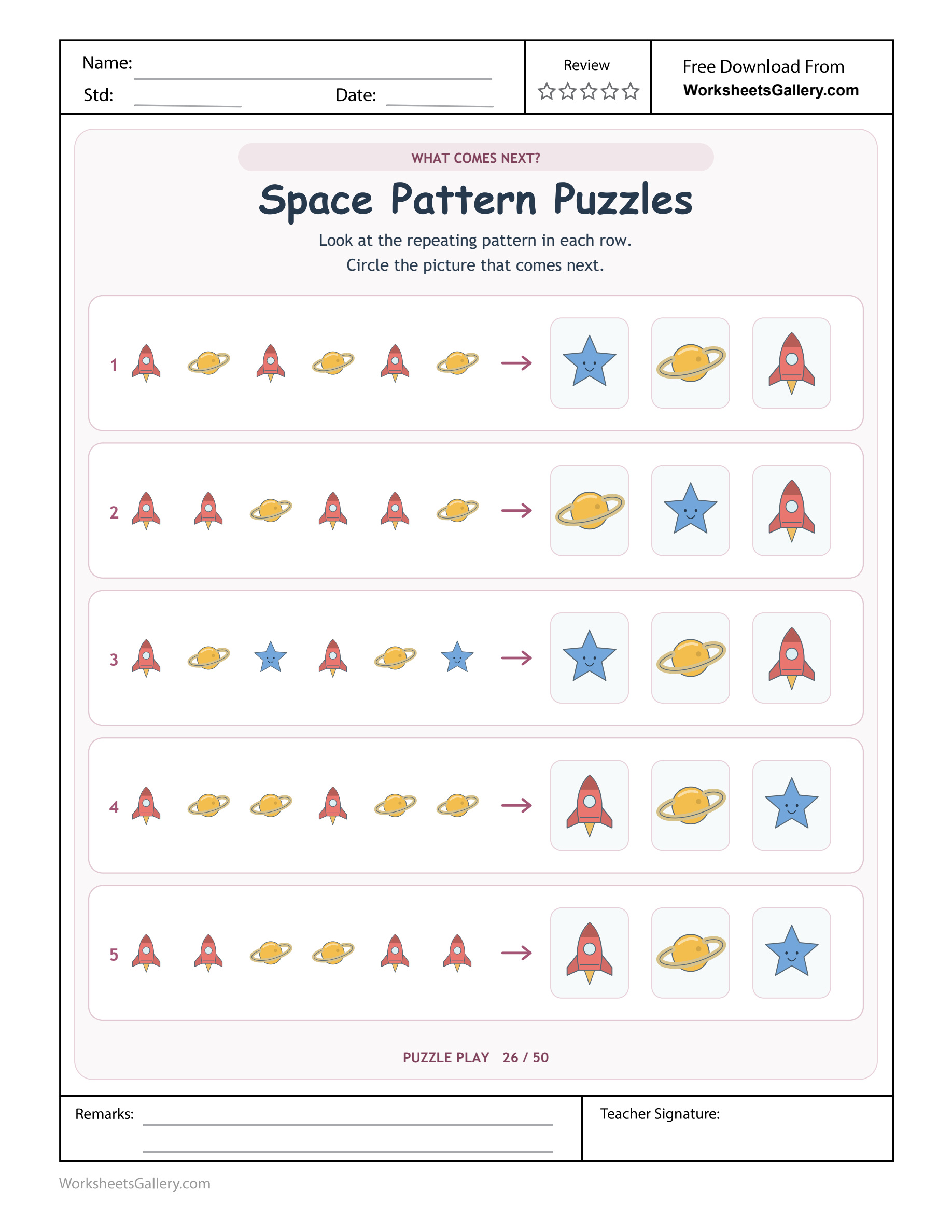
Three space pictures can hide several different repeat rules. Space Pattern Choices asks children to listen to each row, identify its reusable block and predict one more picture. Rockets, ringed planets and stars supply the vocabulary; the important decision is how their positions repeat. Begin by chanting a short section together and let your child point before circling. An adult can help name an unfamiliar picture without supplying the rule. The five rows invite comparisons between alternating units, doubled pictures and a final unit that has not yet finished.
Space Pattern Choices: read the actual puzzle
Space Pattern Choices: The five rows share a small space vocabulary, but their repeat units change. Start by saying the printed pictures in order. The first row alternates rocket and planet, so one complete unit contains two pictures.
A repeated pair of rockets is meaningful. In the second row, rocket-rocket-planet forms a three-picture unit. Stopping after the first two rockets can make the following planet seem surprising, even though it belongs to the rule.

Double picture deserves a second look
The third sequence includes a star as well as a rocket and planet. Treat the star as a member of that row, not a decoration. Confirm the same three-picture block appears twice before predicting another item.
The final line ends partway through an AABB unit. Six visible pictures do not necessarily contain a whole number of repeats. Continue the unit already underway rather than restarting simply because the row of printed examples has ended.
Partners explore prediction
At a small-group space station, one child chants a row while another taps a finger below each printed picture. A third partner marks where a unit restarts. They exchange jobs before discussing a row with a different repeat length.
A Space Pattern Choices classroom note can describe describing first, next, again and twice with a visible example. Record the actual choice boundary prompt, too.

Another visit through flexible checking
Keep the space voices playful: a whispering rocket or slow planet chant changes the experience while the underlying order stays stable. Recognise the explanation, not how quickly all five circles appear.
Revisit Space Pattern Choices through incomplete unit. Recognise explanations about incomplete unit from Suri.

Revisit the double picture difficulty
Choosing a rocket merely because the last picture is a planet works for the alternating row and fails elsewhere. Ask for the entire repeat. A correct final circle without a coherent unit is useful grounds for another conversation.
Return to Space Pattern Choices evidence by asking “How many times does that picture occur in the unit?” Separate pencil execution from Suri’s repeat boundary reasoning.
Four checkpoints for Space Pattern Choices
| Pause here | Inspect this clue |
|---|---|
| Repeat boundary | Locate the point where the whole unit begins again. |
| Choice boundary | Keep the three candidate pictures outside the sequence until a prediction is made. |
| Double picture | Notice two successive rockets or planets without merging them into one. |
| Incomplete unit | Continue the last partially printed block. |
Repeat boundary — Suri’s inspection
For Space Pattern Choices, ask “Which pictures belong in one repeating block?” Locate the point where the whole unit begins again.
Choice boundary — Suri’s inspection
For Space Pattern Choices, ask “What would you say before looking at the choices?” Keep the three candidate pictures outside the sequence until a prediction is made.
Double picture — Suri’s inspection
For Space Pattern Choices, ask “How many times does that picture occur in the unit?” Notice two successive rockets or planets without merging them into one.
Incomplete unit — Suri’s inspection
For Space Pattern Choices, ask “Has this little block finished yet?” Continue the last partially printed block.
Readiness for choice boundary
Offer pointing and oral chanting before introducing abstract A/B labels. A child can recognise a repeat without yet knowing the word pattern or writing a letter code.
Suggested Space Pattern Choices range: ages four to six. Suri’s readiness depends on unit recognition and interest in choice boundary. Shorten this Space Pattern Choices visit when needed.
Distinctions behind double picture
Repeat boundary — the Suri discussion
A repeat is different from a story. A child may prefer a rocket to fly toward a star, but the task asks what continues the printed structure. Enjoy the story after establishing the rule, so imagination does not have to compete with the evidence.
Choice boundary — the Suri discussion
Saying a unit slowly exposes its internal counts. Rocket-rocket-planet has three positions, even though only two types of picture appear. Two types and two positions are different ideas; concrete pointing makes that distinction available without a formal lesson.
Double picture — the Suri discussion
Use a fresh arrangement to check transfer. If an adult changes every rocket to a circle and every planet to a square while preserving positions, the repeated structure survives. Let the child notice that sameness before introducing symbolic notation.
Imagine Suri investigating at home
Imagine Suri laying two toy rockets and a planet on a placemat. Her aunt repeats that group once, then pauses. Suri predicts aloud before touching a worksheet option. They compare the spoken unit with the paper instead of using the toy arrangement as a memorised answer.
Try “Which pictures belong in one repeating block?” during this imagined Space Pattern Choices visit. Let Suri explain repeat boundary before recording.
Five play invitations after choice boundary
Launch chant with Space Pattern Choices
Replace rocket and planet with two body sounds. Repeat the whole unit twice, then let the listener supply the next sound.
Unit fence with Space Pattern Choices
Place small counters beside the start of each repeating block on a separate picture strip; discuss whether the distances stay consistent.
Captain changes the rule with Space Pattern Choices
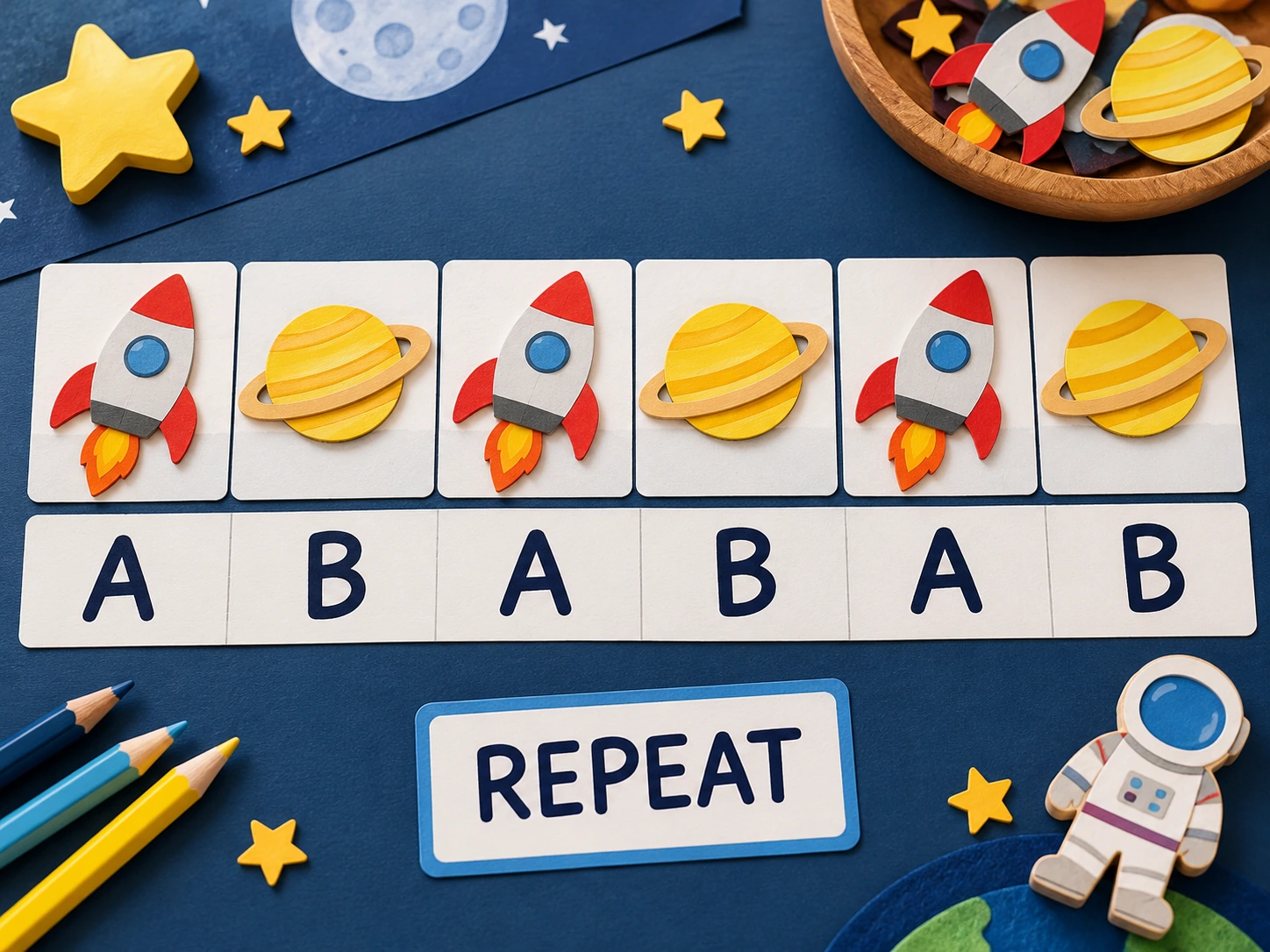
Build an AB row with large tokens, announce a new AAB rule and let the child rebuild rather than merely add one picture.
Hidden launch tile with Space Pattern Choices
Cover one token within a homemade repeat, keeping neighbouring complete units visible. Ask which picture would preserve the same rule.
Explain the tempting choice with Space Pattern Choices
Show two plausible next tokens beside an invented strip. Invite the child to explain the rejected token as well as the chosen one.
Six observations from repeat boundary
Unit recognition — repeat boundary
Space Pattern Choices invites identifying a reusable block rather than naming isolated pictures. Notice Suri’s unit recognition explanation: “Which pictures belong in one repeating block?”
Prediction — choice boundary
Space Pattern Choices invites using an established repeat to justify an unseen next item. Notice Suri’s prediction explanation: “What would you say before looking at the choices?”
Sequence language — double picture
Space Pattern Choices invites describing first, next, again and twice with a visible example. Notice Suri’s sequence language explanation: “How many times does that picture occur in the unit?”
Selective attention — incomplete unit
Space Pattern Choices invites ignoring a colourful candidate that contradicts the row. Notice Suri’s selective attention explanation: “Has this little block finished yet?”
Pencil placement — repeat boundary
Space Pattern Choices invites circling one option without obscuring its neighbouring choice. Notice Suri’s pencil placement explanation: “Which pictures belong in one repeating block?”
Flexible checking — choice boundary
Space Pattern Choices invites changing the repeat length when a new row begins. Notice Suri’s flexible checking explanation: “What would you say before looking at the choices?”
Eight closer readings of repeat boundary
Predict before peeking
Try covering only the answer choices while leaving a complete pattern row visible. Ask the child to name the next space picture, then uncover the candidates. This separates deriving a prediction from recognising a familiar option. If the prediction changes when the choices appear, compare both ideas with the same repeated unit rather than simply accepting the new circle. This Space Pattern Choices distinction supports unit recognition.
Count positions, not picture types
A rocket-rocket-planet block contains three positions but only two kinds of picture. Touch each position as its name is spoken. The repeated rockets should receive two taps. This small distinction becomes especially useful when a child knows that a pattern uses rockets and planets but has not yet noticed how many of each belong in its unit.
Keep the candidate row separate
The arrow marks a transition from the examples to three possible continuations. Those options are not extra members already added to the pattern. Trace the printed examples up to the arrow, pause, and discuss what is still missing. Only then compare the predicted item with the available choices and record one circle around the selected picture. This Space Pattern Choices distinction supports sequence language.
Listen through a whole block
When chanting the AAB row, give the two rockets separate syllables and let the planet complete the little phrase. Repeat that same phrase rather than speeding through a long list. A child can use the spoken rhythm to hold the unit while looking at the pictures, but the chant must continue to match every visible position.
A star changes the vocabulary
The ABC line introduces a third picture type. Before predicting, ask the child to name the star and find its other occurrence in that row. Establishing the full three-item unit prevents the previous rocket-planet alternation from being carried into a new problem. Read the new row as fresh evidence rather than assuming that the page has one universal rule. This Space Pattern Choices distinction supports pencil placement.
An unfinished unit still has a rule
AABB can be hard to recognise when the printed line stops after the next pair of rockets. Show how the last two positions continue an already established four-picture block. The next item completes that partial block; the child does not need to invent a different rule because the visible examples end before the block does.
A useful adult observation
Notice whether the child identifies a rule before or after looking at the candidates. You might hear a full repeated phrase, a picture-by-picture chant or a guess based on the last item alone. Record that particular approach. It gives a clearer next teaching step than a total of correct circles, which can conceal several different ways of reaching an answer. This Space Pattern Choices distinction supports unit recognition.
A small comparison across rows
After one row is understood, choose a second with a different unit length and ask what changed. The pictures may still include a rocket and a planet, while their internal counts differ. Let the child show the difference with taps or large tokens. Comparing two secure examples can make the changing rule noticeable without introducing every pattern type at once.
Save and print Space Pattern Choices
Select the premium Space Pattern Choices PDF through eligible membership access. The space-pattern edition carries no domain text or website watermark, and its five-row PDF contains no ads. The original sample has a separate control. Save your chosen file and inspect its complete portrait boundaries before printing; all five repeat rows and their options should remain visible.
Other choices beyond unit recognition
For Space Pattern Choices, the saved catalog suggests road-following after space pattern choices; aiming-and-stopping after space pattern choices; picture-recipe drawing after space pattern choices. Read each linked activity’s rule with Suri; its repeat boundary response may differ.
For Suri, browse NAEYC writing ideas alongside space pattern choices or PBS Parents activities beyond space pattern choices. Watch unit recognition with sequence language, then revisit repeat boundary.
Popular Worksheets
Printable resources families and teachers are downloading now.
 Free
 Free
 Free
 Free