
Silly Guest Sorting: 6 Clever Category Exceptions
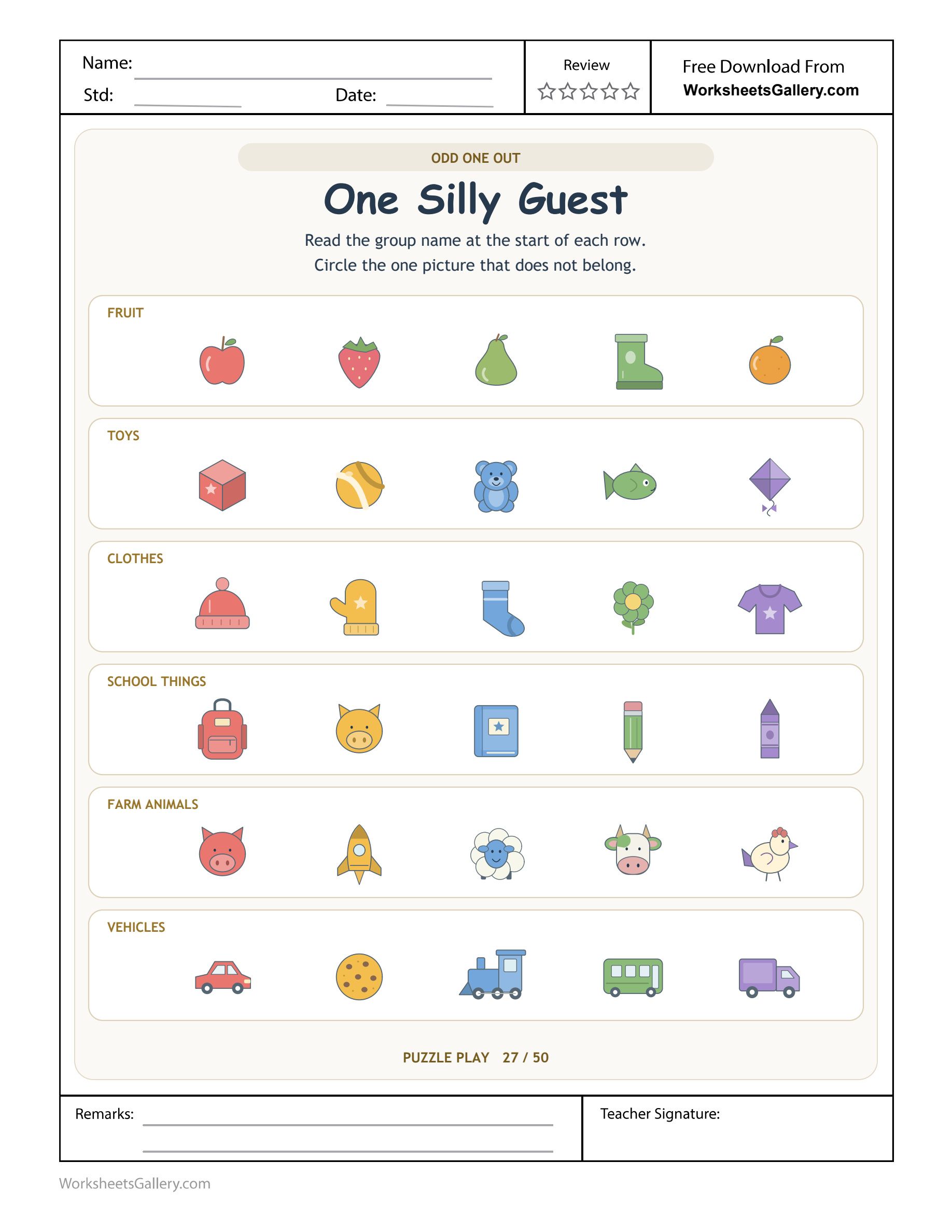
$5 · 25 supplied sheets: Silly Guest Sorting. Use the printed category to identify one outsider, even when several pictures share a colour.
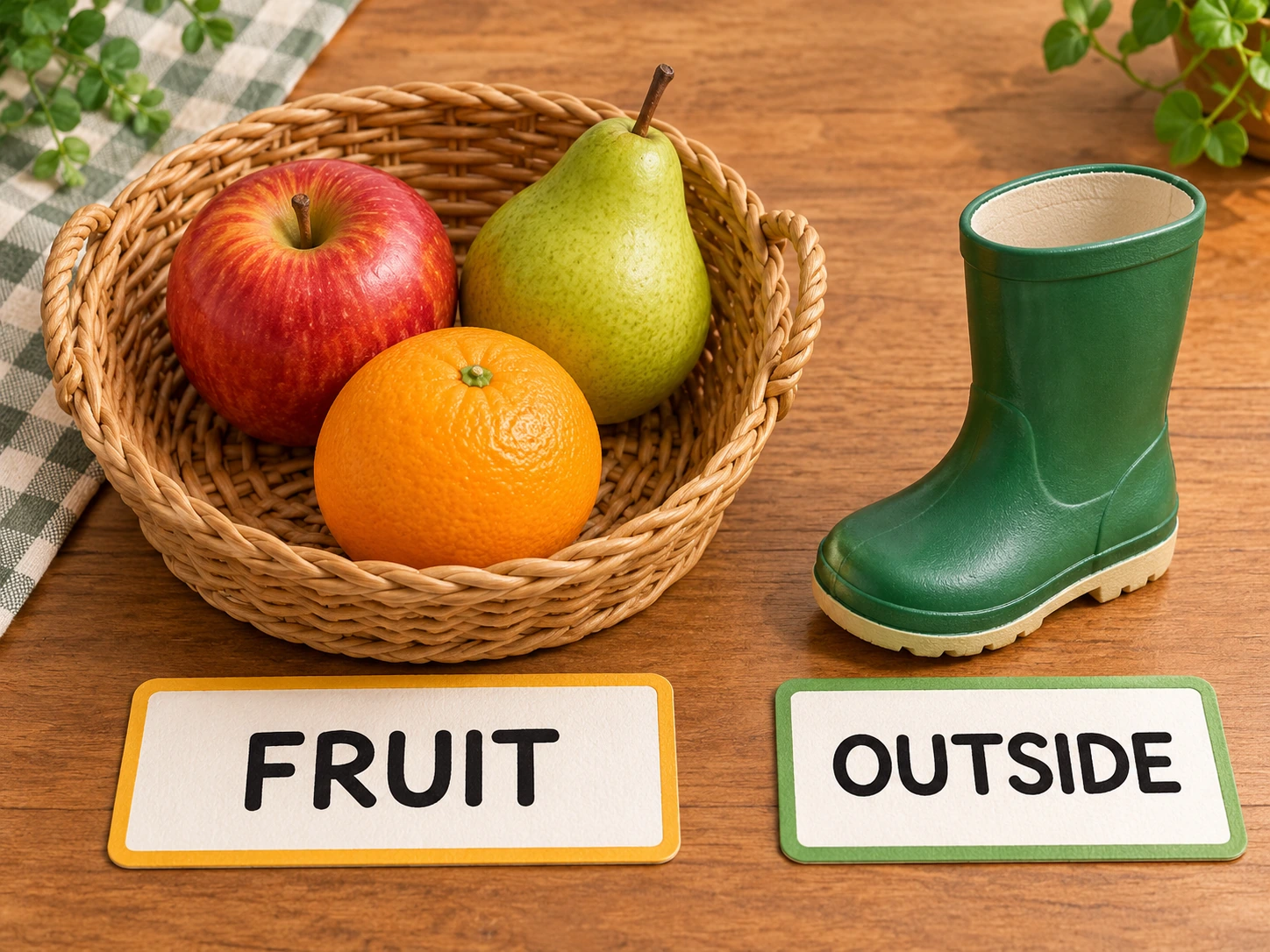
A boot among apples and pears makes a useful conversation starter. In Silly Guest Sorting, the printed category decides which picture is the visitor. Children inspect six labelled rows, consider five candidates in each and circle one outsider. Discuss why a picture fits somewhere else instead of treating it as wrong in every setting. You can read the group names aloud while leaving the classification to your child. Familiar objects create an approachable starting point, and the changing labels offer a reason to pause before each new row.
Silly Guest Sorting: read the actual puzzle
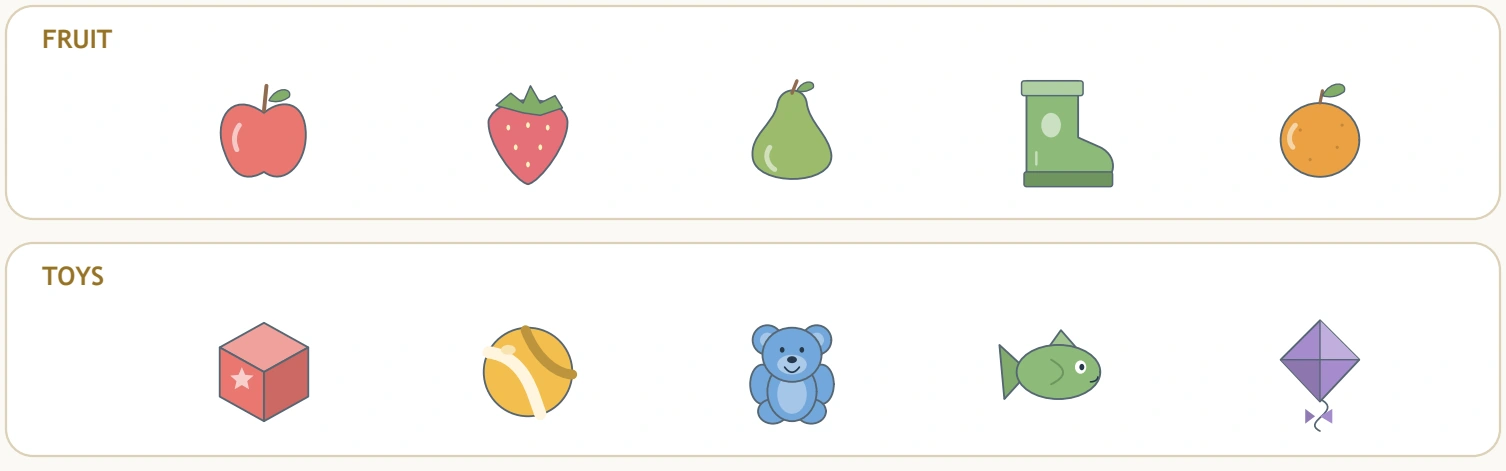
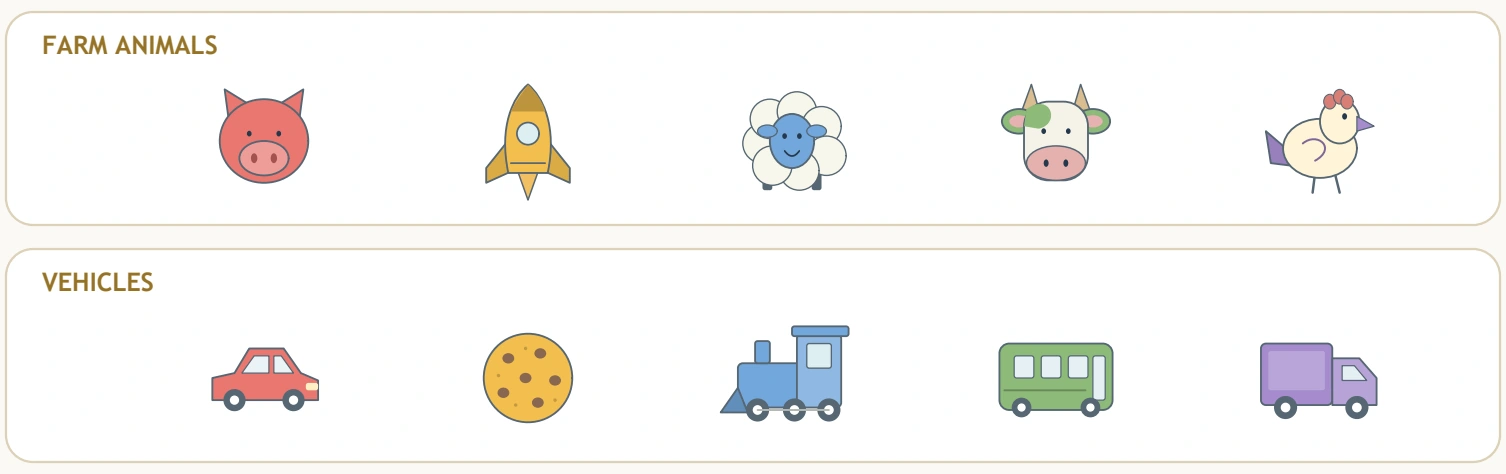
Silly Guest Sorting: Every line names its own group. Four pictures fit that label and one is an outsider. Read FRUIT before considering apple, strawberry, pear, boot and orange; a colour match cannot make the boot something to eat.
The TOYS line requires a different test. A fish shares bright colour and a friendly face with nearby playthings, yet the printed category asks about the represented object. Explain that the drawing stands for a fish rather than a toy model unless the activity says otherwise.
Try the rule deserves a second look
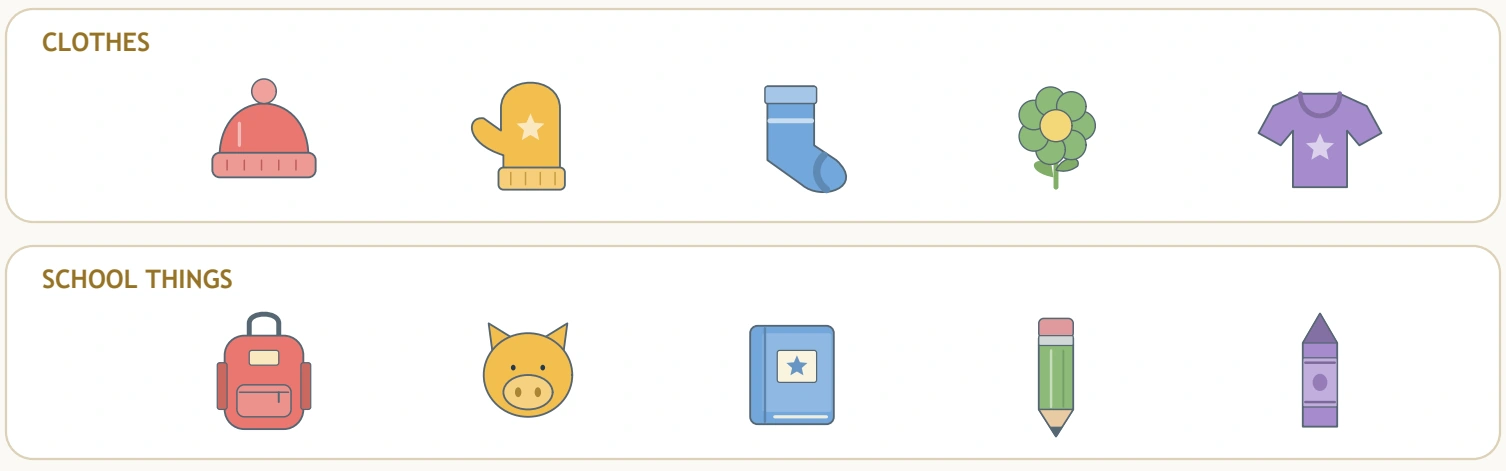
FARM ANIMALS includes familiar animal faces and an unexpected rocket. Naming all five pictures is a useful preliminary conversation. Then identify the common group and decide which picture has no place in that specific line.
The response is one circle on each of six rows. This is exclusion, not a request to circle every correct member. Keeping the mark on the outsider allows a partner to see the exact decision that was made.
Five play invitations after name the pictures
One visitor at tea with Silly Guest Sorting
Place three fruit pictures and one school object around an imaginary tea table. State FRUIT and ask which visitor needs a different table.
Category voices with Silly Guest Sorting
Say a group name in a character voice, then offer one matching and one nonmatching picture. Explain the choice without relying on the voice.
Outsider becomes host with Silly Guest Sorting
Move the excluded item to a new group and add objects that fit it. The former guest now belongs, because the rule changed.
Reason relay with Silly Guest Sorting
One partner points to an exception; the other finishes a because statement naming the row category. Exchange roles after one well-supported decision.
Colour decoy with Silly Guest Sorting
Make a group with several differently coloured members and one same-coloured outsider. Discuss why colour alone does not settle this particular task.
Imagine Pavel investigating at home
Pavel notices the boot because he wore boots that morning. His grandfather asks whether that connection explains FRUIT. Pavel names the edible pictures and revises his reason. The conversation uses his first idea as a starting point without calling the picture silly in every possible context.
Try “What does this row ask us to look for?” during this imagined Silly Guest Sorting visit. Let Pavel explain read the category before recording.
Partners explore inhibiting preference
A teacher gives partners different speaking jobs: one reads a group label with help and the other names an exception. Before a circle is made, each child contributes one example that genuinely belongs. The group rotates the jobs for the next row.
A Silly Guest Sorting classroom note can describe explaining a mismatch through the named category. Record the actual name the pictures prompt, too.
Distinctions behind try the rule
Read the category — the Pavel discussion
An odd-one-out puzzle needs an agreed rule. Without the printed labels, children could propose several sensible groupings. Read the category aloud so the activity becomes a shared reasoning problem rather than a contest to guess an adult’s private idea.
Name the pictures — the Pavel discussion
The farm row offers an especially clear contrast between animals and a vehicle. Once the distinction is secure, invite a more challenging clothing row. Adjust the entry point by familiarity instead of assuming the first printed line must always be the easiest.
Try the rule — the Pavel discussion
A circle that touches two pictures is a recording ambiguity. Invite Pavel to indicate his chosen guest before discussing pencil work. The classification can be sound even when the outline of the mark needs a steadier second attempt.
Readiness for name the pictures
Picture naming can be supported in the family language. Translate the group label and discuss its meaning before asking for an English explanation; pointing to the outsider can still demonstrate the relevant decision.
Suggested Silly Guest Sorting range: ages four to six. Pavel’s readiness depends on category meaning and interest in name the pictures. Shorten this Silly Guest Sorting visit when needed.
Revisit the try the rule difficulty
A child may circle all four members, having understood the category but missed the response instruction. Acknowledge that classification, then contrast finding members with identifying the single guest outside the group. Avoid treating the marks as proof that nothing was understood.
Return to Silly Guest Sorting evidence by asking “Can you explain why this one does not belong?” Separate pencil execution from Pavel’s read the category reasoning.
Eight closer readings of read the category
A category is the agreed test
The row heading supplies the reason for grouping, so read it even when an outsider seems obvious. A child could reasonably group pictures by colour, size or a remembered experience in another game. Here the shared category is explicit. Return to that label when two people offer different explanations. This Silly Guest Sorting distinction supports category meaning.
A friendly face is not membership
Several pictures have smiling faces, including objects that are not animals. Ask what the drawing represents rather than treating the face as the deciding feature. Naming a rocket as a rocket keeps the farm-animal comparison grounded in object identity, even when its illustration looks as friendly as the sheep.
Wearable or merely green
The green boot and green pear create a useful discussion about surface similarity. Colour can describe both, while FRUIT asks for a different property. Let the child identify the shared colour first, then explain why that true observation is insufficient for deciding which object belongs in the named group. This Silly Guest Sorting distinction supports reasoned exclusion.
One line at a time
A strip of paper can cover lower rows while leaving the current heading and all five candidates visible. Use it as a place keeper rather than a way of hiding evidence. After the outsider is discussed, move the strip and deliberately read the next category before inspecting another set.
Make the exception clear
Before circling, ask the child to point to the single intended outsider. Then compare the pointed answer with the final pencil mark. If the circle includes a neighbour, clarify the mark without repeating a category explanation the child already understands. Recording and classification deserve separate attention. This Silly Guest Sorting distinction supports controlled marking.
Explain a member as well
After finding the fish outside TOYS, invite an explanation of why a ball belongs. This complementary question checks whether the child has identified the group rather than merely noticed the most unusual drawing. A concise spoken reason or a matching real object can provide useful evidence.
From excluded to included
Move the idea of an outsider into a new imaginary setting. The rocket excluded from FARM ANIMALS could join a collection of vehicles. State the new rule aloud before reconsidering it. That change demonstrates that belonging depends on a specified group rather than a permanent good-or-bad label attached to an object. This Silly Guest Sorting distinction supports category meaning.
Choose a precise next prompt
If the child names every picture but cannot identify an outsider, ask about the category’s meaning. If the category explanation is sound but the wrong picture is circled, inspect the recording step. If a picture is unfamiliar, supply its name first. Those three situations need different assistance, even when the final mark looks similar.
Another visit through rule switching
Let the child invent a welcoming place for the outsider after solving a row. The boot can join a clothing shelf, for example. Returning an object to a sensible group keeps the tone playful and kind.
Revisit Silly Guest Sorting through record the outsider. Recognise explanations about record the outsider from Pavel.
Four checkpoints for Silly Guest Sorting
| Pause here | Inspect this clue |
|---|---|
| Read the category | An adult supplies the printed group name when needed. |
| Name the pictures | Agree on the represented objects before classifying them. |
| Try the rule | Test a candidate against the group rather than its colour. |
| Record the outsider | Circle only the exception on that row. |
Read the category — Pavel’s inspection
For Silly Guest Sorting, ask “What does this row ask us to look for?” An adult supplies the printed group name when needed.
Name the pictures — Pavel’s inspection
For Silly Guest Sorting, ask “What is each picture showing?” Agree on the represented objects before classifying them.
Try the rule — Pavel’s inspection
For Silly Guest Sorting, ask “Can you explain why this one does not belong?” Test a candidate against the group rather than its colour.
Record the outsider — Pavel’s inspection
For Silly Guest Sorting, ask “Does your circle show the picture you meant?” Circle only the exception on that row.
Six observations from read the category
Category meaning — read the category
Silly Guest Sorting invites connecting a spoken group label with several concrete examples. Notice Pavel’s category meaning explanation: “What does this row ask us to look for?”
Inhibiting preference — name the pictures
Silly Guest Sorting invites setting aside a favourite object that is irrelevant to the rule. Notice Pavel’s inhibiting preference explanation: “What is each picture showing?”
Reasoned exclusion — try the rule
Silly Guest Sorting invites explaining a mismatch through the named category. Notice Pavel’s reasoned exclusion explanation: “Can you explain why this one does not belong?”
Vocabulary links — record the outsider
Silly Guest Sorting invites naming clothing, school objects, fruit and vehicles in context. Notice Pavel’s vocabulary links explanation: “Does your circle show the picture you meant?”
Controlled marking — read the category
Silly Guest Sorting invites enclosing one small picture while leaving nearby examples visible. Notice Pavel’s controlled marking explanation: “What does this row ask us to look for?”
Rule switching — name the pictures
Silly Guest Sorting invites adopting a new category at the start of the next line. Notice Pavel’s rule switching explanation: “What is each picture showing?”
Save and print Silly Guest Sorting
The original Silly Guest Sorting sample lets you inspect the six category rows. Eligible active members can instead choose its clean premium PDF, which removes website watermark and domain branding and contains no embedded ads. Open the saved printable before using the printer, checking that the row labels and outsider choices fit within the page edges.
Other choices beyond category meaning
For Silly Guest Sorting, the saved catalog suggests road-following after silly guest sorting; aiming-and-stopping after silly guest sorting; picture-recipe drawing after silly guest sorting. Read each linked activity’s rule with Pavel; its read the category response may differ.
For Pavel, browse NAEYC writing ideas alongside silly guest sorting or PBS Parents activities beyond silly guest sorting. Watch category meaning with reasoned exclusion, then revisit read the category.
Popular Worksheets
Printable resources families and teachers are downloading now.
 Free
 Free
 Free
 Free