
Mixed Shelf Detective: 6 Brilliant Label Checks
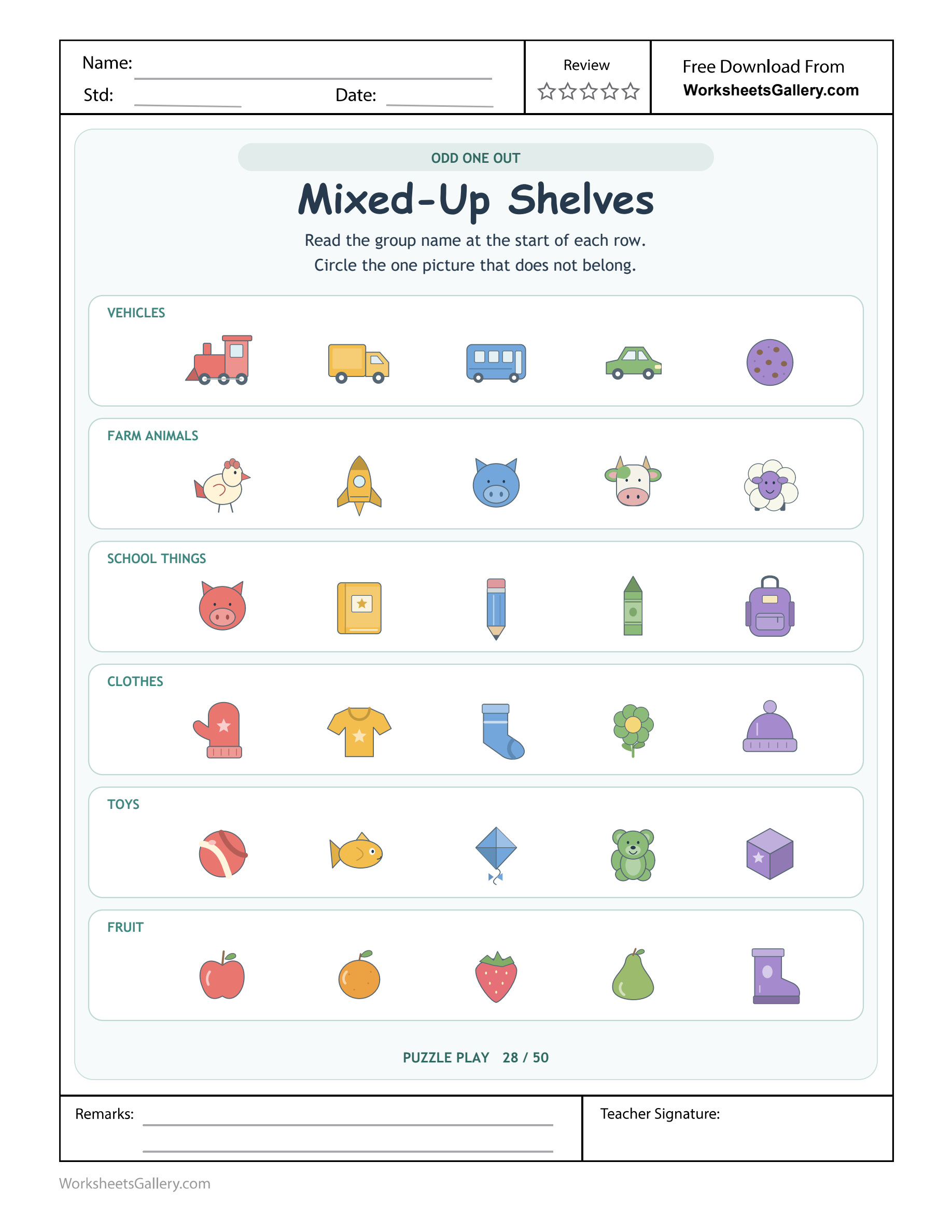
$5 · 25 supplied sheets: Mixed Shelf Detective. Read a new shelf label on every row instead of carrying the previous category forward.
The shelves have their own rules, and every sign deserves a fresh reading. Mixed Shelf Detective places familiar pictures under six category labels, with one exception to find on each line. A child who remembers a previous outsider still needs to explain the current group. Read the shelf heading together, name any unfamiliar objects and test the five pictures against that heading. One circle records the excluded guest. The aim is a reason a partner can understand, with enough time to reset the question when the next shelf begins.
Mixed Shelf Detective: read the actual puzzle
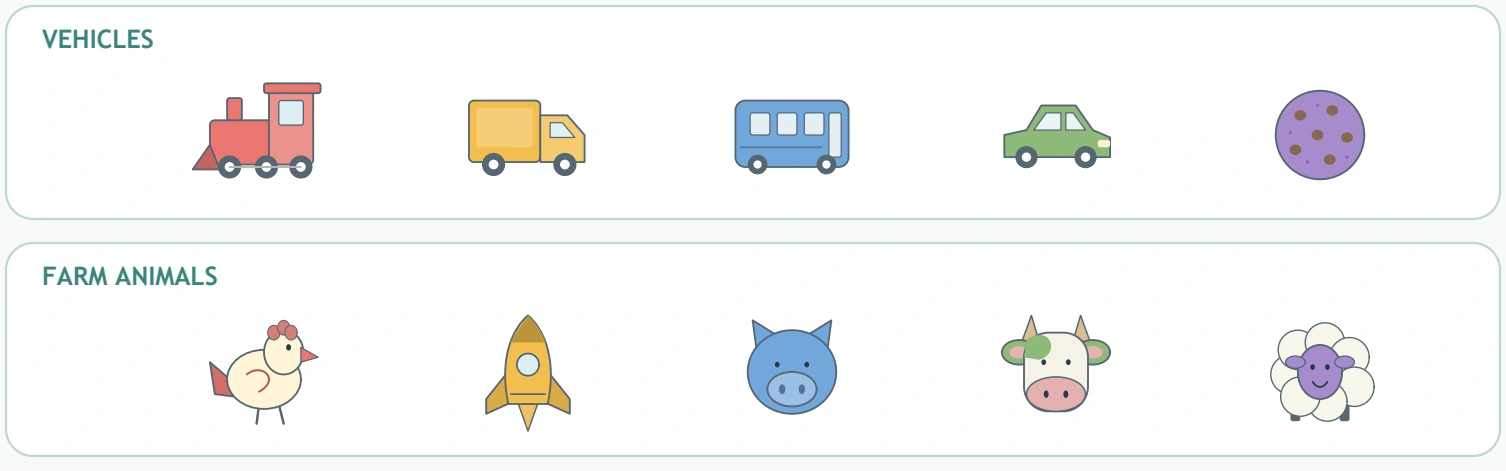
Mixed Shelf Detective: The opening shelf is VEHICLES. A train, truck, bus and car share that group, while a cookie is out of place. Starting from the label makes the decision independent of the picture’s position or favourite colour.
Six rows rearrange familiar categories: vehicles, farm animals, school things, clothes, toys and fruit. Reset the question at each label. Remembering the rule from the previous shelf would produce a different sorting job from the one printed.
New-row reset deserves a second look
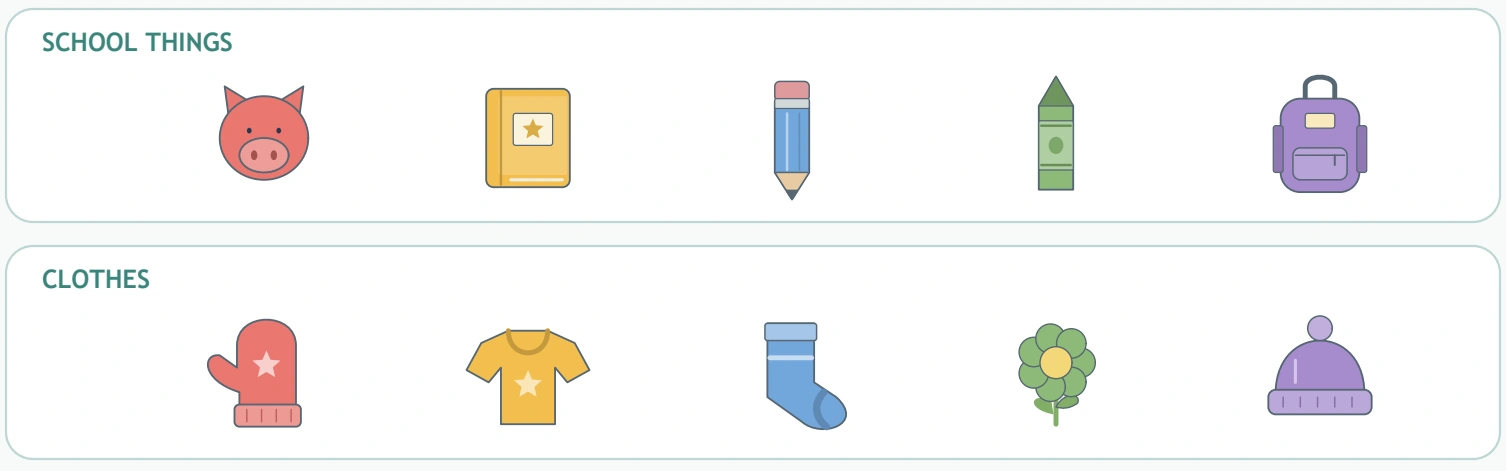
The clothing row mixes wearable items with a flower. The relevant comparison concerns use, not whether something can be held in a hand. Invite a short explanation that connects the excluded picture with the actual label.
Each shelf has five objects and one exception. The child circles that exception, leaving four members unmarked. Reading labels is an adult-supported part of the activity; independent word reading is not a prerequisite for discussing the categories.
Readiness for membership test
Begin with actual classroom objects if a category is unfamiliar. Touch a book, pencil and backpack while saying SCHOOL THINGS, then return to their drawn versions. Keep this naming support separate from giving away the outsider.
Suggested Mixed Shelf Detective range: ages four to six. Marta’s readiness depends on rule maintenance and interest in membership test. Shorten this Mixed Shelf Detective visit when needed.
Another visit through explainable choices
Invite the child to choose which shelf to inspect next during a later visit. Reordering the visit preserves the printed rules while reducing reliance on the remembered sequence of answers.
Revisit Mixed Shelf Detective through single exception. Recognise explanations about single exception from Marta.
Partners explore task resetting
A classroom shelf monitor reads labels aloud while a second partner checks pictures. A third child acts as a visitor who must understand the explanation. The monitor changes for each shelf, making listening and rule resetting visible parts of the task.
A Mixed Shelf Detective classroom note can describe describing why clothing, food or transport fits a named use. Record the actual membership test prompt, too.
Imagine Marta investigating at home
Marta helps organise an imaginary cupboard with her teacher during a home-learning visit. After the vehicle shelf she expects another transport question, then spots FARM ANIMALS. They pause to read the new label and move their marker to the fresh row before naming an exception.
Try “Which shelf are we organising now?” during this imagined Mixed Shelf Detective visit. Let Marta explain shelf heading before recording.
Six observations from shelf heading
Rule maintenance — shelf heading
Mixed Shelf Detective invites holding one category steady while inspecting its five candidates. Notice Marta’s rule maintenance explanation: “Which shelf are we organising now?”
Task resetting — membership test
Mixed Shelf Detective invites replacing the previous row rule with the newly printed label. Notice Marta’s task resetting explanation: “What makes these four belong together?”
Functional vocabulary — new-row reset
Mixed Shelf Detective invites describing why clothing, food or transport fits a named use. Notice Marta’s functional vocabulary explanation: “Did the label change on this shelf?”
Comparative reasoning — single exception
Mixed Shelf Detective invites considering an entire group before rejecting one picture. Notice Marta’s comparative reasoning explanation: “Can your partner find the object you excluded?”
Visual organisation — shelf heading
Mixed Shelf Detective invites keeping an eye and pencil within the current shelf boundary. Notice Marta’s visual organisation explanation: “Which shelf are we organising now?”
Explainable choices — membership test
Mixed Shelf Detective invites giving a partner evidence instead of only naming an answer. Notice Marta’s explainable choices explanation: “What makes these four belong together?”
Four checkpoints for Mixed Shelf Detective
| Pause here | Inspect this clue |
|---|---|
| Shelf heading | Say the current label before inspecting the objects. |
| Membership test | Compare all five objects with the named group. |
| New-row reset | Leave the previous category behind when moving down. |
| Single exception | Check that one circle records one outsider. |
Shelf heading — Marta’s inspection
For Mixed Shelf Detective, ask “Which shelf are we organising now?” Say the current label before inspecting the objects.
Membership test — Marta’s inspection
For Mixed Shelf Detective, ask “What makes these four belong together?” Compare all five objects with the named group.
New-row reset — Marta’s inspection
For Mixed Shelf Detective, ask “Did the label change on this shelf?” Leave the previous category behind when moving down.
Single exception — Marta’s inspection
For Mixed Shelf Detective, ask “Can your partner find the object you excluded?” Check that one circle records one outsider.
Five play invitations after membership test
Shelf sign swap with Mixed Shelf Detective
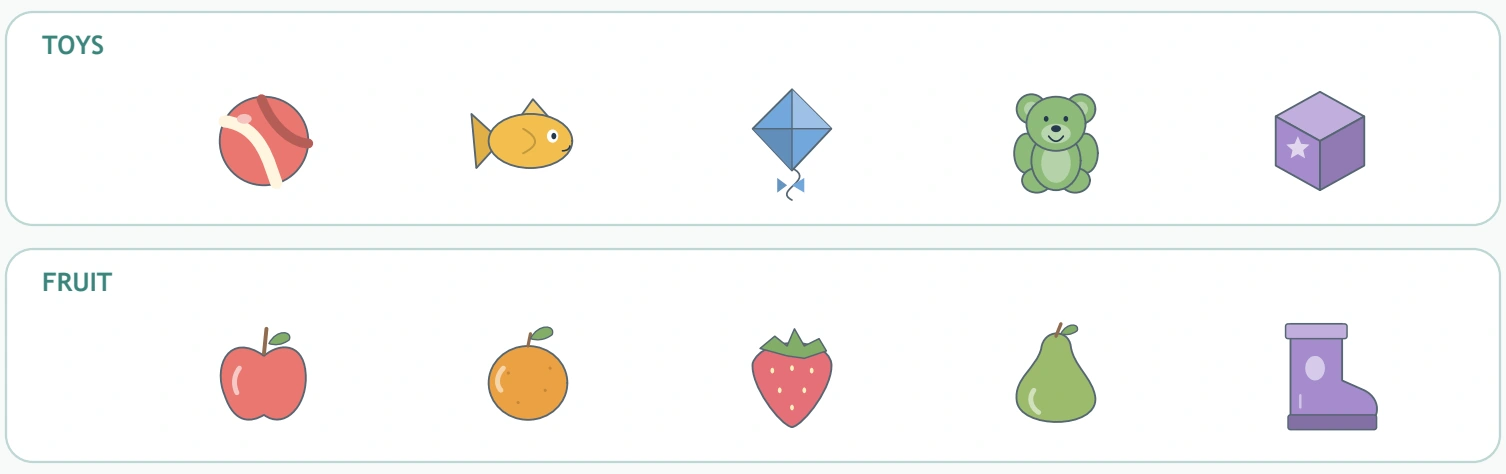
Place a TOYS label above a homemade group. Change it to FRUIT and discuss which objects would need moving before the shelf could make sense.
Shopkeeper explanation with Mixed Shelf Detective
One partner is a customer asking why an object was removed. The shopkeeper must refer to the shelf name rather than say it looks funny.
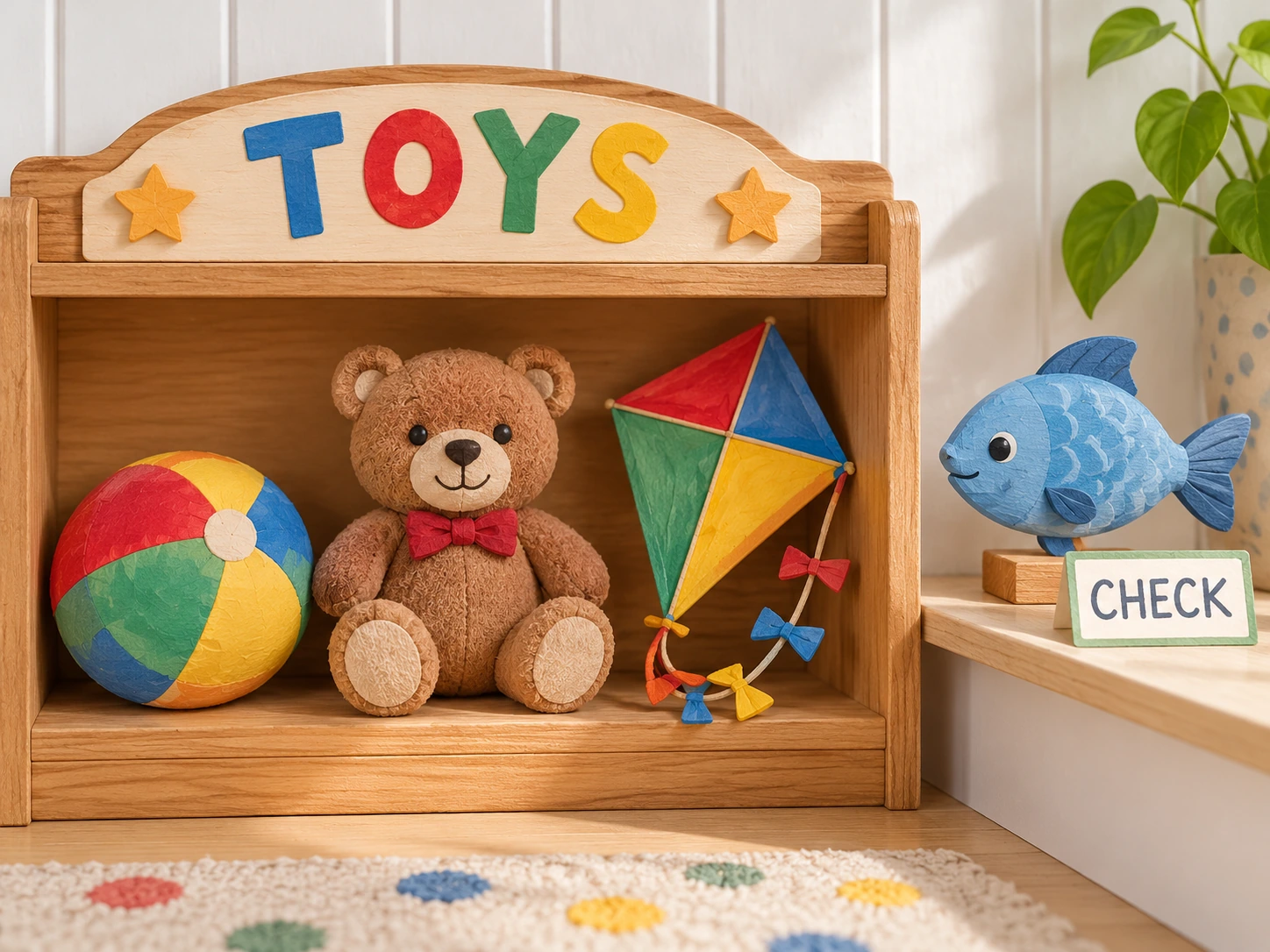
New outsider position with Mixed Shelf Detective
Arrange four group members with an outsider at a new location. Let the child notice that position does not determine membership.
Label delivery with Mixed Shelf Detective
Carry a written category sign to a group of real safe objects. Read together and check whether every object belongs under that label.
One sensible relocation with Mixed Shelf Detective
After excluding a picture, invent another named shelf where it would fit. Explain both the departure and the new membership.
Eight closer readings of shelf heading
Start with the shelf sign
Build a visible routine of touching the label before looking across its five objects. The touch marks a change of rule, not a command to read independently. An adult can supply the heading while the child demonstrates what it means through the pictures that follow. This Mixed Shelf Detective distinction supports rule maintenance.
Avoid an answer-position habit
The odd picture does not have one fixed position across the six shelves. Ask for a reason tied to the label before recording a circle. On a separate object arrangement, move the outsider to a new position and see whether the child can preserve the same category-based explanation.
Pictures can represent ordinary objects
A toy-like drawing of a pig represents a farm animal in this activity. Explain that convention if a child argues that every coloured picture could be a toy. Their observation is understandable; agreeing on what the illustrations stand for makes the printed category task well-defined. This Mixed Shelf Detective distinction supports functional vocabulary.
A useful comparison between shelves
Compare FRUIT with CLOTHES after each has been understood separately. A boot fits one category and not the other. The object itself has not changed. Let the child name the changing shelf rule, using a real wearable item or fruit picture if the contrast needs a concrete example.
Look across the whole group
An immediate outsider guess can be checked by naming the four remaining members. This makes the common category explicit and catches a choice based solely on one striking colour. Leave the full row visible during that comparison so the child can support an explanation with all five candidates. This Mixed Shelf Detective distinction supports visual organisation.
Give the reader a role
A partner who reads a shelf label is contributing information needed for the decision. Make that job explicit, then let the other child explain membership. Swap those jobs on the next line. This prevents fluent reading or confident pointing from allowing one participant to control the whole puzzle.
Allow concise category language
A short phrase such as “cookie, not a vehicle” can express the essential reasoning. Expand it conversationally if useful, without requiring an elaborate sentence before the child may make a mark. The goal is an understandable category decision, with language support proportionate to the child’s current expression. This Mixed Shelf Detective distinction supports rule maintenance.
Revisit through a fresh ordering
On another visit, let the child select a shelf halfway down the page. Read its heading and solve it before returning to an earlier row. Choosing a different order encourages attention to labels rather than recall of a fixed sequence of outsider answers from the first session.
Revisit the new-row reset difficulty
An adult who says “find the same one again” can accidentally encourage memorised outsider positions. Instead, announce the current shelf label. The boot is not excluded because it sits at the far right; it is excluded from FRUIT because it is footwear.
Return to Mixed Shelf Detective evidence by asking “Did the label change on this shelf?” Separate pencil execution from Marta’s shelf heading reasoning.
Distinctions behind new-row reset
Shelf heading — the Marta discussion
Changing a label can change a correct answer without changing any objects. Demonstrate that idea with a small separate group before returning to the printed shelves. It clarifies why reading the heading is part of the reasoning rather than an administrative step.
Membership test — the Marta discussion
The rows are useful opportunities for language, but a long sentence is optional. “Flower, not clothes” can express the essential rule. An adult can expand that meaning conversationally without requiring the child to repeat an elaborate scripted explanation.
New-row reset — the Marta discussion
Watch where the child looks after completing a row. Moving straight to the next pictures without checking their label suggests a routine to teach: stop at the shelf sign, say the group, then inspect. That observation is more useful than a general judgement about attention.
Save and print Mixed Shelf Detective
A Mixed Shelf Detective membership download provides the clean shelf PDF. Active-plan eligibility applies to its premium control. The PDF retains the shelf labels and pictures without website watermark, domain text or embedded advertisements. A separate original sample preserves the uploaded edition. In print preview, keep every shelf and the outer border inside the selected portrait paper area.
Other choices beyond rule maintenance
For Mixed Shelf Detective, the saved catalog suggests road-following after mixed shelf detective; aiming-and-stopping after mixed shelf detective; picture-recipe drawing after mixed shelf detective. Read each linked activity’s rule with Marta; its shelf heading response may differ.
For Marta, browse NAEYC writing ideas alongside mixed shelf detective or PBS Parents activities beyond mixed shelf detective. Watch rule maintenance with functional vocabulary, then revisit shelf heading.
Popular Worksheets
Printable resources families and teachers are downloading now.
 Free
 Free
 Free
 Free