
Picnic Hidden Pictures: 6 Delightful Tiny Discoveries
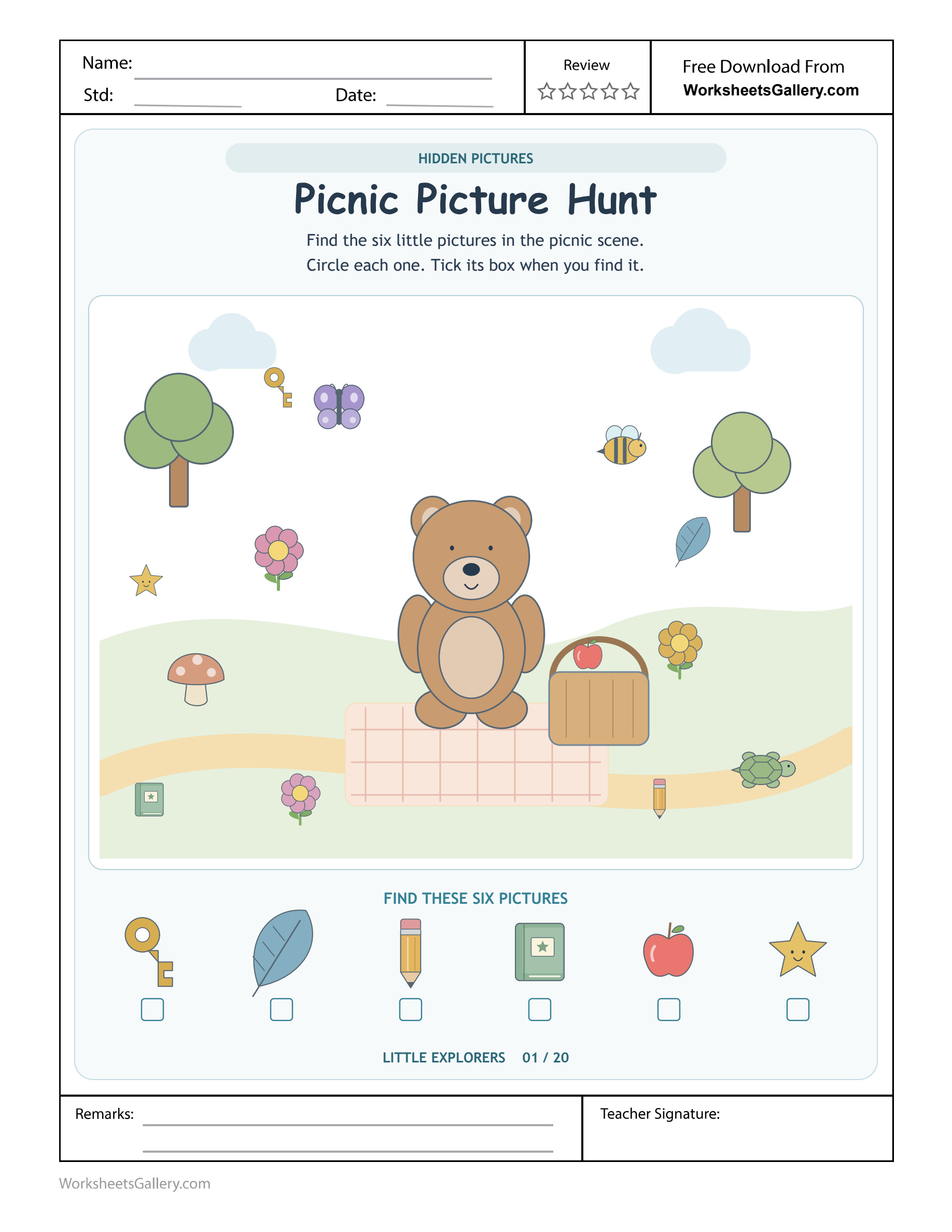
$5 collection companion: Picnic Hidden Pictures. Locate one target at a time, then coordinate a scene circle with a checklist tick.
A tiny key can be surprisingly easy to overlook when a large teddy occupies the middle of the picture. Picnic Hidden Pictures invites children to slow down, select one of six target pictures and search a friendly outdoor scene for its match. After circling a discovery, they tick the corresponding box beneath the picture list. This is a looking-and-recording activity for supported preschool and kindergarten play. The targets remain visible throughout; remembering a hidden list is not required. An adult can help establish picture names while leaving the actual search to the child.
Two marks describe one discovery — Picnic Hidden Pictures
The page has a large picnic illustration above a six-picture checklist. In Picnic Hidden Pictures, a circle identifies the object inside the scene, while a tick records that the same target has been found. These marks do different jobs. A child who ticks every box without locating the objects has completed a list of marks, not the pictured search.
Begin by exploring that relationship with a finger. Point to the key in the checklist and ask what shape should appear in the scene. Once the child locates it, have them point back to its target box before using the pencil. This short rehearsal makes the two response locations clear without requiring an adult to reveal every hiding place.
There are many inviting things to notice in Picnic Hidden Pictures: trees, a butterfly, flowers and the teddy itself. They enrich the setting, but only six specific pictures belong to the target list. An interesting bee is still worth talking about; it simply does not need a checklist tick unless the instruction changes during a separate play extension.
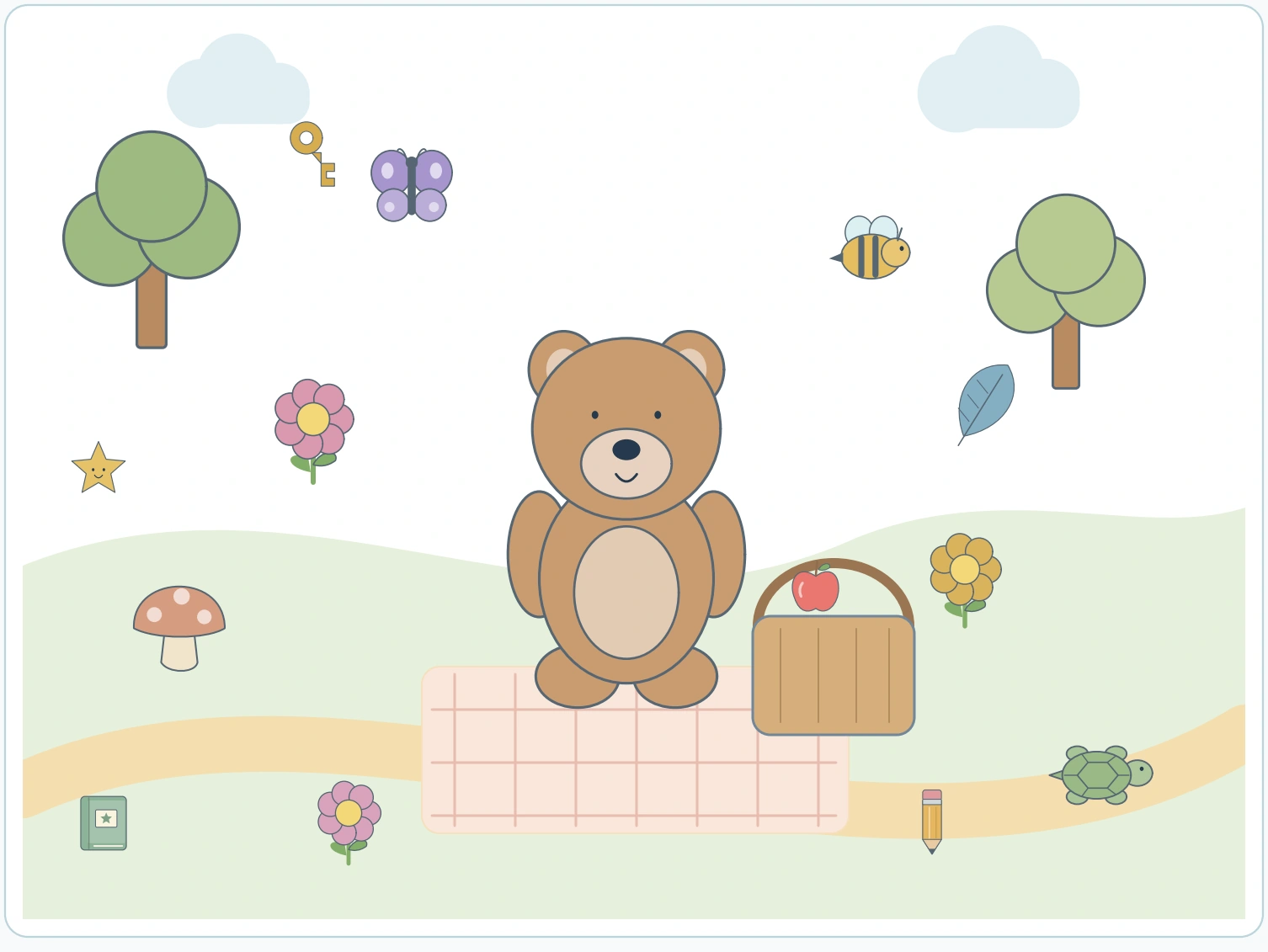
Establish the picture names before searching: Picnic Hidden Pictures
The six targets are a key, a blue feather-shaped picture, a pencil, a book, an apple and a star. The blue target has a leaf-like outline, so accept a child's descriptive name and point to the exact picture intended. A disagreement over its name should not become a disagreement over whether the same shape has been located.
For Picnic Hidden Pictures, useful descriptions combine more than colour. “The yellow thing” could refer to several details. “The key with a round opening” gives the search a clearer target. Likewise, a star has a recognisable outline, while a pencil has a long body and pointed end. Invite one descriptive feature before the child starts sweeping the scene.
Matching identity rather than display size: Picnic Hidden Pictures
The checklist images and scene images need not look equally large. The activity asks whether they represent the same object, not whether their printed dimensions match. A child can check the book's rectangular cover or the apple's stem. This distinction is helpful when a promising candidate looks smaller than its reference picture.
A suggested search routine with room to choose
- Let the child choose a target from the lower picture bank and describe one of its features.
- Look through the scene in a manageable area, such as around the left tree or along the lower path.
- Check a candidate against the target before circling it.
- Return to the matching checklist entry and tick its own box.
- Select another unticked target, or pause and leave the remaining discoveries for later.
This routine gives Picnic Hidden Pictures a visible rhythm: choose, search, compare, record. It does not prescribe which target must be first. A confident child may spot an apple immediately and then return to select another picture. Encourage an explanation of the match rather than requiring every child to use the same scanning direction.
When the eye keeps jumping back to the teddy
The teddy is the visual centre of Picnic Hidden Pictures, but several targets sit near the scene edges. Suggest inspecting a smaller region instead of repeatedly saying “look harder.” A scrap of plain paper can cover an irrelevant half temporarily. Leave the chosen target visible so that reducing the search area does not accidentally turn the activity into a memory challenge.
Quiet adult reference: the six locations: Picnic Hidden Pictures
| Target | Place to inspect | Useful checking detail |
|---|---|---|
| Key | Upper left, below a cloud | Round opening and toothed end |
| Blue feather-shaped target | Right side, below the tree | Slanted blue outline and central marking |
| Pencil | Lower right beside the path | Long narrow body with a pointed tip |
| Book | Bottom left | Small rectangular cover |
| Apple | On the picnic basket | Rounded fruit with a stem |
| Star | Left side below the tree | Pointed star outline |
Use these Picnic Hidden Pictures locations to check an explanation or decide whether a crop has shown enough context. They are not a script to read aloud before the child searches. If support is needed, move gradually from a broad area clue to a nearer landmark rather than pointing directly at every answer.
Six observations worth noticing: Picnic Hidden Pictures
Choosing a meaningful feature
Picnic Hidden Pictures offers a reason to distinguish a pencil point from a key's teeth or a book cover. Listen to which feature the child uses. Naming a useful detail can be more informative than an immediately correct circle.
Filtering a busy setting: Picnic Hidden Pictures
A child needs to hold one chosen target in attention while other attractive drawings remain present. On Picnic Hidden Pictures, notice whether the search stays connected to the selected picture or becomes an unrelated tour of every item in the scene.
Returning to a reference: Picnic Hidden Pictures
Looking back at the target bank is sensible checking, not a failure to remember. Picnic Hidden Pictures keeps that reference available deliberately. Praise a careful comparison when a candidate initially seems uncertain.
Coordinating pencil marks: Picnic Hidden Pictures
A loose circle and a small tick require different movements. Understanding can be shown by pointing even when those marks are uneven. Keep the search decision separate from how neatly the child records it.
Using location language
“Below the cloud” and “beside the path” connect a found object to stable landmarks. Picnic Hidden Pictures gives these phrases a concrete purpose. Accept a gesture first, then model a short location phrase that matches what the child is showing.
Monitoring what remains: Picnic Hidden Pictures
Unticked boxes make unfinished targets visible. A child can review the bank and decide what to inspect next. This is an opportunity for self-checking within Picnic Hidden Pictures, rather than an adult repeatedly announcing which object has not been found.
At home: a child directs the adult's finger: Picnic Hidden Pictures
Imagine Ada finding the little book during a quiet table activity. Instead of touching it for her, the parent asks where to move a pointing finger. Ada says “down there,” then adds “near the left corner.” The adult follows that instruction and asks whether the rectangle matches the book in the target bank.
Once Ada confirms the match, she circles the scene object and chooses its checklist box. The adult notices the completed connection: she found the book, described where it was and recorded that same discovery. If she prefers to dictate the location while the adult makes a tick, the reason for the response remains hers.
The Picnic Hidden Pictures session can end after a few discoveries. Ada may want to tell a picnic story instead of searching for the final target. Save the partially completed page and let its remaining boxes provide a clear invitation another day. Finishing all six is an available goal, not a condition for enjoying the picture.
In a small group: the finder and the verifier: Picnic Hidden Pictures
For an imagined classroom pair, one learner chooses a target and searches while the other watches the lower bank. After a candidate is found, the verifier points to the intended checklist entry and asks which visible feature proves the match. Then they exchange roles for the next target.
The adult can listen for a difference between guessing from colour and identifying an object. In Picnic Hidden Pictures, a useful note might record that a child compared the star's outline independently, or that a spoken region clue helped locate the pencil. Describe the support actually given instead of attaching a broad ability label to one attempt.
Keep enough space for both learners to see the whole page. Do not let a partner repeatedly reach over and circle before the finder has finished explaining. Pointing, checking and marking can be shared without turning the search into a race for ownership of the answers.
Five little search games after the picnic
A target for a tabletop: Picnic Hidden Pictures
Place a toy key beside three familiar objects and draw a quick key card. Match the card to the object, then turn the card over only after the match is explained. This makes the reference relationship from Picnic Hidden Pictures concrete without reproducing the entire scene.
Change the clue, keep the object
Describe a pencil first by shape and then by its use. Ask which clue made it easier to identify. Keep both clues accurate; an invented description should not force the child to guess the adult's preferred answer.
Send a location message
Hide a large picture card in plain sight near a safe room landmark. One partner describes its location while another points. Swap roles and encourage a more precise phrase only when the first instruction leaves several possible places.
Draw an extra picnic guest: Picnic Hidden Pictures
On a separate sheet, invent one additional object for the picnic and make a matching target picture. Explain where it would go and what feature would help another person find it. The new drawing is an extension, not an unprinted seventh answer in Picnic Hidden Pictures.
Inspect the checklist backwards: Picnic Hidden Pictures
Choose a ticked entry and explain which scene circle belongs to it. This reverses the usual direction of the search. It is especially useful if a tick has drifted toward a neighbouring box and the child wants to clarify the intended record.

An inviting level of challenge
Picnic Hidden Pictures suits many adult-supported children around four to six, with individual differences in naming, visual attention and pencil control. A learner can participate by matching and pointing before being ready to record all six discoveries. Read the short instructions together and provide a stable drawing surface with comfortable materials.
Common difficulties include circling an attractive unlisted object, ticking a neighbouring box or searching without checking the selected target again. Return to the relevant picture relationship. “Which target were you looking for?” is more useful than erasing a mark without discussing it. If the scene feels crowded, offer a region clue or a shorter visit.
On a return to Picnic Hidden Pictures, invite Ada to choose the first target herself or explain a discovery she remembers. She may search more systematically, but a different route can still be effective. Appreciate the explanation and the willingness to investigate; there is no need to attach a stopwatch to the picnic.

Choose the original or the clean printable: Picnic Hidden Pictures
The original Picnic Hidden Pictures sample and the premium clean PDF use separate download controls. Members with an eligible active plan can obtain the clean single sheet; website watermark and domain wording have been removed, and no advertisements are embedded in that file. The supplied original remains available for inspecting the uploaded edition.
Save the chosen PDF and examine its portrait printer preview. Keep the entire scene, target bank and six small boxes within the page boundaries. The related $5 collection offers this activity alongside the other nineteen Little Explorers sheets in one combined clean PDF, through its own purchase control.
Beyond this particular search
After Picnic Hidden Pictures, explore Garden Hidden Pictures beside Picnic Hidden Pictures, Space Picture Search after Picnic Hidden Pictures, Fruit Search Totals beyond Picnic Hidden Pictures. Keep each new instruction separate from Picnic Hidden Pictures.
For adult ideas that combine looking, conversation and purposeful marks, visit NAEYC's early-writing suggestions for families or explore PBS Parents activities for early language play. With Picnic Hidden Pictures, keep the emphasis on an explained discovery and a meaningful record of the chosen target.
Popular Worksheets
Printable resources families and teachers are downloading now.
 Free
 Free
 Free
 Free