
Toy Shelf Differences: 6 Brilliant Location Reports
$5 collection companion: Toy Shelf Differences. Use shelf positions to distinguish recolouring, replacement and disappearance.
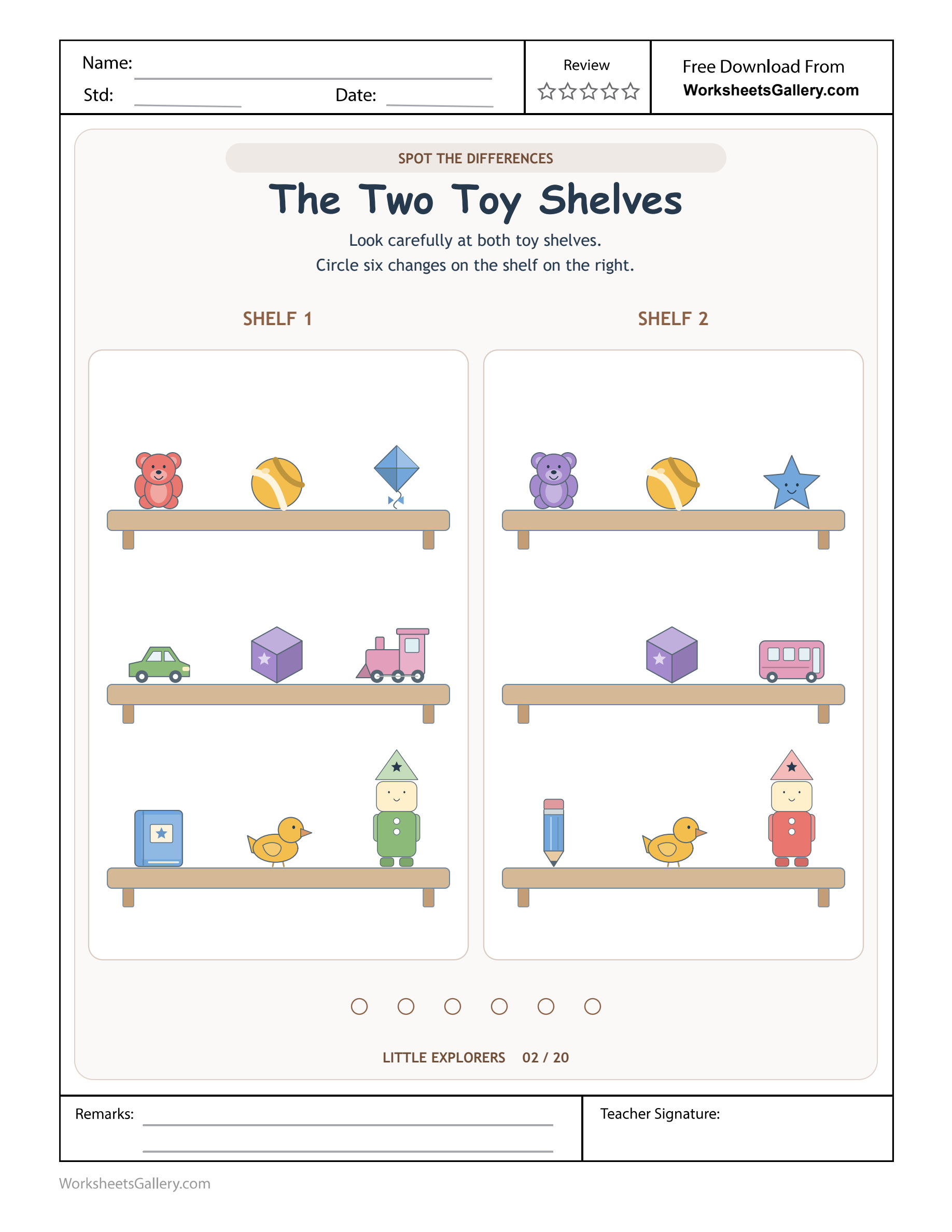
The purple teddy is an obvious clue, but what should a child circle when a toy has disappeared altogether? Toy Shelf Differences turns that question into a careful conversation about places. Children compare two three-level toy displays and identify six changes on the right-hand shelf. Some objects change colour, some are replaced and one is missing. The task suits supported preschool or kindergarten observation, with an adult available to discuss location words. There is no need to count every object as different simply because the child has noticed it for the first time.
Treat the shelves as corresponding places — Toy Shelf Differences
Each display has three levels, with three picture positions on every level. The left-hand display is labelled SHELF 1; the right-hand display is SHELF 2. In Toy Shelf Differences, comparing the same place across the two displays is more reliable than repeatedly looking from one whole shelf to the other without a chosen reference.
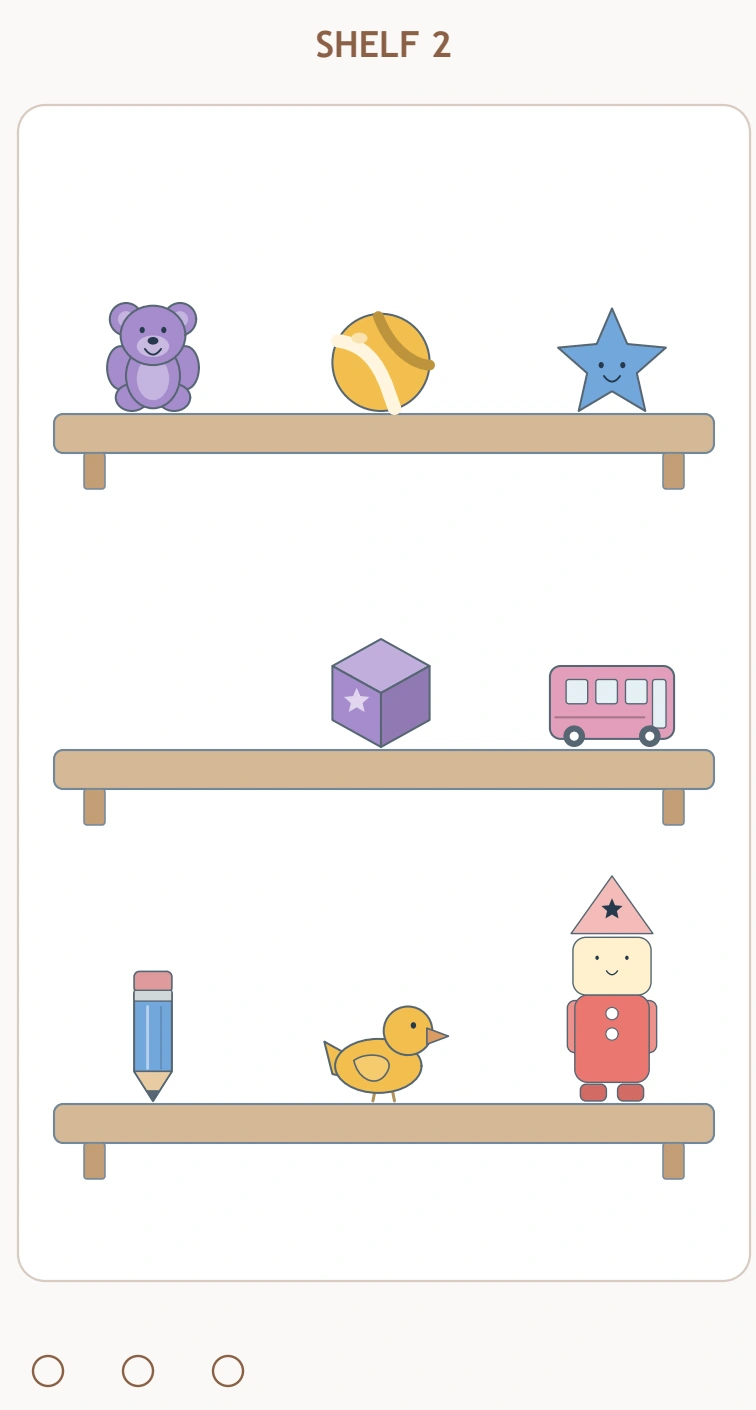
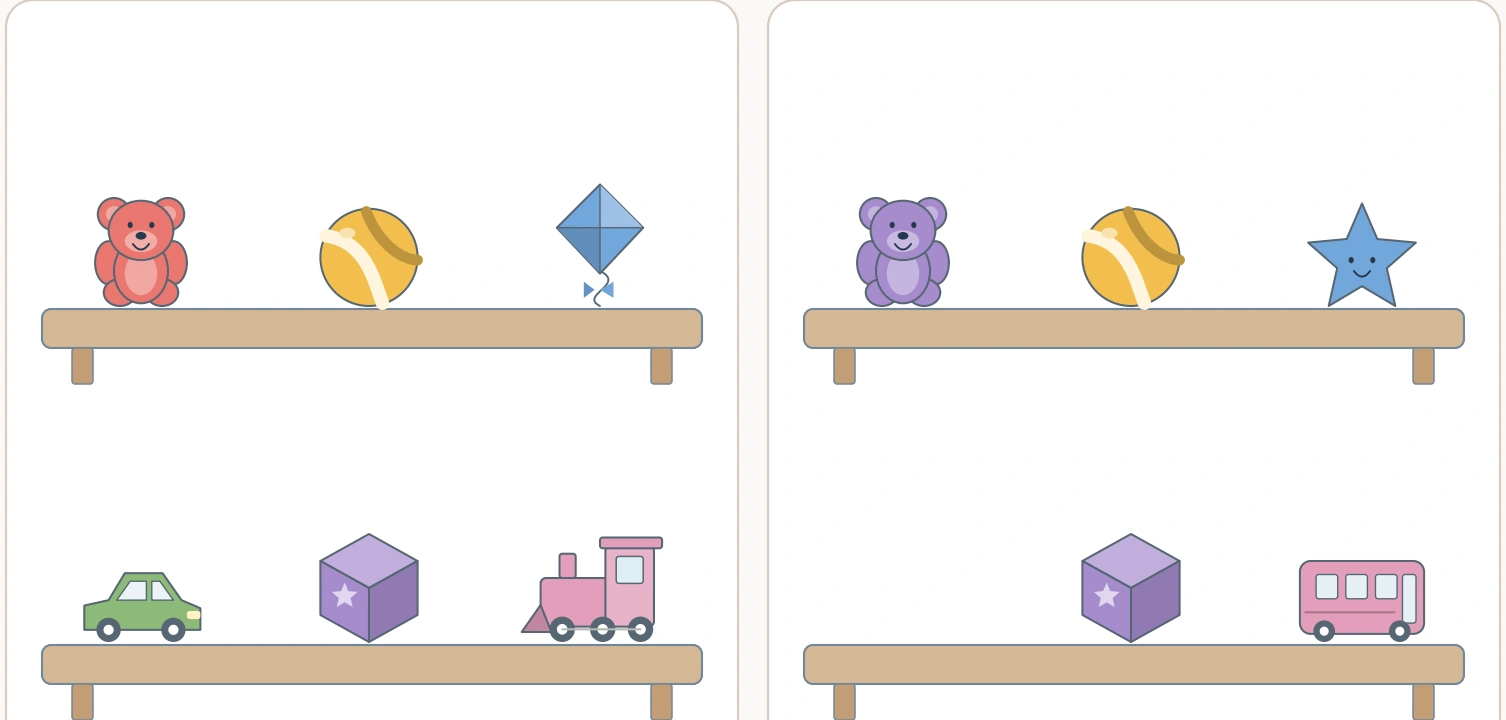
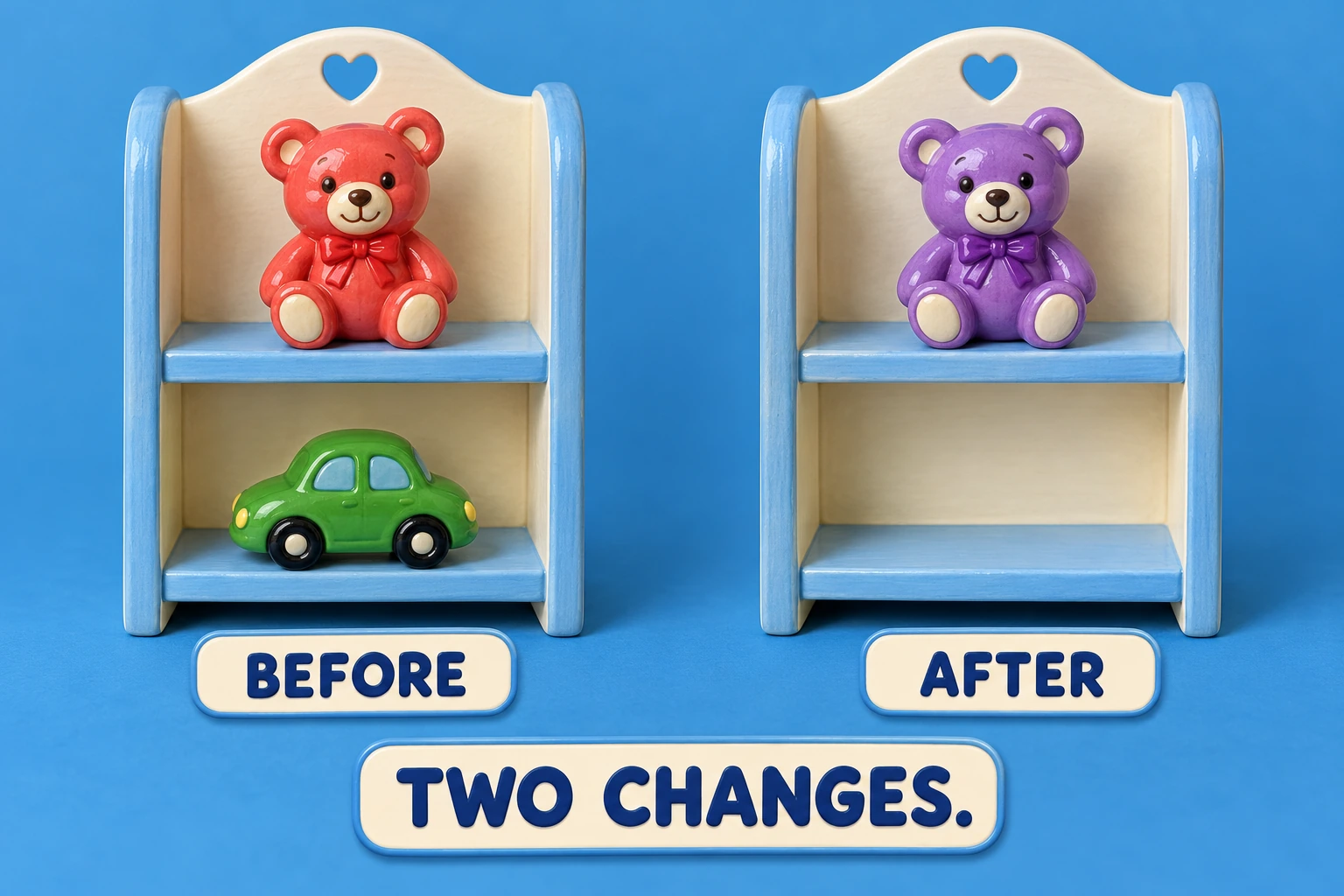
Start with the upper left position. A teddy sits there in both pictures, but its colour changes. Next, move to the neighbouring ball. Its identity, colour and place remain stable. That unchanged ball is useful evidence: the task is to find alterations, not to mark every pair encountered during the comparison.
The shelf levels provide a natural way to organise Toy Shelf Differences. An adult might say “top shelf, right end” rather than simply “over there.” These descriptions can be adjusted to the child's language. Pointing to corresponding positions is a valid first explanation before the child is comfortable using top, middle, bottom, left and right together.
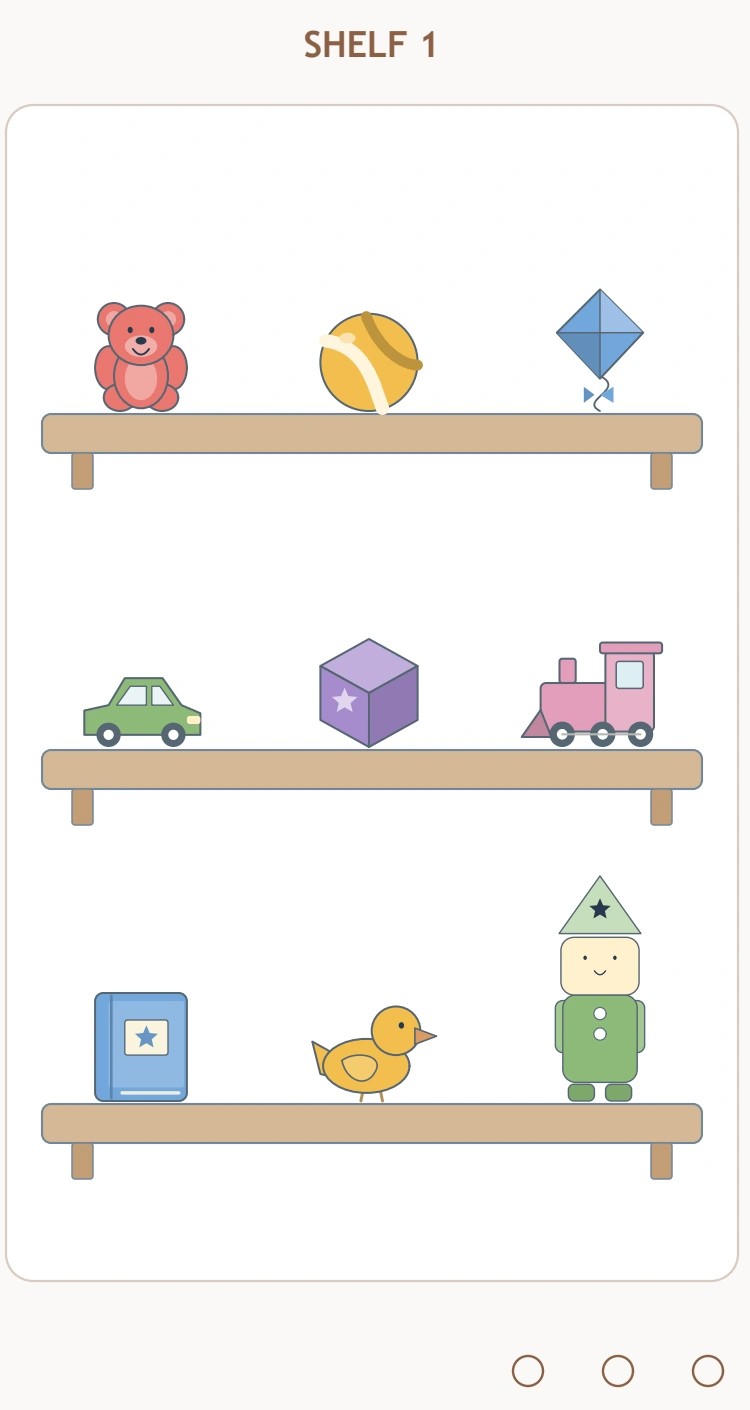
A private map of the six changes: Toy Shelf Differences
| Position | What Shelf 1 shows | What changes on Shelf 2 |
|---|---|---|
| Top left | Coral-red teddy | The teddy becomes purple. |
| Top right | Kite | A star replaces the kite. |
| Middle left | Car | The car is absent. |
| Middle right | Train | A bus appears in its place. |
| Bottom left | Book | A pencil replaces the book. |
| Bottom right | Green robot | The robot becomes coral red. |
This Toy Shelf Differences reference is intended for the adult checking a discovery. Allow a genuine search before supplying these locations. A child can find the bottom pencil before the top teddy; the worksheet does not require an order of discovery. The important relationship is between a marked place on the right and a change that can be demonstrated across the pair.
Why a replacement counts once: Toy Shelf Differences
A kite disappearing and a star appearing describe one changed location, not two separate answers. The same applies to the train-to-bus and book-to-pencil substitutions. Counting the old and new object names separately would inflate the six changes in Toy Shelf Differences. Refer back to their shared place when explaining how to count the discoveries.
The missing car needs an explanation too: Toy Shelf Differences
The middle-left place on SHELF 2 contains no replacement toy. A child may hesitate because circling an empty region feels unlike circling a purple bear. Ask where the car stood on SHELF 1 and which position corresponds on the second display. The missing object's location can still be identified even though there is no new picture to outline.
For Toy Shelf Differences, a loose circle around the right-hand missing-car area is enough to record that discovery. Do not ask the child to draw the car back in as the answer; restoring an object would change the scene rather than identify its absence. A spoken explanation can clarify a broad or uneven circle.
Keep the comparison anchored: Toy Shelf Differences
If the child calls the middle block a change, compare its two appearances deliberately. Check shape, colour and position before deciding. An unchanged object need not be ignored during the search; it can become an anchor that confirms which row and place are being inspected.
Begin with support, then release the decision
Read the Toy Shelf Differences direction together: circle six changes on the shelf on the right. Point out the right-hand response area before starting. Demonstrate a comparison using the unchanged ball so that the adult has modelled a method without immediately giving away a correct altered location.
Invite Bram to choose a place to investigate next. He can point between the corresponding toys, say what stayed or changed and then make his own circle if a difference is supported. The six small circles below the display can help keep track of discoveries; they do not reveal which locations changed.
When Bram has several marks, review their reasons rather than announcing whether the total looks promising. Two overlapping marks might refer to the same replacement. One large circle might cover both a changed and unchanged object. Ask what each mark means, then let him clarify it. The explanation should guide the correction.
Seven useful learning observations: Toy Shelf Differences
A stable comparison frame: Toy Shelf Differences
Toy Shelf Differences encourages a child to keep one location in mind while looking across the two displays. Notice whether the shelf level and horizontal position remain consistent during the comparison. This is different from finding two similar-looking toys anywhere on the page.
Identity and colour separated
The teddy and robot retain their identities when recoloured. A child can say “same toy, different colour” rather than treating every altered feature as a wholly new object. The two examples in Toy Shelf Differences make that distinction visible.
Absence recognised as information
The car's empty place is meaningful because the other shelf supplies a reference. A child who explains the missing toy is using evidence about a relationship, not merely naming a picture directly in front of them.
Specific descriptive language
“The train became a bus” communicates more than “that one is different.” Offer the relevant toy name if it is unfamiliar, then leave the comparison to the learner. Vocabulary support should not be confused with solving Toy Shelf Differences for them.
Marks tied to reasons
A circle is most useful when another person can tell which location it records. Uneven marks are acceptable. Ask whether Bram can reconnect each circle with a stated change, keeping the reasoning separate from handwriting neatness.
A manageable review process
Checking the top, middle and bottom levels can prevent a frantic whole-page search. Some children prefer another systematic route. Observe whether their chosen method helps them revisit a place without counting it twice.
A comfortable change of mind
An initial guess about the ball can be revised after its two pictures are compared. Give attention to the evidence that prompted the revision. Toy Shelf Differences can support thoughtful uncertainty without making an incorrect first guess feel like a public failure.
A classroom exchange: describe before pointing: Toy Shelf Differences
Imagine a teacher pairing two learners with Toy Shelf Differences. The first describes one suspected change without touching the paper. The listener finds the corresponding place and explains what the left shelf showed. Only after they agree on the evidence does the finder circle the right-hand location.
This arrangement gives both partners something useful to do. The listener is not simply waiting for a turn with the pencil. They must interpret the location description and check the comparison. If the instruction is too demanding, let the finder point to a shelf level while the listener names the place within it.
The teacher might record a brief observation such as “needed the word middle, then independently compared the train and bus.” That is a description of support during a hypothetical task, not a standardised ability score. Partners can exchange roles after a discovery, keeping the discussion cooperative rather than competing to find the most differences.
At home: a toy-room report
Picture Bram noticing that the robot's head looks familiar even though its body colour has changed. His grandparent asks him to report the change as if he were telling someone how the toy room had been rearranged. Bram points to the bottom right on both displays and explains which feature differs.
They then inspect the missing-car place together. The grandparent gives the broad clue “middle shelf” only if Bram needs a starting region. He decides whether the relevant place is the left or right end. After explaining the absence, he records it on SHELF 2.
The Toy Shelf Differences conversation can pause when Bram has had enough comparing. On a later visit, the adult can ask him to explain one existing mark before looking for another. Reconnecting a mark with its reason gives the second session a purpose beyond merely completing what was left unfinished.
Four ways to investigate change with real objects
One swap on a tray: Toy Shelf Differences
Place a toy ball, block and car on a tray. Let the child inspect them, then replace the car with a bus while keeping the other positions stable. Talk about the substituted location. Begin with the before arrangement still available in a quick drawing if remembering it adds too much difficulty.
A colour-only report
Draw two simple bears with the same outline and position. Change only their colour. Ask which feature differs and which features remain. This isolates one kind of evidence used in Toy Shelf Differences, without requiring a second complicated shelf search.
The absent-object marker
Arrange three picture cards in a row, remove one and invite the child to place a counter where it stood. Explain that the counter records a missing location rather than replacing the absent picture's identity. Keep the original row visible in a photograph or drawing for direct comparison.
Build an unchanged anchor: Toy Shelf Differences
Create two small arrangements with an identical centre block and one altered outer object. Ask how the stable centre can help align the two displays. Let the child invent the next change and check whether the partner compares corresponding positions.
Readiness and the mistakes that deserve a second look: Toy Shelf Differences
For a learner of four, five or six, Toy Shelf Differences can provide a supported comparison session. A child may identify a colour alteration before being ready to describe a disappearance or replacement. Let those distinctions emerge through the pictures instead of demanding all the terminology before the task begins.
Common difficulties include marking the left-hand shelf, counting a replacement twice, circling every toy or assuming that a blank position cannot be an answer. Return to the printed right-hand instruction and compare one location. Avoid repeatedly asking for speed; careful observation is the relevant demand here.
For regular practice, invite a fresh kind of explanation: a colour report on one visit, a replacement report on another or a description of something unchanged. Bram can point or dictate while an adult writes a note. A clearer account of one place is a worthwhile reason to reopen Toy Shelf Differences even when all six changes are already familiar.
Keep the shelf printable complete: Toy Shelf Differences
Use the original-upload control to inspect the supplied Toy Shelf Differences sample. A separate premium control gives eligible active members the clean single-page PDF. The premium version excludes website watermark, domain lettering and embedded advertisements while retaining both displays and their six-change instruction.
After saving the file, preview the portrait page before printing. Neither toy shelf should be clipped at its outer edge. This activity also belongs to the $5 twenty-sheet Little Explorers collection, available through the related purchase page. The combined file is an optional way to store all supplied concepts together.
If comparison becomes the next interest: Toy Shelf Differences
After Toy Shelf Differences, explore Copycat Picture Checks beside Toy Shelf Differences, Picnic Change Detectives after Toy Shelf Differences, Space Change Search beyond Toy Shelf Differences. Keep each new instruction separate from Toy Shelf Differences.
Explore PBS Parents ideas for talk and literacy at four or consult NAEYC's family writing resource for additional adult-supported play. For Toy Shelf Differences, a well-located comparison, an honest revision and a clear explanation are useful things to notice.
Popular Worksheets
Printable resources families and teachers are downloading now.
 Free
 Free
 Free
 Free