
Teddy Tray Recall: 8 Wonderful Memory Discoveries
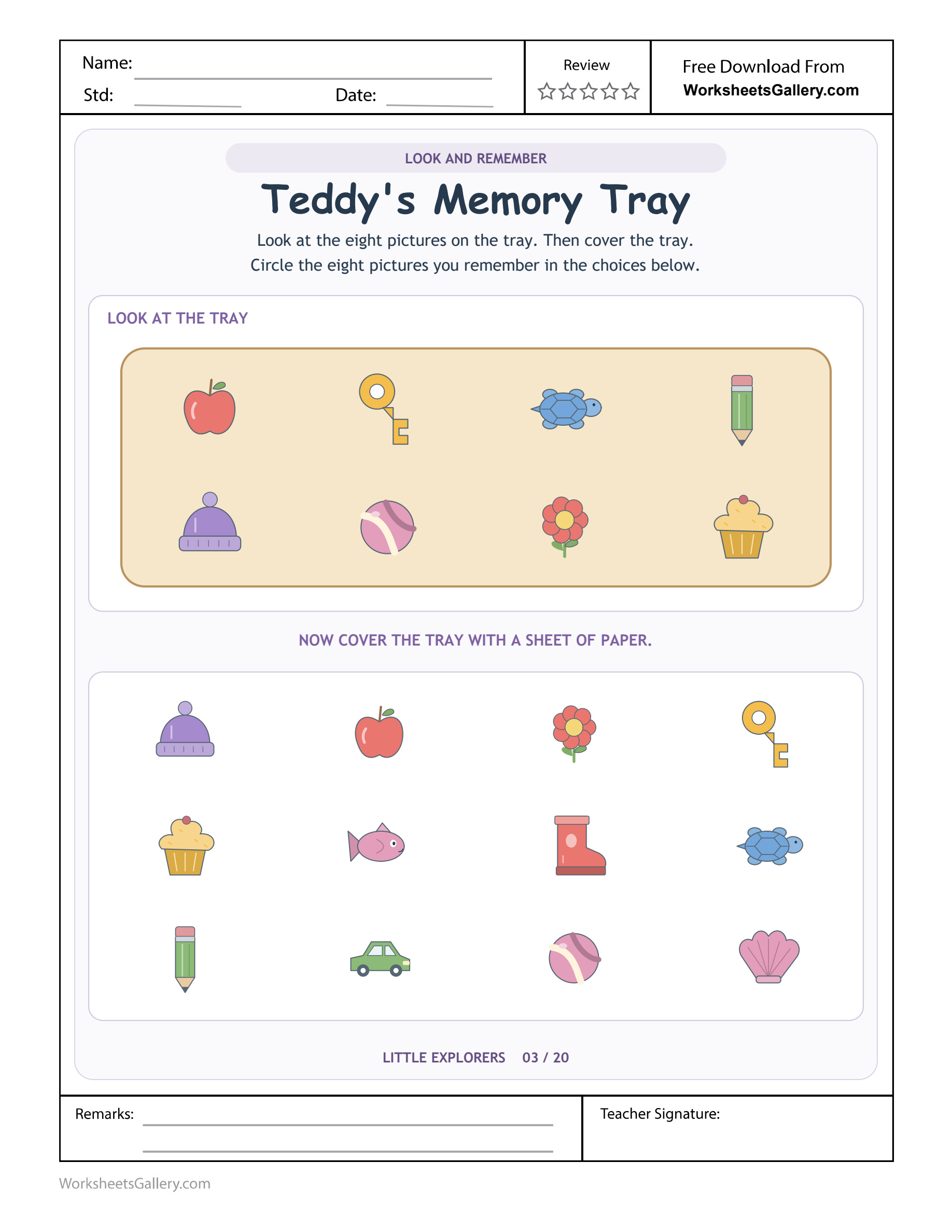
$5 collection companion: Teddy Tray Recall. Cover the reference tray before recognising eight remembered objects among twelve choices.
“I remember the hat, but was the fish there too?” That is the kind of uncertainty worth exploring with Teddy Tray Recall. Children look at eight objects on Teddy's tray, cover the reference with paper and circle the remembered pictures among twelve choices below. The page asks for recognition after looking, rather than a speeded search against an open model. A grown-up can help name unfamiliar objects and manage the cover. Leave room for a genuine attempt, a comfortable reveal and a conversation about what the child noticed while the tray was still visible.
Looking has a beginning and a stopping point — Teddy Tray Recall
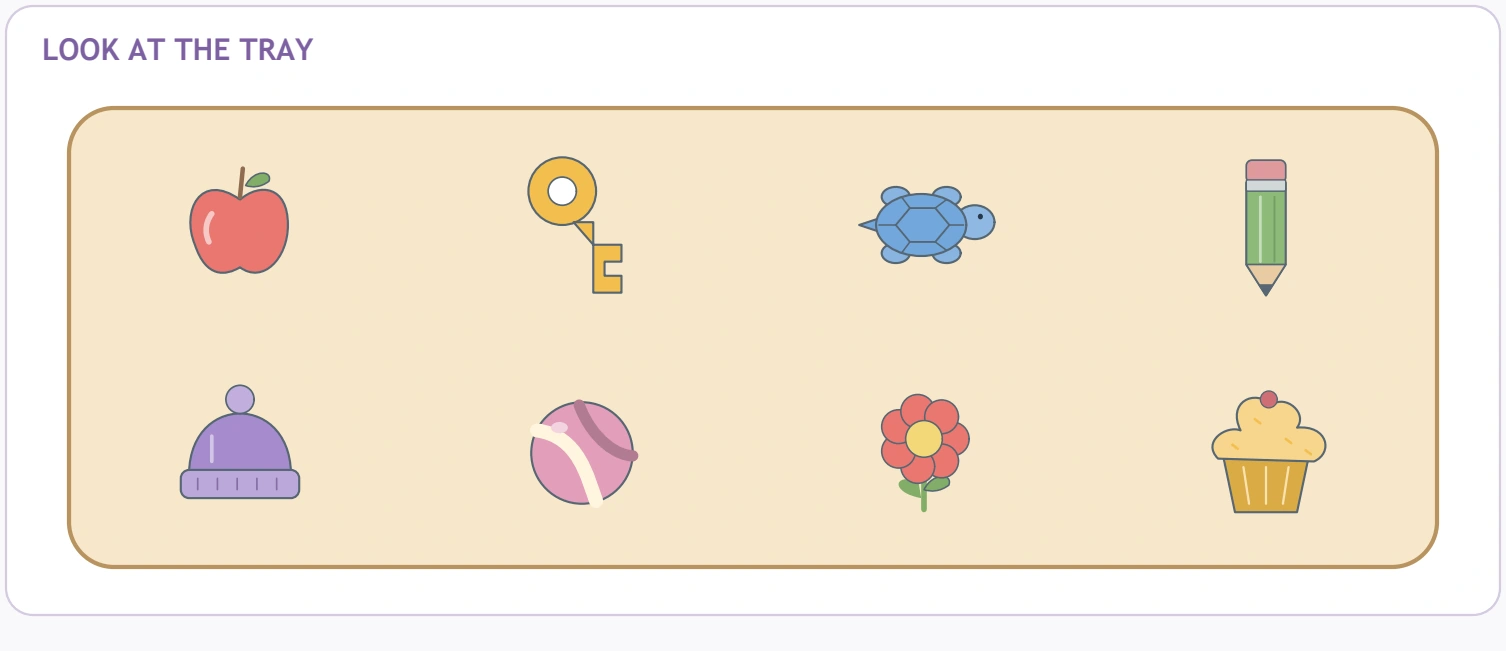
The upper part of Teddy Tray Recall contains a rounded tray with two rows of four pictures. Under that reference is a clear instruction to cover the tray. The lower panel then offers twelve possible objects. Preparing a piece of opaque paper before beginning makes this transition straightforward: the adult does not have to improvise a cover while accidentally pointing out remembered answers.
Agree that the child will have a comfortable opportunity to inspect the reference. The source does not demand a fixed number of seconds. An adult can invite a final look and ask whether the child is ready, without repeatedly delaying the cover until every item has been recited flawlessly.
In Teddy Tray Recall, the cover changes where the evidence comes from. Before covering, the child can compare a name with a visible drawing. Afterwards, the child decides whether an offered picture belonged to the earlier set. Keeping the tray open would make that second part a different, directly supported matching task.
Meet Teddy's eight objects: Teddy Tray Recall
The reference includes an apple, key, turtle, pencil, hat, ball, flower and cupcake. Establish these names in a relaxed way. If Celia calls the hat a beanie or the ball a beach ball, there is no need to reject an accurate familiar description. The useful agreement is about which picture that name identifies.
The Teddy Tray Recall tray is deliberately varied: something to wear, something to write with, a living creature and several familiar everyday objects. A child may organise those pictures in a personally useful way. They might point to the two things with stems, name the pencil and key together or remember where the turtle sat.
A grouping is an option, not a required trick: Teddy Tray Recall
You can model noticing a relationship without insisting that the child adopt an adult mnemonic. “I noticed a hat that could be worn” offers one way into Teddy Tray Recall. It is different from demanding a fixed chant that must be repeated before the activity counts as successful.
What the lower choices ask the child to do
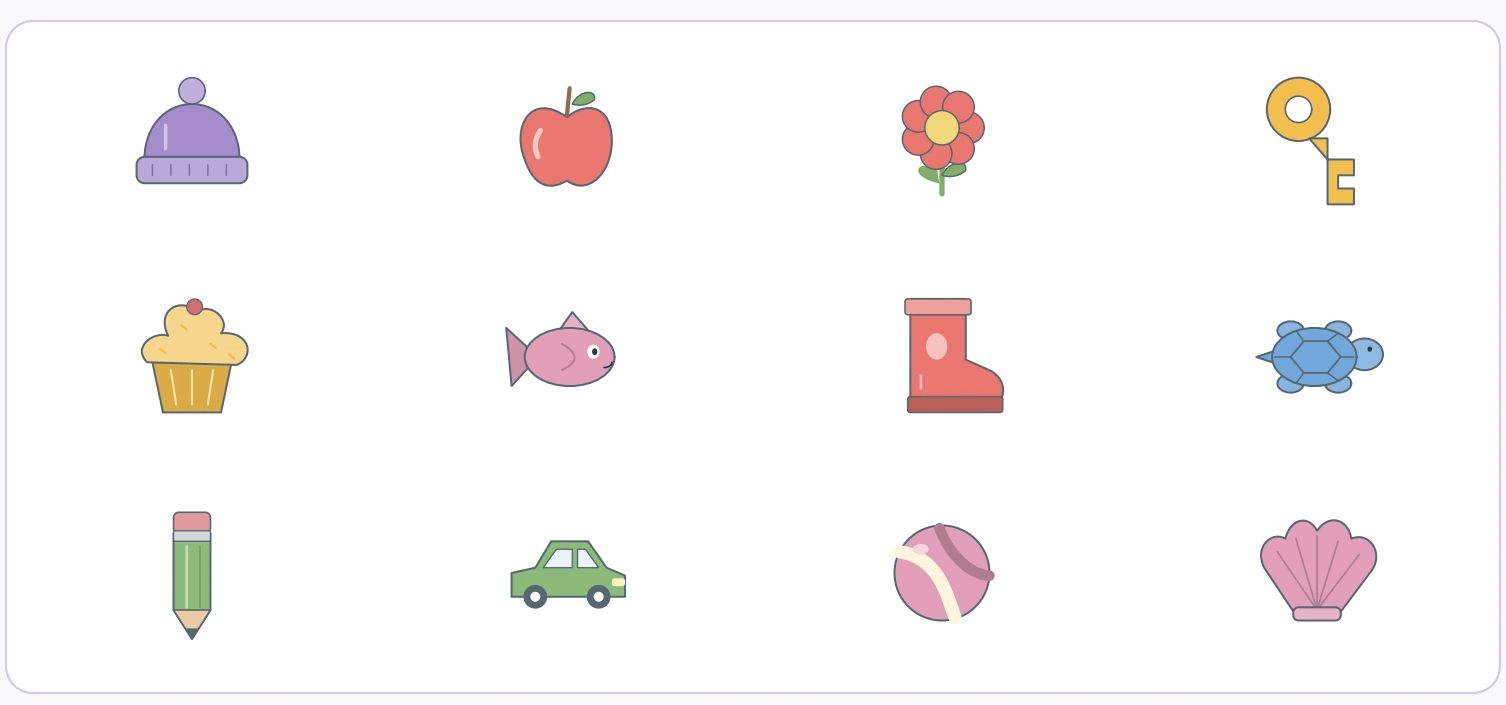
There are twelve pictures in the response panel, arranged in three rows of four. Eight belong to the earlier tray. The fish, boot, car and shell are distractors: they appear in the choices but were not among the reference objects. A familiar or attractive picture is not automatically a remembered tray member.
For Teddy Tray Recall, the child circles the pictures themselves. The adult reference numbers in the table below describe left-to-right, top-to-bottom positions; those numbers are not printed answer labels for the child to circle. A child can inspect the response panel in any comfortable order, provided the decision remains about membership in the covered set.
| Choice row | Pictures in that row | Remembered members |
|---|---|---|
| First | Hat, apple, flower, key | All four belonged to Teddy's tray. |
| Second | Cupcake, fish, boot, turtle | Cupcake and turtle belonged. |
| Third | Pencil, car, ball, shell | Pencil and ball belonged. |
Keep this Teddy Tray Recall checking table away from the child's view until the attempt is ready to discuss. The corresponding choice positions are 1, 2, 3, 4, 5, 8, 9 and 11. Use the objects' identities to verify a mark; a counting slip by the adult should not override a visibly correct picture choice.

A reveal that explains the attempt: Teddy Tray Recall
Once Celia has made the choices she wants to make, lift the cover. Invite her to compare one circled picture with the tray and then inspect an uncertain uncircled picture. Let the original reference settle the question. “You chose the fish; where would it be on the tray?” creates a clearer discussion than a quick announcement that a mark is wrong.
If Celia requests a peek during the attempt, decide openly how to proceed. The adult can offer another look and call the rest a supported matching visit. Alternatively, she may prefer to finish her first attempt and reveal afterwards. The point is to describe what happened honestly, not to protect a pretend perfect memory performance.
Do not add a new requirement to remember exact colours, positions or an ordered spoken list. Teddy Tray Recall asks which eight pictures were present. A child who remembers the turtle in a different tray position can still recognise its membership correctly. Additional position questions belong in a clearly separate extension.
Five aspects of the activity to observe
How inspection is organised: Teddy Tray Recall
Watch whether Celia gives attention to both tray rows or repeatedly revisits one favourite object. Teddy Tray Recall makes a useful distinction between noticing the whole reference and spending the looking time on one memorable drawing. A gentle invitation to inspect another region may be enough support.
How an object is named: Teddy Tray Recall
A shared name can connect the visible reference to a later choice. Listen for whether Celia is recalling an object or struggling to label an unfamiliar drawing. Naming help before the cover can reduce that extra difficulty without supplying the later selections.
How uncertainty is expressed
“Maybe the shell” and “I definitely remember the key” communicate different degrees of confidence. Teddy Tray Recall allows an adult to listen to those explanations without demanding certainty on command. Leave the final decision to the child when a genuine attempt is intended.
How a response is recorded: Teddy Tray Recall
A child can point, dictate or loosely circle a remembered member. Keep this recording demand separate from recognition. If pencil control is tiring, an adult can place small counters beside the chosen pictures, then discuss which objects those counters represent.
How the reference is used afterwards
During the reveal, notice whether Celia compares a disputed object with the actual tray rather than defending a guess because it has already been marked. Returning to evidence is a useful part of Teddy Tray Recall, even when the first choice needs changing.
At home, the child can operate the cover
Imagine Celia and her aunt placing Teddy Tray Recall on a low table with a sheet of paper ready. They name the turtle and cupcake together because those drawings prompted questions. Celia examines the rest of the tray, then slides the cover into place herself when she is ready for the choices.
Her aunt avoids hovering a finger above the remembered objects in the lower panel. When Celia wonders about the boot, the adult asks whether she wants to decide now or leave it uncertain until the reveal. That response preserves her thinking instead of converting uncertainty into an adult hint.
Afterwards, they compare the hat, flower and one missed picture. Celia may describe a relationship that helped her, or she may simply enjoy seeing the tray again. Save the sheet if she wants another discussion later. A future visit can explore how she looked, not merely whether she can reproduce yesterday's marked choices.
In class, distinguish helper roles from answer giving: Teddy Tray Recall
For a hypothetical paired session, one learner handles the cover while another inspects the tray and makes an attempt. The cover helper checks that the reference is fully hidden but does not name lower choices or tap the remembered pictures. This makes the helper's role useful without turning it into solving for a partner.
An adult can read the printed directions, agree on picture names and then observe. If a learner needs a smaller memory set, explain that you are adapting Teddy Tray Recall: for example, show only four selected reference pictures and the corresponding limited response choices. That adapted experience should not be presented as an unchanged eight-object attempt.
Switch roles only when both children understand the procedure. The learner who has already seen the reveal may know the answers on a repeated sheet, so a second turn is an opportunity to discuss strategy rather than a fresh blind attempt. Treat the exercise as supported play and conversation, without public rankings.

Six variations for remembering without pressure: Teddy Tray Recall
Give a tiny tray a shared name
Arrange three safe objects and invite the child to name the collection, such as “things for our pretend picnic.” Look together, cover it and offer a small set of picture choices. The reduced set is a separate game inspired by Teddy Tray Recall, not an invisible change to the printed instructions.
Tell a short object story: Teddy Tray Recall
Invent a sentence involving two tray items: a turtle finds a key, for example. Ask which objects appeared in the spoken sentence. Keep this oral story distinct from claiming that the worksheet itself contains a prescribed memory story.
Describe before revealing
After covering a small household display, invite one description without naming the object immediately. “Something we wear when it is cold” might suggest a hat. Let the listener identify the intended item, then reveal the objects to check the account.
Offer a trustworthy checker: Teddy Tray Recall
Place a drawn reference beside a closed box of two familiar objects. The child makes a choice, then opens the box to check. Practise the idea that checking can confirm or revise a decision. Neither result needs to be turned into a competitive score.
Compare two looking routes: Teddy Tray Recall
On separate small displays, try naming objects in rows and then try grouping them by a feature. Discuss which approach felt comfortable. There is no need to announce one universally superior method; the conversation can remain about what this learner noticed.
Become the tray designer: Teddy Tray Recall
Let Celia select a few objects for an adult to inspect and remember. She controls the cover and checks the adult's choices afterwards. This role reversal can make the procedure in Teddy Tray Recall more understandable while giving her a genuine reason to explain membership carefully.
Comfortable support and useful return visits
Adult-supported children around four to six may enjoy Teddy Tray Recall, with adjustments to language, looking time and the way responses are recorded. A child who wants to point can still make meaningful choices. A child who needs objects named first can receive that help before the cover is applied.
Common problems include covering part of the choice panel, leaving the reference visible, treating every familiar picture as a tray member or quietly changing the rules to remember order as well. Revisit the printed sequence of looking, covering and choosing. Pause if the task is tiring rather than extending the looking period into repeated demands for flawless recitation.
For another visit, ask Celia what she would like to notice during the looking phase. The familiar eight-object set may no longer provide a new memory attempt, but it can still support discussion of grouping, naming and evidence. Keep a separate household game available if she wants a genuinely fresh collection to inspect.

Saving Teddy's printable tray
The clean Teddy Tray Recall single-sheet PDF is supplied through the premium membership control for an eligible active plan. Its website watermark and domain text are removed, with advertisements absent from the PDF. Choose the independent original sample control if you want the uploaded edition for inspection.
Preview the saved portrait document before printing. Both tray rows, the cover instruction and all twelve choices should fit on the paper. The related Little Explorers purchase brings this page and the other nineteen supplied activities together for $5 USD. Its combined clean PDF has its own purchase access.
More possibilities after a remembered set: Teddy Tray Recall
After Teddy Tray Recall, explore Picture Group Clues beside Teddy Tray Recall, Garden Hidden Pictures after Teddy Tray Recall, Toy Half Partners beyond Teddy Tray Recall. Keep each new instruction separate from Teddy Tray Recall.
For additional ways to talk through play, browse PBS Parents' age-four literacy suggestions and NAEYC guidance on purposeful early writing at home. In Teddy Tray Recall, appreciate a careful look, an honest uncertainty and the willingness to check the remembered set after the cover is lifted.
Popular Worksheets
Printable resources families and teachers are downloading now.
 Free
 Free
 Free
 Free