
Exact Path Detective: 12 Clever Turn Comparisons
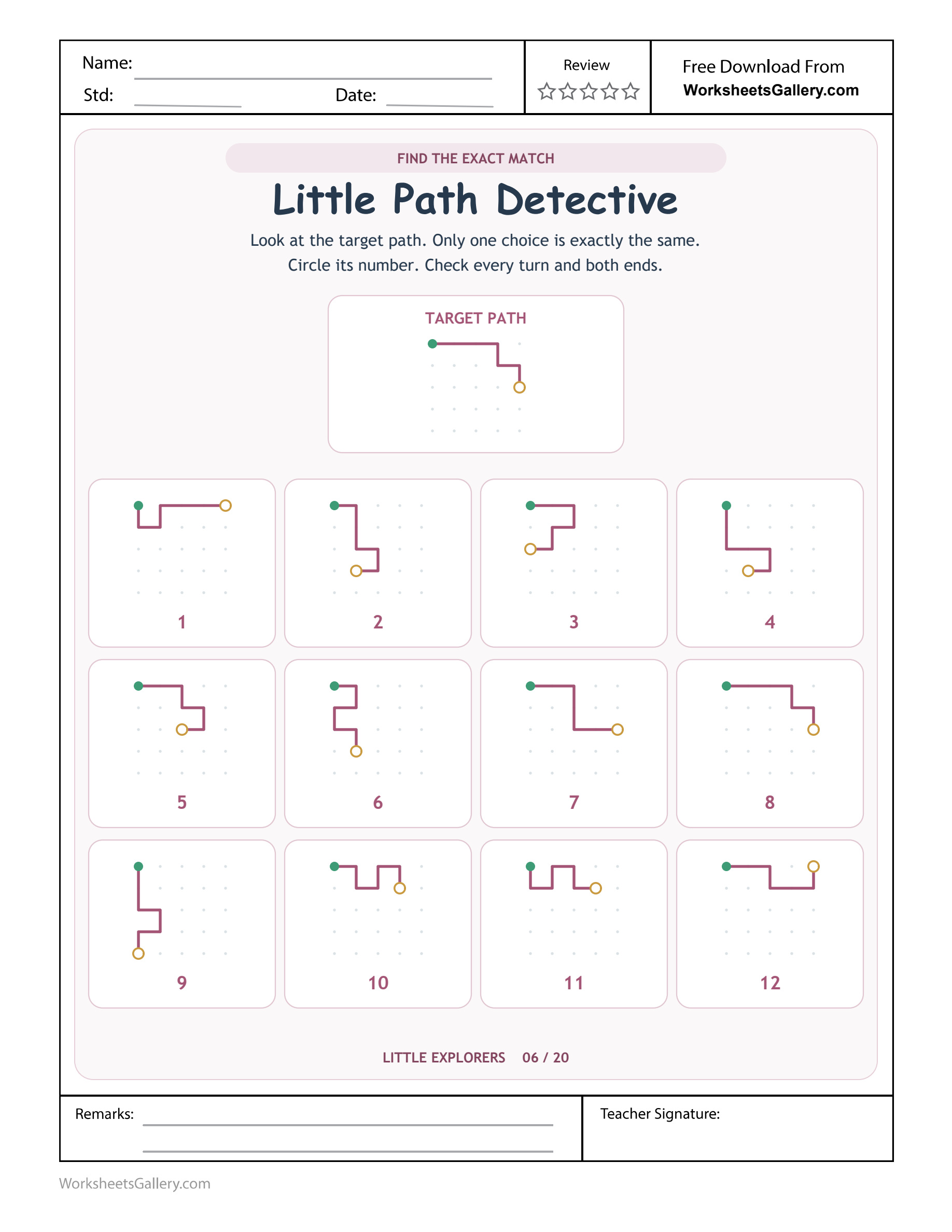
$5 collection companion: Exact Path Detective. Compare every segment and endpoint of a target path against twelve alternatives.
Several little paths look convincing until one bend or endpoint gives them away. Exact Path Detective asks children to inspect a target route and choose its exact counterpart from twelve numbered alternatives. A green dot marks the beginning and a gold ring marks the other end. The challenge is comparison, not finding a way through a maze or inventing a new route. With adult support, preschool and kindergarten learners can name directions, check one section at a time and circle the number beneath the candidate whose whole arrangement agrees with the model above.
Begin with the two ends — Exact Path Detective
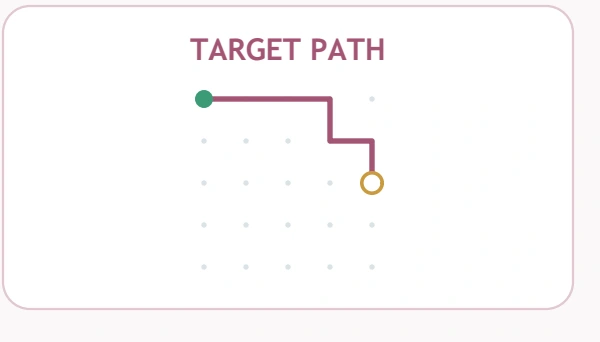
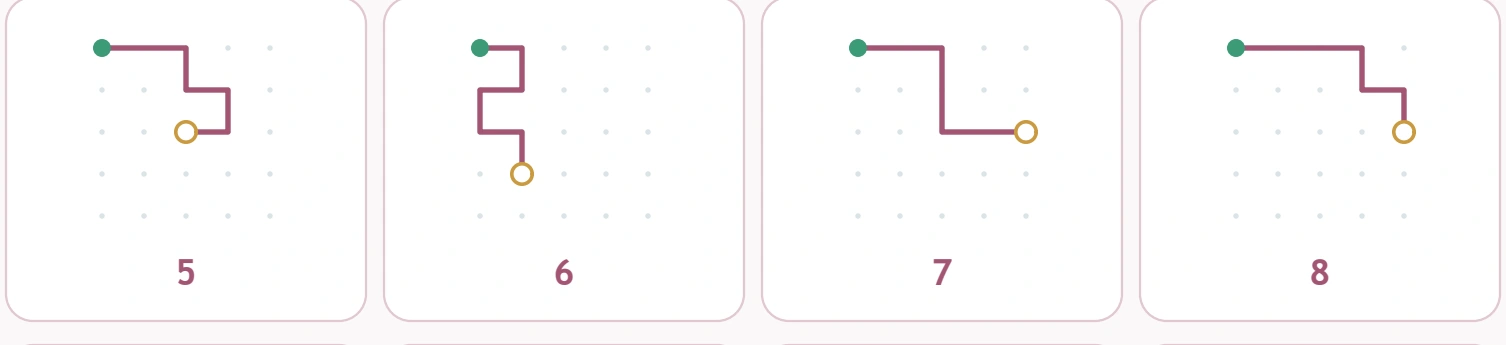
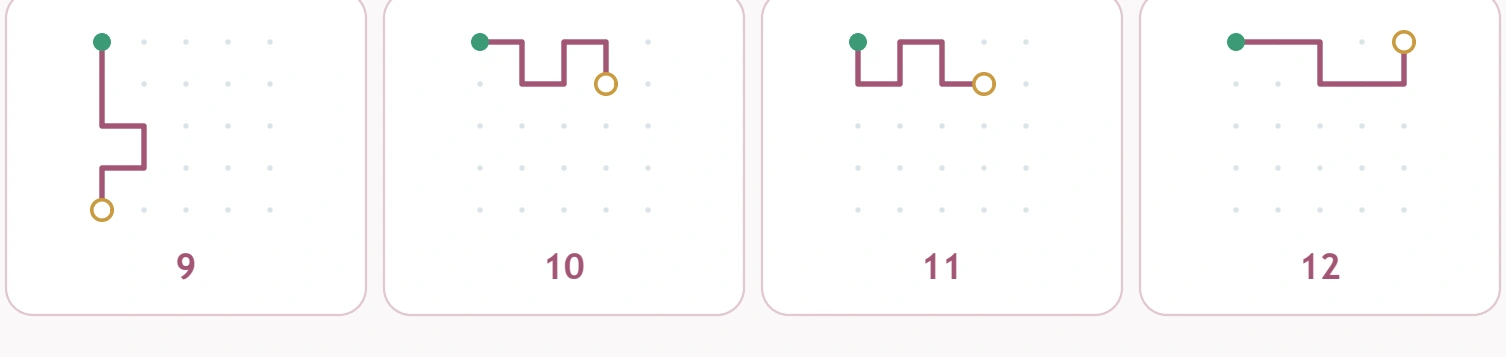
The top reference is labelled TARGET PATH. Below it are three rows of four alternatives. In Exact Path Detective, the green start and gold finish give the child consistent places from which to inspect the model and a candidate. Without those anchors, a vaguely similar zigzag may seem close enough.
Ask Faris to point to the green dot on the target and then to the green dot on a chosen alternative. Follow the route away from that start with a finger. The direction sequence matters, but so do the lengths of its straight runs and the relative position of its finish. Matching just the opening movement is not sufficient.
The path can occupy a different place on the sheet while still matching the target shape. Exact Path Detective is comparing the route within each little panel, not asking the child to place every candidate at the target's absolute page coordinates. Look at the arrangement of turns and endpoints inside the frame.
What counts as exact in this puzzle: Exact Path Detective
| Feature | Comparison to make | Why it matters |
|---|---|---|
| Opening run | Check its direction and relative length from the green start. | A matching first move alone cannot prove the rest of a route. |
| Internal bends | Follow each change of direction in sequence. | An added or reversed turn changes the shape. |
| Straight-run spacing | Use the faint dot field to inspect how far a run extends. | Similar turns can connect different distances. |
| Gold endpoint | Confirm its position relative to the final bend. | A nearly matching route may finish somewhere else. |
These checks describe Exact Path Detective's visual demand. The child does not need to write a direction code or supply a technical description of every segment. A finger demonstration and a short explanation such as “this one turns the other way at the end” can show the relevant observation.
Orientation remains part of the picture: Exact Path Detective
A turned-over or rotated version is not an exact visual match in this task. Keep the printed page orientation stable while comparing. If Faris rotates a loose homemade path in a later game, discuss that as a different investigation rather than quietly changing what the supplied worksheet asks.
Work through candidates without chasing guesses
Read the Exact Path Detective instruction aloud and point out where the response number belongs. Let Faris choose a candidate to inspect. He can look back at the target as often as needed; the reference is not meant to be memorised and hidden.
If a candidate disagrees at a clear turn, name that point of disagreement and move on. There is no requirement to continue counting every later dot once the route has already failed the exact-match test. Conversely, when several early features agree, keep checking rather than accepting the resemblance too soon.
The matching candidate is number 8, in the second row at the right. Keep that adult reference private during an initial attempt. When Faris chooses it, ask him to demonstrate the whole correspondence. A circled 8 can be supported by a careful comparison or produced by a lucky guess; the visible explanation helps distinguish those possibilities.
A useful wrong candidate can reveal the method
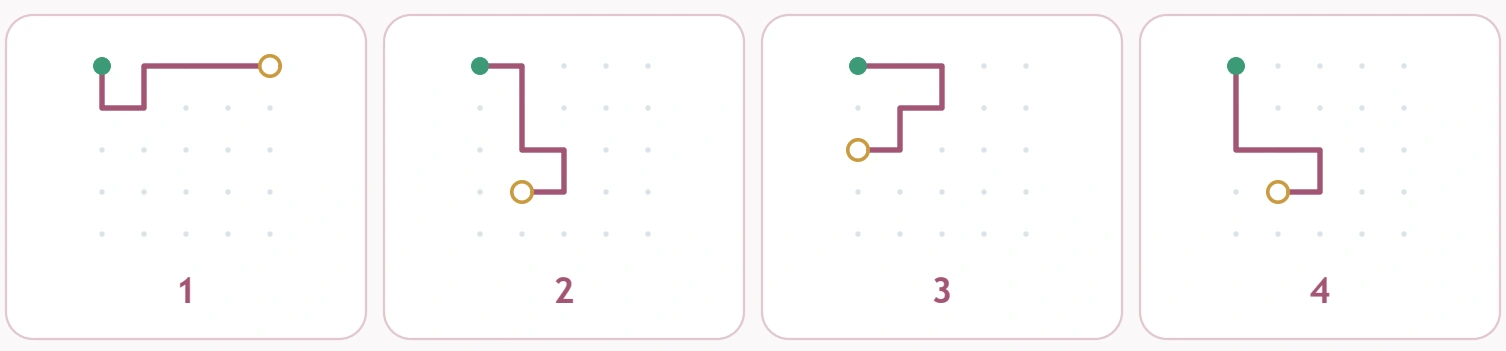
Suppose Faris likes a route whose first horizontal run resembles the target. Ask where its next bend leads. Then compare that same stage in the reference. A candidate can be rejected for one observable mismatch without the adult announcing a whole list of deficiencies.
For Exact Path Detective, the question “Where did they stop agreeing?” is often more useful than “Are you sure?” It points attention toward evidence. Repeatedly asking for certainty can encourage the child to change a reasonable answer simply because an adult sounds doubtful.
Similarity is the start of inspection
Noticing a similar opening is worthwhile. It has identified a candidate worth checking. The next step is to test the remaining route. This keeps comparison constructive: the child is refining a promising observation, not being told that the initial resemblance was a foolish thing to notice.
Six ways this investigation makes thinking visible
Tracking a stable reference: Exact Path Detective
Exact Path Detective keeps one model available above a field of alternatives. Notice whether Faris returns to the target when a detail becomes uncertain. Consulting the reference is an appropriate checking strategy rather than a sign that the child should have memorised it already.
Separating overall shape from a local feature: Exact Path Detective
A candidate may share the target's general stepped appearance while containing a different bend. Ask about one specific section. This helps the child move between an initial whole-picture impression and the details that establish an exact match.
Describing movement in order: Exact Path Detective
Words such as right, down and next can accompany a finger route. A child can also demonstrate without those words and hear the adult name the movement. Exact Path Detective gives the language a visible purpose rather than presenting direction vocabulary in isolation.
Monitoring relative distance: Exact Path Detective
The faint background dots can make the lengths of straight runs easier to compare. They are reference points, not extra destinations to join arbitrarily. Notice whether Faris uses them to inspect spacing when two turns look similar.
Making a deliberate response mark: Exact Path Detective
The source asks for the candidate's number to be circled. A child might instead circle a whole path or trace it heavily. Clarify the response location while keeping any correct comparison intact. Recording instructions and spatial reasoning are separate parts of the attempt.
Revising with a stated reason
A change from one candidate to another can be thoughtful if the child points out the mismatch that prompted it. Give that explanation attention. The value of Exact Path Detective is not limited to an immediately correct first selection.
A classroom conversation at the comparison table: Exact Path Detective
Imagine a teacher placing Exact Path Detective between Faris and a partner. Faris selects a candidate, while the partner points to the corresponding stage of the target. They take turns saying or showing what agrees before discussing any disagreement.
The teacher listens for whether they compare the same part of each route. If Faris is at the final bend while the partner is still checking the opening run, their descriptions may sound contradictory even though they are looking at different stages. A shared starting point can resolve that confusion.
After they choose an answer, the adult asks one learner to show why a different candidate fails. This is an optional discussion, not an additional marked problem on the sheet. The pair's explanations can reveal a clearer comparison method than their speed at reaching number 8.
A home conversation with cord models: Exact Path Detective
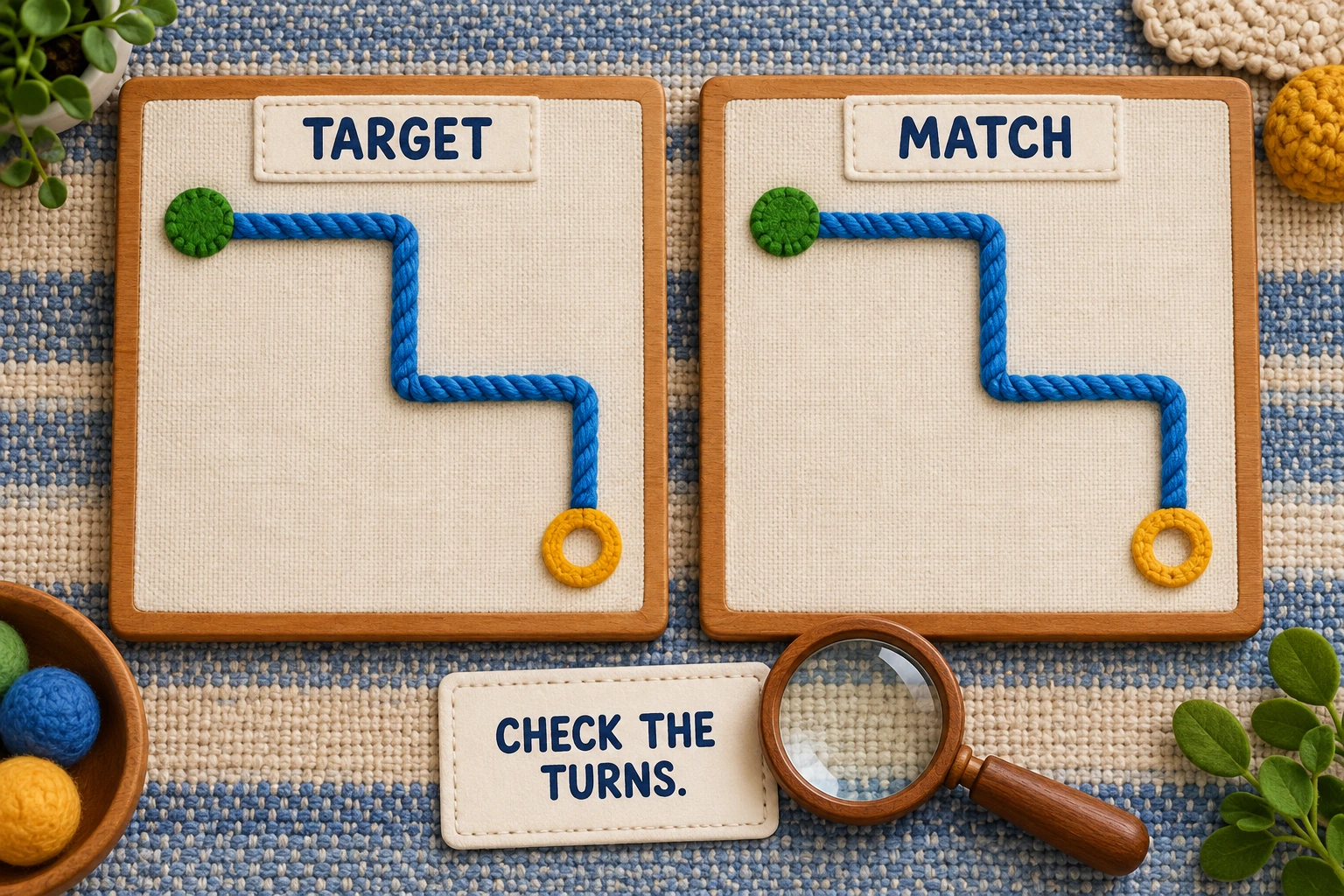
In an imagined home activity, Faris's grandparent makes two simple stepped routes from cord on separate mats. Both have visible starts and finishes. Before opening Exact Path Detective, they compare one turn and discuss whether the cord arrangements agree.
On the worksheet, Faris decides to inspect the middle row first. His grandparent follows that choice rather than insisting on a left-to-right elimination routine. They return to the target whenever the relative length of a run seems uncertain.
If Faris begins tracing the whole candidate field instead of selecting one number, the adult rereads the response instruction. The cord example has offered a way to think about shape; it does not change the printed task into a tracing exercise. A later visit can revisit one useful comparison without requiring another full-page search.
Four extensions for a child who enjoys the turns
A single-bend alteration: Exact Path Detective
Draw two short paths on a separate sheet and change one bend in the second. Ask a partner to point to the first place they disagree. Start with a small clear difference, then let the child design a pair for the adult.
A direction narrator: Exact Path Detective
One person follows a simple visible route with a finger and names each movement. The listener points to the same section on a matching model. Keep both models open so that this remains a comparison game rather than a hidden-instruction memory challenge.
An endpoint inspector
Make two routes with matching openings but different finishing positions. Invite the child to compare the gold-ring equivalents after checking the earlier sections. Discuss why knowing the beginning does not determine whether the entire path matches.
A turn-and-rotation discussion
Create one path on a small card and turn the card. Ask what stayed the same about the card's drawing and what changed about its orientation on the table. Explain that Exact Path Detective keeps orientation fixed when asking for an exact printed counterpart.
Support that leaves the comparison intact: Exact Path Detective
Many adult-supported learners in the four-to-six range can investigate Exact Path Detective, with substantial differences in how much of the candidate field feels manageable. A temporary paper window can show one response row at a time while leaving the target visible. Explain that the other rows will be inspected too rather than presenting the reduced view as the entire puzzle.
Common mistakes include accepting the first matching segment, ignoring an endpoint, rotating the page to make a candidate seem right or treating the alternatives as a maze to navigate. Return to the model and one chosen feature. A child who can explain a mismatch may be reasoning effectively even before locating the matching choice.
Invite another visit by asking Faris which feature he would inspect first now. He may remember number 8, so a new conversation can focus on proving its match or explaining one distractor. Keep the aim specific and manageable. A short, well-supported comparison can preserve more enthusiasm than repeatedly demanding a full elimination tour.
Obtain the path page and inspect its print boundaries: Exact Path Detective
The premium Exact Path Detective control gives members on an eligible active plan the clean PDF. Domain text and website watermark have been removed, and the printable carries no embedded ads. A distinct original-sample control retains the supplied uploaded version for previewing.
When the file is saved, check its portrait print view for the target, all twelve numbered choices and both endpoint markers. Keep faint guide dots visible rather than shrinking the activity excessively. The related $5 Little Explorers purchase includes this page with nineteen other concepts in a single clean PDF, through the bundle's separate purchase access.
Where a precise comparison might lead: Exact Path Detective
After Exact Path Detective, explore Shape Twin Comparisons beside Exact Path Detective, Rainbow Corner Match after Exact Path Detective, Turtle Pond Maze beyond Exact Path Detective. Keep each new instruction separate from Exact Path Detective.
For further adult play ideas, consult NAEYC's discussion of supporting early writing experiences or try PBS Parents resources for language-rich activities. Let Exact Path Detective remain a place for a specific comparison, an explainable decision and a careful final check of the complete route.
Popular Worksheets
Printable resources families and teachers are downloading now.
 Free
 Free
 Free
 Free