
Number Letter Switching: 12 Brilliant Trail Stops
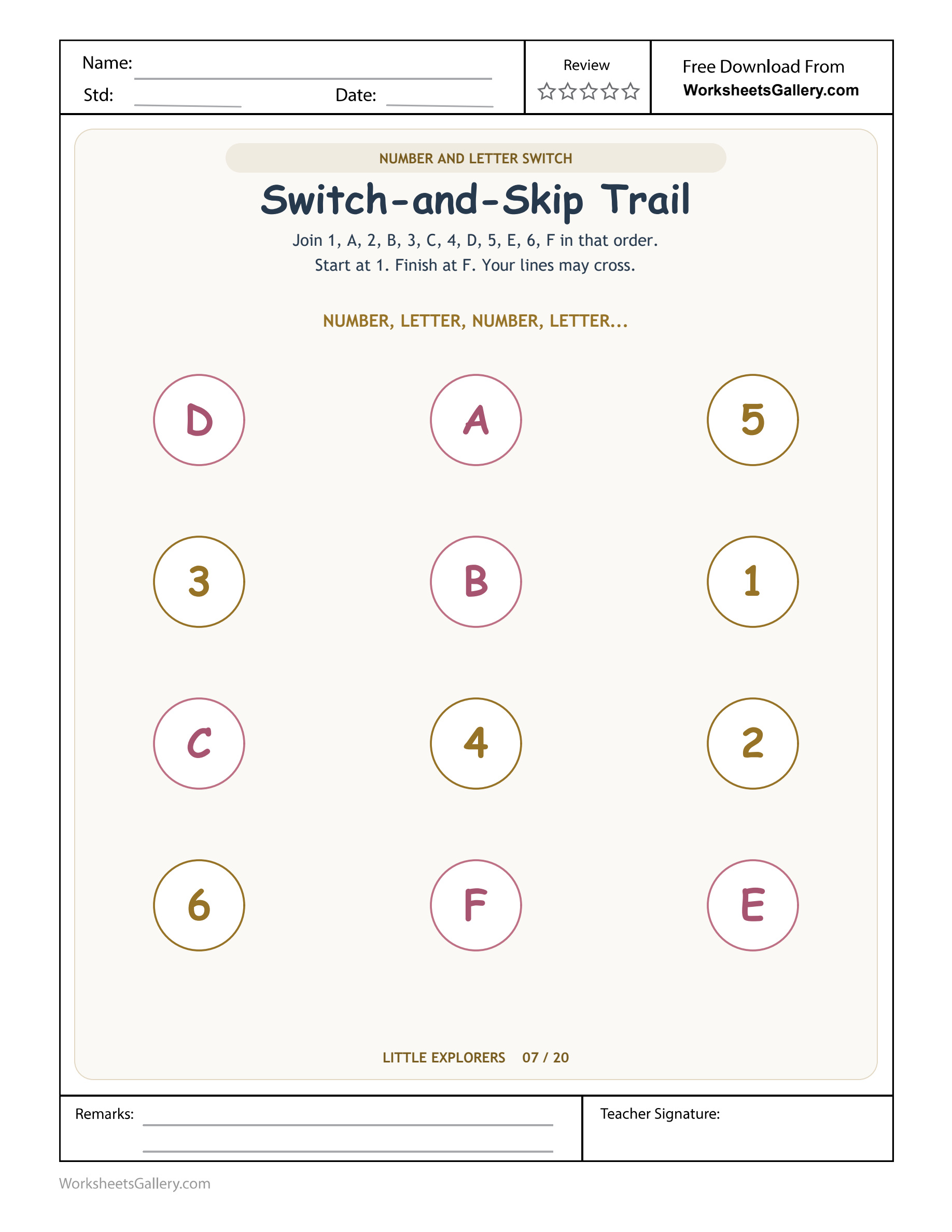
$5 collection companion: Number Letter Switching. Alternate two ordered streams from 1 and A through 6 and F; crossing lines are permitted.
One comes first, but two must wait for A. In Number Letter Switching, children alternate a number sequence with a capital-letter sequence: 1, A, 2, B and onward until 6, F. The printed symbols are scattered across twelve circles, so their positions do not supply the joining order. This adult-supported activity combines recognition, sequence tracking and deliberate line drawing. Crossing lines are allowed by the source instruction. A child can rehearse the next symbol with a finger before recording it, keeping attention on which kind of symbol should come next as well as its identity.
Hear the two sequences before mixing them — Number Letter Switching
Invite Greta to count one through six, then name A through F separately. These are the two familiar streams inside Number Letter Switching. The joining rule alternates between them while preserving the order within each stream. After A, the next number is 2; after 2, the next letter is B.
The word switch describes a change in symbol type. It does not mean skipping a numeral or jumping ahead through the alphabet. A child who joins 1, A, B has kept moving forward among letters but has forgotten the switch back to the number stream. Name the type needed next before asking for the exact symbol.
For Number Letter Switching, an adult might say “number, letter” while Greta supplies the identities. That is procedural support, so notice it honestly when discussing the attempt. As the rule becomes clearer, pause and let her indicate which stream is due without a prompt.
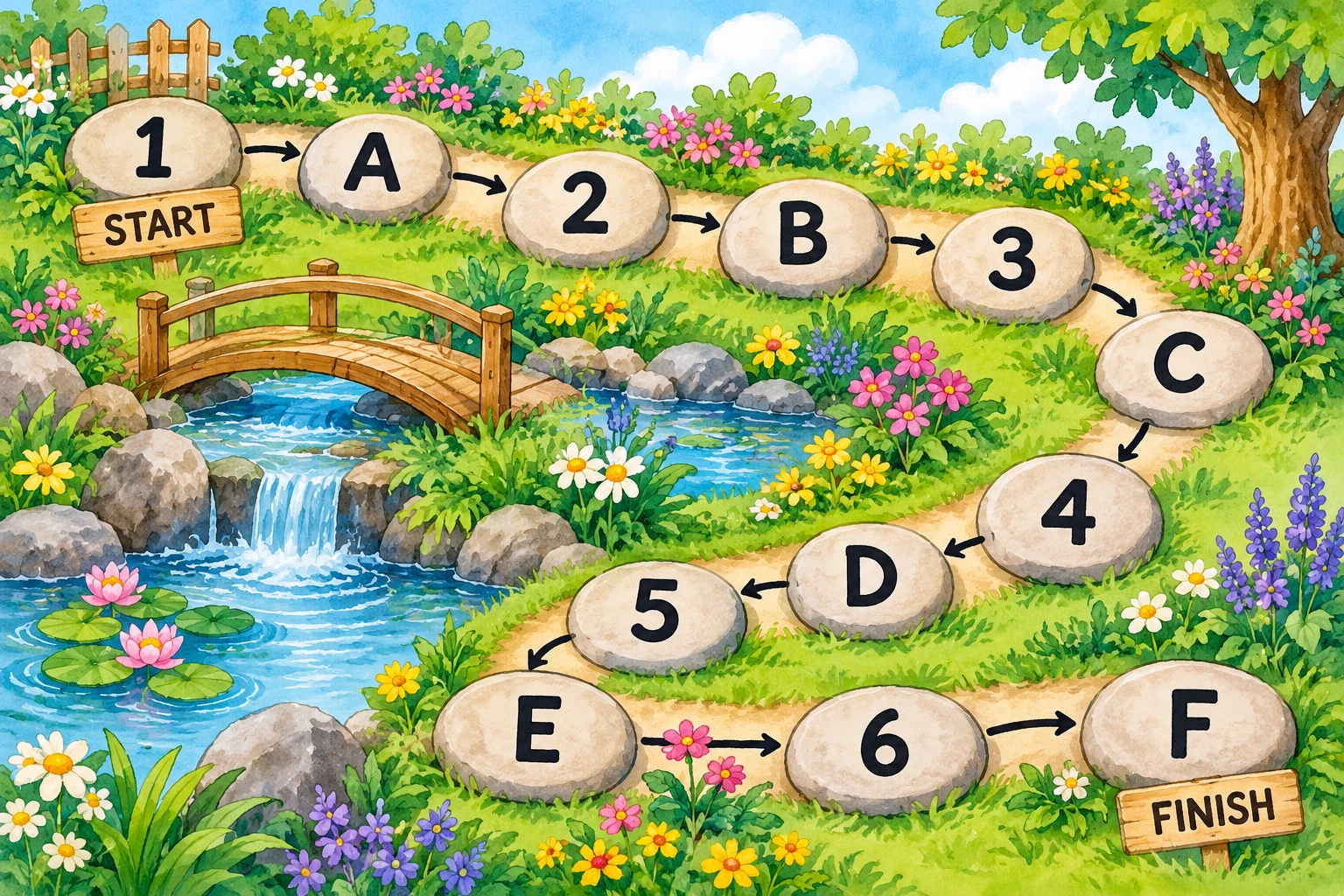
The complete joining order: Number Letter Switching
| Number turn | Letter turn | What happens afterwards |
|---|---|---|
| 1 | A | Return to the number stream at 2. |
| 2 | B | Resume counting at 3. |
| 3 | C | The next number is 4. |
| 4 | D | The next pair begins with 5. |
| 5 | E | Find 6 before looking for the final letter. |
| 6 | F | Stop at the specified finishing symbol. |
Read across each row of this Number Letter Switching table to hear the combined sequence. The printed worksheet states the same order. The child joins the circles on that sheet rather than writing the table again. There are twelve stops, from 1 to F, and eleven connections between consecutive stops.
Why the top row is not the beginning
The highest printed circles contain D, A and 5. Starting at the page's upper left would therefore start at D, which contradicts the given instruction. Find the circle containing 1 before drawing. The required order in Number Letter Switching comes from the number-letter rule rather than from reading the display row by row.

Locate, point, then join
Before each pencil connection, ask Greta to point to the current circle and the next intended destination. This lets her explain the choice before the new line makes the page busier. Once she has located the destination, she can join it without having to search while the pencil is already moving.
Look back at the printed sequence whenever needed. Number Letter Switching supplies that instruction openly; the child is not being asked to memorise a hidden twelve-item list. An adult can read the next part aloud if the language is unfamiliar, leaving the symbol search and line connection to the learner.
Crossings do not cancel a correct sequence
The source explicitly permits crossing lines. A correct connection may pass over an earlier mark because the circle positions are scattered. Do not introduce a no-crossing rule borrowed from a maze or another trail. In Number Letter Switching, a crossing is not automatically evidence of a wrong choice.
Pause at each circle to decide what follows. A crossing point between circles is not a new labelled stop. Continue along the intended connection rather than turning onto an older line just because the marks meet visually.
At home, separate the rule from the pencil work: Number Letter Switching
Imagine Greta explaining Number Letter Switching to her uncle. She points from 1 toward A and says that a letter comes after the first number. Before drawing, they inspect the next number circle together and agree that its identity is 2, even though it is not beside A on the paper.
As more lines appear, Greta chooses to rehearse one connection with a finger. Her uncle asks which stream is due next, then waits for her answer. He does not redirect a crossing line merely to make the page look tidier. The route can be visually busy while its sequence remains correct.
If Greta wants a pause after reaching C, they note the current stop and look at the next required number before setting the page aside. On returning, she can re-establish that place from the printed rule. Stopping midway need not turn the activity into guessing where an unexplained line happened to end.
In class, give the partner a rule-checking job: Number Letter Switching
For a hypothetical paired activity, one learner points to the next destination while a partner says whether the number or letter stream is due. They then check the identity against the printed sequence before a connection is drawn. Switch roles after a few stops so that both children participate in the decisions.
An adult can listen for two different difficulties: finding the next number or letter, and remembering to change stream. A learner who knows that C follows B may still need help deciding when another letter should be used. Number Letter Switching makes that distinction visible through the alternation.
Keep the whole activity available when pairs review their lines. They can point through the sequence and name the labelled circles reached. Avoid judging the route by whether it resembles a neat geometric shape; no particular finished outline is promised by the worksheet.
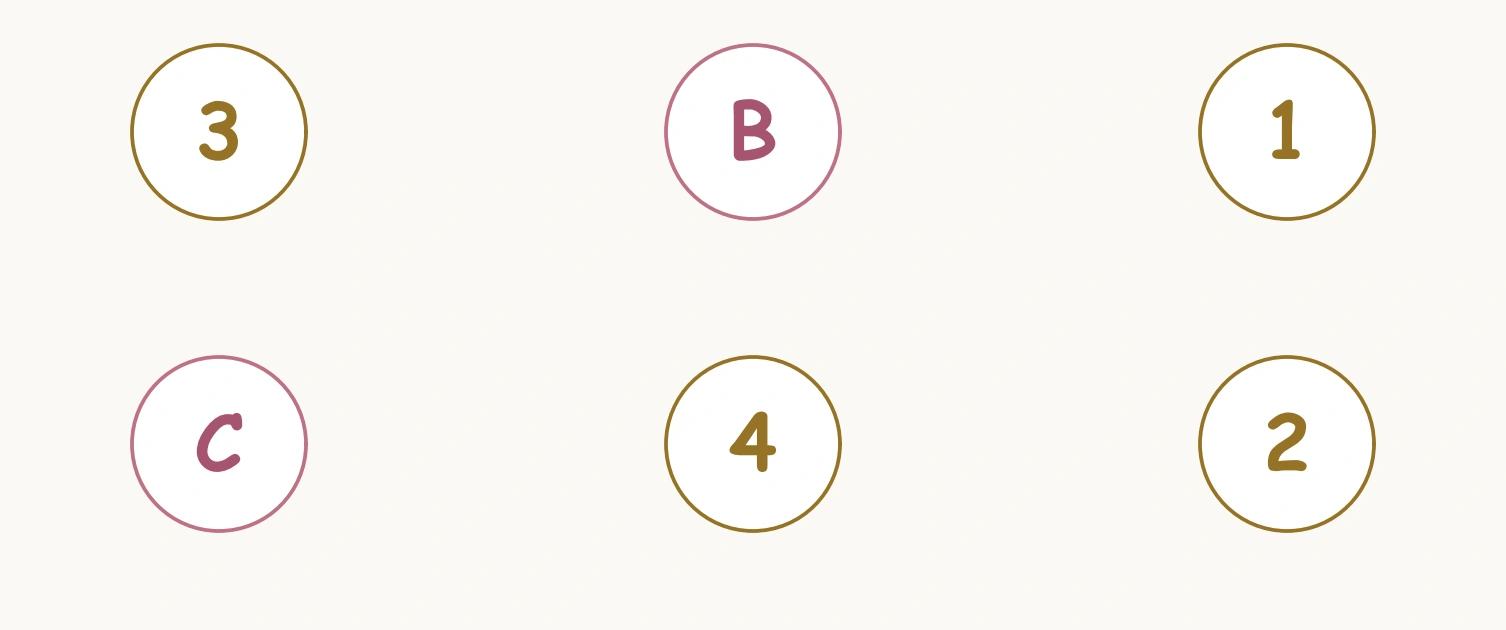
Six useful things to notice along the trail: Number Letter Switching
Recognising scattered symbols: Number Letter Switching
Number Letter Switching asks the child to find a named numeral or capital among other symbols. Correctly counting aloud is helpful preparation, but the printed search adds a separate recognition demand. Notice when Greta can identify a destination independently.
Keeping order within the number stream: Number Letter Switching
The numbers still progress from one to six even though letters intervene. A child who jumps from 2 to 4 has changed that stream's order. Return to the relevant counting relationship rather than restarting every connection automatically.
Keeping order within the letter stream
The letter turns progress A, B, C, D, E, F. The extra number between them does not restart the alphabet. Number Letter Switching provides a small, bounded set in which to hear and show that continuity.
Changing the current rule: Number Letter Switching
After a number, a letter is required; after a letter, a number is required. Naming which type is due can clarify the next decision. This alternation is the source's distinctive demand, rather than a simple number trail with decorative capitals nearby.
Planning a visible connection: Number Letter Switching
Pointing to the destination before drawing separates selection from recording. A child can know the correct next symbol while still finding the line movement awkward. Give the explained choice attention even if the connection is broad or uneven.
Reviewing a route by its stops
A useful check follows the labelled circles in the intended order. It does not count crossing points as extra stops. Number Letter Switching lets the child explain a completed route through names and pointing instead of relying on its overall appearance.
Four play bridges for alternating attention: Number Letter Switching
Two rows of loose cards
Lay numeral cards 1, 2 and 3 in one row and capitals A, B and C in another. Select a card alternately from each row, preserving the order in both. This smaller separate game can make the switching rule visible before returning to the twelve printed circles.
A spoken partner exchange
One partner supplies a number, and the other supplies the corresponding letter turn. Continue through the small agreed range. Let the adult slow down or repeat a pair when needed; the game is about maintaining the rule rather than responding fastest.
Reorder the display, preserve the sequence: Number Letter Switching
Scatter a few cards differently on a mat and follow the same alternating order with pointing. Discuss why moving a card's position does not change which symbol belongs next. This echoes an important distinction in Number Letter Switching without requiring new pencil lines.
Explain a deliberate stream slip: Number Letter Switching
An adult says 1, A, 2, C and asks whether the letter stream stayed in order. Invite the child to identify the part that needs changing. Use an error small enough to discuss clearly, and let the child design the next example for the adult.
The common detours are understandable: Number Letter Switching
A learner may count all six numerals before starting the capitals, join circles by their printed rows or follow an old line through a crossing. Each is a different interpretation of the display. Return to one current stop and ask what type and identity should follow it. That gives the correction a concrete basis.
Do not call a diagonal connection wrong merely because another worksheet required edge-sharing moves. Number Letter Switching has its own rule, and its instruction allows crossing lines. A broad connection can still link the correct pair of circles. Help the child clarify its endpoints when a mark is hard to interpret.
When the page becomes visually crowded: Number Letter Switching
Use a finger or a small pointer to keep the current labelled circle in view. The child can pause before adding another line and locate the next symbol first. If needed, an adult can record a dictated connection on a separate demonstration sheet while Greta continues to make the sequencing decision.
A manageable age range and a return invitation: Number Letter Switching
Suggested use for Number Letter Switching spans supported learners around four to seven, depending on numeral recognition, capital recognition and readiness to alternate the two streams. The same learner may be comfortable naming the symbols separately while finding their interleaving more demanding. Start with a few spoken pairs if that makes the rule clearer.
The activity offers a reason to use language such as next, number, letter, start and finish. It also asks for purposeful pencil movement between chosen locations. These observations need not develop at identical rates. Let pointing or speech reveal the sequence understanding when drawing becomes tiring.
To return without turning practice into repetition for its own sake, ask Greta to explain one transition she previously found confusing. She might show why E is followed by 6 before F. A specific connection gives the new visit a purpose, even if she already remembers much of the completed route.

Save the twelve-circle printable: Number Letter Switching
Inspect the supplied Number Letter Switching edition through its original-sample control, or use an eligible active member plan to obtain its clean premium PDF. The premium edition preserves every symbol and instruction with website watermark and domain promotion removed. No ads are embedded in the clean file.
Check the whole portrait page before printing, including the lower 6, F and E circles. The alternation instruction and permission for crossing lines should remain readable. The associated $5 Little Explorers purchase combines this alternating trail with nineteen further concept sheets in a single clean PDF, available through its own checkout.
Compare instructions across other trails
After Number Letter Switching, explore Number Neighbour Trail beside Number Letter Switching, Alphabet Touching Trail after Number Letter Switching, Arrow Step Drawing beyond Number Letter Switching. Keep each new instruction separate from Number Letter Switching.
For further ways to combine talk and meaningful marks, visit NAEYC's resource for family writing support and explore PBS Parents examples of early literacy play. With Number Letter Switching, notice the next stream, the next symbol and the labelled destination that makes each connection meaningful.
Popular Worksheets
Printable resources families and teachers are downloading now.
 Free
 Free
 Free
 Free