
Arrow Step Drawing: 5 Brilliant One-Space Direction Games
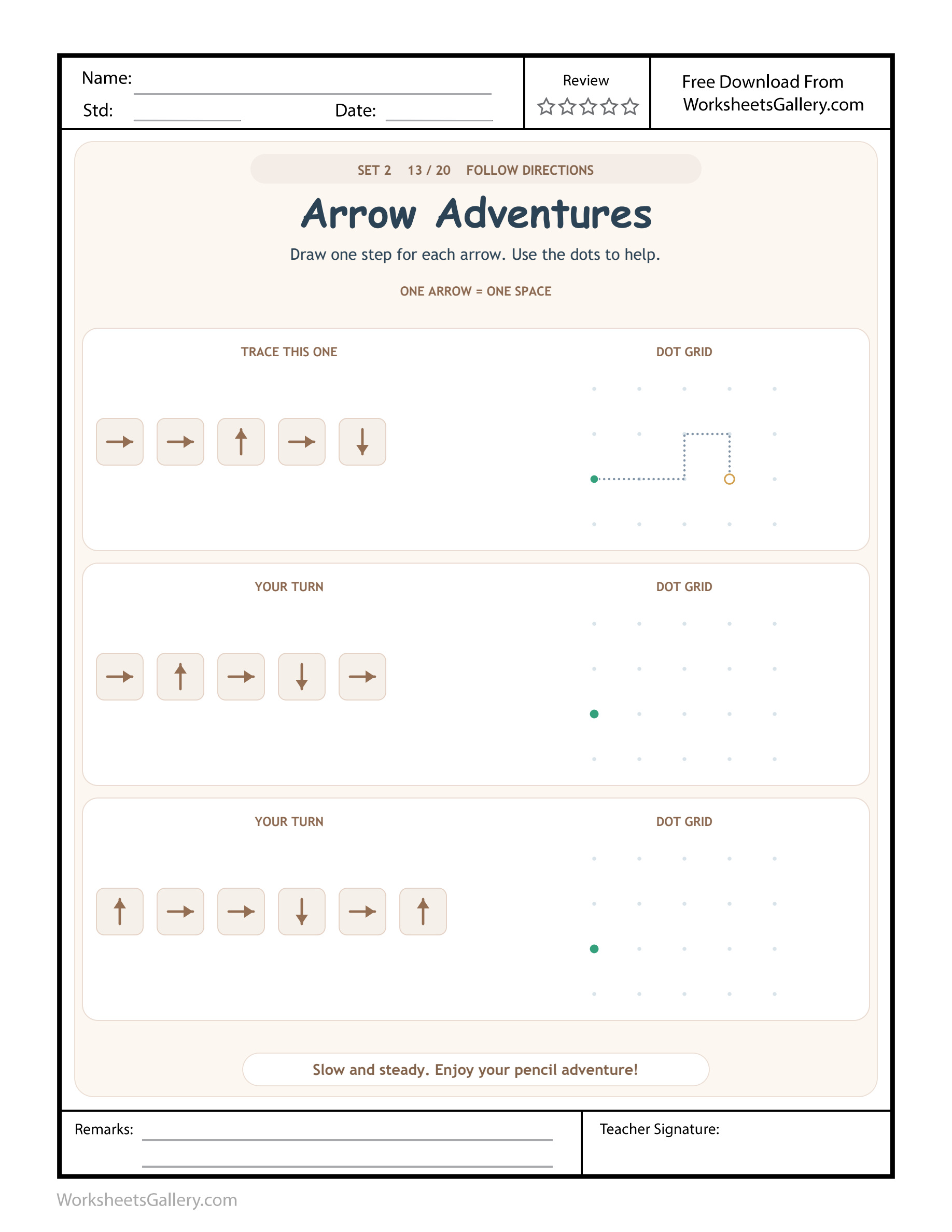
Arrow instructions can lead into another pencil task. This grid-direction sheet accompanies nineteen other supplied concepts in the $4 package. The collection delivers twenty clean pages in source order.
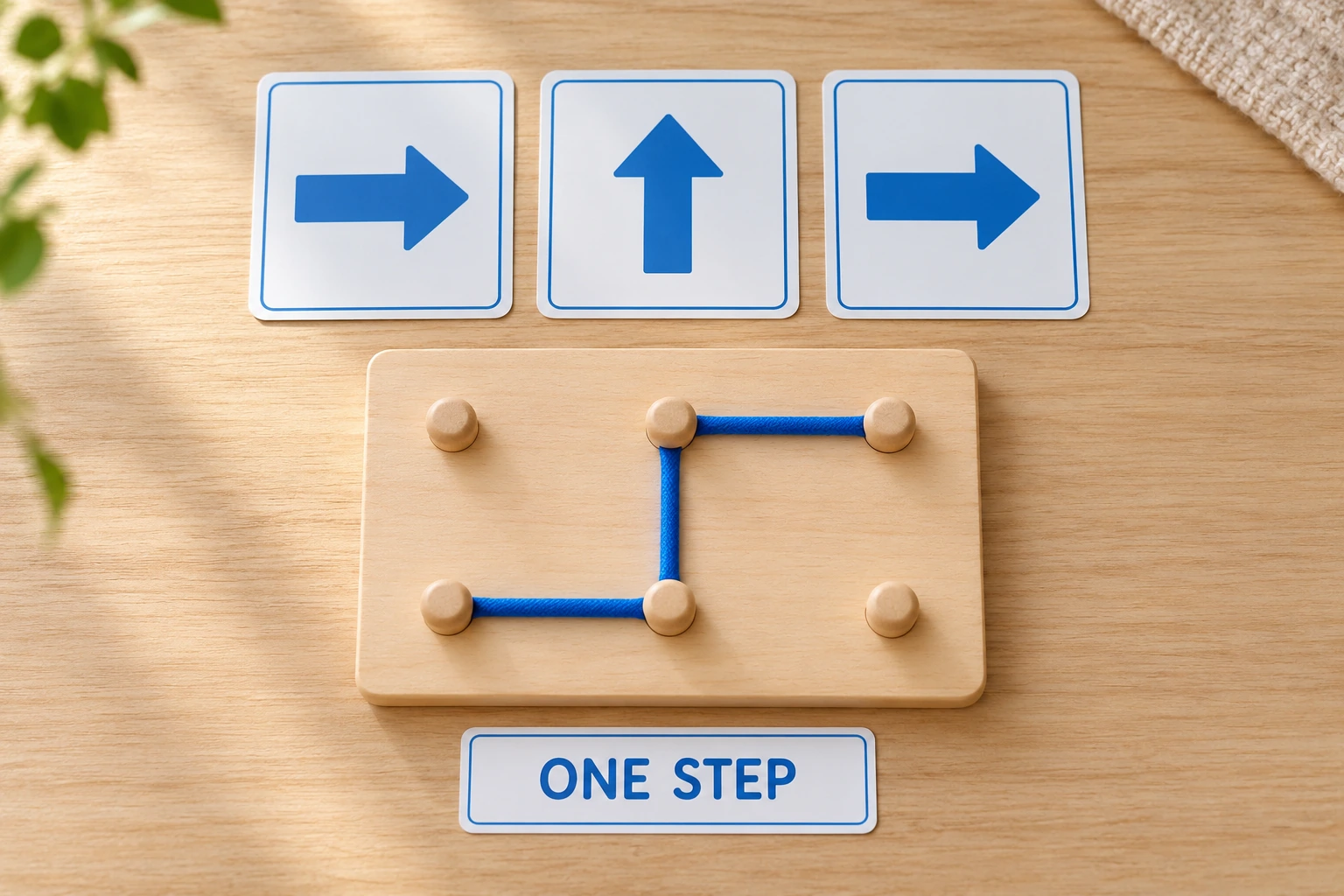
An arrow tells a pencil which way to move, but the grid tells it how far one move should be. Arrow Step Drawing brings those two pieces of information together in the Arrow Adventures worksheet. Children around four to six read an ordered arrow sequence and draw one grid interval for each symbol, beginning at the green dot. One row supplies a tracing model; two leave the route to the child. Arrow Step Drawing makes a small instruction visible as an action, with each new step continuing from the place the previous step reached.
Arrow Step Drawing uses one space between neighbours
The instruction ONE ARROW = ONE SPACE refers to an interval between adjacent grid positions. It does not mean jumping across the entire grid in the arrow's direction. Arrow Step Drawing can begin by pointing to two neighbouring dots and showing the small distance from one to the next.
Two right arrows mean two consecutive intervals to the right. The child may draw them as one straight stretch, but both steps still need to be accounted for. Arrow Step Drawing combines direction and distance, so an adult should clarify the unit before asking the child to interpret a whole row of symbols.
Read the model without skipping its symbols
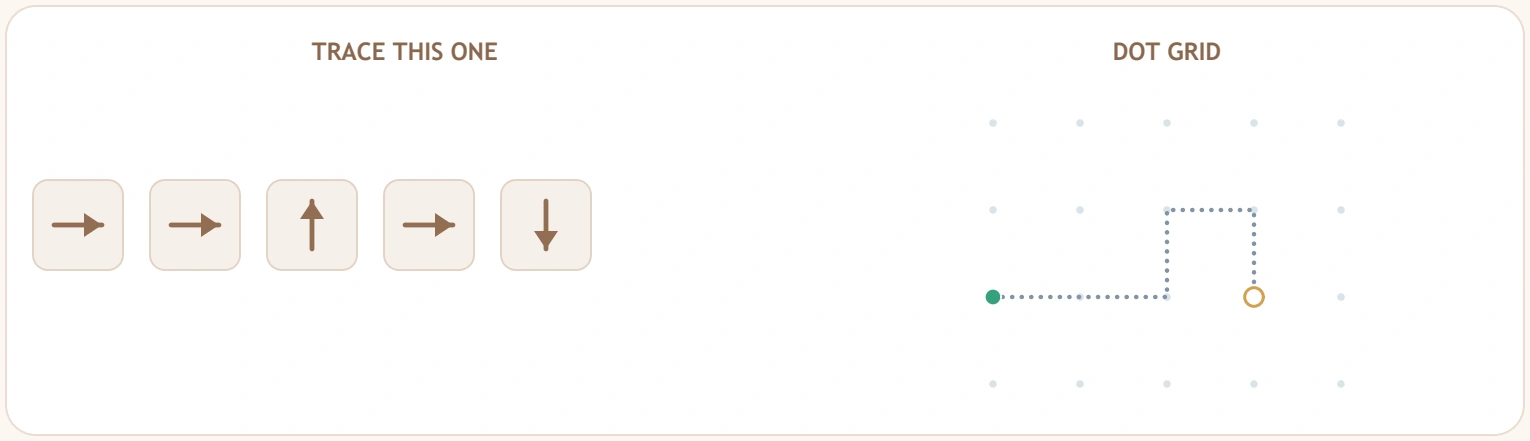
The first sequence is right, right, up, right, down. A dotted route on its grid demonstrates that order. Arrow Step Drawing gives the child a chance to connect each symbol with the corresponding part of the visible path. Point to one arrow while locating the interval it describes.
After the first step, the next begins at the point just reached. Arrow Step Drawing does not restart at the green dot for every symbol. Move a small counter over a separate large grid if the child wants a physical demonstration of keeping a current position. Keep the actual printed model visible during the comparison.
Three Arrow Step Drawing sequences to inspect
| Row | Printed order | Support on the grid |
|---|---|---|
| Trace this one | Right, right, up, right, down | A five-step dotted model |
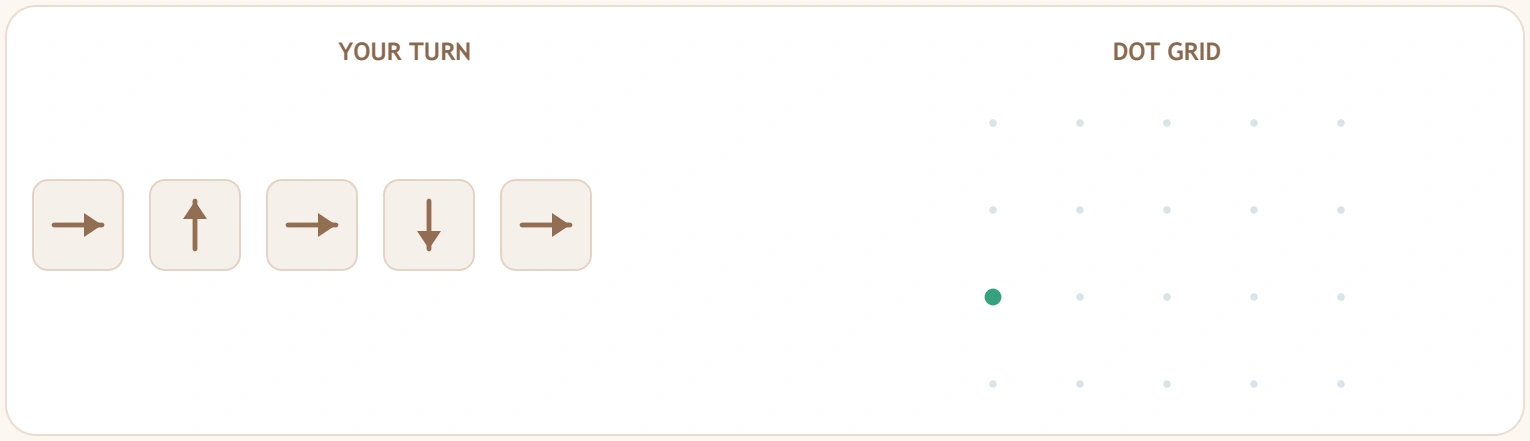
| Your turn | Right, up, right, down, right | Independent five-step drawing |
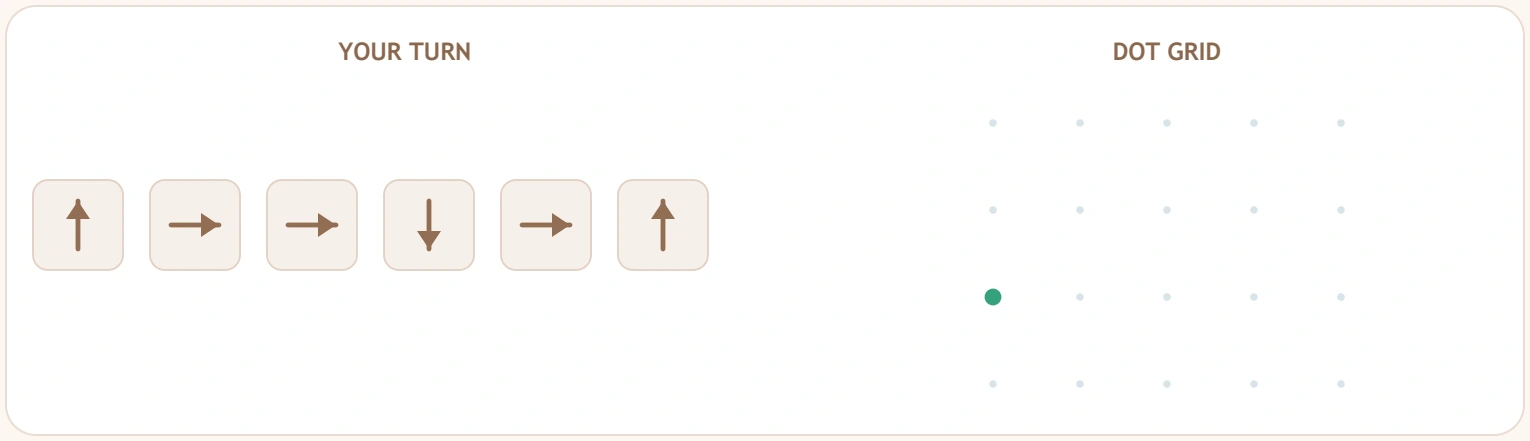
| Your turn | Up, right, right, down, right, up | Independent six-step drawing |
Arrow Step Drawing changes the order between rows, even when some directions repeat. Read each sequence afresh. Remembering the first route's overall shape is not a substitute for interpreting the second row's symbols.
Anya discovers one Arrow Step Drawing move
At school, Anya sees the first right arrow and draws a long line across several dots. Her teacher points to two adjacent grid places and asks where one space ends. Arrow Step Drawing gives them a visible unit to examine: the distance from this dot to its immediate neighbour.
They use a counter on a large separate dot mat. Anya moves it one interval, then another for the second right arrow. Arrow Step Drawing becomes a sequence she can enact. Back at the worksheet, she points to the next arrow before continuing from her current position, with the teacher leaving the new route decisions to her.
Six observations made possible by a short instruction list
- Symbol meaning: Arrow Step Drawing connects an arrow's direction with an actual pencil movement.
- Unit awareness: neighbouring dots make one step a visible interval.
- Order tracking: the child considers which instruction comes next rather than choosing any available symbol.
- Position keeping: Arrow Step Drawing continues from the last endpoint after each move.
- Direction language: right, up and down describe the particular sequences on this page.
- Checking a route: the child can compare a drawn segment with the arrow that was meant to produce it.
These are practical things an adult can notice. They do not make the worksheet a formal test of coding or mathematical readiness. A child may understand a direction while still needing help to locate the next grid position.
The second row changes where the upward move happens
The second sequence goes right, up, right, down, right. Arrow Step Drawing asks the child to draw this route independently. The upward step occurs earlier than it does in the model, so copying the first route's silhouette would lose the printed order.
Point to the first symbol and the green start, then let the child identify the next interval. Arrow Step Drawing can proceed in short considered actions with a pause between symbols. An adult may keep a finger below the current arrow if helpful, without drawing the answer or covering the next instruction.
A home grid game before the smaller page
Make a separate large dot arrangement and put down three finished direction cards. Move a toy or counter one interval for each card while speaking the direction. Arrow Step Drawing can follow when the child understands the relationship between a symbol and a single neighbouring space.
Keep the practice sequence short and clearly separate from the worksheet's own rows. Arrow Step Drawing supplies particular five- and six-step instructions; a homemade warm-up need not duplicate them. At home, a child can also give the adult a short route to follow, making the instruction-reader and instruction-giver roles available to both people.
Use a classroom step caller without racing the drawer
Partners can take turns pointing to the next symbol while the other child draws on an individual sheet. The caller waits until the drawer has reached the next grid position. Arrow Step Drawing is easier to interpret when the pace follows the action, rather than an adult's or partner's quick chant.
A teacher can ask the drawer to show the current position before reading another symbol. Arrow Step Drawing makes that location useful information. If two children produce different routes, compare one instruction at a time instead of displaying one as the universally neat model. The important relationship is between the printed sequence and each attempted movement.
The last sequence has six actions to account for
The final order is up, right, right, down, right, up. Arrow Step Drawing begins this row with an upward move, unlike the earlier two. Locate the green dot again and inspect the first symbol before relying on a familiar starting gesture.
After the repeated right arrows, count two intervals rather than treating the pair as one instruction. Arrow Step Drawing gives repeated symbols a clear numerical consequence. A child can point to each arrow while an adult moves a counter on separate paper, then choose whether to attempt the printed grid themselves.
Five games with meaningful direction cards
Move a toy through three instructions
Use a large play grid and three completed arrow cards. Read them in order and move a toy one interval per card. Arrow Step Drawing offers longer paper sequences later. The small game can finish after three moves, leaving time to explain which symbol produced the final position.
Be an interval inspector
Draw two completed example steps on separate paper, one between neighbouring dots and one jumping farther. Ask which shows one interval. Arrow Step Drawing can follow after the child has compared them. Keep the examples labelled ONE and MORE so the teaching surfaces have a meaningful message rather than empty boxes.
Give an adult a short route
Let the child arrange two or three arrow cards and watch an adult follow them slowly. Arrow Step Drawing can borrow the same read-then-move rhythm. The child may correct the adult's deliberate pause by pointing to the next symbol, creating an opportunity to explain rather than merely answer questions.
Mark the current traveller
Use a movable counter to show where a toy route currently ends. After each instruction, name or point to its new place. Arrow Step Drawing uses the pencil endpoint in that role. The counter game can clarify why the next action starts there instead of returning to the original green dot.
Tell a symbol-to-step story
Give each movement a story purpose, such as going up to a lookout or right to a door, while retaining one interval per arrow. Arrow Step Drawing supplies a comparable ordered action task. Keep the story short enough that the direction rule stays understandable. A spoken ending can complete the play without a further paper requirement.
✎ Common confusions concern order, distance or position
Skipping a symbol changes the order. Jumping several intervals changes the distance. Returning to the green dot after each arrow changes the current position. Arrow Step Drawing makes those differences worth separating, because each calls for a different explanation.
Try one arrow, one next space when distance is the issue. If order is uncertain, point below the current symbol and wait. Arrow Step Drawing should not become an exercise in repeated erasing before the source of the confusion has been identified. A large toy demonstration can sometimes make the relationship clearer than another verbal correction.
Support ages four to six with visible information
Children interested in arrows and route games may enjoy the worksheet with an adult nearby. Arrow Step Drawing can be shared through pointing, counter movement or one independent printed row. There is no requirement that every four-year-old complete all three sequences without support.
For related movement work, the robot's corner routes and rocket direction-and-reset sheet offer guided comparisons. The mountain turning-point resource explores another kind of route change. Arrow Step Drawing adds symbol translation, so make that extra decision clear when moving between activities.
Revisit a sequence through a new role
On a later day, let the child be the step caller or grid inspector before offering another drawn route. Arrow Step Drawing can stay interesting through a changed role, rather than a demand to finish the same row at a faster pace. Remember which relationship the child explained so the next invitation can build on that observation.
Families can find broader writing ideas in NAEYC's guidance about home writing experiences and browse literacy activities grouped under age four at PBS Parents. Arrow Step Drawing can accompany pretend maps and instructions created for a real listener during play.
Download Arrow Step Drawing with its grids
The free sample uses the original branded sheet. Request the clean Arrow Step Drawing premium PDF through the membership option on this page, with your eligible plan current on the logged-in account. Once the website confirms access, save the protected file and open the print dialogue to inspect all three sequences.
Arrow Step Drawing's premium version keeps every arrow and dot guide. It is free of watermarks and printed ads; the domain and website-name promotions are also absent. Preserve the whole page border when printing so no instruction card is clipped. The native collection card offers the twenty-sheet discovery purchase for $4. Read the next symbol before making the next move.
Popular Worksheets
Printable resources families and teachers are downloading now.
 Free
 Free
 Free
 Free