
Next Shape Thinking: 4 Wonderful Two-Box Pattern Games
A repeated unit has a place in the full supplied group. The pattern-extension worksheet is included in the premium twenty-page PDF. Purchase the $4 collection when a wider range of pencil decisions suits your plan.
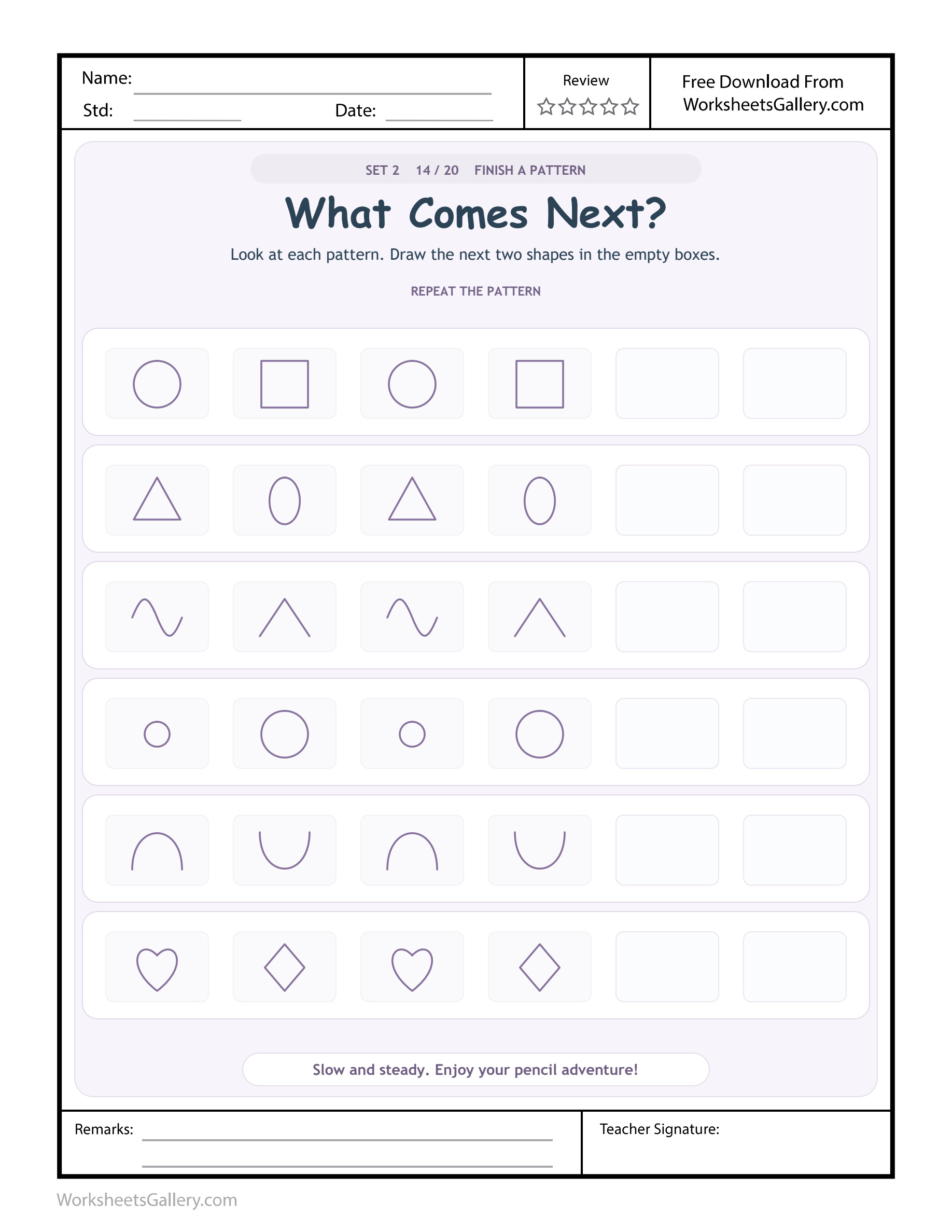
Two empty boxes can ask a more interesting question than one. Next Shape Thinking invites children around three to six to inspect an alternating pattern, then draw both of its next members. The What Comes Next? sheet contains six rows, each with four supplied examples and two response spaces. Shapes, sizes and line directions take turns. Next Shape Thinking makes the repeated relationship the guide: the child predicts what belongs after the last example, then checks what should follow that prediction. The pair matters more than choosing two favourite pictures.
Read a Next Shape Thinking row as repeated partners
Begin with the first two examples and ask what comes after them. The same two-part unit appears again in positions three and four. Next Shape Thinking uses that repetition to make the next pair predictable. An adult can point through the four supplied examples slowly before inviting a spoken or gestured continuation.
The first row alternates a circle and square. Next Shape Thinking asks for the relationship to continue into the two remaining boxes. Drawing two circles would preserve one familiar member but lose the alternation. Looking back at the repeated pair gives the child information for both decisions.

Six relationships, not six unrelated guesses
| Row comparison | What changes between partners |
|---|---|
| Circle and square | The kind of whole shape |
| Triangle and oval | A pointed shape and a rounded one |
| Wavy and pointed line | The character of the line's change |
| Small and large circle | Size while the shape stays circular |
| Arch and bowl curve | Which way the curved form faces |
| Heart and diamond | Two recognisable outline forms |
Next Shape Thinking keeps an alternating structure across these different appearances. A child needs to inspect what is actually changing in the selected row, rather than assume that every pattern alternates two entirely different objects. Next Shape Thinking includes size and orientation as useful differences too.
Omar predicts a Next Shape Thinking pair before drawing
Omar's aunt lays out a finished circle-square token sequence beside the sheet. Omar points through it and says the pair aloud. At the first response box he names a circle. His aunt asks what would come after that circle. Next Shape Thinking gives Omar a way to predict both answers while the pencil is still resting.
He points back to the earlier circle-square pair and names the square. They remove the toy tokens and look at the printed row again. Next Shape Thinking has connected his prediction with visible evidence on the page. Omar draws two uneven but recognisable shapes and explains why they belong in that order.
Seven observations behind a pair of answers
- Unit recognition: Next Shape Thinking gives children a repeating two-part relationship to notice.
- Prediction: a child decides what belongs before making the mark.
- Order checking: both next members need to preserve the alternation.
- Feature comparison: Next Shape Thinking asks whether shape, size or direction is changing.
- Drawing transfer: the supplied examples remain available while the child creates a response.
- Language use: next, again, smaller and upside down can describe particular rows.
- Reason giving: a child can point to the repeated pair as evidence for their choice.
These are practical opportunities rather than a score for general mathematical ability. A child might understand the continuation but need support drawing a diamond. Keep the prediction and the pencil movement distinguishable when discussing the attempt.
Make the two response places visible before starting
Point to the four given examples, then to the two empty boxes. Next Shape Thinking becomes clearer when the child knows which marks are information and which spaces are theirs to use. Ask them to predict the first answer, then the second, using words or pointing to the matching examples.
Only then offer the pencil if drawing is welcome. Next Shape Thinking does not require the child to hold both predictions silently in memory. They may inspect the earlier examples again while completing each box. A spoken pair or two pointing gestures can be a useful response before any independent drawing.
Size can be the repeating difference
The circle-size row keeps the same kind of shape while changing how large it appears. Next Shape Thinking asks the child to notice small-large-small-large, rather than search for a different object after every circle. Compare the first two members closely before continuing the sequence.
If the child draws two equal circles, ask what changed in the supplied pair. Next Shape Thinking gives a specific comparison to inspect. Avoid making exact measurement the new requirement; a clearly intended smaller and larger circle can express the pattern even when their sizes do not precisely duplicate the printed examples.

A classroom pattern reader gives evidence
A teacher asks each child to choose a row and explain its repeated partners. Some children name shapes; others tap or point through the sequence. Next Shape Thinking allows either way to show the rule. Each child then predicts the next pair on an individual copy rather than borrowing a neighbour's finished answers.
When two predictions differ, return to the supplied examples. Next Shape Thinking gives the group visible evidence to discuss without relying on who spoke first. A teacher can ask where a proposed answer appears earlier and what followed it there, helping the child inspect the relationship instead of announcing a correction immediately.
Keep the drawing task manageable at home
Choose one row with familiar forms and put the sheet on a steady surface. Next Shape Thinking can start with the circle-square pair if the child enjoys those shapes. A child who recognises a pattern but does not want to draw can point to completed example cards on separate paper instead.
The pattern-parade movement sheet offers a related way to discuss changing rules. Next Shape Thinking asks for a predicted continuation, rather than repeating a guided movement. Explain the selected activity's purpose so the child knows whether they are following a path or deciding which member belongs next.
A heart and diamond need two different drawings
The last row alternates a heart and diamond. Next Shape Thinking asks the child to retain that order even when one form is more appealing or easier to draw. Inspect their key features: the heart has rounded shoulders and a lower point, while the diamond has four slanted sides.
For a child interested in those features, the garden contour sheet offers another drawing comparison. Next Shape Thinking keeps the repeating relationship as its main decision. A roughly drawn but correctly chosen member may show the prediction more clearly than a polished favourite placed in both boxes.

Four pattern games with completed examples
Open a two-part pattern shop
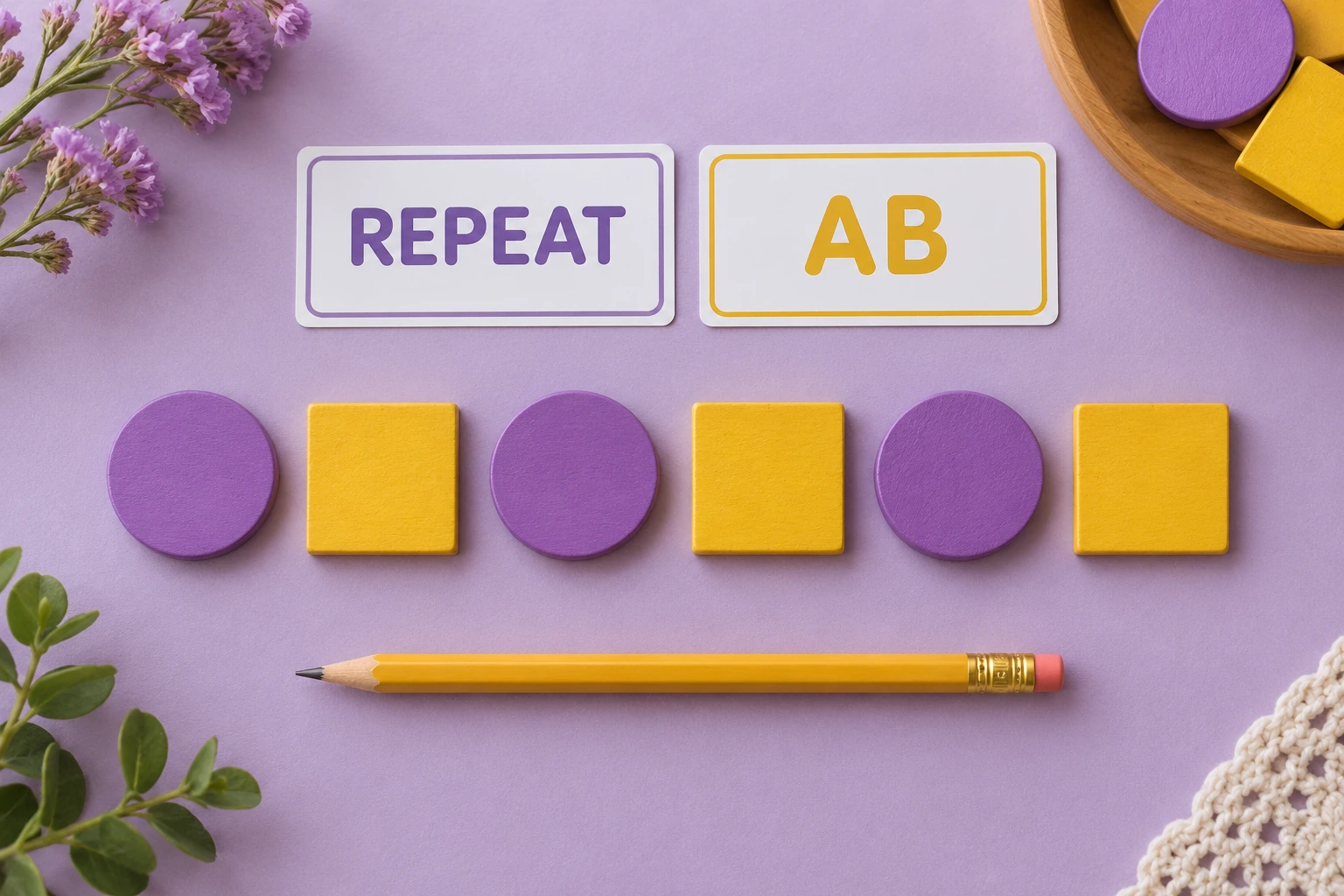
Arrange finished circle and square tokens in an alternating display. A pretend customer asks for the next two pieces, and the child chooses them while explaining the order. Next Shape Thinking can follow when a drawn continuation is wanted. Keep the play pieces separate from the worksheet's empty boxes so the printed response remains the child's own.
Speak the pair, then point to it
Choose a row and give its two members descriptive names, such as little circle and big circle. Say the pair while pointing through the examples. Next Shape Thinking can borrow that spoken rhythm without imposing speed. Let the child pause before the answer spaces and decide what should happen next.
Design a new alternating display
Make a separate completed pattern using two different familiar objects. Invite the child to describe which pair repeats. Next Shape Thinking supplies six printed examples afterward, but the home-made display can stand alone. Keep it a two-part alternation if that is the relationship you are discussing, rather than changing the rule without explanation.
Host an evidence tour
After completing a chosen row, the child shows a visitor where the repeated pair appears earlier. Next Shape Thinking makes that explanation visible. The visitor asks about one decision rather than judging the whole page. A pointing tour can be enough even if the child does not want to provide a spoken account.
✎ Common guesses can be checked against the given pair
Repeating the last supplied member, drawing the same answer twice, and choosing a favourite shape all bypass the alternating relationship. Next Shape Thinking lets an adult ask which earlier pair supports the choice. That question directs attention back to the evidence without turning the activity into a memory contest.
Use say the pair, then continue it when helpful. Next Shape Thinking should not require a flawless outline before the prediction is acknowledged. If the child can point to the intended member but struggles to draw it, offer a separate shape demonstration or a broader drawing space for practice.
Match support to ages three to six
Physical two-object displays can give younger children a tangible place to begin. The size rows and changing line directions may interest older preschoolers. Next Shape Thinking can be shared through pointing, speaking or drawing, without requiring all six patterns in a single sitting.
The shape-builder resource gives a third related comparison of forms. Next Shape Thinking combines recognisable forms with a repeating rule. Choose the support that clarifies the actual difficulty, whether it concerns identifying the pair or making a particular mark with the pencil.
Return to another kind of difference
If the child first explored circle and square, a later visit could examine size or the arch-and-bowl direction change. Next Shape Thinking offers a new comparison without requiring a longer session. Ask what changes and what stays familiar, then let the child select a manageable row.
For wider family reading, explore NAEYC's support-writing-at-home suggestions and the PBS Parents literacy area organised for age four. Next Shape Thinking can accompany everyday designs, pretend shop displays and pictures made to communicate a child's own idea.
Save Next Shape Thinking with both answer spaces
The free sample provides the original branded worksheet. The clean Next Shape Thinking PDF is available through the premium membership control. Use the account holding an eligible current plan and follow the site's authorisation before saving the protected file. Inspect the six rows in a PDF viewer, then check the entire border in the print preview.
Next Shape Thinking's premium edition keeps all twenty-four given examples and twelve intended response boxes. Watermark-free pages contain no printed advertising, site name or domain branding. The native collection link leads to a separate $4 purchase of all twenty concepts. Predicting two next members can be enough for a satisfying first visit.
Popular Worksheets
Printable resources families and teachers are downloading now.
 Free
 Free
 Free
 Free