
Snail Shell Search: 20 Clever Pattern Inspections
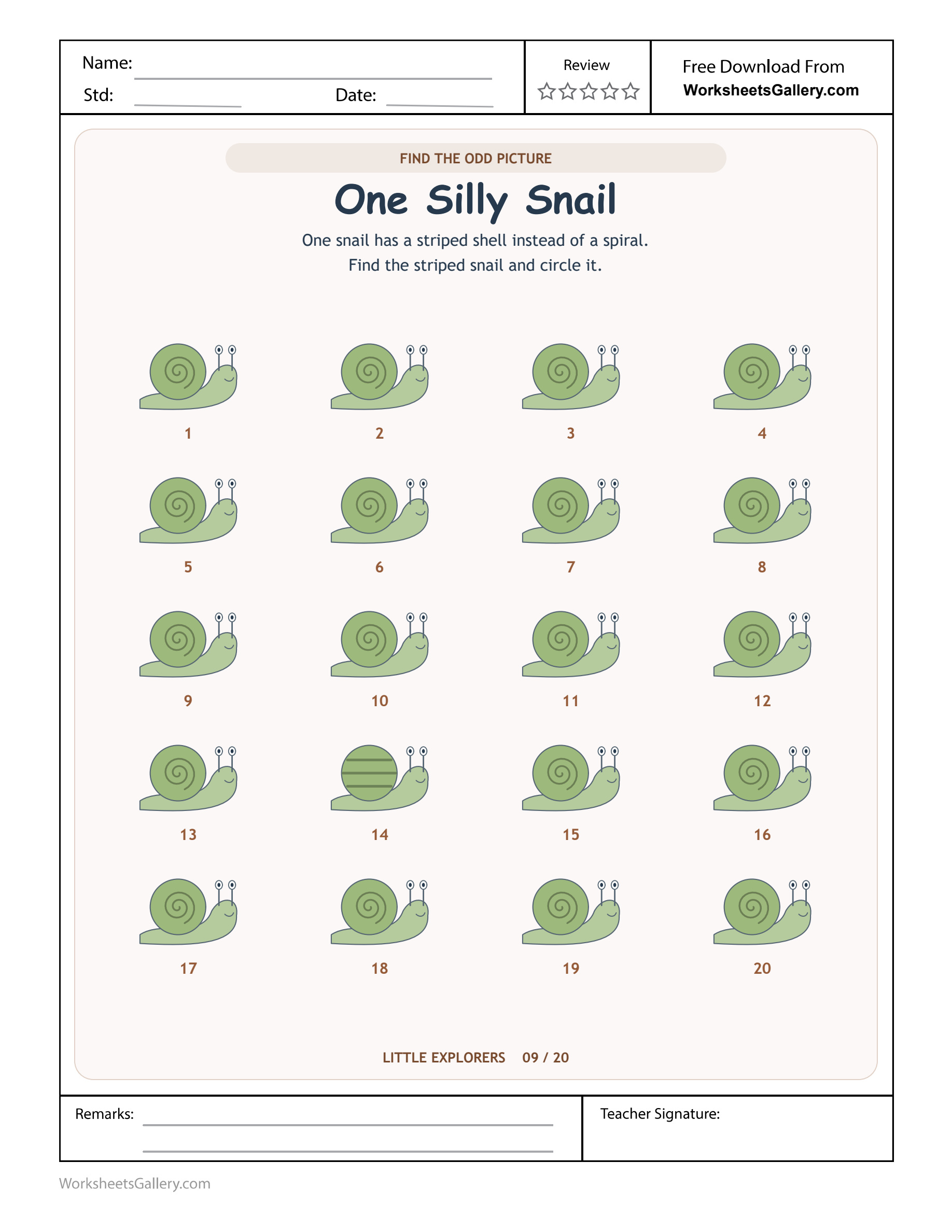
$5 collection companion: Snail Shell Search. Scan twenty numbered snails for the single striped shell among nineteen spirals.
Most of the snails carry a spiral, but one shell tells a different visual story. Snail Shell Search asks children to inspect twenty numbered pictures and circle the snail with stripes. The important clue is the shell marking, not the direction the snail faces or which picture happens to attract attention first. This supported preschool or kindergarten puzzle can begin with a simple description of a spiral and a stripe. Let the child choose a manageable way through the field, then ask which visible feature makes the selected snail different from its neighbours.
Name the feature the search is about — Snail Shell Search
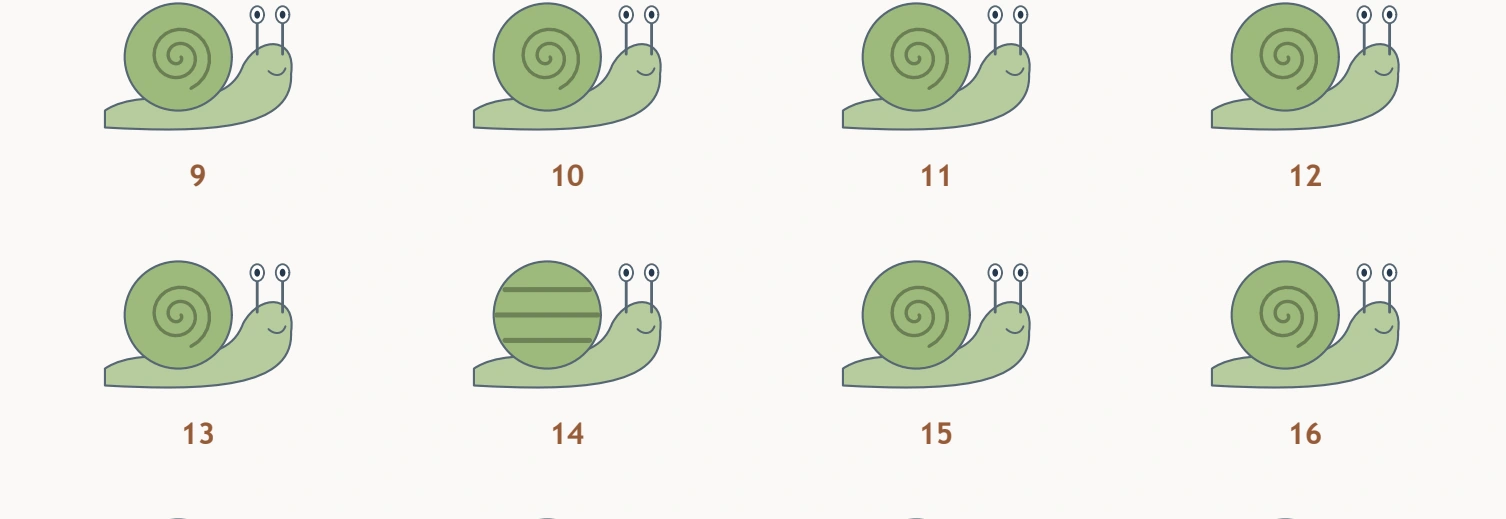
The Snail Shell Search direction states that one snail has a striped shell instead of a spiral. Begin by looking at a familiar example in the field. A spiral curls around towards its middle, while the striped shell contains straight horizontal markings. The child does not need formal shape terminology before being able to show that distinction.
An adult can trace the spiral in the air and make a separate straight-line gesture for a stripe. Keep these demonstrations beside the page rather than drawing over the source pictures. Ask Isla which marking the instruction asks her to find. That makes the target feature clear without pointing directly to the unusual snail.
In Snail Shell Search, the bodies, faces and green shell areas are deliberately similar. The search depends on noticing a local marking inside that familiar overall picture. A large change in outline or colour is not required for one example to differ from the rest.
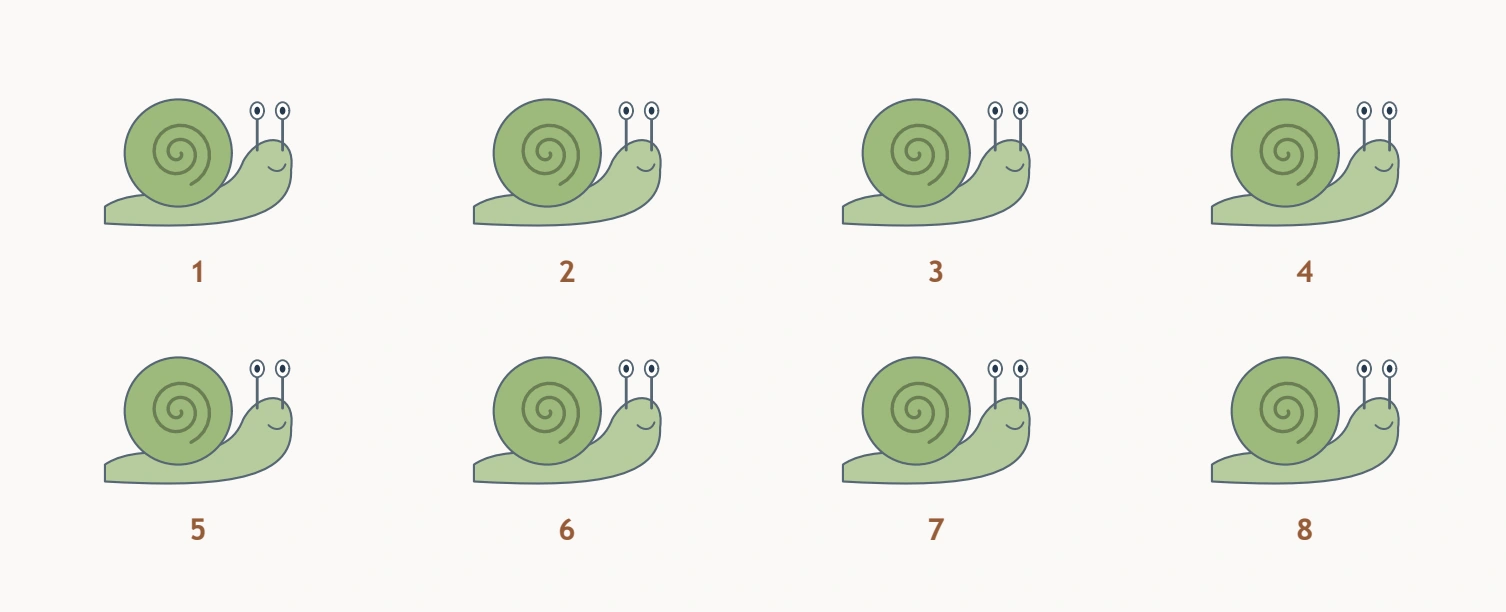
Twenty positions, one relevant exception: Snail Shell Search
The snails are arranged in five rows of four, with numbers underneath. These labels help an adult discuss a location and check a choice. The response instruction asks for the striped snail to be circled; the child is not asked to write a new number in a box or colour all twenty pictures.
For Snail Shell Search, the target is snail 14, in the fourth row and second column when inspected from the top left. Treat that location as a private checking reference during a first attempt. Let Isla identify the shell marking before supplying its number.
A label can locate an answer without explaining it: Snail Shell Search
Saying “fourteen” identifies a printed position, but it does not state why that snail fits the instruction. Ask the child to point to the stripes or describe what is different about the marking. A useful explanation can be nonverbal: a straight-line gesture beside the chosen shell may communicate the relevant observation.
Choose a search route that can be revisited
Some children naturally inspect Snail Shell Search from left to right. Others notice a promising shell in the middle immediately. Either can work. A systematic route becomes helpful when the child is losing track of which pictures have already been checked or keeps returning to the same favourite snail.
Offer a row-sized view if the whole field feels crowded. A piece of paper can cover unrelated rows temporarily while the selected row remains visible. Explain that the other rows will also be inspected. This reduces the visual amount presented at once without changing which shell marking the task asks for.
| During the search | What to inspect | What to avoid assuming |
|---|---|---|
| Choosing a first region | A row or a small group of neighbouring shells | The answer must be near the page's beginning. |
| Considering a candidate | The marking inside its shell | A familiar snail body means every detail matches. |
| Checking the candidate | How its straight markings differ from a nearby spiral | A number alone proves the reason. |
| Recording the discovery | A clear circle around the intended snail | Every inspected snail needs a mark. |
The Snail Shell Search numbers can help relocate a picture after a pause, but there is no requirement to recite all twenty before searching. If number naming is an extra difficulty, point to the row and position while keeping the shell comparison central.
Pause when a candidate looks promising: Snail Shell Search
Once Isla notices a striped-looking shell, invite a comparison with one nearby spiral. Ask what her eye sees inside each. This confirmation is more useful than repeatedly asking whether she is sure. It gives the decision a visible reason.
If her first choice has a spiral, explore that marking together. She may have been comparing a different feature or may simply have lost the intended target. Return to the source instruction and the straight-line gesture. A revised choice can show that she has clarified what to inspect.
There is no need to mark every rejected picture: Snail Shell Search
Covering the Snail Shell Search field with crosses can make the remaining search busier. The printed activity asks for one circle, so a finger or a spoken observation can record a checked non-target temporarily. If a child wants an elimination method, try it first with a small separate set of pictures.
Five learning observations from one unusual shell: Snail Shell Search
Attending to a small local feature: Snail Shell Search
The whole snail remains recognisable in every position. Snail Shell Search makes the shell marking the deciding detail. Notice whether Isla can focus on that part without needing every picture to be dramatically different.
Comparing against a repeated example: Snail Shell Search
A neighbouring spiral supplies a useful reference. The child can point between the markings and show the contrast. This is more informative than accepting a choice merely because it came with a confident voice.
Organising a crowded field: Snail Shell Search
Moving through one row or returning to a remembered label can support the search. Observe whether the chosen approach helps Isla avoid repeated checking of the same region. Another route can still be effective if she keeps track comfortably.
Using precise descriptive language: Snail Shell Search
Words such as curly, round, straight and striped can express different levels of description. Model a helpful term after listening to the child's own account. Snail Shell Search provides a visible reason to refine language, rather than requiring vocabulary definitions before play begins.
Making one purposeful mark
The circle should communicate which snail the child intends. A broad or uneven circle can still do that. Keep the precision of the search decision separate from the smoothness of the pencil movement used to record it.
At home, a two-shell rehearsal: Snail Shell Search
Imagine Isla and her aunt drawing a spiral and a few straight stripes on spare paper before opening Snail Shell Search. They compare the two markings with finger gestures. Isla then says which type she will look for in the numbered snail field.
Her aunt lets her inspect the lower half first. When Isla identifies a candidate, the adult asks her to show its marking and compare a neighbour. Only after that explanation do they use the number underneath to describe where the unusual snail sits.
If Isla wants to stop after the discovery, the adult can save an optional story about the snail for later. There is no reason to demand that every remaining spiral be counted aloud. A return visit could revisit the feature comparison or let Isla design a new shell pattern on another sheet.
In class, let a listener check the feature: Snail Shell Search
For a hypothetical partner activity, one child finds a candidate in Snail Shell Search and explains what to inspect. The listener looks at that shell and a neighbouring example before agreeing. Partners can point and gesture if the words spiral and stripe are still unfamiliar.
A teacher might note that a learner independently found the unusual shell but needed the word striped, or that a row window made the field easier to inspect. Those are descriptions of the support and observation in this activity. They should not be reduced to a public ranking of who finished first.
When partners already know the location, change the discussion rather than pretending the page is a new blind search. Ask them to describe the shell difference to a toy visitor or explain how a row reference helps another person find the picture. Familiarity can support clearer communication even after the answer is remembered.
Five shell-pattern games away from the worksheet: Snail Shell Search
Build two contrasting marks
Use a drawing tool to make one large spiral and one set of straight stripes on spare paper. Invite the child to point to the marking named aloud. Reverse roles so that the adult also has to interpret the child's description.
Invent an odd shell
Draw a few simple shells with the same repeated marking and one with a different feature. Ask a partner what makes the unusual example different. Keep the first invented field small so that the explanation remains clearer than the search burden.
Give a location clue
Arrange four picture cards in a row and describe one by its position and feature. Let the listener point before the answer is confirmed. This separates locating a picture from explaining why its marking matters, as in Snail Shell Search.
A snail's pattern story: Snail Shell Search
Pretend the striped snail wants to introduce its shell to the spiral group. Invite one spoken sentence about the difference. The story need not imply that being different makes the snail better or worse; it simply gives the visible feature a voice.
Find a spiral on another object: Snail Shell Search
Look at a familiar drawn spiral or decorative pattern in a book and compare it with a straight striped design. Keep the examples visible together. The extension is a conversation about markings, not a requirement to find a perfect real-world copy of the source snail.
Support interest without turning the puzzle into a race: Snail Shell Search
Snail Shell Search is a suggested adult-supported activity for many learners around four to six. Interest in comparing repeated pictures, comfort with the visible field and the ability to indicate an intended target are useful starting points. A child can participate by pointing before being ready to make a controlled circle.
Common detours include searching for a different face, circling the largest-looking body, counting labels instead of inspecting markings or assuming that the first unusual impression must be correct. Return to one shell and the printed stripe-versus-spiral instruction. Give the child time to compare a neighbour.
For regular engagement, invite Isla to explain one useful search habit on a later visit. She may show how she kept her place or how a straight-line gesture helped. A small off-page shell design can offer a fresh challenge once number 14 is familiar. There is no need to disguise a remembered answer as a new discovery.

Keep every numbered snail in the print view
Eligible active members can save the clean Snail Shell Search PDF from its premium control. The file omits domain promotion and website watermark and contains no embedded advertisements. Use the original-sample option separately when reviewing the supplied upload.
In portrait printer preview, check all five rows, their number labels and the complete striped shell before printing. The activity also appears in the $5 Little Explorers twenty-sheet bundle, offered through the related purchase page as one clean combined PDF. That collection purchase is separate from the single-sheet membership option.
Other chances to explain a visible difference: Snail Shell Search
After Snail Shell Search, explore Picture Group Clues beside Snail Shell Search, Copycat Picture Checks after Snail Shell Search, Shape Twin Comparisons beyond Snail Shell Search. Keep each new instruction separate from Snail Shell Search.
Adults can explore PBS Parents ideas for describing and discussing pictures or read NAEYC suggestions about meaningful drawing and writing. With Snail Shell Search, give attention to the shell feature, the comparison that confirms it and the circle that records the chosen snail.
Popular Worksheets
Printable resources families and teachers are downloading now.
 Free
 Free
 Free
 Free