
Delivery Arrow Plans: 4 Clever One-Step Journeys
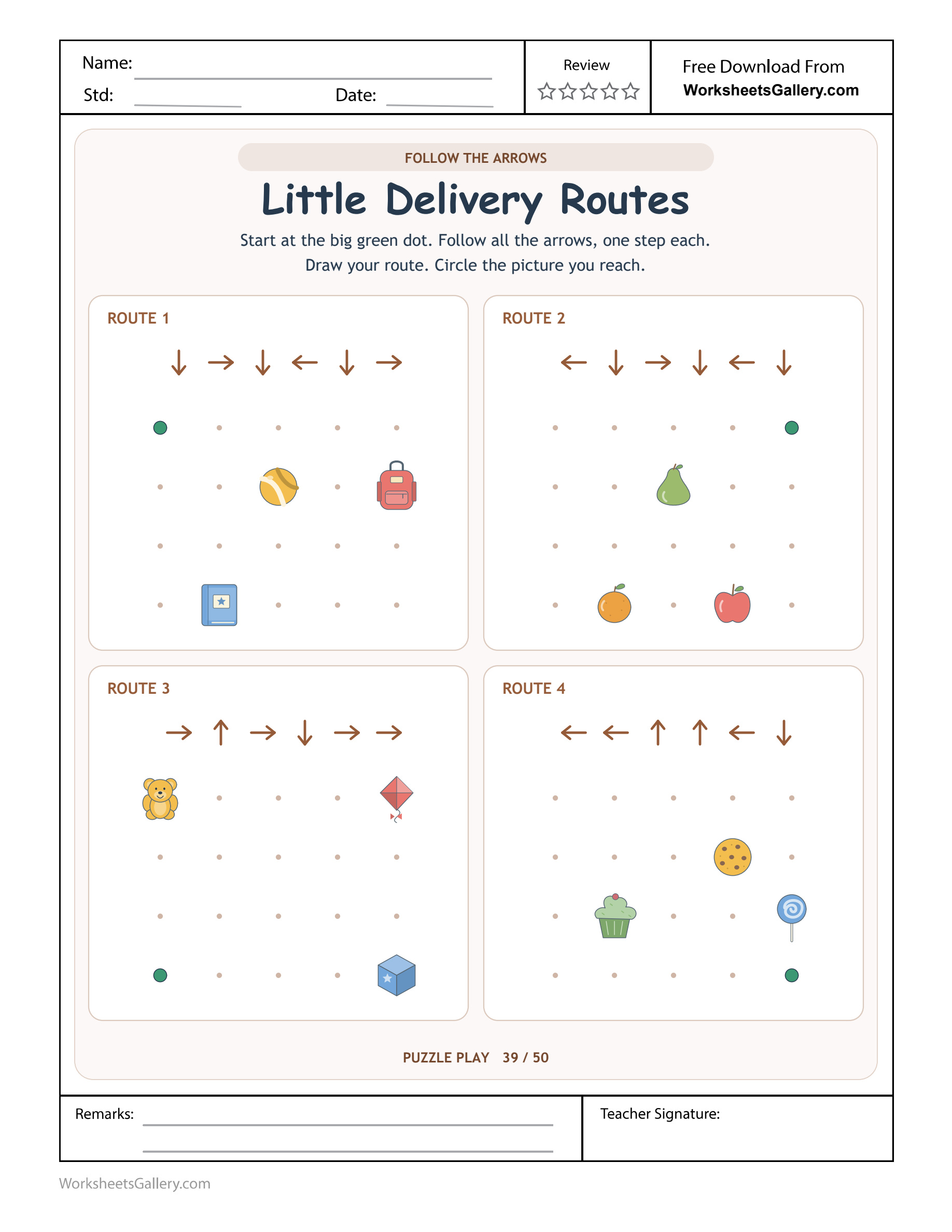
$5 · 25 supplied sheets: Delivery Arrow Plans. Execute every arrow once from the green starting dot; the destination is discovered at the end.
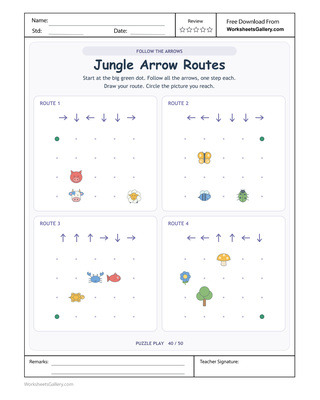
A short arrow string gives the delivery driver all the instructions needed. Delivery Arrow Plans begins each route at a large green dot, moves one neighbouring dot per arrow and asks children to circle the picture reached at the end. Four small grids offer different starting positions and turns. Say one instruction at a time while a finger keeps the current location, then record the route when the movement makes sense. The final picture is discovered by following the whole sequence, rather than choosing a favourite destination and drawing a convenient shortcut.
Delivery Arrow Plans: read the actual puzzle
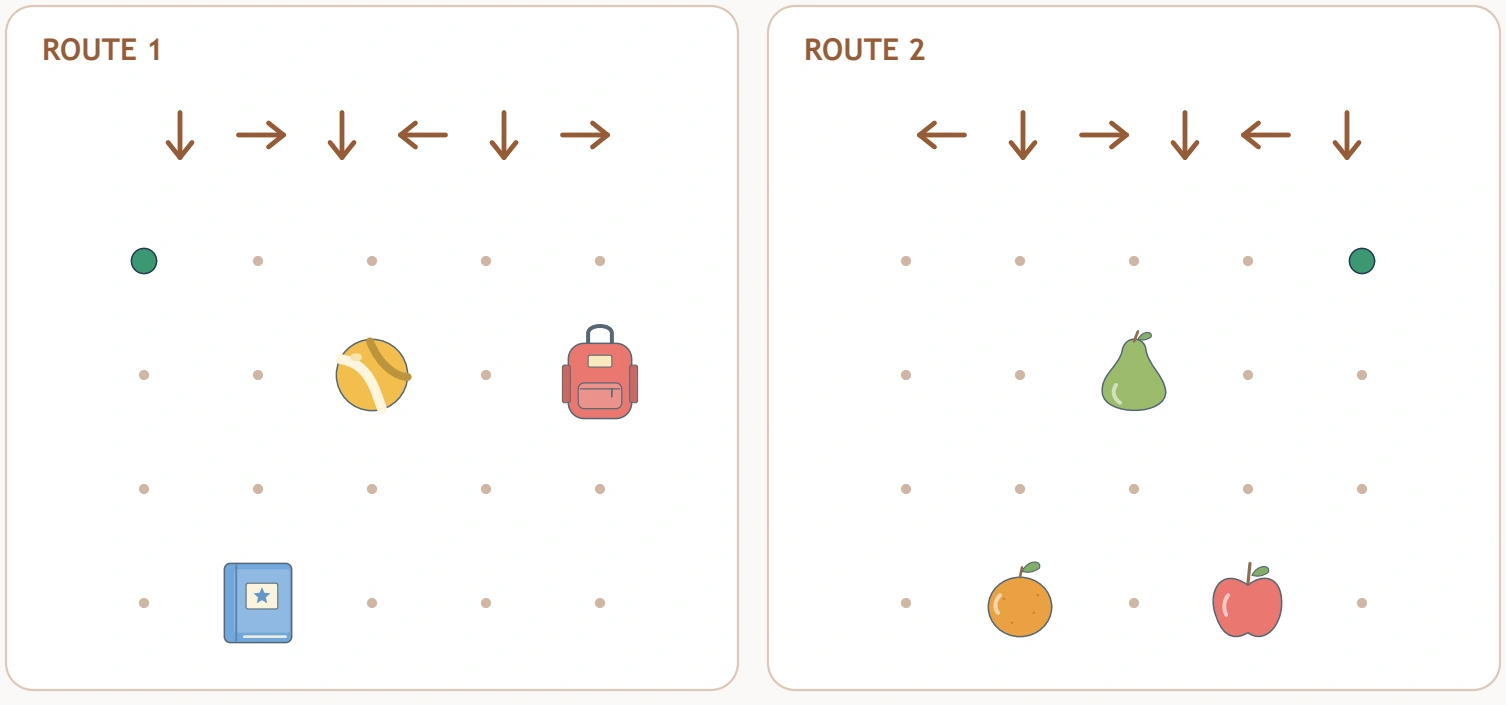
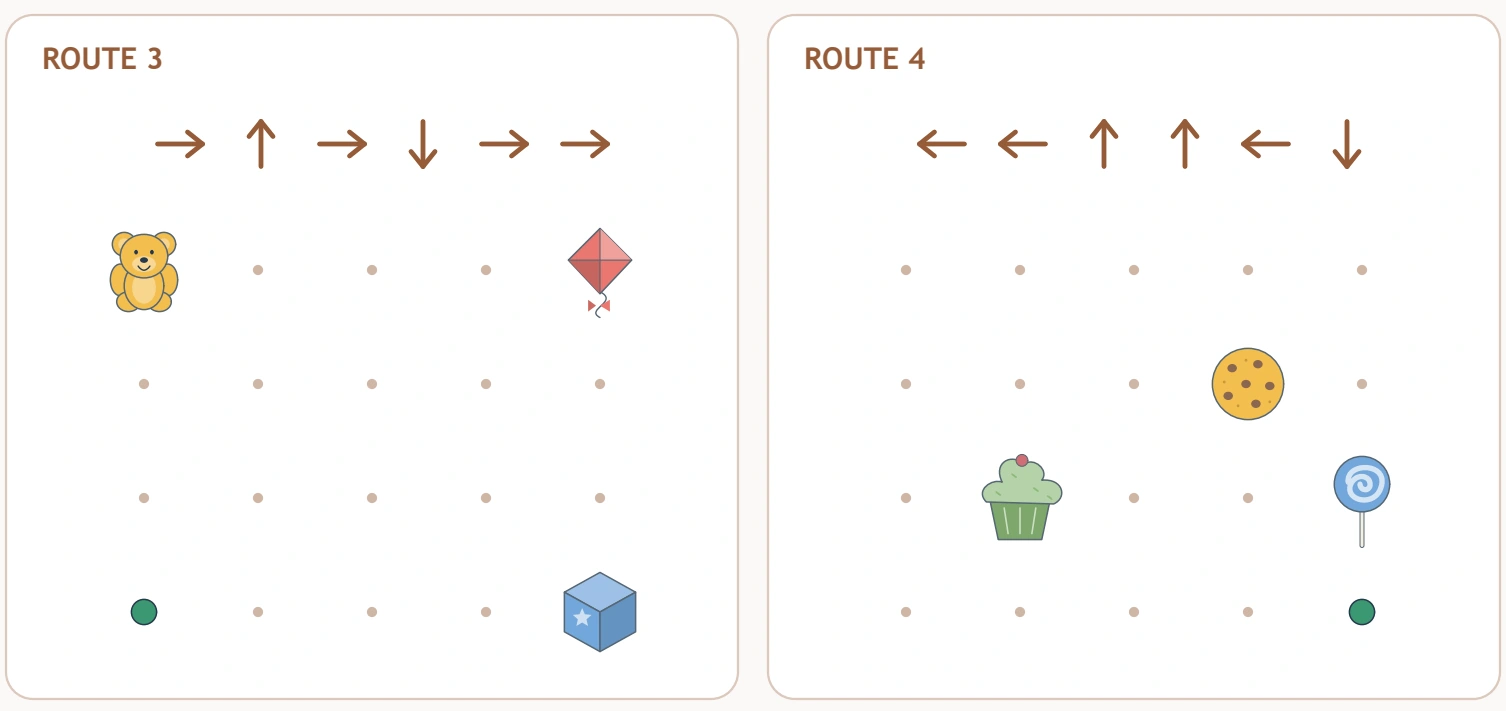
Delivery Arrow Plans: Each of four route panels has a green start, a six-arrow instruction line and a dot field containing pictured destinations. Restart from the green dot for every panel; the endpoint of a previous route has no role in the next one.
An arrow means one step to the next dot in that direction. It does not mean keep travelling until an object appears. Two successive downward arrows therefore create two individual moves, with an intermediate stop that still counts.
Instruction place deserves a second look
Keep the current position while looking back at the next instruction. A small marker or a pointing finger can preserve that location. Losing it and restarting from the green dot after every arrow changes the route completely.
Only after executing the final arrow should the child circle the reached picture. A route may pass another pictured object along the way. The question concerns the endpoint of the whole instruction sequence, not the first interesting object encountered.
Six observations from green starting dot
Sequential execution — green starting dot
Delivery Arrow Plans invites carrying out instructions in their given order. Notice Mei’s sequential execution explanation: “Where does this particular route begin?”
Directional vocabulary — single-arrow step
Delivery Arrow Plans invites connecting left, right, up and down with visible movements. Notice Mei’s directional vocabulary explanation: “Did that arrow produce exactly one step?”
State tracking — instruction place
Delivery Arrow Plans invites retaining the current location between separate commands. Notice Mei’s state tracking explanation: “Which arrow have you already carried out?”
One-to-one correspondence — final delivery
Delivery Arrow Plans invites matching one arrow with one neighbouring-dot move. Notice Mei’s one-to-one correspondence explanation: “Where did the whole sequence leave you?”
Route recording — green starting dot
Delivery Arrow Plans invites drawing a path that shows the movements actually executed. Notice Mei’s route recording explanation: “Where does this particular route begin?”
Endpoint checking — single-arrow step
Delivery Arrow Plans invites distinguishing a final destination from a picture merely passed. Notice Mei’s endpoint checking explanation: “Did that arrow produce exactly one step?”
Another visit through endpoint checking
Let the child become a delivery navigator for an adult on a short invented grid. A deliberately mistaken extra step gives a reason to explain the one-arrow rule again.
Revisit Delivery Arrow Plans through final delivery. Recognise explanations about final delivery from Mei.
Distinctions behind instruction place
Green starting dot — the Mei discussion
The dot field is a spatial arrangement, while the arrow strip is an ordered list. Looking between them places demands on keeping a place in two different representations. A marker supports that coordination without choosing the next move for the child.
Single-arrow step — the Mei discussion
A route is determined by its start and instructions together. The same arrow sequence from another starting dot may lead somewhere else or leave the available field. Return to the printed green start whenever the journey becomes uncertain.
Instruction place — the Mei discussion
The activity differs from finding any open maze path. There may be a shorter way to reach a picture, but the instructions specify this journey. Celebrate accurate execution of the given sequence before inventing alternative routes as a clearly separate game.
Readiness for single-arrow step
An adult can name arrow directions while the child executes them. If left-right language is unfamiliar, compare the visible arrow orientation with the possible next dots before requiring a spoken direction word.
Suggested Delivery Arrow Plans range: ages four to six. Mei’s readiness depends on sequential execution and interest in single-arrow step. Shorten this Delivery Arrow Plans visit when needed.
Revisit the instruction place difficulty
Moving two dots for one arrow or stopping at the first picture produces a different journey. Re-enact the route with a marker and count one move per instruction. Keep the final circle separate from drawing the travel line.
Return to Delivery Arrow Plans evidence by asking “Which arrow have you already carried out?” Separate pencil execution from Mei’s green starting dot reasoning.
Eight closer readings of green starting dot
Locate this panel’s start
Each small delivery question has a separate green dot. Point to it before the first instruction and avoid carrying a previous endpoint into the new panel. Starting position is part of the evidence: even a perfectly followed arrow string can produce another journey when it begins from the wrong dot. This Delivery Arrow Plans distinction supports sequential execution.
One arrow consumes one move
Move only to the next dot in the shown direction. An arrow is not an invitation to travel until a picture appears or until the edge of the field is reached. Demonstrate a single command on a larger spare grid if the intended step length needs clarification.
Preserve two current places
The child needs a current dot in the field and a current instruction in the arrow strip. A marker can hold either place while a finger handles the other. This separates tracking demands from direction choice, allowing the child to focus on applying the next command accurately. This Delivery Arrow Plans distinction supports state tracking.
A repeated arrow repeats the action
Two downward commands should be carried out as two neighbouring-dot moves. Touch each arrow as it is used, with an intermediate stop after the first. Counting commands consumed is useful, but jumping directly across several positions can hide whether one or more steps were omitted.
A picture passed is not delivered
A route can travel through or near one pictured object before reaching another at its end. Keep executing the remaining commands rather than stopping at the first recognisable destination. The final circle answers where the complete string leaves the traveller, not which object attracted attention earliest. This Delivery Arrow Plans distinction supports route recording.
Rehearse before drawing a line
Follow a short portion with a finger when the movement rule is new. Once its steps make sense, record those same connections with the pencil. The drawn route can then support a later explanation rather than becoming a collection of trial lines that obscures the original dot field.
Debug the first mismatch
If a route ends at an unexpected place, compare the commands with the travelled steps from the start. Look for the first point where they stop agreeing. Correcting that local mismatch is clearer than repeatedly guessing a different endpoint and drawing a new convenient path toward it. This Delivery Arrow Plans distinction supports sequential execution.
Explain why shortcuts do not answer
A shorter line to a favourite object may be a valid invented delivery plan, but it is not the journey specified by this arrow string. Enjoy designing alternatives afterward. During the printed task, success is faithful execution of the supplied start and commands, followed by an accurately recorded endpoint.
Four checkpoints for Delivery Arrow Plans
| Pause here | Inspect this clue |
|---|---|
| Green starting dot | Identify the start inside the current panel. |
| Single-arrow step | Move to one neighbouring dot in the indicated direction. |
| Instruction place | Keep track of both the current dot and next arrow. |
| Final delivery | Circle the destination after the last instruction. |
Green starting dot — Mei’s inspection
For Delivery Arrow Plans, ask “Where does this particular route begin?” Identify the start inside the current panel.
Single-arrow step — Mei’s inspection
For Delivery Arrow Plans, ask “Did that arrow produce exactly one step?” Move to one neighbouring dot in the indicated direction.
Instruction place — Mei’s inspection
For Delivery Arrow Plans, ask “Which arrow have you already carried out?” Keep track of both the current dot and next arrow.
Final delivery — Mei’s inspection
For Delivery Arrow Plans, ask “Where did the whole sequence leave you?” Circle the destination after the last instruction.
Five play invitations after single-arrow step
Two-command delivery with Delivery Arrow Plans
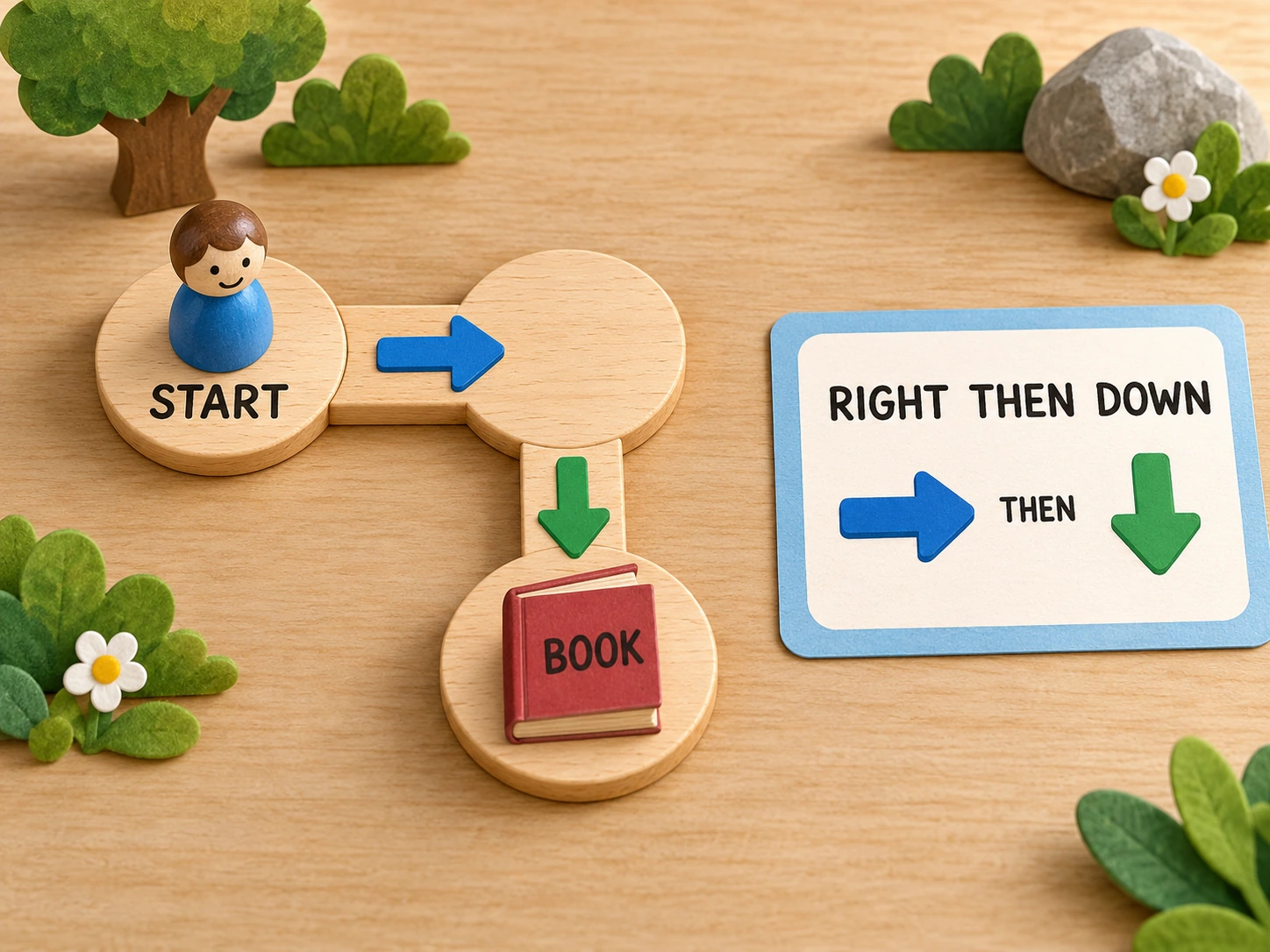
Make a small dot grid and give a toy a right-then-down instruction, checking its final location together.
Instruction bookmark with Delivery Arrow Plans
Slide a small counter along a written arrow strip after each command so the next unused instruction stays obvious.
Passed or arrived with Delivery Arrow Plans
Create a route that passes one picture before ending at another. Discuss which object is the delivery destination.
Driver and navigator with Delivery Arrow Plans
Take turns reading arrow commands and moving a large marker, keeping the roles separate for one short journey.
One extra move with Delivery Arrow Plans
An adult adds a second step to a single arrow on an invented route. Let the child locate where the instruction stopped matching the movement.
Imagine Mei investigating at home
Mei’s father reads the first arrow while Mei moves a large marker one step. They pause, locate the next arrow and continue from the marker’s new position. Reaching a pictured book after the complete string provides a check on the journey.
Try “Where does this particular route begin?” during this imagined Delivery Arrow Plans visit. Let Mei explain green starting dot before recording.
Partners explore directional vocabulary
A classroom delivery team has a navigator who reads one arrow and a driver who points to the next dot. A checker tracks how many instructions have been used. Rotate the jobs between the four panels rather than giving one confident speaker every command.
A Delivery Arrow Plans classroom note can describe retaining the current location between separate commands. Record the actual single-arrow step prompt, too.
Save and print Delivery Arrow Plans
Download the clean Delivery Arrow Plans edition using the premium option available to eligible active members. The PDF preserves every route while omitting website watermark, domain branding and embedded ads; its original sample has a separate control. Open the saved file and confirm that all four panels fit fully on the portrait printer preview.
Other choices beyond sequential execution
For Delivery Arrow Plans, the saved catalog suggests road-following after delivery arrow plans; aiming-and-stopping after delivery arrow plans; picture-recipe drawing after delivery arrow plans. Read each linked activity’s rule with Mei; its green starting dot response may differ.
For Mei, browse NAEYC writing ideas alongside delivery arrow plans or PBS Parents activities beyond delivery arrow plans. Watch sequential execution with state tracking, then revisit green starting dot.
Popular Worksheets
Printable resources families and teachers are downloading now.
 Free
 Free
 Free
 Free