
Happy Shelf Groups: 4 Brilliant Sorting Decisions
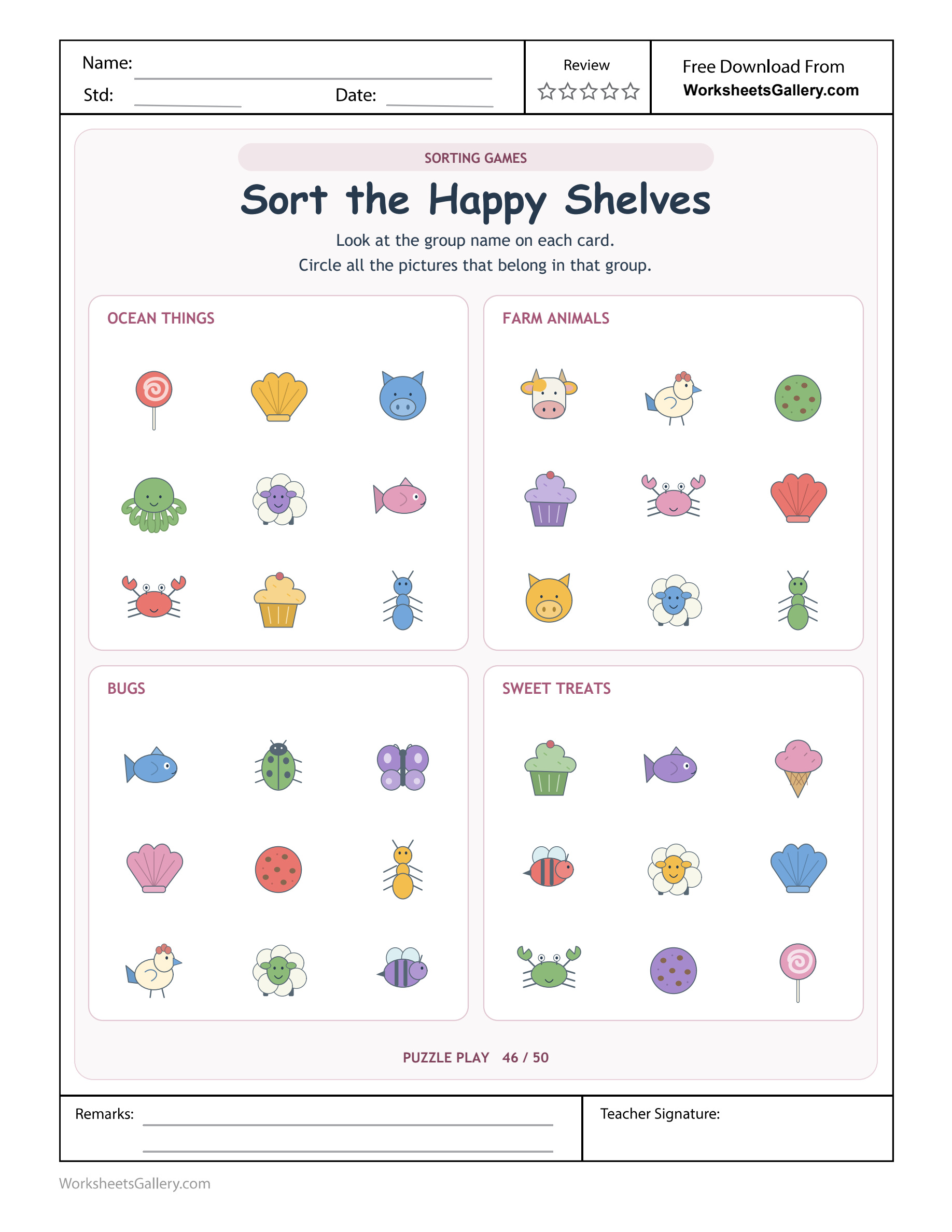
$5 · 25 supplied sheets: Happy Shelf Groups. Apply a fresh group label to each card and leave unrelated pictures unmarked.
Four cheerful shelves mix useful category members with pictures that belong elsewhere. Happy Shelf Groups asks children to circle every object fitting the heading on each card. Ocean things, farm animals, bugs and sweet treats provide the four rules, with nine candidates to inspect in each field. Read a heading together, check all its positions and leave unrelated pictures unmarked. An adult can supply an unfamiliar object name without deciding its group. The interesting work is maintaining one category long enough to include all its members, then changing rules deliberately for another shelf.
Happy Shelf Groups: read the actual puzzle
Happy Shelf Groups: The four cards name OCEAN THINGS, FARM ANIMALS, BUGS and SWEET TREATS. Their separate boundaries indicate separate questions. A picture should be tested against the label above its own field rather than a category from the adjacent shelf.
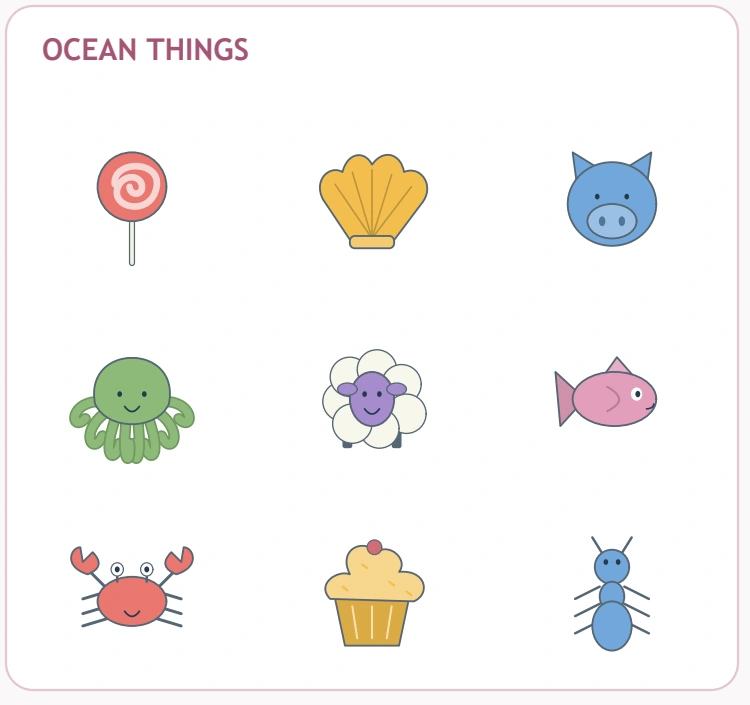
Each nine-picture field contains several members. The ocean card includes shell, octopus, fish and crab, while other objects are distractors. Continue searching after one correct circle because the instruction asks for all pictures belonging to the group.
Member explanation deserves a second look
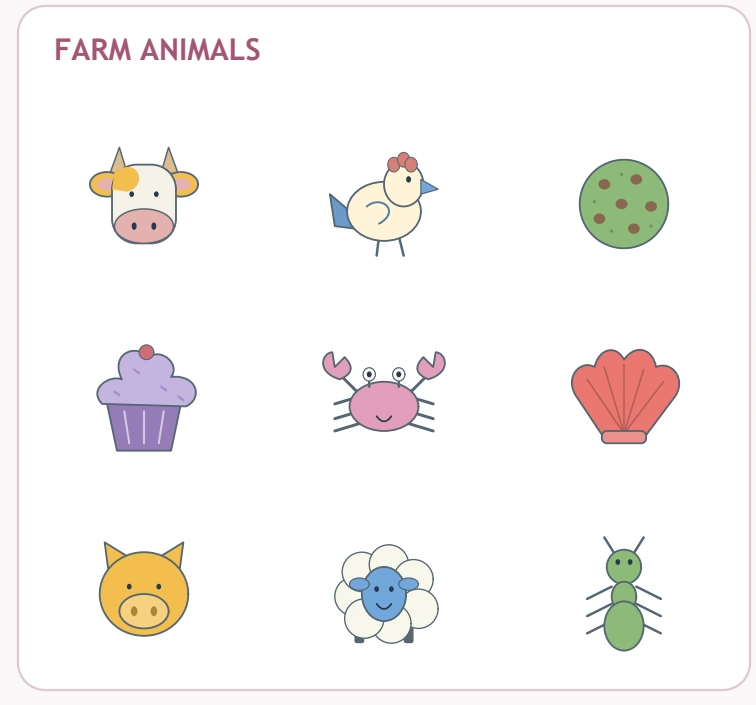
Different cards can use similar-looking colours or faces without sharing a category. A green cookie belongs with sweet treats rather than bugs merely because it is green. Name the represented object before using its group rule.
A simple row sweep lets a child consider every candidate once. Circle qualifying members individually and leave distractors clear. There is no need to move objects between cards or mark every picture in order to demonstrate a complete inspection.
Partners explore inclusive scanning
A shelf-inspection team assigns one child to name candidates and another to explain membership. A recorder circles their agreed inclusions. Before moving to the next field, the team identifies one distractor that was deliberately left clear.
A Happy Shelf Groups classroom note can describe naming animals, insects and treats through familiar pictures. Record the actual whole-field coverage prompt, too.
Four checkpoints for Happy Shelf Groups
| Pause here | Inspect this clue |
|---|---|
| Shelf category | Read the current group heading before inspecting candidates. |
| Whole-field coverage | Consider all nine positions under that heading. |
| Member explanation | Connect each circled object with the named category. |
| Intentional exclusion | Explain at least one picture left unmarked. |
Shelf category — Tomas’s inspection
For Happy Shelf Groups, ask “What group does this shelf collect?” Read the current group heading before inspecting candidates.
Whole-field coverage — Tomas’s inspection
For Happy Shelf Groups, ask “Which pictures have not yet been checked?” Consider all nine positions under that heading.
Member explanation — Tomas’s inspection
For Happy Shelf Groups, ask “Why does this picture belong on this shelf?” Connect each circled object with the named category.
Intentional exclusion — Tomas’s inspection
For Happy Shelf Groups, ask “Where might this other object belong instead?” Explain at least one picture left unmarked.
Six observations from shelf category
Category persistence — shelf category
Happy Shelf Groups invites using one stable rule across a mixed picture field. Notice Tomas’s category persistence explanation: “What group does this shelf collect?”
Inclusive scanning — whole-field coverage
Happy Shelf Groups invites finding several correct members rather than stopping at one. Notice Tomas’s inclusive scanning explanation: “Which pictures have not yet been checked?”
Object vocabulary — member explanation
Happy Shelf Groups invites naming animals, insects and treats through familiar pictures. Notice Tomas’s object vocabulary explanation: “Why does this picture belong on this shelf?”
Surface-feature restraint — intentional exclusion
Happy Shelf Groups invites setting aside a shared colour when identity determines membership. Notice Tomas’s surface-feature restraint explanation: “Where might this other object belong instead?”
Separate-circle control — shelf category
Happy Shelf Groups invites recording multiple selections without joining their boundaries. Notice Tomas’s separate-circle control explanation: “What group does this shelf collect?”
Rule transition — whole-field coverage
Happy Shelf Groups invites changing category deliberately when another card begins. Notice Tomas’s rule transition explanation: “Which pictures have not yet been checked?”
Eight closer readings of shelf category
Read the new shelf label
Pause at OCEAN THINGS, FARM ANIMALS, BUGS or SWEET TREATS before scanning the corresponding field. A label states the current membership test. Carrying a previous group into the neighbouring card changes the question, even when some pictures are familiar from an earlier shelf or another worksheet. This Happy Shelf Groups distinction supports category persistence.
Name identity before a surface feature
A spotted green cookie may resemble a bug through colour and pattern. Name the represented object, then relate it to the printed category. That sequence respects the child’s true visual observation while explaining why a shared surface feature does not determine membership in the group currently requested.
Continue beyond the first member
Each card contains several qualifying pictures. Finding a shell on the ocean shelf starts the inspection but does not complete it. Ask which positions remain unconsidered and keep the current heading visible while continuing. The instruction all supplies a different stopping rule from a one-answer puzzle. This Happy Shelf Groups distinction supports object vocabulary.
Keep a simple search order
Inspect three pictures across one row before moving down to the next. A place-keeping finger can make the current candidate explicit. This small routine reduces revisiting the same pictures while skipping others, without adding a separate checklist that could become more demanding than the classification itself.
An omission needs a possible explanation
Invite a reason for leaving one picture unmarked. A child may correctly identify it as food, a toy or an animal belonging elsewhere. Such an explanation distinguishes deliberate exclusion from an incomplete scan and gives the adult evidence that is not visible in a count of circles alone. This Happy Shelf Groups distinction supports separate-circle control.
Several circles should stay distinct
Use an individual centred mark for each included member. A large loop enclosing both a genuine member and a distractor can obscure the intended choices. Confirm the child’s pointed or spoken selections before adjusting the drawing, preserving an accurate category decision even when pencil control needs support.
Count only after reasoning
A total can serve as a final check, but it cannot replace testing each picture. The right number of circles might include an incorrect substitution. Review one inclusion and one exclusion against the same shelf label before using a completed count as evidence that the group search is finished. This Happy Shelf Groups distinction supports category persistence.
The auditor has another purpose
For a later visit, an adult can pretend to have packed one misplaced object on a separate shelf model. Let the child inspect the display and explain the needed change. This offers a fresh expert role while keeping the same category reasoning available without demanding immediate repetition of the entire page.
Another visit through rule transition
Invite the child to become the shelf auditor, checking an adult’s hypothetical collection for one misplaced object. Explain the relevant label instead of asking for another full page of marks.
Revisit Happy Shelf Groups through intentional exclusion. Recognise explanations about intentional exclusion from Tomas.
Five play invitations after whole-field coverage
Bug shelf builder with Happy Shelf Groups
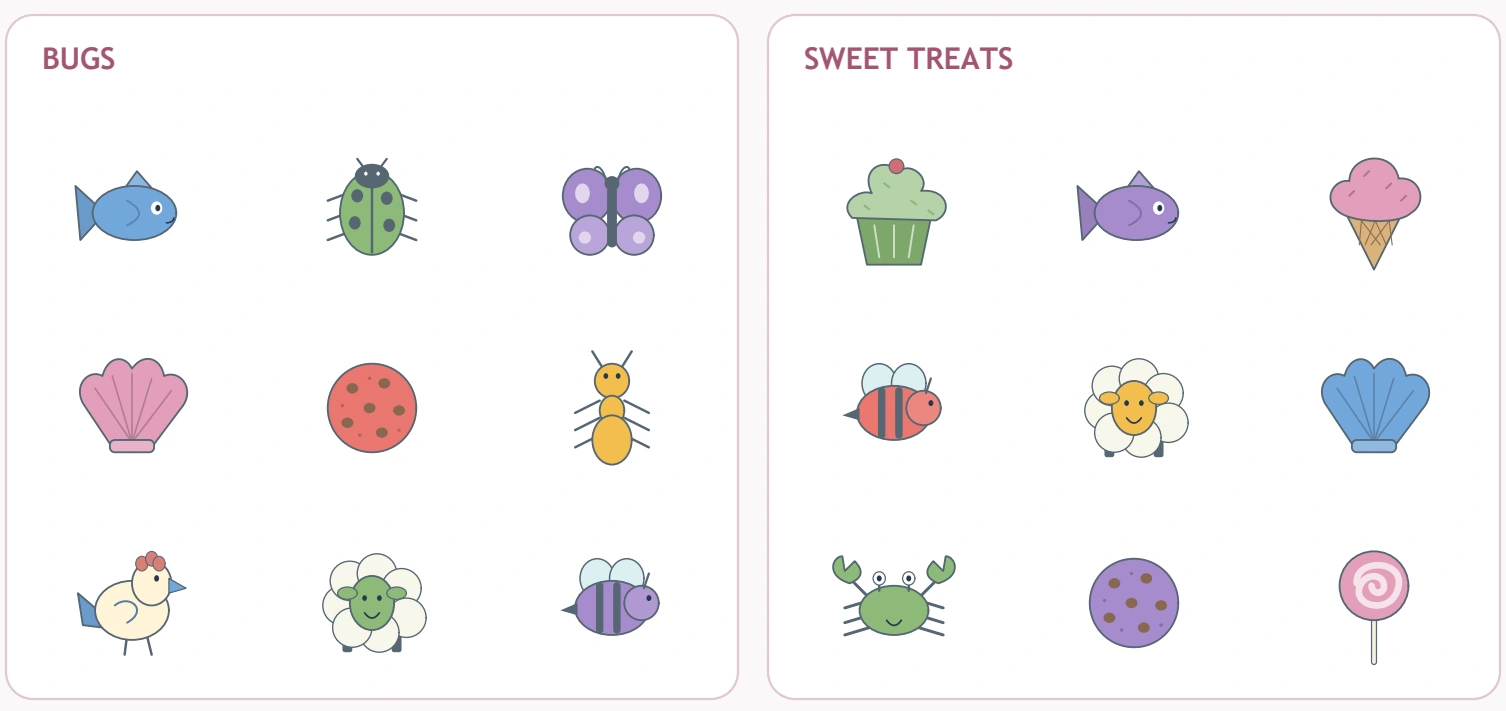
Collect bee, butterfly and ladybug pictures beneath a BUGS sign, leaving an obvious food picture outside the group.
Treat shop audit with Happy Shelf Groups
Make a pretend sweet-treat display with one non-food object. Ask a partner to explain the item that needs moving.
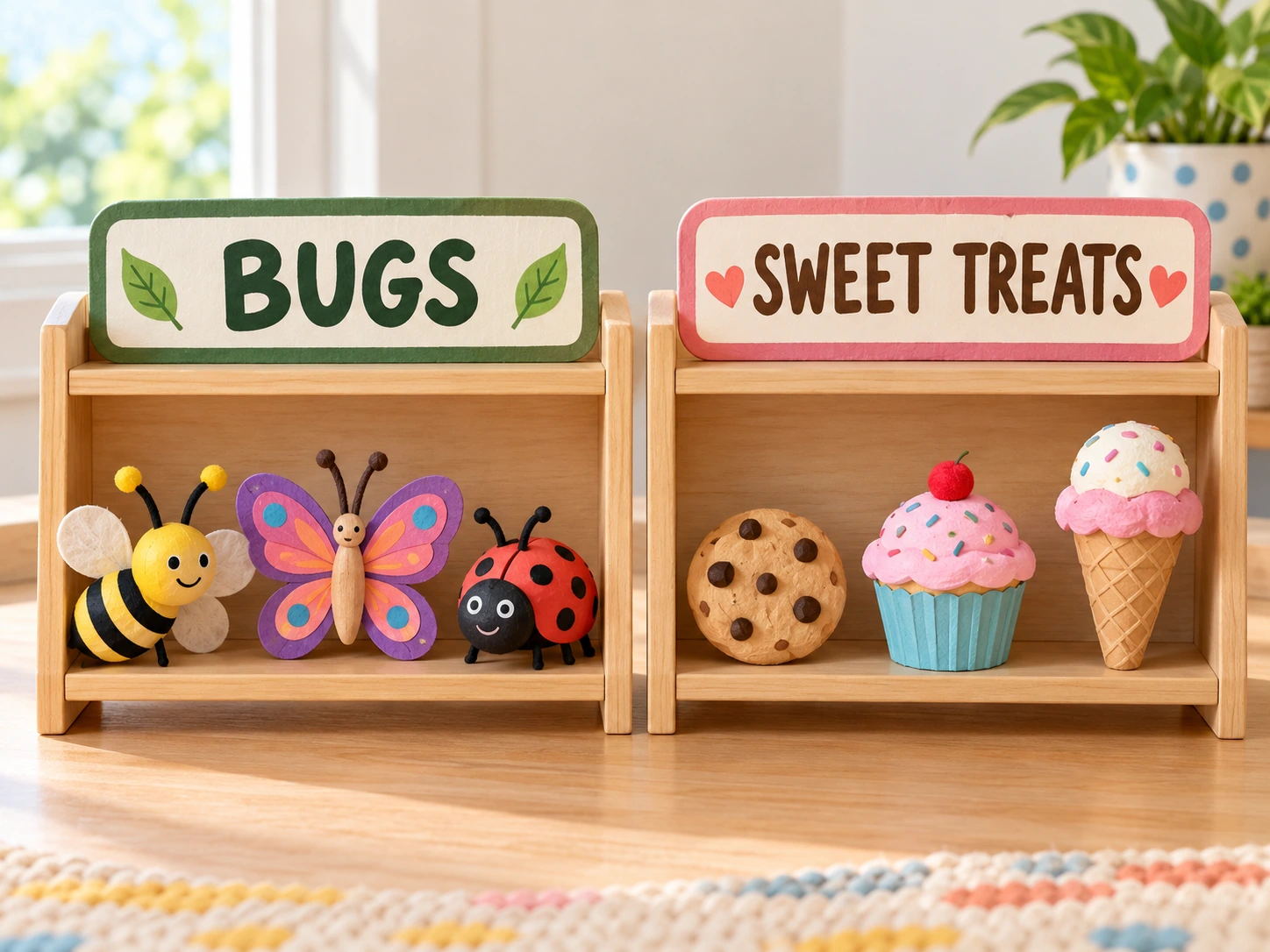
Category handover with Happy Shelf Groups
Use a clear spoken announcement when switching between two object groups, making the change of rule part of the game.
Every position checked with Happy Shelf Groups
Arrange a small nine-picture field and use a row sweep to distinguish considered distractors from uninspected positions.
Defend an omission with Happy Shelf Groups
Choose an uncircled item from a separate model and explain why leaving it out was a deliberate group decision.
Readiness for whole-field coverage
Use the child’s familiar names for the represented objects, discussing group meanings in the home language when useful. Pointing can demonstrate classification before a spoken explanation or several small circles are comfortable.
Suggested Happy Shelf Groups range: ages four to six. Tomas’s readiness depends on category persistence and interest in whole-field coverage. Shorten this Happy Shelf Groups visit when needed.
Imagine Tomas investigating at home
Tomas and his mother pretend to organise a miniature shelf. Tomas includes a green cookie with a ladybug because both have spots. They name the cookie, read BUGS again and decide how its everyday identity affects membership.
Try “What group does this shelf collect?” during this imagined Happy Shelf Groups visit. Let Tomas explain shelf category before recording.
Distinctions behind member explanation
Shelf category — the Tomas discussion
A correct total of circled pictures is only a secondary check. The classification must be supported for each object. A child could circle the right number of candidates while including a distractor and omitting a genuine member.
Whole-field coverage — the Tomas discussion
Familiar category names may still need discussion. Explain what the printed activity means by bugs and ocean things using its visible examples. Keep the conversation practical rather than turning a preschool grouping task into a test of technical biological terminology.
Member explanation — the Tomas discussion
A child who inspects every picture and leaves some unmarked has done more work than the circles alone reveal. Ask for one exclusion explanation to make that reasoning visible, especially when judging whether the field was searched completely.
Revisit the member explanation difficulty
A child may continue using OCEAN THINGS while examining the neighbouring farm card. Point to the new heading before reviewing its pictures. Another shortcut is counting four circles and stopping without checking whether the chosen objects actually fit the label.
Return to Happy Shelf Groups evidence by asking “Why does this picture belong on this shelf?” Separate pencil execution from Tomas’s shelf category reasoning.
Save and print Happy Shelf Groups
Use the premium download for a clean Happy Shelf Groups copy through an eligible active member plan. This PDF retains four category panels without website watermark, domain text or advertisements. Inspect the supplied original through its separate sample. In print preview, check that every shelf heading and all nine choices per panel remain within the portrait outline.
Other choices beyond category persistence
For Happy Shelf Groups, the saved catalog suggests road-following after happy shelf groups; aiming-and-stopping after happy shelf groups; picture-recipe drawing after happy shelf groups. Read each linked activity’s rule with Tomas; its shelf category response may differ.
For Tomas, browse NAEYC writing ideas alongside happy shelf groups or PBS Parents activities beyond happy shelf groups. Watch category persistence with object vocabulary, then revisit shelf category.
Popular Worksheets
Printable resources families and teachers are downloading now.
 Free
 Free
 Free
 Free