
Picnic Number 2: 7 Joyful Pear-Counting Discoveries
Continue beyond two with the ten Number Discovery Boards. The clean 1–10 collection brings every lesson into one $4 PDF.
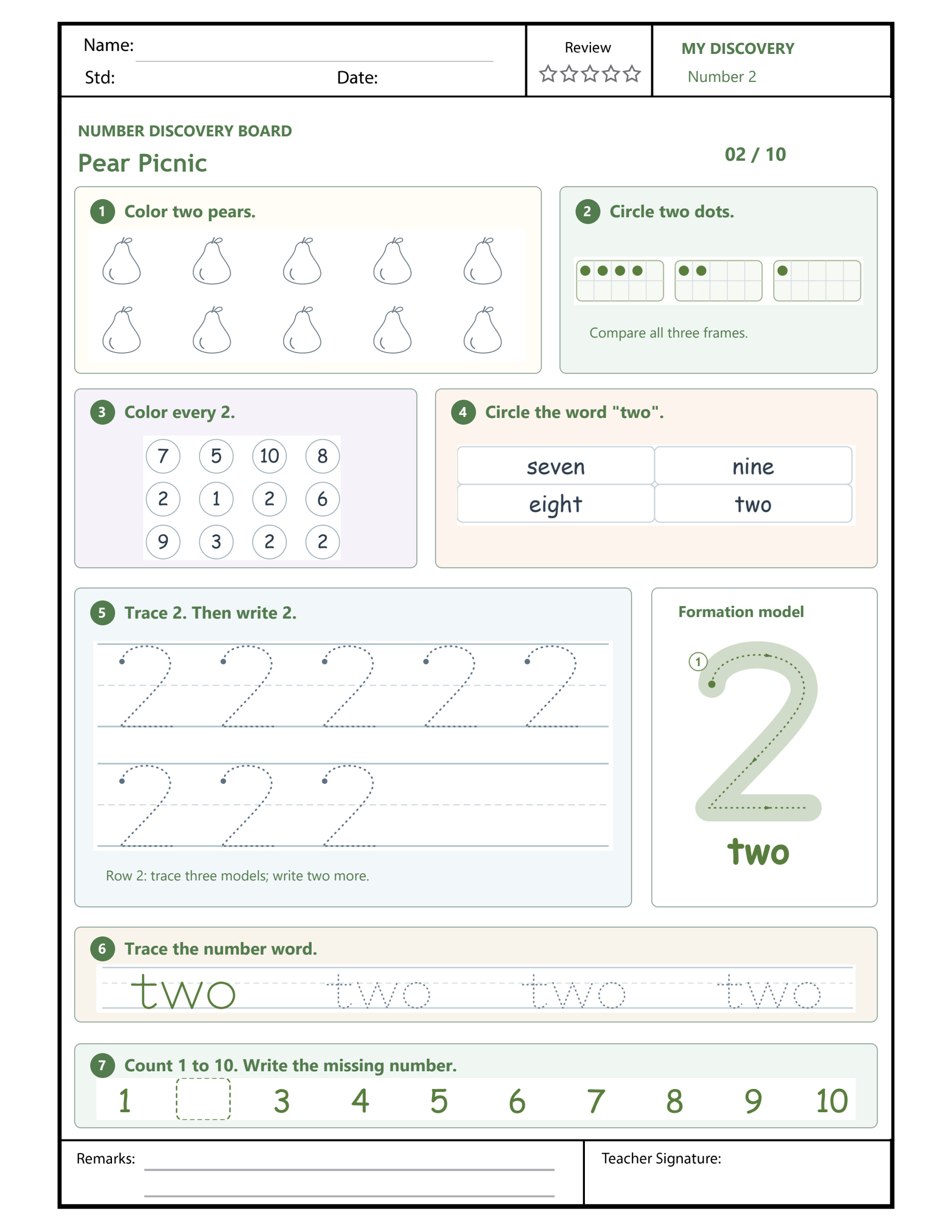
The entire two board is shown without cropping.
Pear Picnic retains picture quantities, frame choices, print recognition, numeral and word practice, and a missing-2 sequence.
Basil brings two cloth mats to the pretend picnic and puts a pear on each. When the mats move together, the fruit becomes a pair without becoming one object. Number 2 explores that distinction through the Pear Picnic discovery board. Picture colouring, dot choices, numeral recognition, word finding and pencil practice give adults several ways to investigate the same amount. Begin with the two visible pears and listen to Basil's explanation. The printed activities can follow in whichever order serves the conversation, with time to pause between thinking about quantity and practising handwriting.
Discovery note 01Number 2 keeps both members of a pair visible
A pair consists of two things considered together. The pears do not have to touch, match in size or occupy identical mats. Place them apart, count them, then bring the mats closer while the child watches. Ask what happened to the objects themselves. Neither pear disappeared, and no new pear arrived, even though the space between them became smaller.
Use large pretend fruit or drawings for this conversation. A child who points to both pears while saying two has made a different response from someone who names the colour of a single pear. Acknowledge the description and bring attention back to the amount. This is a chance to clarify the question, rather than treating every off-topic answer as a lack of counting knowledge.
Discovery note 02Start a partner exchange in the classroom
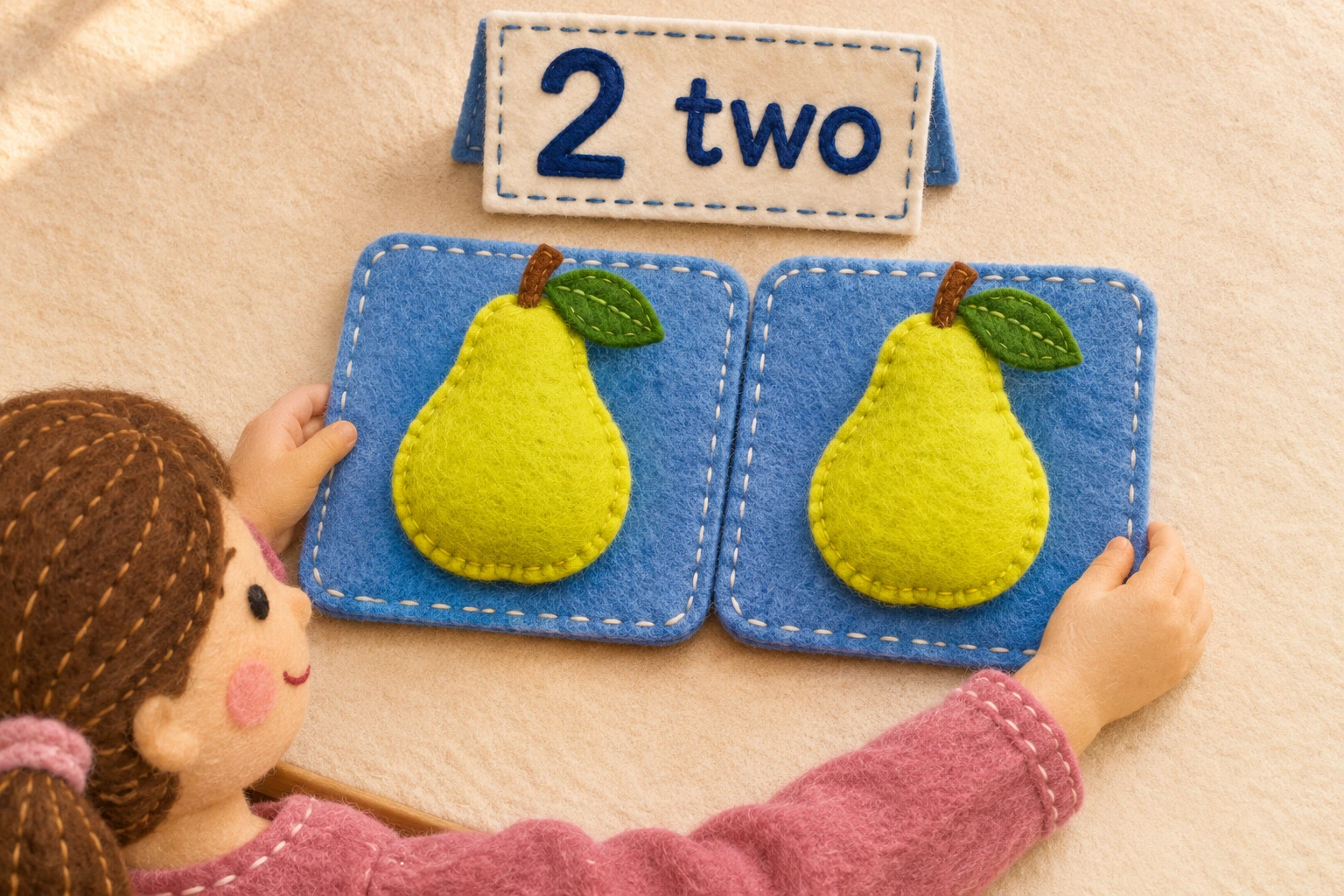
At a small-group table, one learner sets out two large fruit cards and another checks the picnic order. The teacher reads the completed 2 label aloud, then lets the partners swap jobs. A third learner can become the guest who requests a pair. Keeping the amount unchanged across those turns gives everyone a chance to participate without introducing several new number goals.
Next, display the board's dot alternatives. Let each child decide before partners share explanations. A confident speaker can help describe a decision after another child has pointed, but should not routinely choose on that child's behalf. The adult notices whether learners count the dots, recognise the small pattern or use the two pears as a comparison. All three approaches can be discussed without ranking children by speed.
Discovery note 03The middle frame earns its circle
The three printed frames contain four dots, two dots and one dot. The centre alternative matches this picnic. In that frame, two occupied places sit within a larger ten-place structure. Counting only the coloured dots is different from counting every available cell. A child who announces ten may be describing the frame's capacity rather than the amount currently shown.
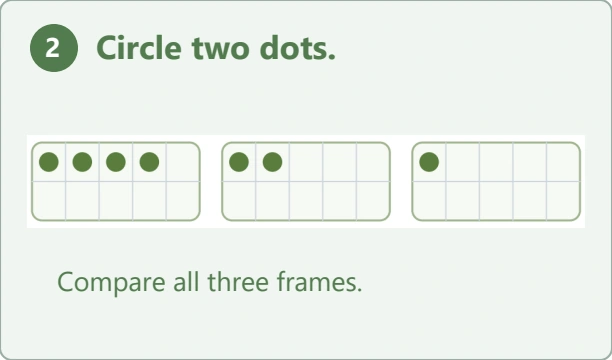
Build the middle pattern on a separate large frame if the printed cells are difficult to inspect. Touch each counter once and say the total after the second touch. Shift those counters to two other cells without adding anything. Basil can decide whether the new arrangement still belongs with the same numeral card. Return to the printed alternatives to identify their actual quantities, not to memorise a preferred answer position.
Discovery note 04Five useful gains from the picnic conversation
- Seeing a pair: two separate pears can be described together, supporting quantity language beyond naming either individual fruit.
- Tracking a small collection: watching the mats move allows the learner to compare a spatial change with an unchanged total.
- Reading an instruction carefully: choosing two fruit pictures and colouring every 2 call for different actions on different parts of the paper.
- Connecting symbols: the numeral, written word and two-dot pattern each refer to the picnic amount through a different representation.
- Preparing a movement: the large formation route provides a visual plan before a child attempts the curved and slanting pencil path.
Those opportunities support attention, language and controlled movement, but a single finished sheet cannot show every part of a child's understanding. Ask how a choice was made and note where assistance was useful. A spoken answer, pointing response and written mark each reveal something different.
Discovery note 05Choose two pears from a larger printed supply
Ten outlined pears appear on the picture shelf. The child colours two, leaving eight unselected. They can be neighbours or sit in different rows. Requiring the leftmost pair would add a positional rule that the worksheet does not ask for. Let Basil identify the chosen pictures first, then begin colouring once the pair is agreed.
If the learner selects a third pear, compare the new group with the two real props. One-to-one pairing can make the extra picture visible without erasing the child's whole attempt. Use two large counters to mark the intended pictures temporarily if that is helpful. Once the quantity is understood, the child can decide how to distinguish the selected pair on a fresh copy or a separate drawing.
Discovery note 06A matching symbol may appear several times
In the twelve-circle hunt, 2 appears at positions 5, 7, 11 and 12 when the circles are read across four at a time. There are four correct symbols to colour, even though the target number represents an amount of two. Explain the instruction as finding all copies of the same numeral, rather than as creating a collection containing two circles.
The first row contains no matching 2. That makes it useful for noticing that a row can legitimately remain untouched. A child need not colour something simply because there is space to colour. Compare each candidate with the large model and allow a quiet checking pass after the initial search. The checking pass is about evidence, not about finding a hidden trick.
Discovery note 07Two sits between one and three
The bottom sequence prints 1 before its gap and 3 afterwards. Filling the missing place with 2 completes the count from 1 to 10. Basil can explain the neighbouring numbers aloud before making a written response. The visible neighbours offer support that is unavailable when a number is presented entirely on its own.
On spare paper, lay out three large completed cards for 1, 2 and 3. Read the sequence, lift the card showing 2, and ask Basil to return it to the middle place. Change which partner removes the card rather than changing the whole number range immediately. When the relationship is secure, compare it with the worksheet's longer sequence and locate the same gap without rushing through the remaining numbers.
Discovery note 08A written name joins the picnic
Seven and nine occupy the upper row of the word-choice panel; eight and two appear beneath them. The lower-right choice is the required name. Give Basil access to the model spelling two so that the decision can be based on print. A beginning counter may need the adult to read every choice, and that support does not invalidate a correct quantity explanation.
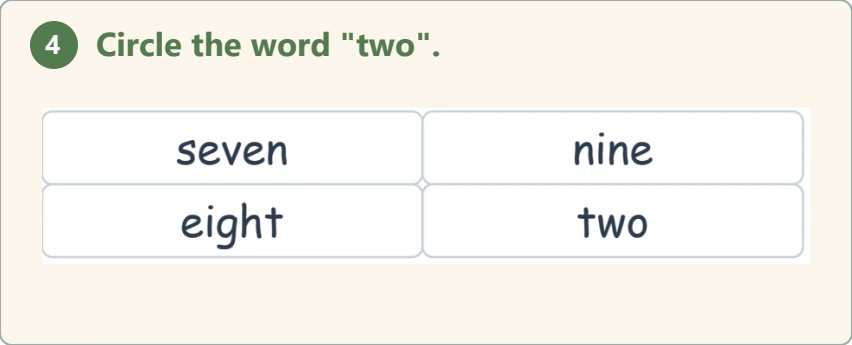
The separate writing strip shows an outlined two followed by three dotted copies. Naming the letters can be interesting, but it is not necessary to turn this short number session into a full spelling lesson. Read the complete name beside the numeral and the pair of pears. The useful connection is that these different forms can all refer to the same amount.
Discovery note 09Follow one numeral route, then leave room to try
Look together at the large 2 and its start marker. Demonstrate the particular route shown, giving the curve and finishing movement time to remain visible. Basil can trace with a finger before using a pencil. Avoid presenting several alternative styles of 2 during the same uncertain first attempt; a stable model makes comparison easier.
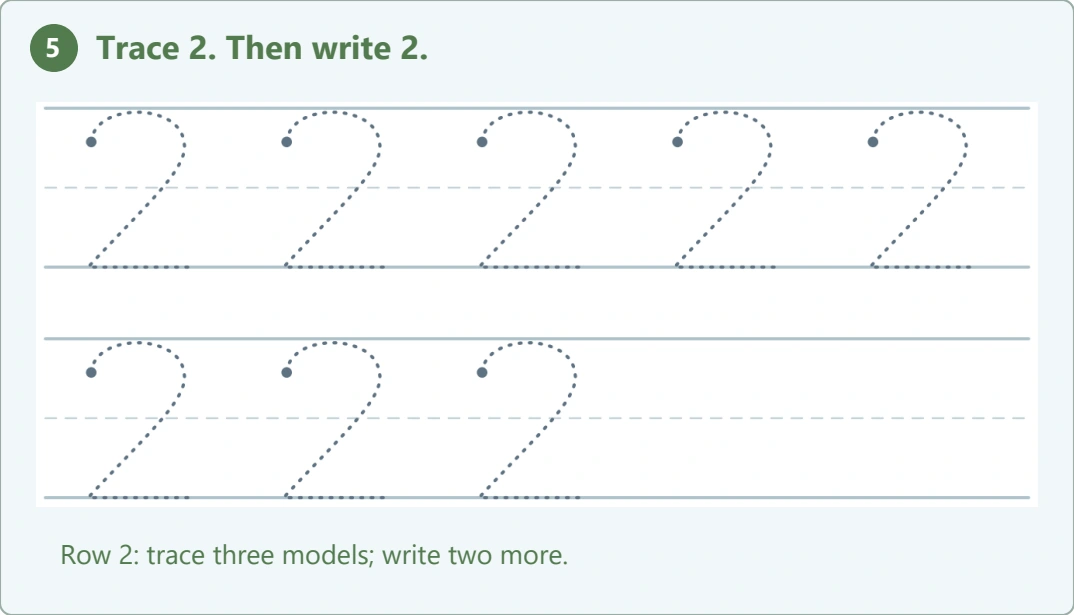
The upper practice line contains five dotted 2s. The lower line provides three dotted examples and space for two further attempts. Trace the three supplied models there, then decide whether independent writing is comfortable. The instruction concerns a number of examples, so the learner keeps writing 2 throughout. A dictated quantity explanation can accompany one short trace when hand control is still developing.
Discovery note 10A home picnic that makes the paper useful
Invite Basil to prepare fruit for two toy guests using large paper pears. Let each guest receive a pear, then bring the two fruit pictures together for checking. The adult asks how many pears the picnic used altogether. This keeps the group visible instead of relying on the child's memory of an object that has already been hidden or removed.
Afterwards, choose a paper task together. The dot frame provides a compact quantity comparison; the word panel gives a print question; the numeral line offers movement practice. The child can choose among two suitable options after the adult identifies the current need. Revisit the remaining area at another picnic rather than turning seven printed sections into a compulsory checklist.
Discovery note 11Read the response before deciding what to repeat
| Basil's choice | Possible question | A picnic response |
|---|---|---|
| One pear for the pair | Are both individual fruits being counted? | Place one on each visible mat. |
| Two hunt circles only | Was the quantity rule used for a symbol search? | Compare another printed 2 with its model. |
| Frame cells counted | Is capacity confused with occupied places? | Touch just the two counters. |
| Amount known, numeral reversed | Is the formation route unfamiliar? | Return to the start dot and one slow model. |
Do not assume that every uncertain response needs a new worksheet. Repeating a clear practical comparison may address the issue more directly. If the spoken request itself is unfamiliar, demonstrate with the fruit before expecting an explanation in a complete sentence.
Discovery note 12Five extra ways to investigate a pair
Pack a two-item lunch picture
Choose two large food drawings for a pretend bag. Keep the bag open while the learner checks the contents, then place a completed 2 label beside it. The foods may differ; a pair need not consist of matching pears.
Move a picnic boundary
Draw a large circle on spare paper and put two pear cards inside it. Widen the boundary without moving either card out. Ask whether a larger picnic area means more fruit. The unchanged objects provide a clear way to check.
Give the puppet a checking job
A puppet counts the first pear twice and calls the group two. Invite Basil to show a counting action that includes both actual fruits. Keep the correction gentle and visible rather than asking the child to accuse a partner of making a mistake.
Match a pair across materials
Place two large wooden blocks beside two paper pears. Pair each block with a fruit picture and discuss how the collections agree despite looking different. Afterwards, choose the printed dot frame that could represent either collection.
Photograph the same pears apart and together
Take two adult-managed pictures of the unchanged props in different arrangements. Let the learner explain the difference to someone who watched the objects move. Return to the actual pears whenever the photographs make the quantity less clear.
Discovery note 13Let confidence guide the length of the visit
The board is suited to supported preschool and kindergarten work, often within ages three to six. Some children will concentrate on the practical pair while others enjoy the print decisions. Offer large pieces, an adult reading voice and a short writing choice when appropriate. Neatness and quick completion are not substitutes for an explained amount.
Leave the props in a small picnic box for another day and invite a different guest. A changed listener can make the same quantity purposeful again. Notice a particular contribution, such as preserving both pears while moving the mats, rather than offering a reward for finishing every box. Stop when the shared question has a clear answer or when the child needs a break.
Discovery note 14Take the next step in a useful direction
The two-finger counting lesson represents a pair with hands. A count-and-circle picture investigation gives another selection format, while the prewriting discovery workshop separates movement practice from a quantity decision. Explore further shared activities through NAEYC's ideas for family play or PBS Parents' learning-and-growing resources.
Discovery note 15Prepare the Pear Picnic file for another visit
Pear Picnic's source upload occupies its free slot. Eligible members with active access can retrieve the clean two board using the page's membership download controls. Its printable surface has no website watermark, advertising panel or domain lettering. The related ten-board collection is a separate $4 product, linked from this page for families who want every number in one PDF.
Make a single Letter-size proof and inspect the curved 2 models, complete frame and two-dot choice. Save the chosen version where the picnic's adult helper can retrieve it. Printing another copy is most useful when there is a particular comparison or pencil movement worth revisiting.
Related Topics
Popular Worksheets
Printable resources families and teachers are downloading now.
 Free
 Free
 Free
 Free