
Fishpond Number 3: 7 Clever Steps from Fish to Figures
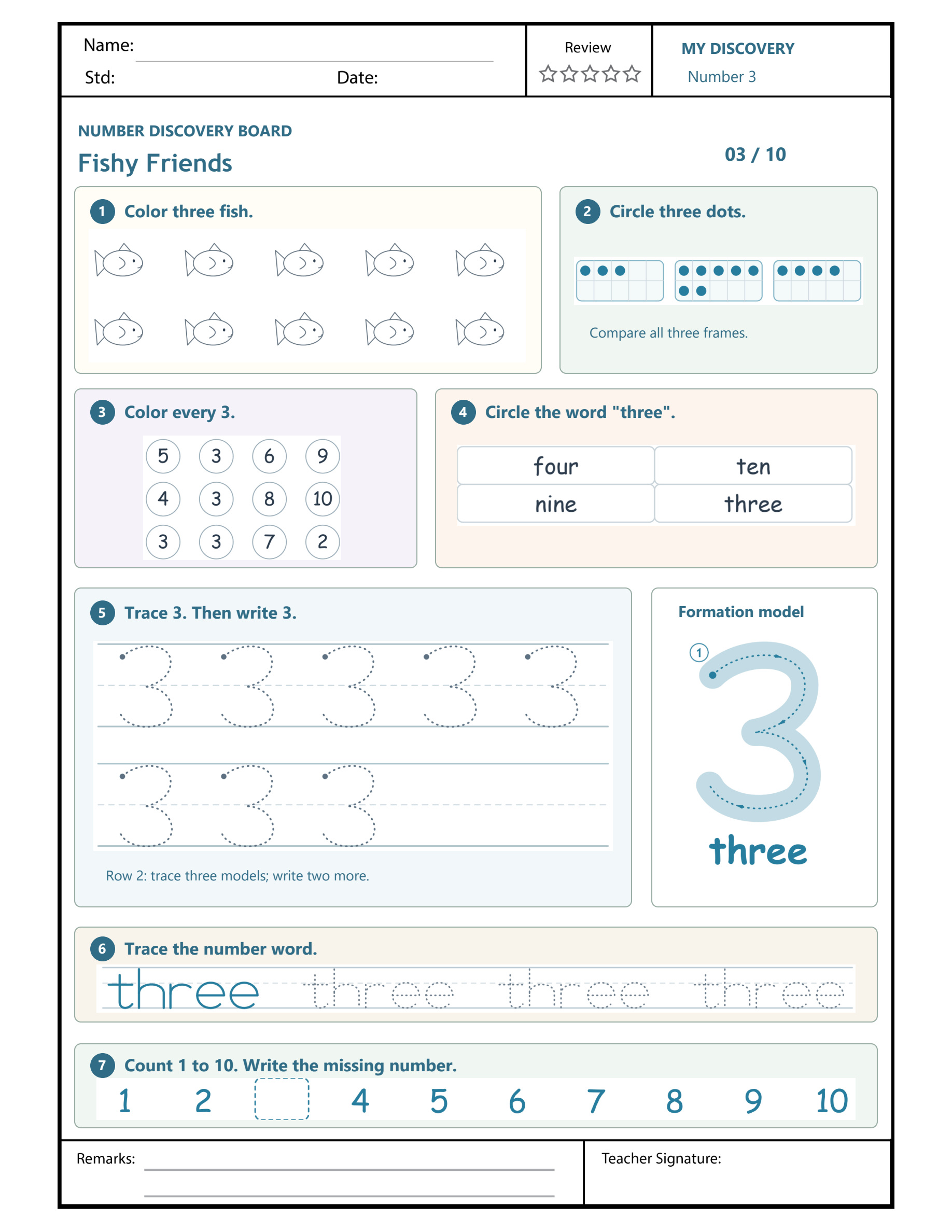
Continue beyond three with the ten Number Discovery Boards. The clean 1–10 collection brings every lesson into one $4 PDF.
The entire three board is shown without cropping.
Fishy Friends retains picture quantities, frame choices, print recognition, numeral and word practice, and a missing-3 sequence.
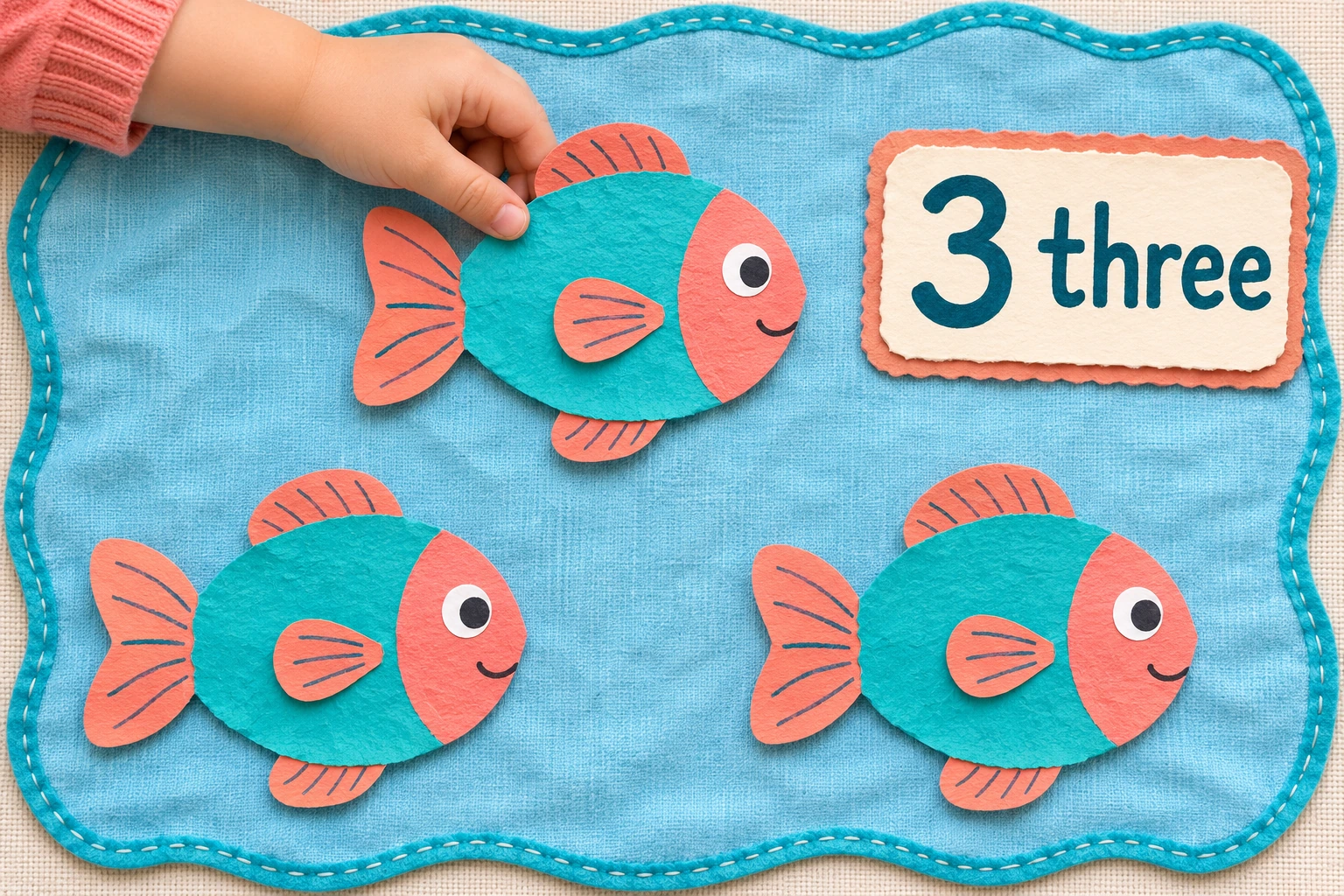
Cleo makes a little pond from blue cloth and places three paper fish in a triangle. One fish swims towards the edge, yet the pond still holds the same group. Number 3 gives that observation a place on the Fishy Friends discovery board, where quantity, print and pencil movements meet. The seven activities include choosing fish, inspecting frames, searching for 3 and completing a counting gap. Use the page to compare representations of three, rather than to test how quickly a child can finish a row of marks or recite a familiar rhyme.
Discovery note 01Number 3 across two different pond arrangements
Place the paper fish in a row, then rearrange them into a triangle without removing any. Invite Cleo to describe what the fish did. A learner may recount because the layout is unfamiliar, or may explain that all three were present throughout the move. Both responses give the adult something specific to discuss. Recognising an unchanged total is different from simply repeating the last number heard.
Leave the fish separate enough that their outlines are easy to follow. When two overlap, a child may be uncertain whether one is hidden, making visibility part of the challenge. Introduce that complication later if useful. A clear first comparison lets the child investigate the arrangement itself, supported by objects that can be pointed to and moved.
Discovery note 02Decide what counts as one fish
The worksheet supplies ten complete fish drawings in a two-row bank. Each fish includes fins, an eye and a tail, but those parts are not separate members of the requested collection. The task asks the child to colour three whole fish. Cleo can identify the chosen outlines before deciding how to decorate them, keeping selection distinct from fine colouring control.
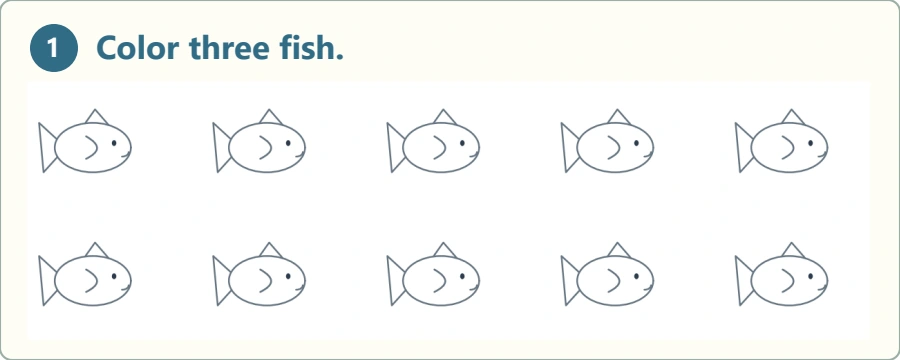
If the count follows tails or eyes rather than complete fish, use a loose paper fish as the counting unit. Move the whole cutout once for each spoken number. Then point to a complete printed silhouette and connect it with that action. It is easier to understand the counting unit when the adult shows it than when the same ambiguous question is simply repeated.
Discovery note 03An adult's compact check of the printed choices
| Fishy Friends area | Printed evidence | Matching response |
|---|---|---|
| Numeral hunt | Twelve entries in rows of four | 3 at positions 2, 6, 9 and 10 |
| Dot alternatives | 3, 7 and 4 dots from the left | The left complete frame |
| Word choices | four, ten, nine, three | three in the lower-right box |
| Sequence finish | A gap between 2 and 4 | A written 3 |
These notes are for checking after an attempt. Reading out every answer before Cleo investigates would turn a comparison into following directions. Offer the visible model when support is needed, and ask for one explained choice before supplying another. The number-hunt positions count across the first four circles, then continue on the next row.
Discovery note 04Find the numeral without counting its curves
A printed 3 has a particular shape, while its quantity meaning concerns a group of three objects. Do not teach the number by counting its curved parts. Instead, place a completed 3 card beside the pond and read it as the label for the collection. When the fish move, the card can remain appropriate because the total did not change.
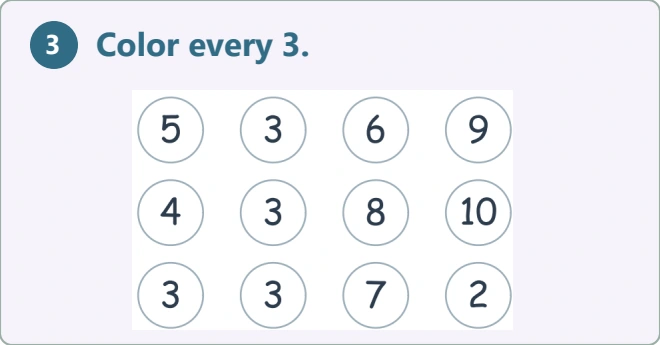
The hunt asks for all matching symbols, so four circles containing 3 should be coloured. That does not conflict with selecting three fish elsewhere. One area requests a quantity of objects; the other requests every occurrence of a symbol. If Cleo stops after the third matching numeral, return to the words of the hunt and check the remaining circles individually.
Discovery note 05Six kinds of thinking to notice in this pond
- Whole-object attention: treating each complete fish as the counted item keeps decorative details from becoming extra quantities.
- Arrangement comparison: a line and a triangle can represent the same three fish, giving spatial changes a visible reference.
- Grouping language: describing two fish near one side and one farther away introduces parts within a small complete collection.
- Visual search: the learner checks twelve numeral candidates while keeping the model available for comparison.
- Print coordination: the name three can be linked with 3 and with a matching dot pattern without pretending those forms look alike.
- Movement planning: tracing the model route gives a child time to connect the upper and lower curves into one written numeral.
The aim is to hear how the child connects these representations. A correct circle made after a partner's instruction provides less evidence of independent comparison than a slower choice the learner can explain.
Discovery note 06Use the frame as another picture of three
The matching ten-frame shows three dots in its top row. The alternatives show seven and four, so the row length alone is not the whole comparison. Cleo can touch or point beneath each dot, then identify which complete box agrees with the pond. The surrounding empty cells belong to the structure but are not additional counted dots.
Try three large counters in different ten-frame cells on spare paper. The amount remains three even if the compact printed pattern changes. Compare that movable version with the worksheet after the child has checked it. Keep the source frame visible rather than asking Cleo to remember both arrangements while also learning the spoken instruction.
Discovery note 07Trace after the fish quantity has a meaning
The numeral studio offers a large directional model, five dotted examples across its upper row and three supplied examples on the lower row. After those lower models, two spaces remain for writing. The target stays 3 throughout; the note about tracing three describes how many models to trace on that second line.
An adult can show the top curve continuing into the lower curve on a large spare sheet, following the route displayed on this board. Cleo may rehearse that route with a finger and choose one pencil attempt. If the lower curve is difficult, demonstrate that turn separately rather than replacing a meaningful counting conversation with many complete copied rows.
Discovery note 08Give the number a readable name
An outlined three begins the word-writing strip, followed by three dotted versions. Read the complete word, then point to the numeral and the paper pond. A learner need not decode all five letters independently to understand the fish quantity. Adults can discuss particular letters when that fits the child's reading experience, without making spelling accuracy the measure of counting success.

For word recognition, the four choices are four, ten, nine and three. The intended match is below ten in the lower-right box. Looking at the whole model is more reliable than selecting whichever word has a familiar initial letter. Give Cleo time to compare before naming the distractors or pointing directly to the answer.
Discovery note 09A missing position can be explained aloud
The sequence runs from 1 to 10 with the place for 3 left open. Its immediate neighbours are 2 and 4. Say that short section together and let Cleo identify the missing name before writing. The learner can explain the relationship with number cards even when forming the numeral still requires help.

Do not use a neat copied 3 as the only evidence that the sequence is understood. Covering the written model briefly and asking which card belongs between two and four gives a different kind of response. Restore the model for the pencil stage. Remembering a relationship and recalling a handwriting route should not have to become one unsupported test.
Discovery note 10At home, open a tiny fish-moving service
Prepare three large fish cutouts and two cloth pond areas. Cleo chooses which pond will receive the complete collection. Move the fish one at a time while the adult watches, then check the destination. If a fish remains behind, its visible location helps explain why the arrival pond does not yet contain all three.
Bring the board into the play after the transfer. The child can choose three printed fish to stand for the moved collection, or select the matching dot frame. A short tracing task can follow if there is still interest. End with a report about the fish move so the session leaves a number idea, not just a paper that has been worked on.
Discovery note 11In class, let partners compare two pond maps
One partner arranges three fish as a straight row and another arranges a separate set of three as a triangle. The teacher asks how the two displays can be checked. Pairing fish across the displays or counting each collection may be useful. Invite the children to describe their chosen checking method before introducing a different one.
Next, share the same board and allocate speaking, pointing and writing roles according to comfort. Change those roles during another turn rather than requiring every learner to perform all three immediately. The adult can record a child's explanation beside a finished drawing. A learner who communicates through gesture can still make a precise comparison of the two collections.
Discovery note 12Four playful returns to the same quantity
Make a two-and-one harbour
Park two fish beside a little paper jetty and one beside a reed drawing. Let Cleo describe both locations, then include every fish in the whole-pond count. No written addition sentence is necessary to discuss the smaller groups within three.
Change the pond's outline
Replace the rectangular cloth with a round paper pond while retaining the same fish. Ask what changed in the scene and what stayed true about its inhabitants. A completed 3 label can be tested against the new display.
Send a spoken fish report
An adult records Cleo saying where the three fish have moved, or writes the dictated report on paper. Replay or reread it beside the visible props. The message gives the quantity a listener without demanding independent sentence writing.
Pair fish with stepping places
Draw three large landing circles on spare paper and put a fish picture on each. Move the circles farther apart, keeping their occupants visible. The number of places can agree with the fish count while their positions change.
Discovery note 13Plan the return around a real observation
For many supported learners aged roughly three to six, a visible pond is an accessible beginning. Some will enjoy grouping immediately; others need repeated one-at-a-time movements. Follow the child's actual response. If language is unfamiliar, show the requested action and accept pointing before expecting a verbal explanation.
Avoid hurried counting, correcting every pencil wobble, or requiring the source pictures to resemble real fish colours. Revisit one question after a pause, perhaps with differently coloured cutouts. Notice a specific achievement such as keeping all three fish in the transfer or explaining the triangle arrangement. When the learner has had enough, the pond can remain ready for another day.
Discovery note 14Follow the fish idea towards another useful resource
The three-carrot finger-counting page changes the representation while retaining the amount. The picture-choice counting resource offers a different marking decision. For writing movements on their own, explore the prewriting concept activities. More shared-play possibilities are available from NAEYC's play collection for carers and PBS Parents' family learning pages.
Discovery note 15Save a Fishy Friends edition that fits your use
The free sample retains the original uploaded worksheet. The redesigned clean three board is supplied through membership downloads for active accounts with eligible access. That edition excludes domain text, the website watermark and advertising. For all ten numbers in a merged clean file, open the related collection card and choose the separate $4 purchase.
Print a US Letter trial to inspect the full border, complete fish outlines and dotted curves. Keep the selected file with the adult's pond-play notes. A later copy has a purpose when it answers a particular quantity or formation question that arose during the first visit.
Related Topics
Popular Worksheets
Printable resources families and teachers are downloading now.
 Free
 Free
 Free
 Free