
Blossom Number 4: 7 Bright Flower-Counting Challenges
Continue beyond four with the ten Number Discovery Boards. The clean 1–10 collection brings every lesson into one $4 PDF.
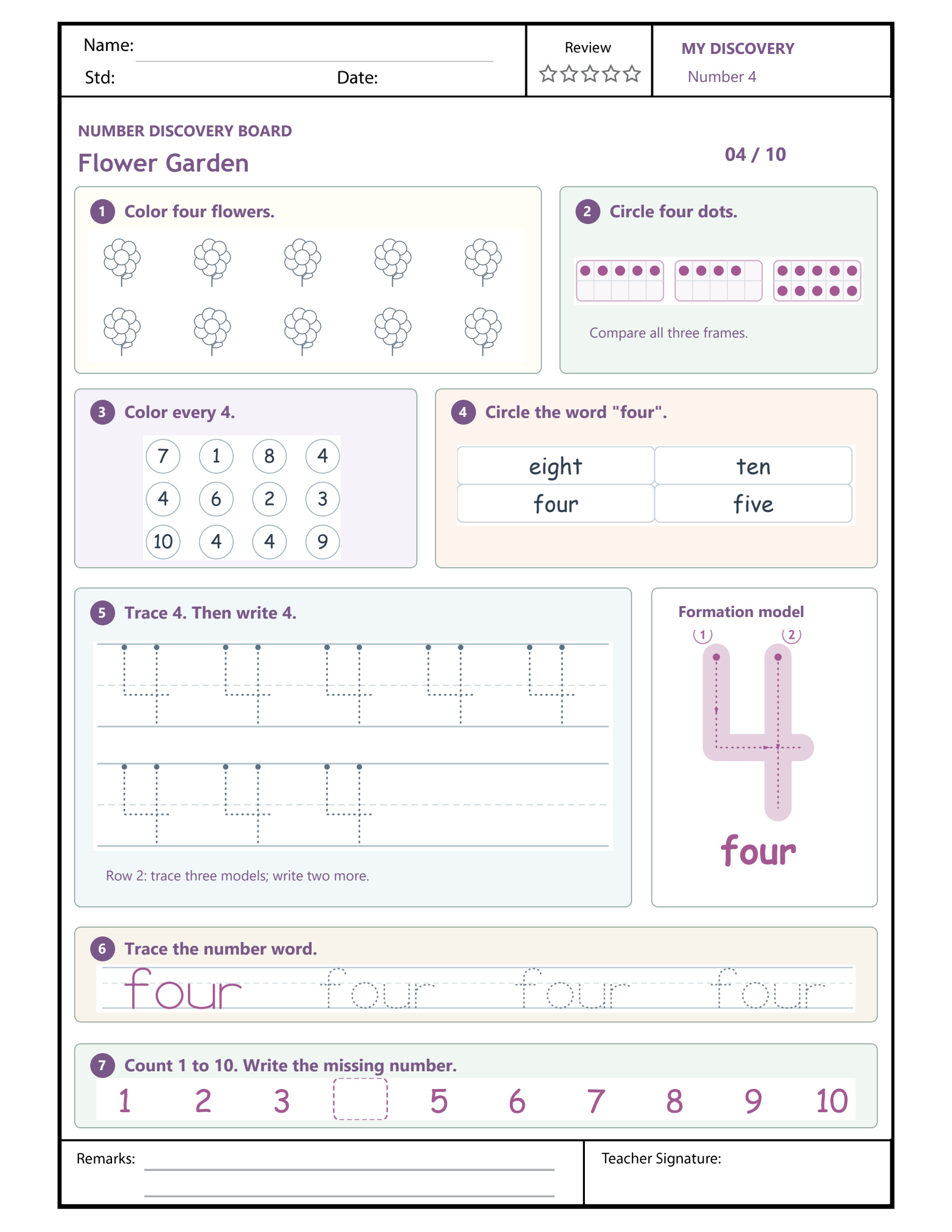
The entire four board is shown without cropping.
Flower Garden retains picture quantities, frame choices, print recognition, numeral and word practice, and a missing-4 sequence.
Four flower pots fit on Davi's little garden mat. Sliding one towards the edge makes the display wider, but it does not grow another flower. Number 4 uses that visible contrast as a starting point for the Flower Garden board. Seven printed tasks connect four with selected pictures, a dot arrangement, written symbols and a place between neighbouring numbers. The clean layout keeps quantity work above the writing area, so discussion can precede pencil control. Let Davi investigate whether a changed-looking garden still agrees with its number label before choosing another task to explore.
Discovery note 01Number 4 can fill a wider garden without growing
Begin with four large paper flowers, each attached to a separate pot drawing or block. Count them while they are close together. Move one pot outward in full view, leaving every flower visible. Ask how the display could be checked now. Davi may recognise the unchanged collection or choose to recount; the adult can listen to the reasoning rather than demanding a particular method.
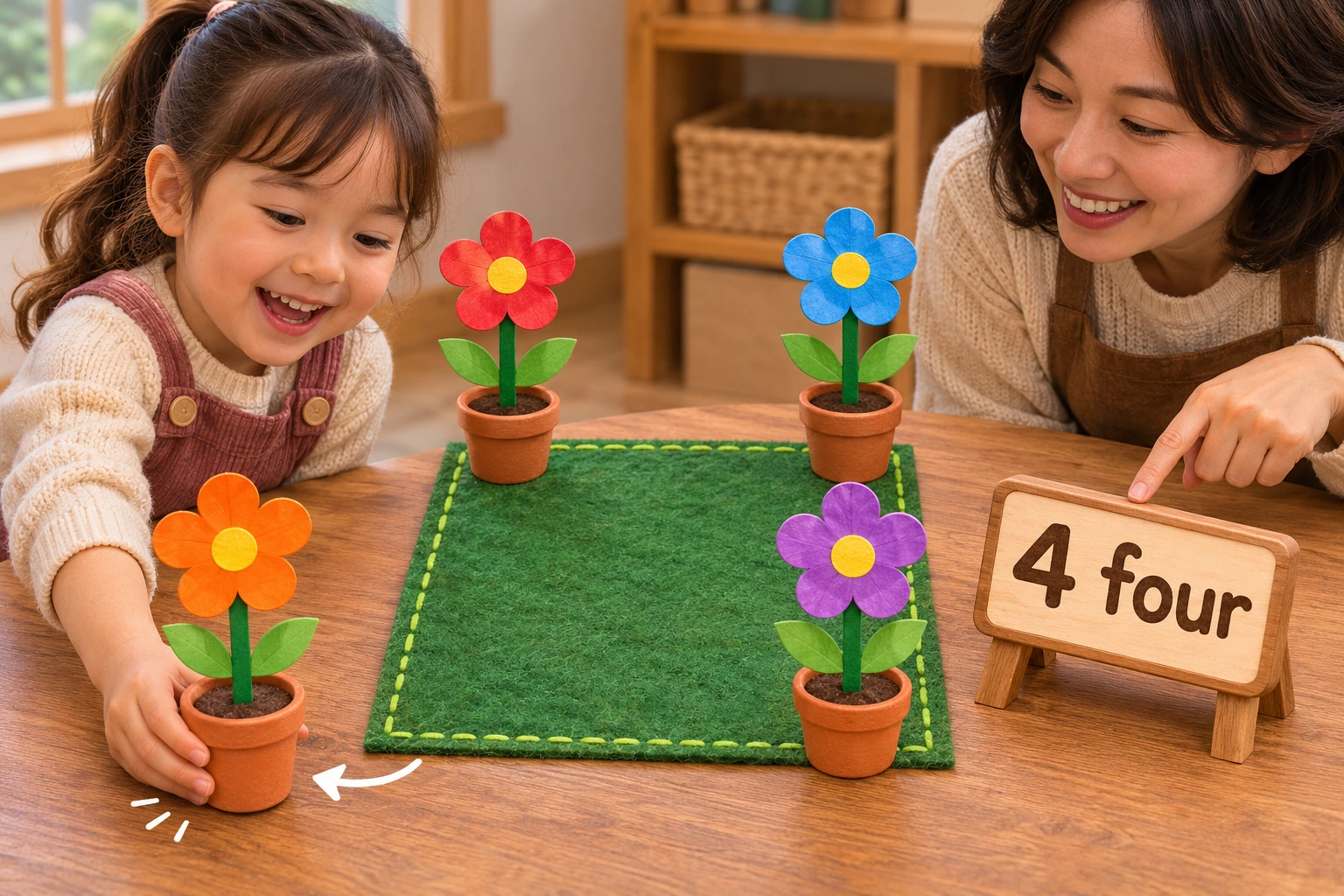
If the new width suggests a larger quantity, bring the pots back together and repeat the movement slowly. Nothing has entered or left the garden. Avoid changing the flowers' sizes or hiding a pot during the same comparison, since either could distract from the spacing question. Keeping the experiment simple makes the child's explanation easier to interpret.
Discovery note 02Check the middle dot arrangement
The Flower Garden alternatives contain five, four and ten dots. Four belongs to the middle frame. It occupies four places along the top row, leaving one unused place in that row and five more below. This provides a structured amount to compare with the movable pots, without requiring a child to recognise the pattern instantly.
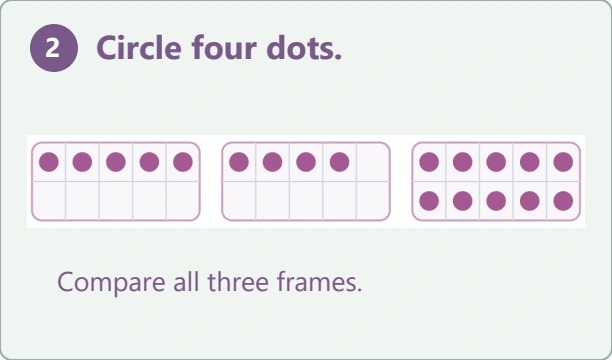
Count the dots if needed, then compare the frame with four large counters on a separate mat. A child who selects ten because both rows look impressive may be attending to visual fullness rather than the requested amount. Acknowledge what was noticed and return to the quantity instruction. The aim is to make a reasoned selection, not to train a preference for the central box.
Discovery note 03Make a flower selection before decorating petals
The board offers ten outlined flowers and asks for four to be coloured. Select complete flowers, not four petals within a single drawing. Davi can mark the intended outlines with removable counters first, then decorate them after the count has been agreed. Different petal colours can belong to the same selected flower without adding new members to the group.
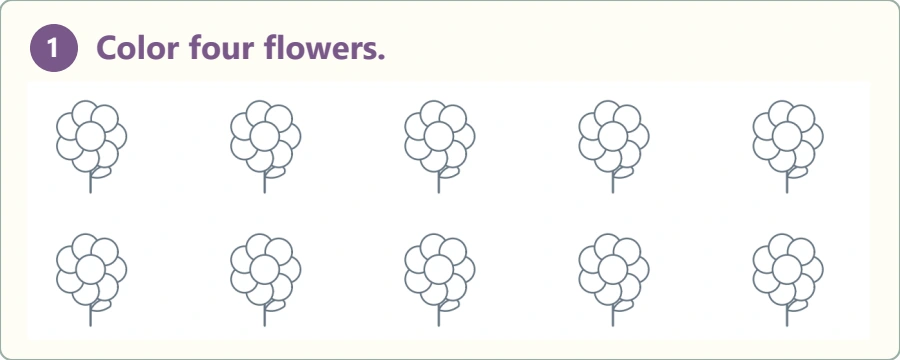
When the child has chosen four, ask which flowers are part of the garden order. The six other drawings can remain available without joining the selected group. Do not insist that the chosen flowers occupy one continuous row. The exercise concerns their number, while their locations provide another opportunity to compare arrangements that satisfy the same request.
Discovery note 04Seven things this garden can make visible
- Quantity beyond width: moving a pot supplies a concrete reason to question whether a longer-looking row must contain more objects.
- Choosing the unit: counting a whole flower keeps petals and leaves from becoming accidental extra members.
- Matching a structured pattern: the four-dot frame represents the garden with occupied places instead of plant pictures.
- Managing a selection: four requested flowers must be distinguished from the larger ten-picture supply.
- Comparing full symbols: numeral searching encourages attention to 4 among other familiar printed digits.
- Coordinating separate strokes: the formation model gives two marked starting points within one complete numeral.
- Connecting order with amount: the sequence gap places four after three and before five, extending the idea beyond a lone label.
Adults can observe these connections individually. A learner may understand the garden's quantity while still finding the pen lifts difficult. Another might form a recognisable 4 yet need to check the dot choice one mark at a time. Those are useful distinctions for choosing the next activity.
Discovery note 05At home, give the garden an adjustable boundary
Place four flower drawings inside a loop of yarn on the table. Davi can enlarge the loop while the adult keeps the flowers in view. Discuss what the boundary changed and whether a flower was added. A larger space can hold the same collection. Use the number card to label the inhabitants rather than to describe the area enclosed by the yarn.
Once that idea has been explored, locate the picture or frame shelf on the board. Invite Davi to show a printed group that agrees with the garden. A short explanation may be enough before a break. If writing is chosen next, an adult can demonstrate one 4 on scrap paper while the real arrangement remains available for checking.
Discovery note 06Two start dots can belong to one numeral
The large open-top 4 model has two numbered starting points. Follow its particular sequence: complete the first indicated part, then begin at the second marker for the remaining stroke. The two starts do not ask for two separate 4s. They show how the complete shape is assembled through more than one pencil movement.
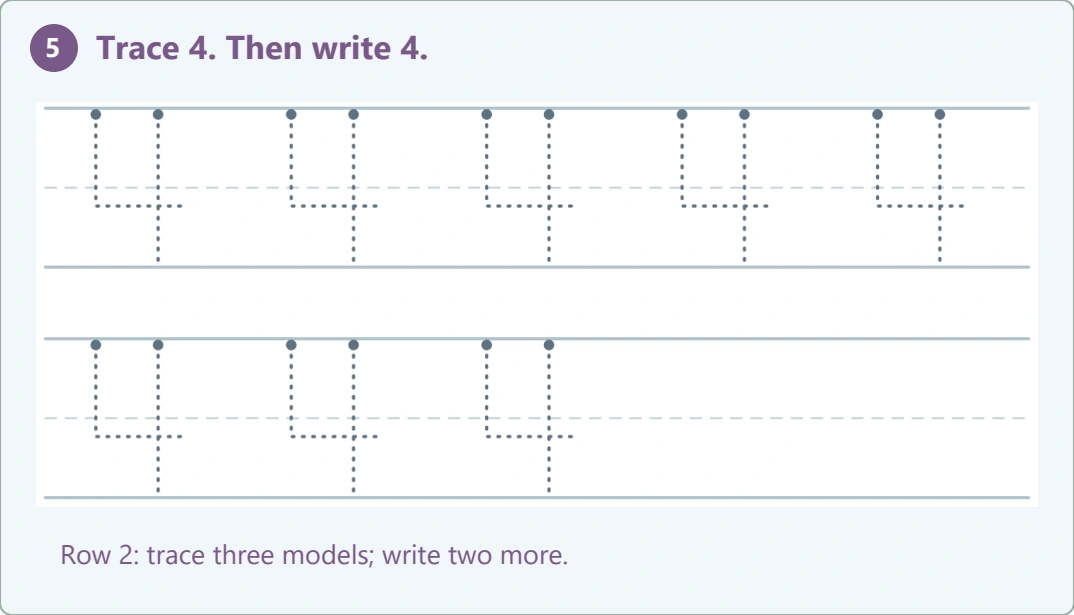
Above the lower writing guide are five dotted 4s on the first row. The second row includes three models with room to add two more. Let Davi practise one supported example before deciding how much of the strip is useful. If the second stroke is missing, show that movement beside the model rather than asking for an entire new row without further guidance.
Discovery note 07Compare four with five in print
The word-choice panel lists eight and ten on its upper row, then four and five below. The correct name is at the lower left. Four and five both begin with f and both have four letters, so a first-letter or word-length guess does not settle this comparison. Keep the model four visible and inspect the remaining letters together.

The outlined name and three dotted copies provide a separate writing opportunity. Read the number word as part of the garden conversation, and explain the spelling at a level suitable for the learner. Counting four plants does not depend on independently decoding every letter. If the child is ready to compare words, f-o-u-r and f-i-v-e offer a specific difference to investigate.
Discovery note 08A numeral hunt has its own garden rule
Read the twelve search circles across four entries per row. The 4s occur at positions 4, 5, 10 and 11. These four matches happen to equal the target amount on this board, but the instruction is still to colour every matching symbol. Explain the matching rule rather than suggesting that any four circles would complete the task.
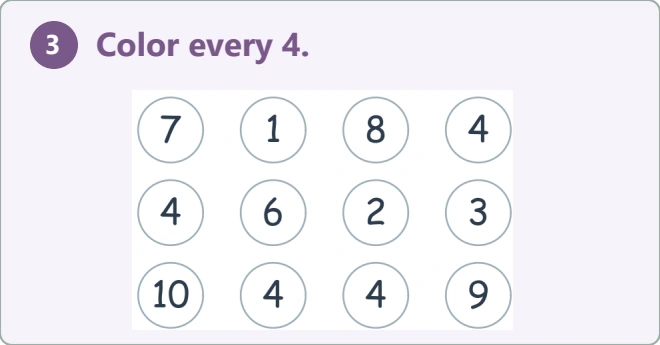
The first 4 sits at the end of its row, followed by another at the beginning of the next. A child moving quickly may skip that row transition. Point to where reading continues without revealing the remaining answer locations. The adult can then see whether the difficulty concerned symbol recognition, keeping a place in the search or interpreting the instruction.
Discovery note 09Fill the position after three
The bottom count leaves a space for 4 between printed 3 and 5. Davi can read the short sequence three, four, five aloud before considering the complete line to ten. Invite a number-card response if handwriting remains uncertain. The spoken relationship supplies a different kind of evidence from copying the visible formation model.
Try a garden path with three completed cards, then remove its middle sign while the child watches. Let Davi repair the path and explain how its neighbours help. Return to the longer printed sequence afterwards. Keeping the gap in the same position initially lets the learner consolidate this relationship without learning a new range at the same time.
Discovery note 10A teacher's comparison table
| Garden event | What it may reveal | Try next |
|---|---|---|
| Wider pots called five | Spacing may be guiding the estimate. | Watch the same pots move back. |
| Four petals coloured | The counted unit needs clarification. | Select four complete flower drawings. |
| Only one 4 stroke made | The second start may have been missed. | Demonstrate the remaining route. |
| five chosen as the word | A shared first letter may be misleading. | Compare the whole four model. |
Use the table as a way to frame another observation, not as a diagnosis from one mark. Ask what the child intended and change the support when the explanation suggests a different issue. A learner may need clearer language, a larger model or simply more time to inspect the page.
Discovery note 11Build a classroom garden together
One learner places four large flower pieces, another rearranges the spacing and a third explains what changed. The teacher can record the spoken explanation on a completed caption card. Rotate the jobs so that arranging, observing and speaking are shared opportunities. A child who prefers pointing can identify every flower included in the collection.
Bring out the board after the group has watched at least one movement. Each child selects a response independently before the group discusses it. Keep the actual flowers on the table, since recalling a hidden display would introduce a memory question. The worksheet can remain partly open while the class has already produced a useful comparison.
Discovery note 12Five garden extensions with a clear purpose
Change the fence shape
Use the same four flower pieces inside a square boundary, then inside a circle. Discuss the enclosure and its inhabitants separately. The flowers need not occupy corners for the number label to remain appropriate.
Prepare four planting places
Draw four large pots on scrap paper and match one flower to each. If the display is checked by pairing, describe that method aloud. It can confirm the quantity without demanding a memorised response to a particular arrangement.
Tell a neighbour about the moved pot
Davi explains the garden change to a partner who watched it happen. The listener points to the moved flower and then to all four. This gives the description a visible referent and an audience.
Compare flowers with other collections
Set four large blocks beside the flower pieces. Pair them one for one, then separate the two displays. Discuss how different-looking objects can support the same quantity card without needing to resemble plants.
Make a four sign for a new garden
The child dictates a label and chooses whether to trace or write its numeral. An adult adds the unfamiliar surrounding words. Place the completed sign beside the actual collection and check that it still describes the display.
Discovery note 13Keep the garden visit manageable
Davi's garden can be adapted for ages roughly three to six, using different levels of support. Some may concentrate on visible object comparisons, while others investigate number words or independent formation. The full seven-task board provides choices rather than a single age-based demand. Select one useful question and allow a response through action as well as speech.
On a later day, alter the boundary or flower colours while keeping the quantity clear. Notice a specific check that Davi makes, such as looking for an added pot or remembering the second start dot. Avoid making identical printouts Davi's only way of revisiting four. A familiar garden with one changed feature can provide a more meaningful return.
Discovery note 14Explore a different representation when it helps
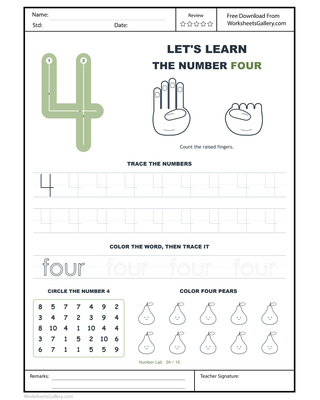
The four-pear number lab links the same amount with fingers and fruit. The before-and-after number homes offer another sequence setting. A prewriting workshop collection may suit a separate movement visit. Families can find additional shared-play settings through NAEYC's family play material and PBS Parents' activity resources.
Discovery note 15Get a Flower Garden copy for your next comparison
Choose the supplied original in the free download option. For the clean four board, use an active membership whose access includes premium worksheets and retrieve the file through the account controls. Website branding, domain printing and advertisements are absent from its printable page. The linked $4 collection offers all ten clean discovery boards as a separately purchased PDF.
Before making additional copies, inspect one US Letter print for intact flower outlines, legible four/five choices and both start markers. Keep the file with the garden materials so the next printing decision follows an actual teaching need.
Related Topics
Popular Worksheets
Printable resources families and teachers are downloading now.
 Free
 Free
 Free
 Free