
Starlight Number 5: 7 Amazing Pattern-to-Print Tasks
Continue beyond five with the ten Number Discovery Boards. The clean 1–10 collection brings every lesson into one $4 PDF.
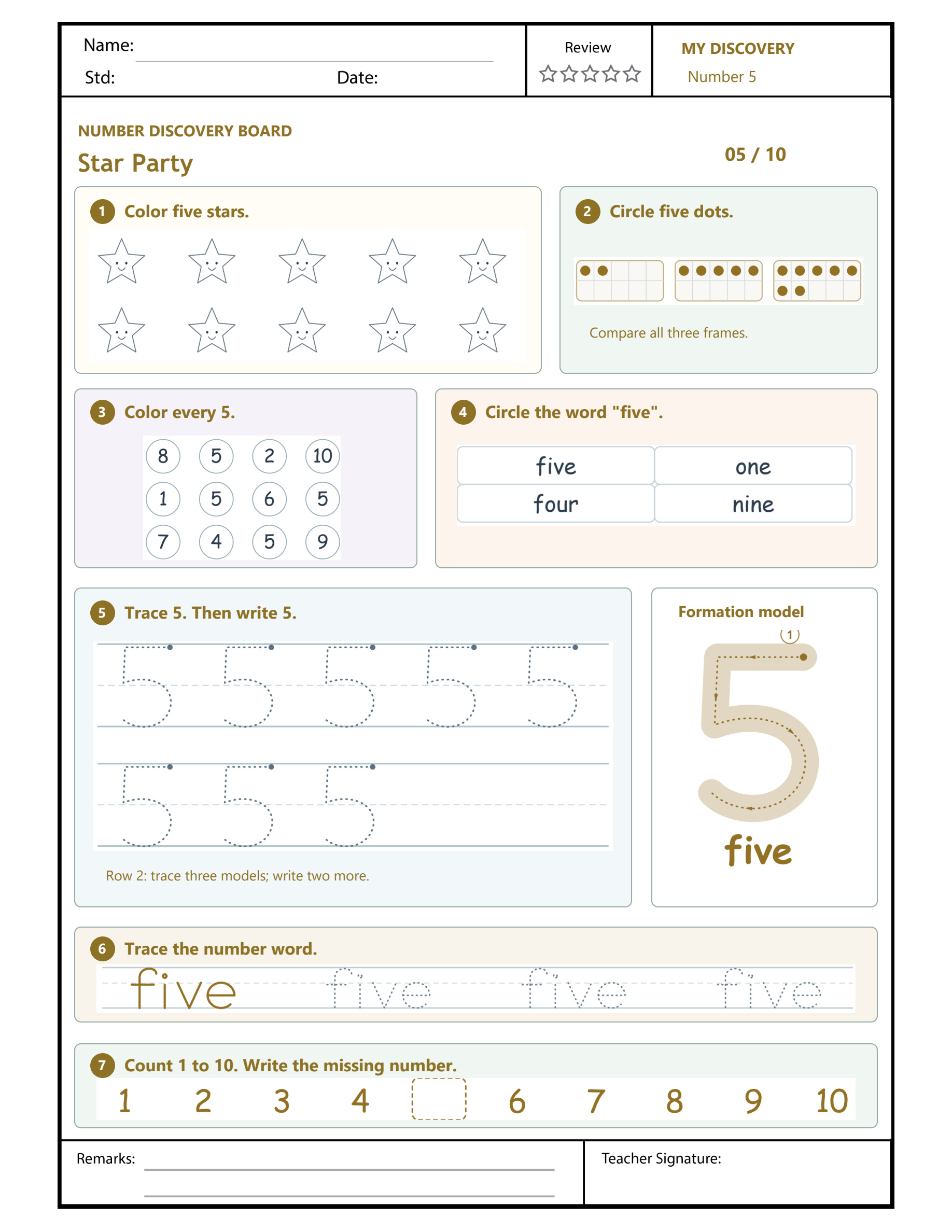
The entire five board is shown without cropping.
Star Party retains picture quantities, frame choices, print recognition, numeral and word practice, and a missing-5 sequence.
Esme hangs five paper stars along a little theatre bar, leaving a gap between every star. The row looks complete, but its length is not what makes the quantity five. Number 5 connects that visible collection with the Star Party discovery board, including picture selection, dot comparison, numeral hunting and written practice. Its seven tasks offer several ways to ask what five means. Start with the hanging stars or the printed frame, then choose a useful writing or recognition question. There is room for a short visit and another thoughtful return.
Discovery note 01Number 5 uses a complete row as a reference
The middle dot choice on this board fills the top row of a ten-frame. It has five dots, while the left alternative has two and the right has seven. The lower row of the correct frame is empty. That is an accurate representation of five, rather than an unfinished requirement to fill every cell on the card.
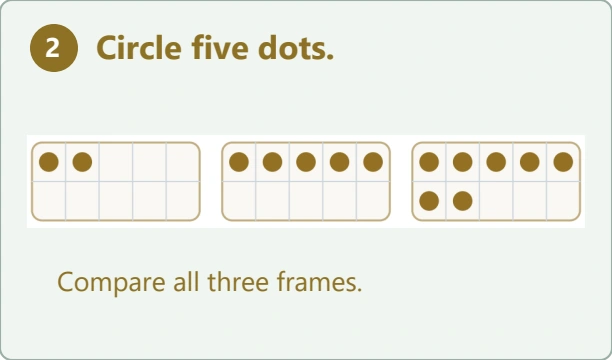
Esme can count the dots before describing the complete row. Over time, the familiar arrangement may provide a useful reference for other amounts. There is no need to demand an immediate answer without counting. Keep the pattern available, invite a checking method and listen to whether the child describes the occupied row or merely guesses from the frame's rectangular outline.
Discovery note 02Stars are the units, not their points
Ten smiling star outlines appear in the picture bank. The selection instruction concerns five complete stars. Counting five points on one star would answer a different question. Put a large paper star beside the worksheet and move that whole piece once for each spoken count. The demonstration makes the intended unit visible without relying on a lengthy correction.
Any five outlines can belong to the chosen group. A child may prefer the first row, alternate between rows or choose a scattered arrangement. Ask Esme to indicate the intended collection before adding colour. The colouring can then express a preference while the quantity remains checkable. Different colours do not require separate counts unless a new sorting question is deliberately introduced.
Discovery note 03Give the theatre row an audience
At home, invite a toy audience to inspect the five hanging stars. Esme points along the bar, counting the actual cutouts once each. The adult can move the stars closer together and ask whether the performance now has a different number of stars. Because all pieces stay visible, the child can check the display rather than rely on a remembered number word.

Use a completed 5 label as the theatre's quantity sign. Later, choose a printed task that connects with that display. The full dot row gives a structured comparison; the picture bank supplies another selection. Writing does not have to begin while the child is still deciding what is being counted. A short oral report to the audience can complete the first session.
Discovery note 04Six benefits worth explaining to an adult helper
- A five-place anchor: a completed frame row offers a visible reference that can later be compared with smaller or larger amounts.
- A clear counting unit: separating complete stars from their decorative points supports careful interpretation of a picture task.
- A selected collection: choosing five from ten requires deciding which objects belong to the response and which remain outside it.
- A symbol to inspect: the numeral hunt asks the learner to recognise every 5 across several rows of distractors.
- A written name to connect: five can be linked with both the quantity and the numeral while adults support unfamiliar reading.
- A movement to rehearse: the start marker and dotted models make the particular formation route available during pencil practice.
Use these opportunities to guide conversation rather than to promise a fixed learning result. A learner's explanation and the support provided matter as much as whether a box eventually contains the expected mark.
Discovery note 05The twelve-circle search is about matching
Five appears at positions 2, 6, 8 and 11 when the search is read in rows of four. Four circles should be selected. The instruction does not ask for five circles merely because the target is 5. This distinction is particularly useful here because the picture task really does request a group containing five objects.
If Esme colours an additional nonmatching symbol to reach five marks, compare that candidate with the large 5. Let the child explain the difference before deciding how to revise the response. Do not turn the hunt into a memory test by withholding its model. Its purpose is a careful comparison of the printed entries, not recall of the adult's answer locations.
Discovery note 06Read the word box before copying the name
Five is the upper-left word choice. One sits beside it, with four and nine underneath. Read the model name and invite a whole-word comparison. A child who can count five stars may still need help recognising the printed word, so an adult reading voice can support that task without taking away the quantity work.
The separate word strip begins with an outlined five and offers three dotted copies. Point to the complete spelling while saying its name naturally. If Esme wants to discuss the letters, connect them to the written model rather than guessing from the number of letters. Four letters can spell five; the length of a written name is not its quantity meaning.
Discovery note 07Let the displayed 5 guide the first pencil attempt
Find the start marker on the large model and follow the route shown there. The model provides a particular sequence of movements; it is not necessary to introduce several possible handwriting forms in this short lesson. The adult can demonstrate on spare paper, then let Esme try a finger movement before choosing a dotted example.
The first numeral row contains five dotted 5s. Three more appear on the lower line, followed by room for two independent copies. The note about tracing three refers to those models, not to writing the numeral 3. Choose a manageable amount of practice. If one bend is difficult, show that bend again rather than requiring repeated complete rows without a clearer plan.
Discovery note 08Five belongs after four and before six
The bottom sequence leaves its fifth position unanswered. The printed neighbours are 4 and 6, and the missing response is 5. Esme can identify it orally, select a completed number card or write the numeral, depending on the support needed. These responses can be considered separately rather than treating handwriting as the only route to an answer.

Read the local section of the count before returning to the complete line from one to ten. If the learner skips from four to six, lay out the three relevant cards and discuss the middle place. A small, visible relationship is easier to investigate than being told to repeat the entire counting sequence until it sounds right.
Discovery note 09A classroom display with changing curators
Give a group five large star pieces and a paper display strip. One curator arranges them, another checks the number and another places the completed label. Change the arrangement on a later turn while keeping all five pieces visible. The teacher listens for a description of the amount, the arrangement or both, then asks the question that needs clarification.
After the practical display, children can make their own printed choices before comparing responses. A child who prefers pointing may identify a matching frame while another explains the choice aloud. Rotate those opportunities. A shared activity should not leave the same confident speaker responsible for every explanation or require a hesitant learner to write before participating.
Discovery note 10A short adult checklist for the star decisions
| What happened | Clarify this distinction | A visible check |
|---|---|---|
| One star's points were counted | Shape parts versus complete objects | Move five whole star pieces. |
| Both frame rows were filled | Capacity versus the requested amount | Compare five counters with one full row. |
| Five hunt circles were chosen | Quantity selection versus symbol matching | Inspect each coloured candidate. |
| A correct count ends in shaky writing | Number meaning versus motor control | Offer one large formation demonstration. |
The checklist suggests where to look next. It does not determine why a child acted a certain way without listening to the child. A response can arise from unclear language, a missed example or a momentary distraction as well as an unfamiliar mathematical relationship.
Discovery note 11Five invitations beyond Star Party
Make a five-seat audience
Arrange five large seat drawings and invite one toy to occupy each. Compare the occupied seats with the hanging stars. The objects differ, but pairing can show that the two collections agree in quantity.
Change the star spacing
Slide the same five stars into an uneven row. Ask Esme to choose a way of checking whether the label still fits. A recount is welcome; the point is to inspect the objects rather than judge the display by width alone.
Build a star-to-dot bridge
Place five large counters below the five cutouts, one beneath each. Move the counters to a ten-frame while leaving the stars available. The bridge provides a practical connection between the theatre display and its printed dot representation.
Dictate a curator's caption
Esme tells an adult what belongs in the display. The adult writes the unfamiliar surrounding words, leaving a place for a supported 5 if the learner wants to add it. Read the completed caption back beside the actual stars.
Trade the display material
Replace the stars with five large leaves or blocks on another visit. Decide whether the quantity label needs changing. The material has changed, while five can still describe the complete collection.
Discovery note 12Keep the task suitable for the child in front of you
Esme's star row offers guided choices for preschoolers and kindergarten children, commonly between three and six years of age. Some need the large props and a spoken count. Others can compare frames, inspect spelling or try the open writing spaces. Choose the entry point according to the response rather than assuming all seven activities are equally accessible.
A satisfying visit can end after Esme explains one correct comparison. On another day, invite a new curator or change the displayed material. That keeps practice regular without making repetition depend on finishing identical copies. Notice the strategy used—perhaps pointing to each whole star or checking a frame's occupied places—and offer time to rest when attention or hand control is tiring.
Discovery note 13Extend the five idea with another resource
The five-finger findings lesson offers a hand-based representation. The counted-picture choice activity changes the response format. The number homes resource can develop before-and-after relationships. For more shared settings, visit NAEYC's family play suggestions and PBS Parents' learning ideas for families.
Discovery note 14Download the Star Party edition you intend to use
The source sheet is offered as a free original. An eligible active membership gives account access to the clean five discovery board through the premium download controls. The redesigned printable carries its activities without the domain name, website watermark or advertising. A separate $4 purchase of the linked collection gathers all ten clean boards into one file.
Use US Letter paper and inspect one proof for the complete border, visible dots and clear start marker. Keep that chosen file near the theatre materials so a later print supports a particular return to five. Producing a whole stack in advance is optional.
Related Topics
Popular Worksheets
Printable resources families and teachers are downloading now.
 Free
 Free
 Free
 Free