
Orchard Number 1: 7 Brilliant Ways to Explore One
Continue beyond one with the ten Number Discovery Boards. The clean 1–10 collection brings every lesson into one $4 PDF.
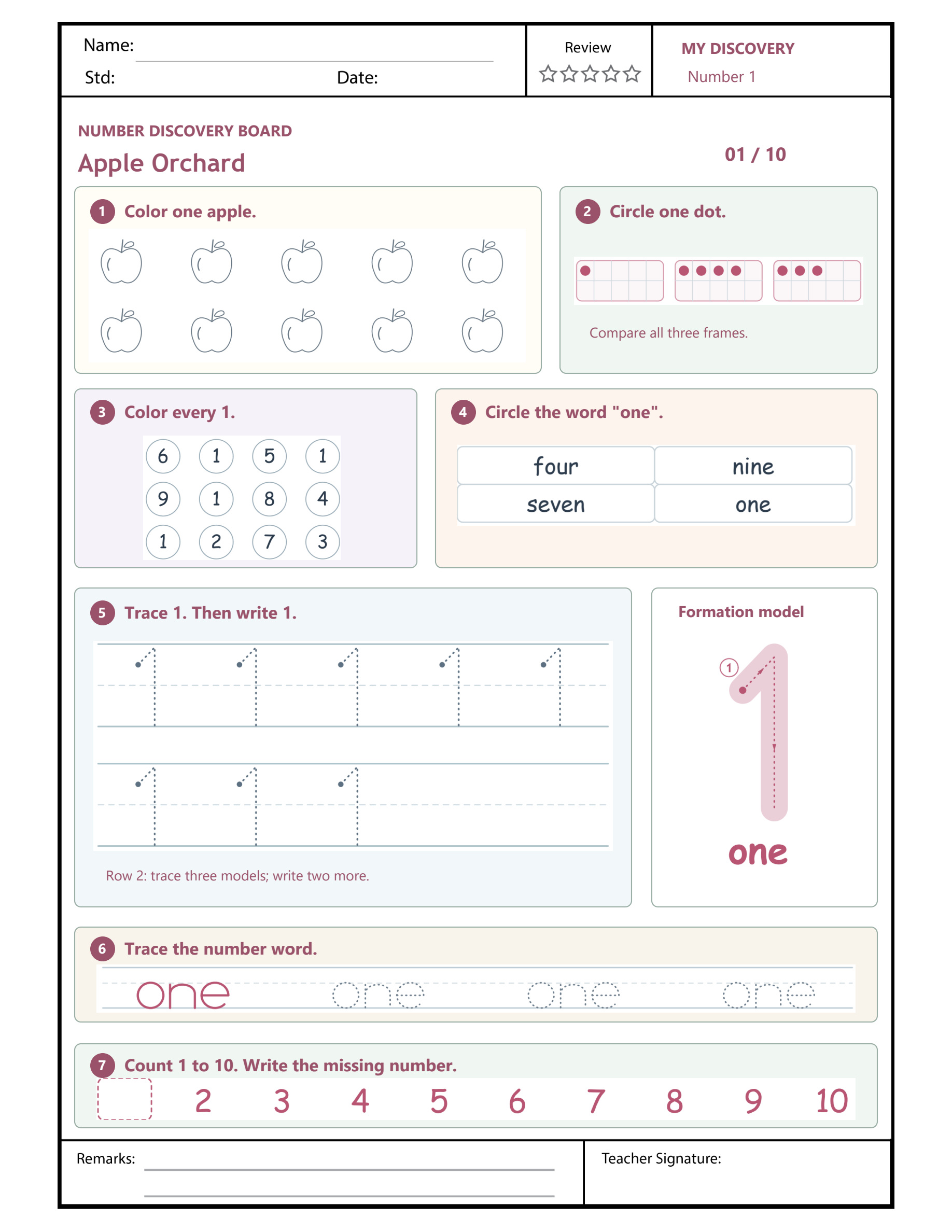
The entire one board is shown without cropping.
Apple Orchard retains picture quantities, frame choices, print recognition, numeral and word practice, and a missing-1 sequence.
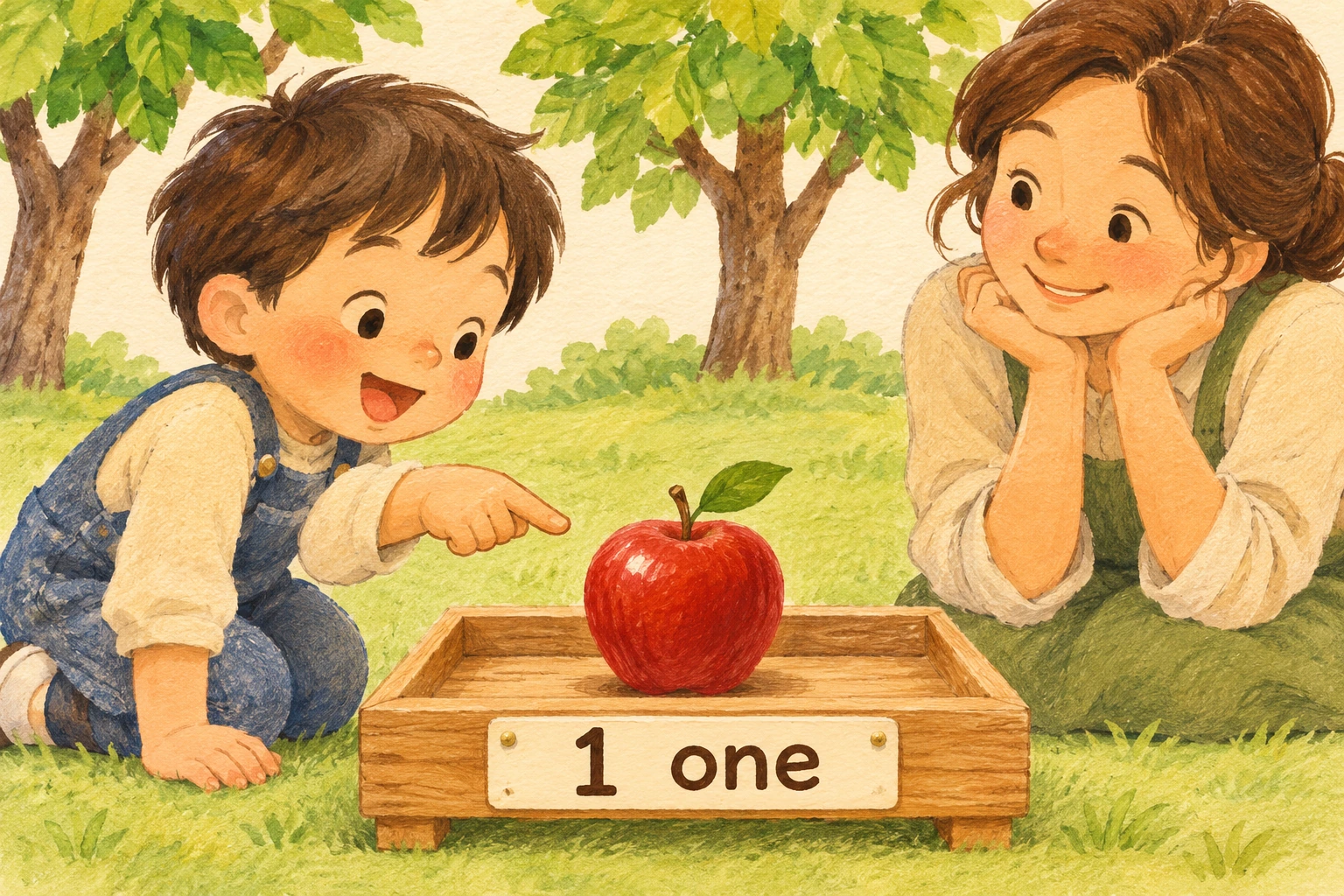
Ada's orchard delivery has one place waiting on the tray. Several apples would look attractive, but the order asks for a single fruit. Number 1 turns that small delivery into seven connected investigations: choosing an amount, comparing dots, spotting a numeral, finding its written name and making careful pencil marks. The Apple Orchard board puts the quantity choices before the writing studio. Invite Ada to explain what belongs on the tray, then choose a printed task that makes the idea clearer. A complete page is not required for a worthwhile first visit.
Discovery note 01Number 1 gives the delivery label an amount
A written 1 might identify a bus, a room or a player. Here it tells how many apples to choose. Make that role clear by putting a completed 1 label beside an empty delivery tray, adding one large pretend apple and reading the label again. The symbol stays the same because the amount agrees with the order. The apple's size or colour does not determine whether there is one.
Now exchange the prop for a smaller apple picture. Ask Ada what changed about the delivery and whether the quantity changed too. An object can look different while still being the single member of the selected group. Avoid placing two pictures on the tray during this first comparison; that would introduce a quantity change at the same moment as the appearance change.
Discovery note 02Ten printed apples are a supply, not an order
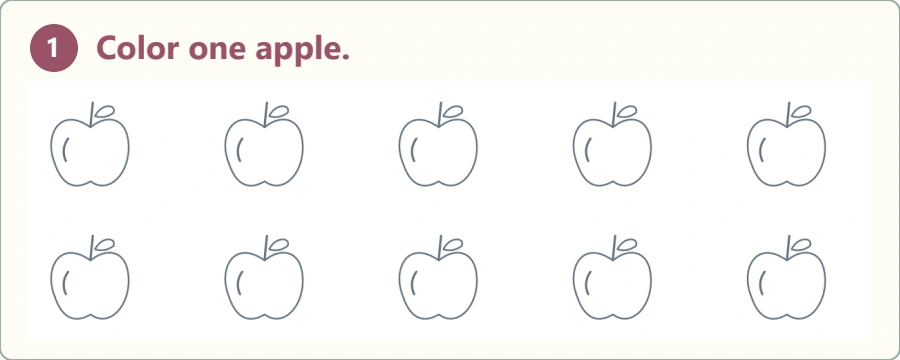
The picture shelf contains ten apple outlines arranged in two rows. Its instruction asks for one coloured apple. Ada may select any complete picture in that supply. The remaining nine outlines can stay uncoloured, even when decorating them would be enjoyable. Choosing a red crayon is optional; selecting the requested amount is the mathematical decision.
Let the learner point to a chosen apple before colouring. If the pointing is accurate but the colouring spreads beyond the outline, keep the two observations separate. A broad crayon mark may reflect developing control. It does not necessarily mean the child intended to select several apples. Ask which picture belongs to the delivery instead of inferring an answer solely from the neatness of the mark.
Discovery note 03Three dot boxes, only one matching amount
Read the frame alternatives from left to right. They contain one, four and three dots. The left frame agrees with the apple order. Its nine unoccupied places do not mean the frame is unfinished; they help show that the selected amount is smaller than the frame's capacity. Ada can point to the occupied place before deciding which complete box to circle.
An adult may offer a large counter on a hand-drawn ten-frame, positioned like the printed model. Move it to a different cell while the child watches. There is still one counter. This separates the amount from a particular corner location, while the printed exercise itself remains unchanged. When returning to the page, compare the actual dots rather than guessing from the position of the answer box.
Discovery note 04Six observations from one small orchard order
- Quantity language: Ada connects the spoken word one with a selected fruit rather than with the name apple.
- Attention to a request: the tray gives the instruction a visible purpose, so the child can explain why a single object belongs there.
- Visual matching: a one-dot frame offers a second representation of the same amount without relying on the fruit illustration.
- Symbol discrimination: the search requires checking individual entries, including familiar digits that do not match 1.
- Hand movement: a starting dot and ruled models provide a route that can be rehearsed before an independent mark.
- Print relationships: one, 1 and the beginning of the sequence describe connected ideas while using different written forms.
These observations need not arrive together. Ada might explain the delivery confidently yet need a fresh demonstration of the numeral route. Another learner may trace neatly while continuing to colour several pictures. Choose the follow-up from the particular response, rather than assigning the same extra work for both situations.
Discovery note 05Find four ones in a twelve-entry search
The numeral hunt uses three rows of four circles. Counting positions across each row, the matching 1 entries occupy positions 2, 4, 6 and 9. This is not an instruction to colour one circle. The wording asks for every matching numeral, so four separate circles should eventually be selected. The object shelf and symbol hunt have different completion rules.
If Ada colours only the first matching digit, reread the hunt instruction and inspect another entry together. Ask whether that symbol also matches the model. If Ada colours a 7, compare the whole printed shape rather than saying only that the answer is wrong. A brief covered model can be uncovered again whenever the visual comparison becomes uncertain.
Discovery note 06Let the pencil follow a visible plan
The large formation model sits beside the lower numeral studio. Its start marker provides a place to begin, and the dotted examples keep the route available during practice. The first row contains five models. The next row has three dotted copies and space for two independent attempts. Here, “trace three models” means three examples of 1, not a change of target to 3.
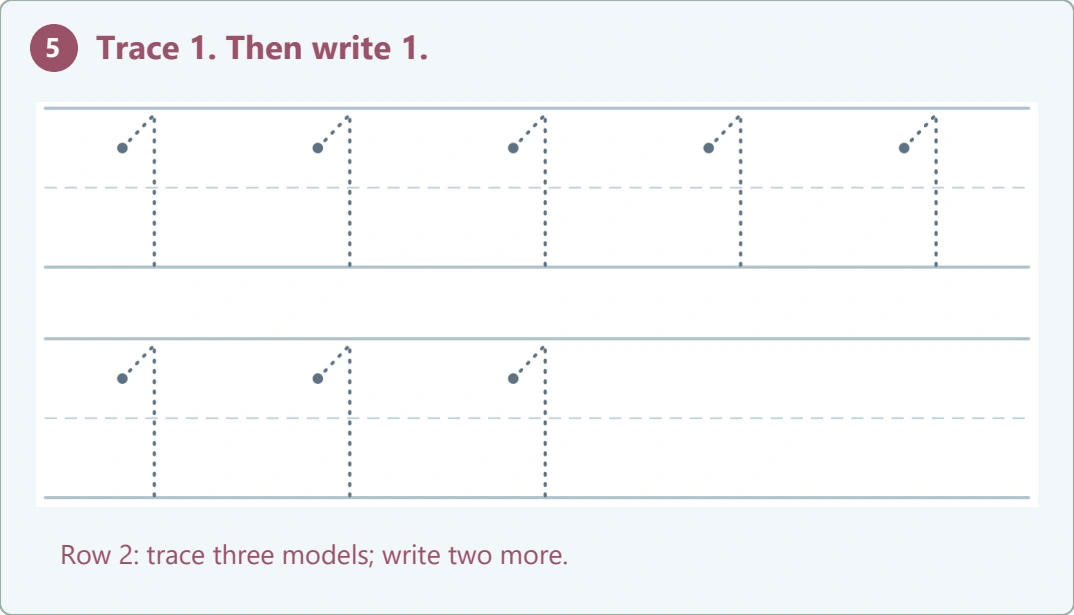
Offer one demonstration on spare paper and let Ada describe the movement with an ordinary word such as down. Follow the particular model shown on this board rather than introducing several handwriting styles at once. A large air movement or finger trace can precede a pencil attempt. The open writing spaces are invitations to try, not a reason to withhold help until an error occurs.
Discovery note 07One has a written name as well
The word strip presents an outlined one and three dotted versions. Read the name aloud while pointing to the complete spelling. A child who cannot independently read this word can still understand the one-apple order. Keep early spelling exploration alongside quantity work, rather than turning the word into a gate that must be passed before any counting success is acknowledged.
The separate word-choice panel contains four, nine, seven and one, arranged as a two-by-two group. One is at the lower right. Invite comparison with the visible model above the writing strip. Looking only for a short word is insufficient because the goal is this particular name. An adult can name the other choices after Ada has had time to investigate the intended match.
Discovery note 08The missing place is the beginning
At the bottom, the counting sequence leaves its first position empty and prints 2 through 10 afterwards. The response is 1. Unlike a middle gap, this space has no printed predecessor on its left. Ada can use the beginning of a spoken count and the visible 2 to explain what belongs there. There is no need to introduce zero as an additional worksheet answer.
Try placing a removable card labelled 1 before a separate row of number cards. Let the child read the complete sequence, remove the first card and restore it. Return to the printed gap after the relationship is clear. A copied digit is useful writing practice, while an explanation of why it belongs at the beginning supplies different information.
Discovery note 09An orchard visit at home
Use a large toy fruit or a paper drawing rather than requiring real food. Invite Ada to deliver one apple to a seated toy customer. The adult checks the tray aloud and gives the child a turn to become the customer. Changing who speaks makes the number request part of an exchange rather than a command that always comes from the same adult.
After the delivery, open the board at the picture shelf. Ada points to an outline that could represent the fruit. Choose either the dot comparison or one numeral model next. Put the sheet away once the selected question has been explored. A later pretend customer can request another single delivery, offering a new reason to return without requiring a stack of identical completed pages.
Discovery note 10A classroom table with different ways to contribute
Give a small group one tray, several large apple pictures and a completed numeral label. One learner prepares the delivery, another checks its quantity and another locates a printed 1. Rotate the jobs. A child may contribute through pointing or arranging while an adult supplies unfamiliar language. Avoid allowing the quickest speaker to answer for everyone.
| Orchard response | Adult move | Next observation |
|---|---|---|
| Several apples chosen | Return to the single-place delivery. | Which fruit meets the order? |
| One apple, several hunt matches | Read both different instructions. | Can the child explain both rules? |
| Meaning clear, pencil hesitant | Show one large numeral route. | Does a supported mark feel manageable? |
Discovery note 11Four further orchard invitations
Change the wrapping
Place the pretend apple beside a paper bag, then inside it without adding another fruit. Ask Ada to explain what the delivery contains. Reveal the object again before recording a quantity so that memory, hiding and counting are not all being tested together.
Curate a single-object shelf
Choose one familiar object for a tiny display and attach a completed 1 card. On another visit, exchange the object. The display's subject changes, while its quantity label can still be appropriate. Let the child explain whether the label needs replacing.
Repair the orchard assistant's sign
A puppet places the written word one beside its tray but shows an unrelated numeral card. Provide a visible 1 model and ask the learner to find a better match. The puppet can thank Ada for a specific comparison without staging a public right-or-wrong contest.
Make a first-stop route
Put large cards 1, 2 and 3 beside three pretend collection points. Begin at 1 and carry a single apple to that stop. Explain separately that the stop label identifies a place, while the apple count describes the delivery. Those uses can share a symbol without being the same question.
Discovery note 12Keep early attempts comfortable
Ada's delivery can suit preschool or kindergarten learners, often aged three to six, when an adult adapts the starting point. A younger participant may stay with the tray and one dot. An older beginning writer may enjoy comparing several printed representations. Base Ada's writing choice on readiness; finishing all seven sections is optional.
For regular revisits, keep a small orchard prop with the chosen sheet and offer a practical invitation. Notice the moment Ada distinguishes the order from the available supply, or explains why several search circles can be correct. If attention fades, finish the pretend delivery and save the writing for another day. The learner should be able to recognise what was achieved.
Discovery note 13Continue with a related kind of number play
The finger-based number studio supplies a different visible representation of small amounts. The neighbour-number homes extend sequence relationships, while the pencil-control concept collection offers separate movement practice. For other adult-and-child play settings, browse NAEYC's family play guidance and PBS Parents' shared learning suggestions.
Discovery note 14Choose your Apple Orchard printable
The uploaded original is available as the free sample. An active membership with eligible premium access provides the clean one discovery board through the page's account controls. That printable removes the website watermark, domain name and advertising. The collection card leads to a separate $4 purchase containing all ten clean boards together, so the individual membership option and combined product remain clear choices.
Check the first US Letter print for its complete outer frame, small dot choices and faint dotted 1 models. Keep Ada's selected edition with the orchard props for a later delivery. A useful print is one the adult can find again when the number question returns.
Related Topics
Popular Worksheets
Printable resources families and teachers are downloading now.
 Free
 Free
 Free
 Free