
Lemon Number Six: 6 Clever Five-and-One Discoveries
Find the five-and-one lemon lesson inside the ten-sheet clean collection for a single $2 purchase.
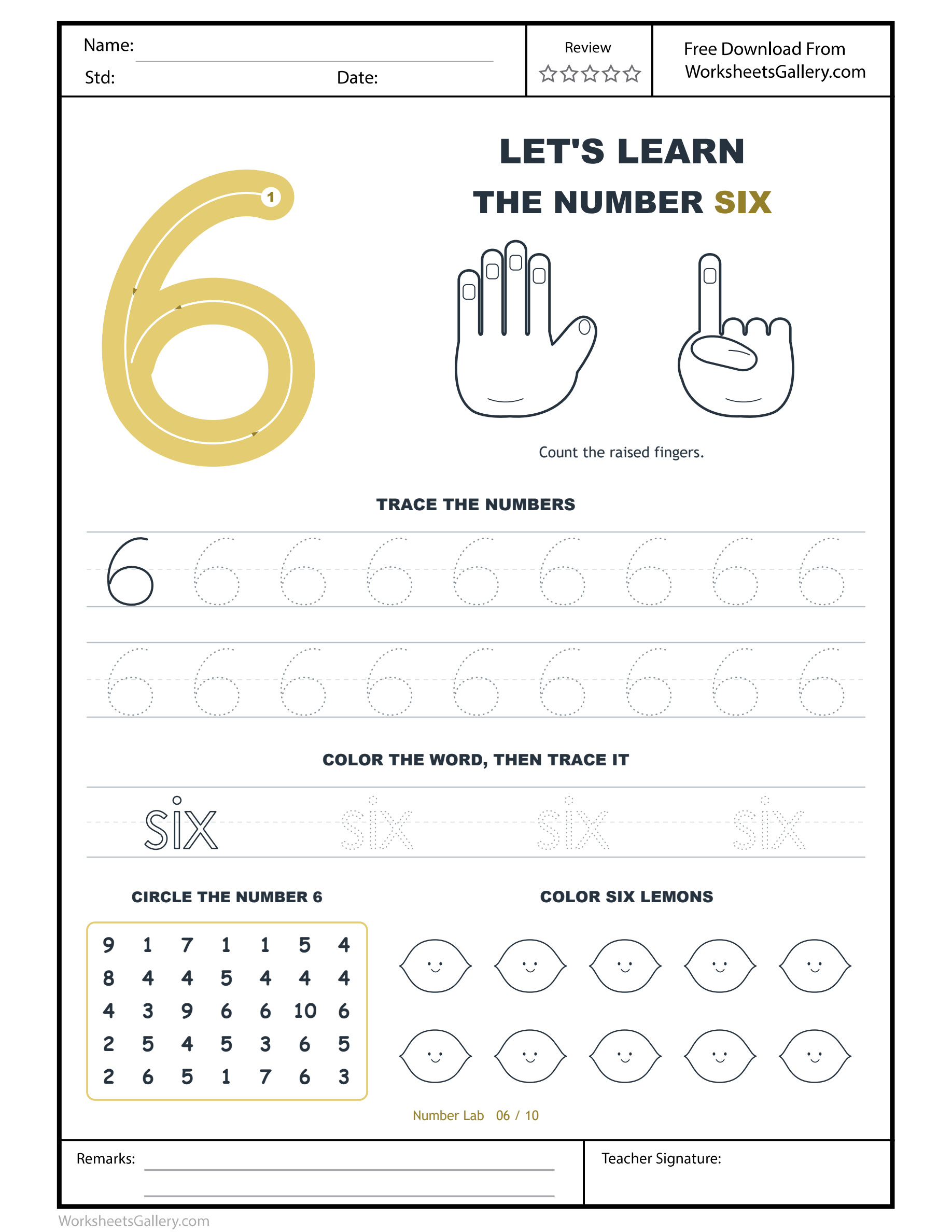
Five fingers fill the first hand, and one more begins a new group. Lemon Number Six uses that visible five-and-one arrangement to explore six through hands, a numeral model, written number practice, a word band and two picture-based checks. The learner searches for matching 6 entries and chooses six lemons from ten outlines. A parent or teacher can let the child count every raised finger first, then discuss the two parts. This page suits an adult-supported number visit where understanding the amount remains separate from how smoothly a pencil follows the dotted route.
AMOUNT
6 / six
HAND PARTS
5 + 1
FOOD CHECK
6 of 10 lemons
🍋 Hold on to the first five — Lemon Number Six
The Lemon Number Six hand picture is a bridge beyond a single hand. Its first hand shows five extended fingers and its second shows one. Begin by asking what is raised on each hand. A child may count one through six across the complete display. That is a valid way to establish the total before exploring a shorter “five, six” count-on description.
Use the illustrated lemon trays beside Lemon Number Six to make those parts easier to discuss. Five lemons share the larger tray, and one sits separately. The completed equation is a supporting adult reference, not a new writing demand on the supplied worksheet. Two visible groups contribute to one total. Let the learner move a pointing finger across the group boundary while explaining how six was checked.
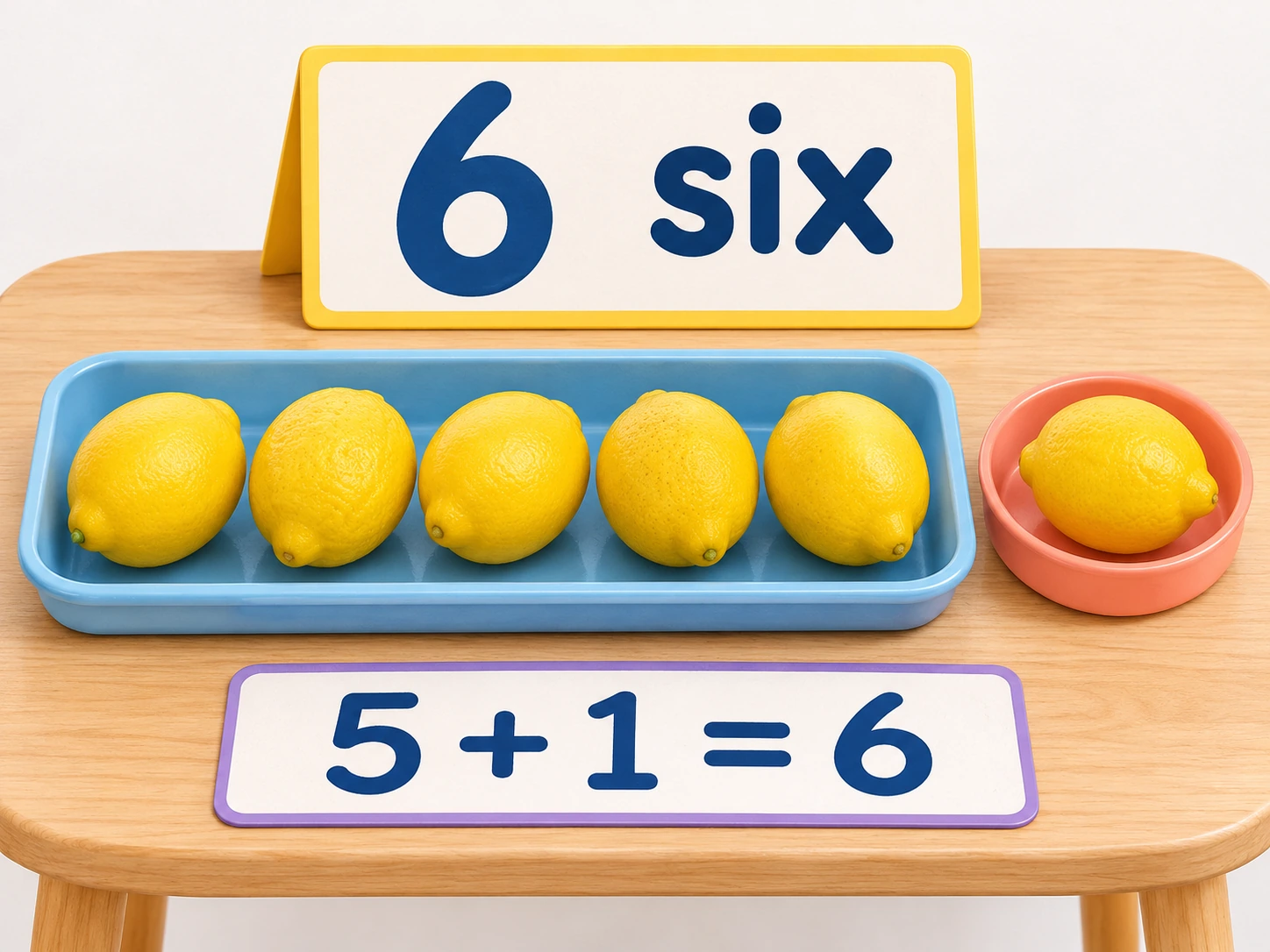
A home demonstration before the dotted line: Lemon Number Six
Consider a possible Lemon Number Six home visit with Faye. A grandparent places five large play counters on a mat, counts them and adds one more on a small coaster. Faye checks the entire collection. The adult then asks whether the coaster's counter belongs to the same order. This question draws attention to the sixth item without hiding or rushing past the original five.
Faye opens Lemon Number Six, compares the hand display with the counters and chooses a short writing turn. The grandparent reads six aloud and waits while Faye follows a few 6 guides. Later, Faye points to six lemons before colouring. A final count of the selected pictures closes the lesson. There is no need to remove the larger group structure as soon as the learner has used it successfully.
Inspect the six route at two sizes: Lemon Number Six
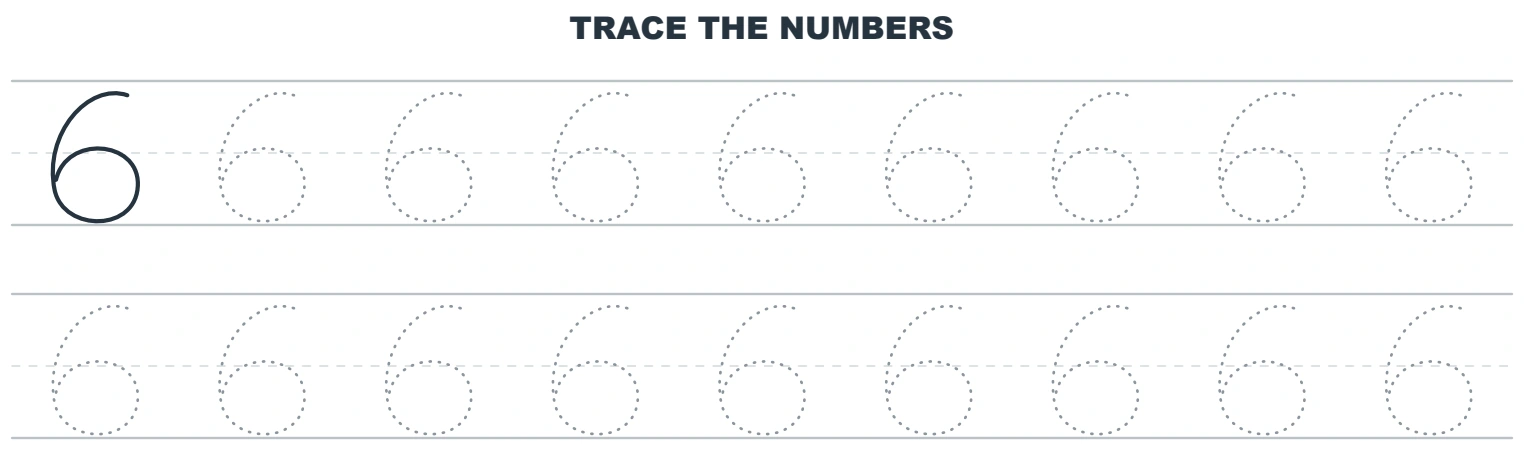
The large numeral in Lemon Number Six offers a starting point and a curved route into the lower loop. Compare that shape with the solid 6 at the beginning of the writing band. A child can make a broad finger movement first, then try the narrower dotted route. Notice the lower enclosure and the upper opening rather than describing the entire mark as a circle.
Give the name six its own moment: Lemon Number Six
The Lemon Number Six word task asks for colouring the outlined six before tracing three dotted copies. An adult can pronounce the whole word before inviting a brief lemon-count report. If the learner notices the letters, welcome the observation without turning the number lesson into a spelling quiz. The printed name stays available as a reference throughout the page.

Check the hunt and the food task independently: Lemon Number Six
The Lemon Number Six search contains six matching 6 entries among 35 numeral choices. The food panel also asks for six coloured lemons, but that shared count is particular to this sheet. Read each instruction on its own. A learner should identify matching symbols in one task and construct a selected quantity in the other, rather than assuming the two panels always have equal totals.
| Number-six check | Reference evidence |
|---|---|
| Hand parts | 5 raised fingers with 1 additional raised finger |
| Hunt layout | 5 rows, 7 entries in each row |
| Matching positions | 18, 19, 21, 27, 30, 34 |
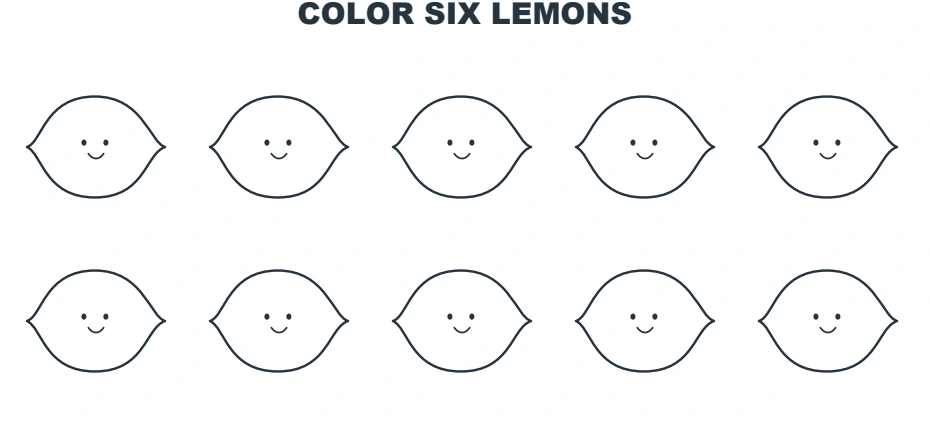
| Lemon selection | 6 coloured and 4 uncoloured out of 10 |
| Written models | 2 numeral rows; an outlined six; 3 dotted word repetitions |
Position numbering for this Lemon Number Six table runs across a row before continuing downward. Use the reference after the learner has tried a manageable section. The first two rows contain no matching 6 entries, so a child who expects a target immediately may benefit from hearing that an empty search row can still have been checked correctly.
Six reasons to observe more than the final answer: Lemon Number Six
The learner can name both parts: Lemon Number Six
Ask where five appears in Lemon Number Six and where the extra one appears. A child who can point to both has something concrete to explain. This part-and-whole conversation introduces a useful way to organise an amount without requiring formal addition notation. Allow a full recount whenever it helps the learner verify the explanation.
A count can continue across a boundary
The two hands in Lemon Number Six create a visible break in the display. Watch whether the count continues at six or restarts at one on the second hand. Naming each part separately is useful, but the whole total still needs to include both. A gentle sweep across the complete display can clarify which question the adult is asking.
Numeral identity can survive a busy field
The Lemon Number Six hunt requires recognition of 6 with changing neighbours. Compare a doubtful entry with the model rather than supplying its name immediately. A row cover can help a learner maintain a route. This is an attention-and-shape task, and it may need different support from the physical counting that established the six-finger amount.
A pencil can plan a loop: Lemon Number Six
The Lemon Number Six numeral band invites deliberate curved movement. Ask the child to look before beginning, then notice whether the lower loop connects as intended. Offer a larger version or fewer repeats when control is tiring. Correct quantity reasoning does not depend on a perfectly closed pencil loop, so discuss writing and counting as separate accomplishments.
Written and spoken number language can meet: Lemon Number Six
Read the Lemon Number Six word six and invite a report about the coloured lemons. A child might say a full sentence or point while an adult models it. Words such as extra, altogether and remaining become easier to discuss when their references are visible. Do not require the learner to read every instruction independently before participating in the activity.
A selected group can be audited
After the Lemon Number Six food task, count only the coloured lemons and then inspect the four remaining outlines. An adult can ask whether a different set of six would also work. This checking habit makes room for several correct picture choices. It also separates the mathematical amount from a preference for neat rows or a particular colour.
A classroom order desk for five and one: Lemon Number Six
A teacher could set up a Lemon Number Six order desk with a packer and a reporter. The packer places five objects in a tray and one beside it. The reporter explains the complete order before checking the worksheet hands. These are possible roles for classroom use, not measured outcomes. Keep the objects large and easy to separate so the group boundary is clear.
When returning to Lemon Number Six, each partner chooses a different response: one explains a grid decision, the other checks six coloured pictures. Rotate on another turn. A useful teacher note might be “counted both hands from one, then described five and one.” That records a real strategy if observed, without demanding that every child adopt counting on during the same lesson.
Four extra jobs for a six-item order
1. Add one passenger to a full row: Lemon Number Six
Make five seats with large blocks and put one toy passenger at each. Add a sixth seat just outside the row and invite a Lemon Number Six learner to describe the new total. Count the passengers after the move. The visual arrangement makes “one more than five” available to discuss, while the learner can still check the amount through ordinary counting.
2. Compare two packing methods: Lemon Number Six
Prepare six counters in a line and another six as five plus one. Ask which display matches the Lemon Number Six hand structure more closely, then check whether both contain the same amount. This question separates arrangement from quantity. If the learner chooses the structured display as having more, pair counters across the groups to inspect what is actually present.
3. Give the shop a spoken correction: Lemon Number Six
An adult packs five pretend lemons for a six-item order inspired by Lemon Number Six. Ask the young shop checker to describe the shortfall. They can add one item, recount and tell the customer the revised total. Keeping the mistaken parcel as the adult's work makes correction a shared shop job instead of a judgement on the child's worksheet.
4. Make a six-mark message: Lemon Number Six
Draw five dots close together and one dot at a short distance on a finished card. A Lemon Number Six learner can choose another clear arrangement of six marks for a message to a partner. Ask the partner to check the count before reading the numeral. This activity provides a reason to make a quantity visible without requiring six realistic lemon drawings.
Comfortable pacing and common detours: Lemon Number Six
For ages three to six, Lemon Number Six may require an adult to read, point, count alongside or stabilise the sheet. Copying a hand pose is optional. Some children can recognise the picture but find finger isolation awkward. Let them use counters or point to the drawing so a physical difficulty does not obscure what they understand about six.
If a Lemon Number Six learner stops at five, revisit the second hand. If the child counts the second hand separately as one, ask about both hands altogether. If four or seven lemons receive colour, check the selected pictures one by one. These responses target different questions. Give one prompt, then time to look, rather than layering several explanations over the same uncertain attempt.
Return to Lemon Number Six when a real five-and-one situation appears, such as a full toy row gaining a new visitor. Let the child choose whether to be packer or checker. Praise an observable step like carrying the count onto the second hand. A planned stop after that job keeps repeated practice purposeful and leaves the remaining pencil work as an invitation.
Different pictures for a six conversation: Lemon Number Six
The six-rubber-duck lesson provides Lemon Number Six with another group to inspect. For a familiar reference, use the five-turtle page; for a possible next amount, see the seven-umbrella activity. Select the representation that clarifies the current question rather than advancing only because a sheet looks finished.
For further Lemon Number Six play planning, an adult can browse the PBS Parents family learning area and NAEYC's reading about play at home. These outside organisations offer optional educational material. Their resources are separate from the worksheet file and from the number collection sold on this site.
Choose six on paper, or keep all ten numbers ready: Lemon Number Six
The free option gives the original Lemon Number Six sample. Use an active eligible member account for its separate clean premium PDF, with the activity layout intact. The premium lesson excludes the website’s domain label and watermark and carries no printed advertisements. The related package card leads to the $2 purchase-only collection containing all ten clean number sheets. Membership alone does not replace that collection purchase.
To print Lemon Number Six, save the PDF and select US Letter with no scaling beyond Actual Size or 100%. Inspect one copy for a clear lower 6 loop, readable dotted guides and the full frame. In the collection file, choose its sixth page for this lesson. Place a small five-and-one object display nearby if it will help the learner explain the amount before tracing it.
Popular Worksheets
Printable resources families and teachers are downloading now.
 Free
 Free
 Free
 Free