
Trace Number 1 to 10 Worksheet: Fun for Little Learners!

Discover the Joy of Numbers: A Complete Guide to the Trace Number 1 to 10 Worksheet
Trace Number 1 to 10 Worksheet gives learners focused practice. Introducing foundational numeracy to young minds is a critical step in their educational journey. Our comprehensive Trace Number 1 to 10 Worksheet set provides a delightful and effective pathway for children aged 3-6 to learn and practice numbers. This collection of ten printable worksheets, each focusing on a single digit from one to ten, is meticulously designed to foster number recognition, improve fine motor skills, and build early math confidence. From tracing the numeral shapes to counting charming illustrations, these activities offer a multi-sensory approach to learning that makes mastering numbers an exciting adventure.
Trace Number 1 to 10 Worksheet gives learners focused practice. We understand that engaging young learners requires more than just rote memorization. That's why each worksheet in this series is crafted to be interactive and visually appealing, incorporating elements like cute chicken characters and stars to color. This approach not only makes learning numbers enjoyable but also reinforces the concept of quantity associated with each numeral. Whether used at home for supplemental learning or in the classroom to introduce or reinforce number concepts, this worksheet set is an invaluable resource for educators and parents alike.
Why This Worksheet Set is a Must-Have for Early Learners
Enhanced Number Recognition
Trace Number 1 to 10 Worksheet gives learners focused practice. Each page is dedicated to a single number, allowing children to focus intently on its shape and name. Repeated exposure through tracing and visual cues helps solidify their understanding of each numeral from 1 to 10.
Development of Fine Motor Skills
Trace Number 1 to 10 Worksheet gives learners focused practice. The act of tracing dotted lines requires precise hand movements and control. This practice is fundamental for developing the fine motor skills necessary for handwriting, drawing, and other detailed tasks.
Improved Hand-Eye Coordination
Trace Number 1 to 10 Worksheet gives learners focused practice. Following the dotted lines accurately demands coordination between what the child sees and how their hand moves. This consistent practice sharpens their ability to guide their movements with visual feedback.
Early Counting and Quantity Association
Trace Number 1 to 10 Worksheet gives learners focused practice. Activities like coloring a specific number of stars or identifying the correct number of chickens visually link numerals to their corresponding quantities, building a crucial understanding of mathematical concepts.
Boosted Concentration and Focus
Completing each tracing and coloring task requires sustained attention. This helps children develop their ability to concentrate for longer periods, a vital skill for academic success.
Building Confidence and Independence
Successfully completing each numbered page provides a sense of accomplishment. This positive reinforcement encourages children to tackle new challenges with growing confidence and a desire for independent learning.
A Closer Look at Each Number Activity
This series thoughtfully progresses from one to ten, ensuring a smooth learning curve. Each worksheet is structured to provide a clear learning experience:
Number One: The Foundation
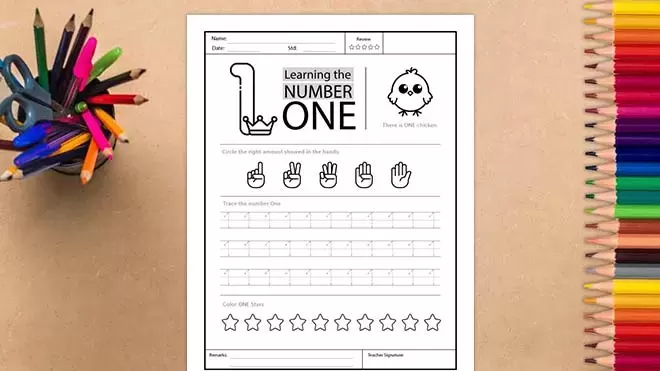
The journey begins with the number one. Children trace the numeral '1' and see a single chicken, reinforcing the concept of 'one' as a solitary item. The instruction to 'Circle the right amount showed in the hands' includes five hand gestures, with the first showing one finger up, a clear visual cue. Following this, they trace multiple dotted '1's and are prompted to 'Color ONE Stars', connecting the numeral to a quantity of one.
Number Two: Building Blocks
The second worksheet introduces the number '2'. Children trace the numeral and observe two chickens. The hand gesture section shows the second option with two fingers raised. They then trace multiple dotted '2's and color 'TWO Stars', solidifying the association between the numeral, its name, and its quantity.
Number Three: Expanding Concepts
With the number '3', children continue the pattern of tracing the numeral and seeing three chickens. The hand gesture activity presents the third option with three fingers. Tracing dotted '3's and coloring 'THREE Stars' further reinforces the numerical concept and its visual representation.
Number Four: Visual Reinforcement
The number '4' worksheet features four chickens and the corresponding hand gesture. Children trace the numeral '4' and color 'FOUR Stars'. This consistent structure across all worksheets ensures familiarity and builds confidence as they progress through the numbers.
Number Five: Reaching Halfway
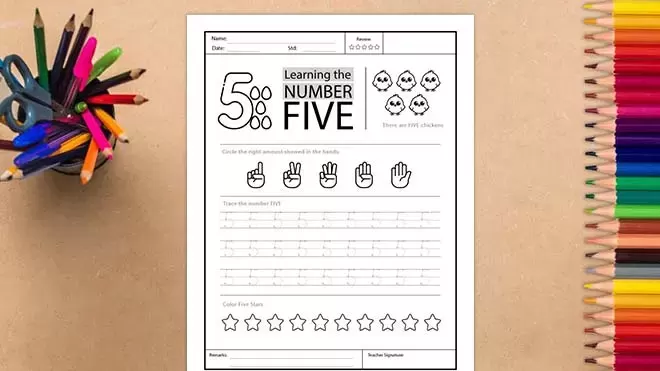
As children reach the number '5', they trace the numeral and see five chickens. The hand gesture section clearly depicts five fingers. The activity continues with tracing dotted '5's and coloring 'Five Stars', reinforcing the concept of five.
Number Six: Continued Practice
The number '6' worksheet presents six chickens and the corresponding hand signal. Children trace the numeral '6' and color 'SIX Stars'. This repetition is key to mastery and helps build a strong numerical foundation.
Number Seven: Exploring Larger Quantities
The number '7' worksheet continues the engaging format with seven chickens and the correct hand gesture. Tracing the numeral '7' and coloring 'SEVEN Stars' further develops their understanding of quantity and numeral formation.
Number Eight: Reinforcing Patterns
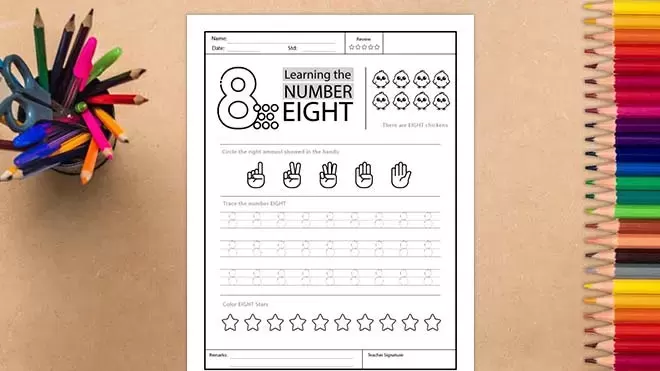
With the number '8', children trace the numeral and count eight chickens. The hand gesture section shows the corresponding finger count. Coloring 'EIGHT Stars' provides another opportunity to connect the numeral with its quantity.
Number Nine: Approaching Ten
The number '9' worksheet features nine chickens and the appropriate hand gesture. Children trace the numeral '9' and color 'NINE Stars', building anticipation for the final number in the set.
Number Ten: Completing the Set
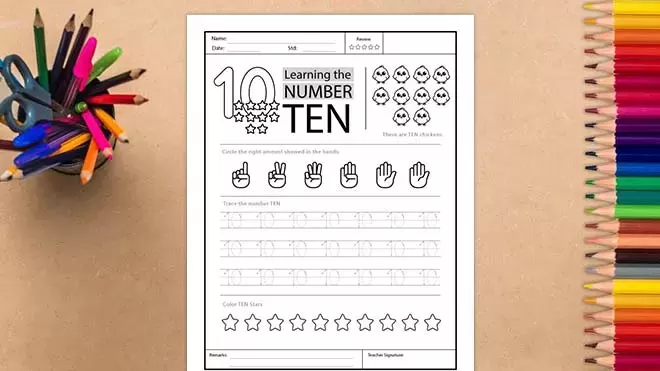
The final worksheet focuses on the number '10'. It includes ten chickens, the corresponding hand gesture, and the prompt to trace the numeral '10'. Coloring 'TEN Stars' provides a satisfying conclusion to the numeral practice, cementing their understanding of numbers up to ten.
Practical Application: Home and Classroom Scenarios
This Trace Number 1 to 10 Worksheet set is incredibly versatile, offering practical applications for both home and classroom environments.
Home Learning Fun
Imagine a rainy afternoon. You can sit down with your child, print out the number '3' worksheet, and say, "Let's learn about three today!" You can point to the three chickens, show them three fingers, trace the '3' together, and then have them color three stars. This focused, one-on-one time not only teaches numbers but also strengthens your bond. For older siblings, you could set up a 'number station' where they can independently choose a worksheet to practice during quiet time. This fosters a sense of autonomy and self-directed learning.
Consider using the worksheets as part of a daily routine. Dedicate five minutes each morning to a new number. This consistent exposure, even in short bursts, is highly effective for young learners. You can also use the completed pages to create a personalized number chart to display in their room, serving as a constant visual reminder.
Classroom Engagement
In a preschool or kindergarten classroom, these worksheets can be used in various ways. They are perfect for small group activities, where a teacher can guide a few students through tracing and counting. For instance, during a math center rotation, students can independently select a number worksheet to complete. The clear instructions and visual aids make them accessible for early learners to use with minimal supervision.
Teachers can also use these worksheets as a quick assessment tool. Observing how a child traces a number or correctly identifies the quantity of stars can provide valuable insights into their understanding. The consistent format across all numbers makes it easy to track progress. For a whole-class activity, you could project the worksheet for number '7' and have students trace the numeral in the air with their fingers before attempting it on paper, making the learning more dynamic.
Skill Development Beyond Numbers
While the primary goal is mastering numbers, these worksheets offer a rich environment for developing a range of crucial skills:
Cognitive Skills
- Number Sense: Understanding what each numeral represents in terms of quantity.
- Pattern Recognition: Identifying the consistent structure of each worksheet (tracing, counting, coloring).
- Problem-Solving: Figuring out how to correctly form the numbers and complete the tasks.
- Memory: Recalling the shapes and names of numbers as they progress.
Motor and Perceptual Skills
- Fine Motor Control: Essential for holding pencils correctly and making controlled strokes.
- Pre-writing Skills: The foundation for learning to write letters and words.
- Visual Discrimination: Differentiating between similar numeral shapes (e.g., 6 and 9).
- Spatial Awareness: Understanding how to position the numeral within the given space.
Language and Literacy Skills
- Vocabulary: Learning the names of numbers and related words (e.g., chicken, stars).
- Following Instructions: Understanding and executing directions like 'Trace' and 'Color'.
- One-to-One Correspondence: Matching each object (chicken, star) to a single number count.
Making Practice Engaging and Effective
Keeping young children motivated requires creativity and patience. Here are some ideas to make practicing with the Trace Number 1 to 10 Worksheet set consistently rewarding:
Celebrate Every Milestone
Acknowledge and praise every completed page, no matter how small the perceived progress. Positive reinforcement is a powerful motivator. Consider a sticker chart where children earn a sticker for each number they master.
Turn it into a Game
Instead of just tracing, make it a game. For example, when tracing the number '5', challenge them to see how fast they can trace it while staying within the lines. Or, turn the 'Circle the right amount' section into a quick quiz.
Extend the Learning with Play
Connect the numbers to real-world objects. If working on the number '4', find four toys, four blocks, or four pieces of fruit. This hands-on approach reinforces the concept of quantity in a tangible way.
Storytelling and Roleplay
Create stories around the numbers. For the number '7', you could tell a story about seven brave knights or seven magical stars. This imaginative approach makes learning memorable and fun.
Introduce Variety
While tracing is important, consider other ways to practice numbers. Use playdough to form the numbers, build them with blocks, or use chalk outside. This multi-sensory approach caters to different learning styles and keeps practice fresh.
Common Mistakes and How to Address Them
As children learn, they may encounter a few common hurdles. Being aware of these can help you provide targeted support:
Incorrect Formation
Some numbers, like 6 and 9, or 7 and 1, can be confused. Ensure you model the correct starting point and direction for each numeral. Consistent practice and verbal cues like "start at the top" or "go around" are helpful. For instance, when tracing the number '6', emphasize starting at the top and curving downwards.
Inconsistent Spacing or Size
Children might make numbers too large, too small, or drift off the dotted lines. Gently guide their hand or use a thicker marker for them to follow. Remind them to stay within the lines provided on the worksheet.
Difficulty with Quantity Association
Some children may trace the number correctly but struggle to associate it with the correct quantity. Use physical objects to count along with the worksheet. For example, when coloring 'FIVE Stars', count each star as it's colored, pointing to it individually.
Frustration or Lack of Interest
If a child becomes frustrated, take a break. Shorter, more frequent practice sessions are often more effective than long, arduous ones. Keep the tone light and encouraging. Remember, the goal is to build a positive association with learning numbers.
Extending the Learning: Fun Activities for Deeper Understanding
To further enhance the learning experience and cater to different interests, consider these extended activities:
Number Scavenger Hunt
Hide objects around the house or classroom that correspond to the number being practiced. For example, hide four toy cars and have the child find and count them. This turns practice into an exciting game.
Sensory Bin Numbers
Fill a bin with rice, beans, or sand. Hide number cards or small objects within the bin. Children can dig for numbers, trace them in the sand with their fingers, or count the objects they find. This provides a tactile learning experience.
Number Crafts
After tracing a number, engage in a related craft. For number '5', make a handprint craft. For number '10', create a craft with ten small items, like buttons or pom-poms. This creative application helps solidify the numerical concept.
Number Songs and Rhymes
Incorporate songs and rhymes that focus on numbers, like "Five Little Monkeys" or "Ten Little Indians." Singing together makes learning numbers fun and memorable, and it helps with rhythm and sequencing.
Why Children Adore These Number Activities
Children are naturally curious and drawn to activities that are visually stimulating and interactive. This worksheet set taps into that natural inclination by:
- Featuring Cute Characters: The friendly chickens and stars add an element of fun and make the learning process more approachable.
- Providing a Sense of Achievement: Successfully tracing a number and completing a page gives children a tangible sense of accomplishment, boosting their self-esteem.
- Offering Variety: The combination of tracing, circling, and coloring keeps children engaged and prevents monotony.
- Allowing for Creativity: The coloring sections give children a chance to express themselves and add their personal touch.
- Being Hands-On: The physical act of writing and coloring is more engaging than passive learning.
Download Your Free Printable Worksheets Today!
Ready to help your child embark on a fun-filled journey of number discovery? Downloading this Trace Number 1 to 10 Worksheet set is simple and completely free. These high-quality, printable PDFs are designed with clarity and engagement in mind. You won't find any intrusive ads or watermarks, ensuring a clean and distraction-free learning experience for your child. Simply click the download link, print the pages, and you're ready to start learning!
This resource is part of our extensive Free worksheet library, offering a wide array of educational materials for various subjects and age groups. Explore our collection to find more engaging activities that support your child's development.
Popular Worksheets
Printable resources families and teachers are downloading now.
 Free
Free
 Free
Free
 Free
Free
 Free
Free