
Turntable Number 45 Tracing for a Bright Mid-Decade Study
Continue the turntable lesson from sheet 45 with the full $8 Number Tracing 1–100 collection.
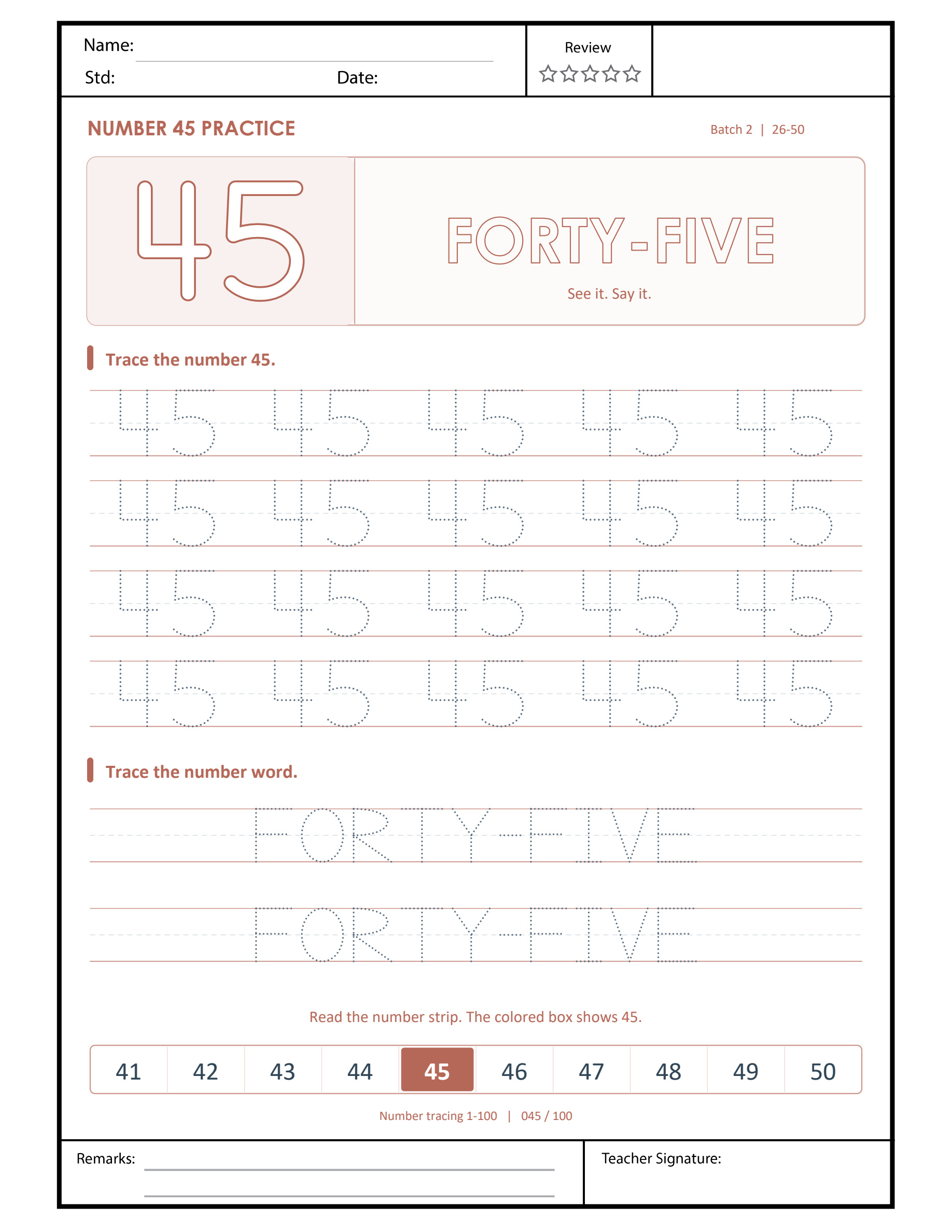
Sheet 45 is shown from top border to the teacher-signature line.
The entire Letter page pairs FORTY-FIVE and 45 with guided writing and an ordered strip from 41 to 50.
A record shop counts forty-five paper sleeves on a turntable display. Four sections have ten sleeves each, and the last holder has five. Cora says the five look halfway full and wonders how that connects to the forty-five label. Number 45 Tracing gives the count a written record. The large 45 sits beside FORTY-FIVE, and four dotted rows invite a short writing turn. Near the bottom, a shaded cell connects 45 to the numbers on either side of it. The page keeps the turntable count in view when the objects are put away.
What does the 45 label count?
Forty-five is five above forty and five below fifty. Within the 41–50 strip, 45 appears in the fifth cell. Compare 45 and 46 as the central two cells of the strip. Distinguish a midpoint between forty and fifty from the layout of ten cells starting at 41.
Ask for two turntable reports. The groups contain 40, and the loose count is 5. Once the totals are combined, look at 45 and say which position records the 4 full groups.
Try hearing about the 5 loose units first. Keep the tens on the left of 45. The order of the turntable reports can change without moving either digit.
Share the 45 check with a partner
Have partners count forward from 40 in ones to 45 and backward from 50 in ones to 45. Use counter moves to show why both walks have five steps.
At the turntable station, ask for the difference between 40 and 45. A learner can show the 5 extra units with counters. For a zero, point to the empty space while reading 45.
Let a speaker read the finished turntable sign while a partner traces 45. Swap jobs and ask Why is 45 the fifth cell when 40 itself is missing from the printed strip? Listen for an explanation of the 45 count before commenting on the written result.
Read the large 45 before using a pencil
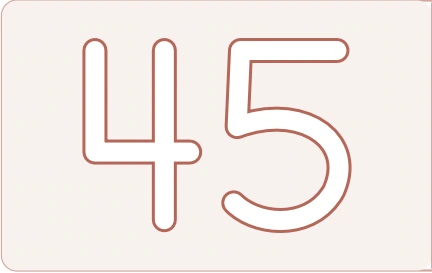
Set the turntable sign by the large 45. Point between its smaller digits and the big outlines. Say forty-five while moving a finger from the first numeral to the last.
See which digit of 45 the child notices first. If attention goes straight to the 5, try a bookmark at the left of 45. Let a partner explain the turntable amount before taking a pencil turn.
Number 45 Tracing with a clear hand movement
For 45, pause after the open 4 and start the 5 with its horizontal top. Rehearse that transition on a scrap, then choose from five 45 models on a dotted line. Rest the spare hand on the page during the lift between 4 and 5.
Pick one feature to watch in the 45 attempt. Compare the digit heights, or see where the strokes of 45 meet the lower guide. If one 45 turn needs work, practise it at a larger size before shrinking it.
Four lines of 45 allow several short visits. Save the lower 45 rows for the next turntable session instead of making the first try last through all twenty models.
Adjust the next attempt at 45
| 45 response | Prompt | Check Forty-Five |
|---|---|---|
| Only the 5 extra units get counted. | Put the 40 portion beside them. | Read the whole label 45 from the joint display. |
| The two 45 digits crowd or touch. | Compare the gap in the large 45. | Follow one 45 pair and lift between shapes. |
| The reader skips part of FORTY-FIVE. | Point through FORTY-FIVE at speech pace. | Match FORTY-FIVE with its separate numeral. |
| The 45 box is guessed from shading. | Name an adjacent printed value. | Find 45 again with the color covered. |
Check the turntable count before correcting the pencil. If the child says 45 correctly, ask which shape needs a slower try.
Find five steps from both ends
Set two cards marked 40 and 50 on the table. Between them use a drawing with ten equal intervals. Let the child start at each end and meet at 45 after five moves. Compare the drawing with the worksheet strip, which starts at 41 and uses a box for each value. This prevents confusion about why two cells sit near the visual center while 45 is exactly halfway between the endpoint amounts. Return to the full outline and let the child trace only one set of digits while thinking of the number's position.
Locate 45 on the 41–50 strip
Count 5 places from the left to find 45. Check by reading up from 41. A learner can use 41 as the first spoken value instead of restarting at one.
Point to 44 on the left of 45. Find 46 to the right of 45. Match one step from 45 with an addition or removal in the turntable count. When the turntable arrangement changes but the count stays 45, leave the pointer in place.
Hide the shaded 45. Ask the reader to name an uncovered neighbor and predict the hidden numeral. Check it against 45, then let the learner choose a nearby box for a partner to guess.

Let FORTY-FIVE do a reading job
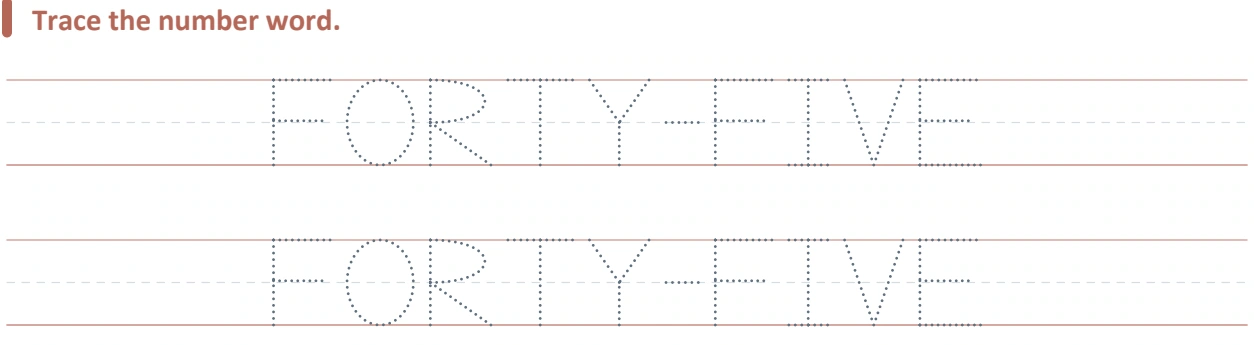
Say forty-five while a learner tracks the capitals. On a second reading, use the final FIVE to identify the ones even when the whole word is long. Use the big FORTY-FIVE reference to check a faint letter in its dotted row.
Make separate turntable labels for 45 and FORTY-FIVE. Ask someone to match both to the count. On the two word rows for 45, a new reader can follow a part of FORTY-FIVE today and return to the rest another day.
Six things to listen and look for around 45
- Explain the turntable display
- Group 45 by tens and ones. Point to the 40 part before describing the extras.
- Manage a turn in 45
- Keep one dotted 45 model visible while changing direction. Pause between 4 and 5.
- Tell FORTY-FIVE from a partial clue
- Read FORTY-FIVE aloud with the numeral in view. Check the letters at its right end.
- Place 45 in a run
- Use 45 to infer a neighbor. Show whether the turntable total rose or fell.
- Recognize 45 in a new layout
- Rearrange the turntable pieces. Does 45 still belong on the label?
- Review one 45 attempt
- Match the finished 45 against its outline. Save a movement for another visit.
Try the turntable count at home
Fold a paper strip into ten equal parts. Mark 40 and 50 at the ends of a separate number path and put 45 at the middle mark before looking for its different position on the worksheet.
Keep the turntable materials in view. Slide the 5 extras to a counted area as the learner counts up from 40. A child who wants more evidence can open one of the ten groups before rechecking 45.
Choose one 45 model to follow. Put the new mark by the turntable count and have another person read it. Invite the learner to explain the 45 label before giving a spelling cue.
Five short activities after the turntable lesson
- Save the 45 record. Draw the turntable groups on a card. Move an extra piece and decide whether 45 still applies.
- Guess the hidden 45 box. Read 45 and its neighbors, then cover 45. Ask a partner for the missing value.
- Make a new turntable order. Add one piece to 45. Write 46 together and point to the changed digit or digits.
- Split the 45 writing job. Have a child dictate FORTY-FIVE while an adult writes it. Trace 45 for a second label on the turntable display.
- Check 45 in a different arrangement. Return the turntable pieces to a row. Ask a visitor to verify 45 without the first layout.
Choose a small goal for the next 45 visit
The 45 printable suits children around ages 5–8 who are ready to compare two-digit numbers. Younger children who already recognize 45 can point, speak and move counters while someone else handles the pencil. A confident writer may copy the turntable label once on a blank slip.
Use one goal during a short return visit. If a child can describe 45 as 4 tens and 5 ones, the next aim might be the shape of the right digit. If both shapes are familiar, put a little more attention on FORTY-FIVE or the place where the target sits on the strip.
Ask which 45 mark the writer would like to save. Keep the child in charge of the final selection and name a feature they can see, such as a clearer gap or a closed loop. It makes a later return to the turntable lesson feel connected to something they already accomplished.
Other ways to prepare for the 45 lesson
For a shorter writing turn than 45, start with the introductory 1–10 tracing set. To isolate the shape of 5 before the turntable activity, try a mixed set of single-digit models or the even-number dice activity as a different warm-up.
Look through family play at NAEYC for a way to adapt the turntable role-play. A family can also choose an idea from PBS KIDS for Parents and give the written FORTY-FIVE sign a job in that game.
Open and print the 45 PDF
Use the free worksheet control for the supplied 45 sheet. To get the clean member edition of FORTY-FIVE, sign in with an eligible active plan and select its premium download.
Choose US Letter portrait and preview the complete border around 45. Print one FORTY-FIVE copy at standard quality and check that the dotted guides are clear. The clean member sheet carries no website watermark or advertising.
The $8 collection card links this 45 lesson with all the other sheets through 100. A family that already has access can open sheet 45 directly inside the collection by selecting that page number.
Related Topics
Popular Worksheets
Printable resources families and teachers are downloading now.
 Free
 Free
 Free
 Free