
Planetarium Number 73 Tracing for a Clever Three-Extra Star Tally
Continue the planetarium lesson from sheet 73 with the full $8 Number Tracing 1–100 collection.
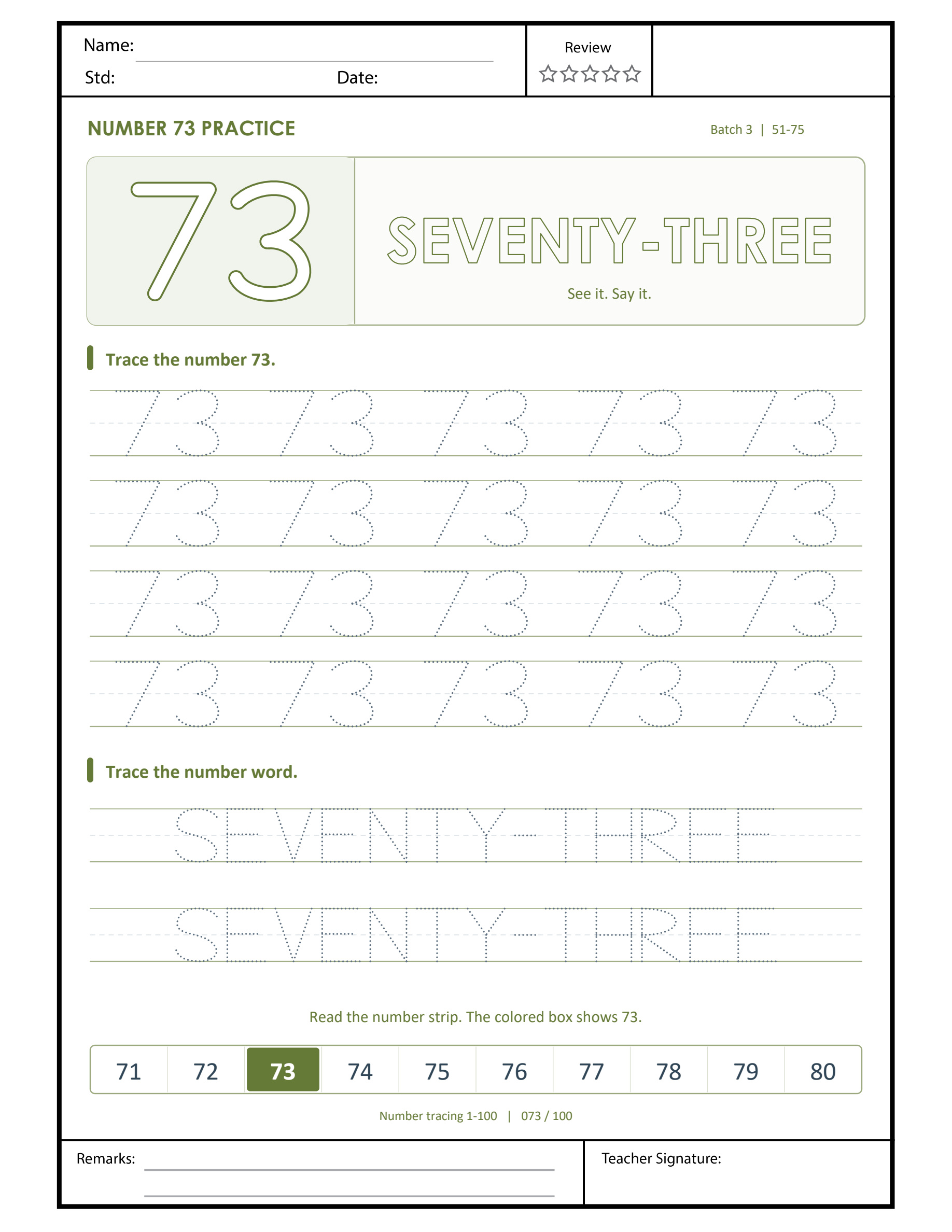
Sheet 73 is shown from top border to the teacher-signature line.
The entire Letter page pairs SEVENTY-THREE and 73 with guided writing and an ordered strip from 71 to 80.
A planetarium volunteer has seventy paper star markers packed away. Three loose markers remain on the model dome. Amira wants a label for the complete supply before the dome is taken apart. Read Number 73 Tracing after the planetarium question has an answer. One part of the page shows the shape of 73 at a generous size. Other parts let a learner trace the figure, study the name SEVENTY-THREE or find the shaded cell in sequence. The planetarium sign gives those marks a purpose the child can explain.
What does the 73 label count?
Seventy-three is seventy plus three. The three pieces on the dome already belong to the inventory. Putting them back into a tray can change the layout without changing the total. Moving one outside the supply changes the count to seventy-two.
Record the planetarium count in two areas. Write 70 over the combined packets and 3 over the loose area. Pull both counts together as 73. Ask which digit refers to the number of packets and what ten objects in each packet contribute to the total.
Put the labels 70 and 3 face down. Can a partner recreate the 73 display from the two digits alone? Let them decide where the tens go, then check the model. That quick reconstruction shows whether the child understands the placement of the digits.
Keep a dome count and a supply count
Write 3 on one slip and 73 on another. Give the small label to the model dome and the larger one to the entire stock. Bring one star down from the dome and place it next to the seven packets so it remains available. Ask which label is now out of date. Repeat with a star that actually leaves the stock and check 72 on the number strip. Before tracing, let the child choose a wider piece of scrap to rehearse the two curves of 3 beside the angled 7.
Read the large 73 before using a pencil
Hold a planetarium label beside the largest 73 on the page. Ask the learner to touch 7 and then 3, while a partner reads the whole amount aloud. Let a child who is still learning the number name echo seventy-three after you.
Turn the small 73 card over and ask where 73 can still be found. Have the learner start on the left of the big pair. An adult can slide a plain paper tab along the underside to mark the reading direction without covering either shape.

Try the planetarium count at home
Set seven labeled ten groups beside three star cutouts. Ask your child to make a note for all the markers and a separate note for the stars on the dome.
Have a family partner count the planetarium display aloud. Let the child check the 70 already grouped, then account for the remaining 3 on a plain sheet. For a second check, turn one ten label over to show what its packet contains.
Make a small 73 label together and put it near the original display. An adult can turn away during the count and return to read the finished sign. Ask the child what information the reader needs to make sense of that sign.
Locate 73 on the 71–80 strip
Begin the spoken run at 71. Point to one cell per word until the finger reaches 73 at position 3. Ask whether the child found the box by reading its value, following the numbers in order, or remembering where the shade appeared.
Read 72 one cell earlier than 73. Move right from 73 to the printed 74. Use the planetarium display to act out a change of one. Invite a child to check the neighboring labels while a partner moves a single item into or out of the counted group.
Draw the number 73 on a slip of paper. Ask a partner to place it directly above the corresponding box, then cover only that box. The listener names 73 after reading one or two uncovered cells from the same short run.

Work out what the reader needs for 73
| What happened with 73 | Offer a clue | Next planetarium check |
|---|---|---|
| The reported total ignores 70. | Show the grouped portion of 73. | Count both parts of the planetarium set. |
| The pencil joins both figures in 73. | Tap the space after 7. | Try a fresh start at 3. |
| The word SEVENTY-THREE gets cut short. | Track the last part of SEVENTY-THREE. | Read the name and select 73. |
| Only the shading gives away 73. | Read aloud from another planetarium cell. | Use a nearby numeral to locate 73. |
Try one prompt from the 73 table. A learner who names seventy-three confidently may need more time only on the written 7 or 3.
Number 73 Tracing with a clear hand movement
While writing 73, leave a gap after the angled 7 before following both curved parts of 3. Use the margin of a separate sheet for a large hand movement. Afterward, choose one of the smaller 73 pairs and keep the unused hand on the paper so the sheet stays steady.
Look at the finished 73 beside the next dotted copy. Pick one visible clue, such as the space after 7 or the height of 3. Ask the child which clue would make a second 73 easier to read. Let them try it once and point to the change.
There are five 73 models in each numeral row. A brief practice might use just one pair on the upper line. Fold a plain strip over the 73 rows below if seeing all the dots makes it difficult to find a starting place.

Share the 73 check with a partner
Let a volunteer take one marker from the dome and keep it inside the supply area. Ask a checker which of the two signs must be revised.
Ask the group at the planetarium station to mark the 70 and the 3 in separate areas. The child with the numeral card can point to each area while reading 73. A partner checks the group count before giving any hint about the handwriting.
Use this question during the role change. Which numeral names the entire supply after one of the three markers is removed from the inventory? Give the checker time to show an answer with the objects. The recorder can point to 73, or write the result if the check changed the amount.
Let SEVENTY-THREE do a reading job
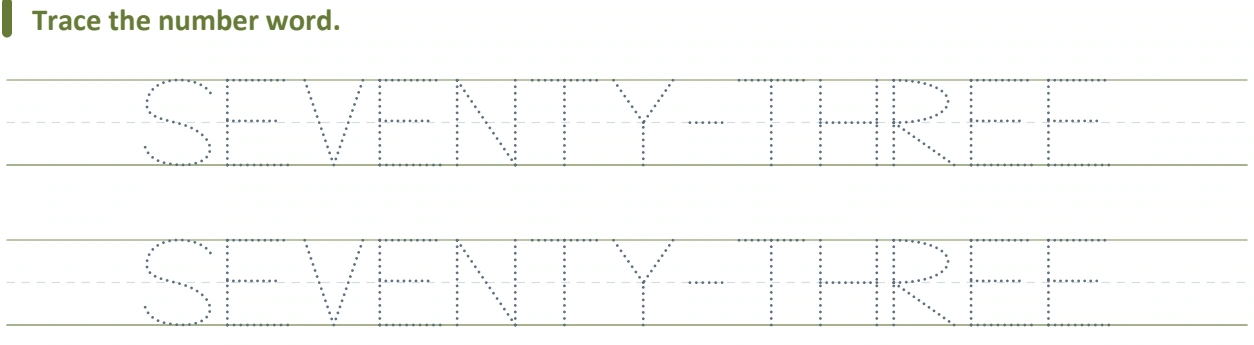
Read seventy-three once before looking at the writing. Then trace the double E in THREE and read SEVENTY-THREE in order. The large SEVENTY-THREE above the numeral rows gives a new reader something to consult if the letter paths in a small dotted copy are hard to make out.
Write SEVENTY-THREE on a slip for the planetarium display. Hold the word slip near a numeral card marked 73. Ask a partner to read one, point at the other and explain why both belong beside the same set of objects. Save a longer writing turn for another day.
Five games to try with the planetarium count
- Make a planetarium inventory card. Sketch the packets for 70 and add 3 dots. Let a new reader identify 73 from the sketch.
- Spot the covered value. Put a slip on the printed 73. Have a partner read the strip to that point, then uncover 73 to check.
- Deliver an extra piece. Add one to the planetarium display and replace 73 with 74. Ask which digit changed this time.
- Pair a word and a figure. Place SEVENTY-THREE near a hand-drawn picture of the planetarium supplies. Give the learner a choice of numeral cards to match.
- Repack the planetarium pieces. Give the group a different-looking arrangement of 73. Ask a second checker to describe how the new arrangement can be counted.
Six observations for the 73 lesson
- Account for the planetarium count
- Break 73 into 70 and 3 and use the groups to explain each digit.
- Control both movements in 73
- Follow one 73 without rushing from the 7 into the 3.
- Connect the written name to 73
- Track SEVENTY-THREE while saying it. Point back to the digit pair after reading.
- Describe a change from 73
- Use the two nearby values to check what happens after adding or removing one.
- Check a rearranged planetarium set
- Recognize the same 73 when the countable pieces move to another position.
- Choose a mark to revisit
- Compare a new 73 with the model and describe one part to try again.
Choose a small goal for the next 73 visit
Offer the 73 sheet around ages 5–8 to children who are starting to read pairs of digits. The planetarium game can be done by pointing and speaking when the pencil work feels long. A child who is ready to write can set the amount next to a blank label and copy just one pair.
Give each 73 visit a purpose the child can say aloud. Today it might be finding 73 near its neighbor. A later lesson can return to a difficult stroke or the final part of SEVENTY-THREE. The unused lines are there for another visit.
Ask the child to choose a 73 they would keep on the planetarium display. Let them tell what makes it readable, whether the spacing after 7 or the height of 3. Start the next session from the child's own observation.
Other ways to prepare for the 73 lesson
Return to smaller figures with the pencil-control path worksheet before 73. To plan a different turn for the planetarium group, choose the introductory 1–10 tracing set or bring in a mixed set of single-digit models and talk about what a numeral reports in that activity.
The planetarium setting can borrow a turn-taking idea from family play at NAEYC. A PBS KIDS for Parents activity may also give SEVENTY-THREE a new use as a sign.
Open and print the 73 PDF
Use the free download to get the original 73 PDF. The member option for SEVENTY-THREE provides a clean sheet without the website watermark or ads. Sign into an eligible plan to use it.
In the print dialog, use US Letter portrait for 73. Make a single test copy to see the pale SEVENTY-THREE guides and the complete frame. Switch to standard quality if the dotted numeral is too faint.
The $8 collection includes 73 as page 73. Open it from the package card when you want to continue from the planetarium activity to other numbered sheets through 100.
Related Topics
Popular Worksheets
Printable resources families and teachers are downloading now.
 Free
 Free
 Free
 Free