
Christmas Counting: 4 Powerful Games for Happy Choices
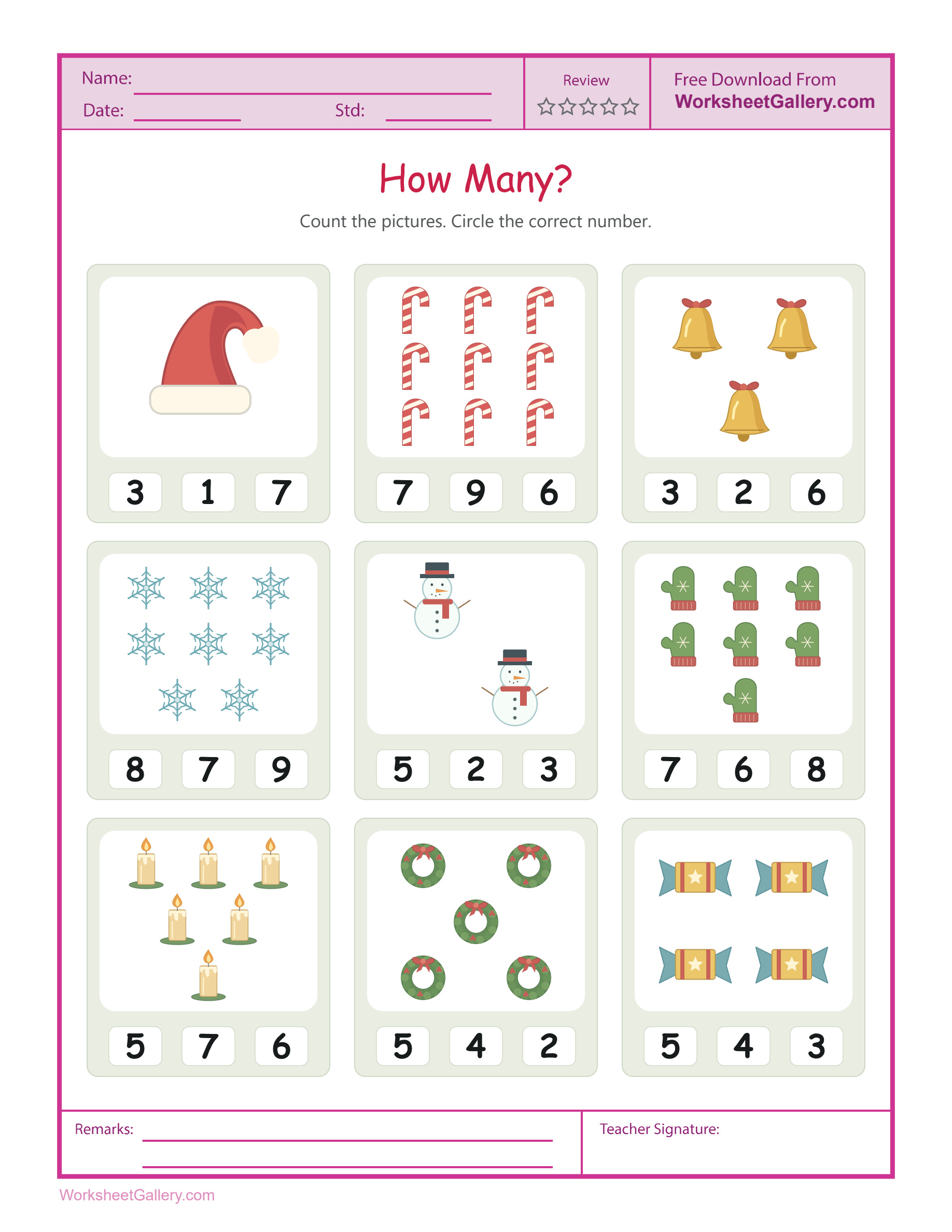
A mitten is one picture, even when real mittens usually come in pairs. Christmas Counting invites children to decide what one means before they start reciting numbers. Nine festive cards present hats, bells, snowflakes and other seasonal objects, each followed by three numeral options. The task is to count the complete drawings and circle the matching number. With Christmas Counting, a striped cane stays one cane, a decorated wreath stays one wreath, and a careful explanation matters as much as the final pencil mark.
Begin Christmas Counting with seven individual mittens
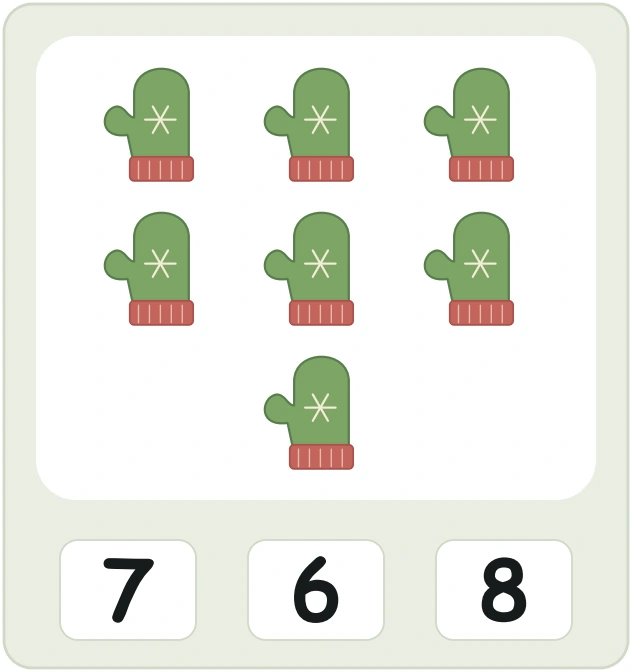
Look at the card on the right of the middle row. Seven green mittens sit in levels of three, three and one. Beneath them, the choices are 7, 6 and 8. The first choice represents the complete pictured collection.
Ask the learner to outline one mitten with a pointing finger, then name it. Christmas Counting uses that whole drawing as the unit. Its thumb is part of the mitten, and the separate pictures are not automatically combined into pairs.
A child who says “three pairs and one” has noticed something interesting about clothing. Acknowledge the observation, then return to the printed question: how many individual mitten pictures are visible? Establish seven by giving each drawing a separate spoken count.
Use Christmas Counting language that keeps the object name beside the number: “seven mittens.” The phrase makes the answer more informative than an isolated “seven,” especially when the next card contains a different kind of object.
A Christmas Counting label for Rowan's pretend stockroom
Rowan and his grandfather imagine that the page is a stockroom list. Before writing a parcel label, they need to report how many individual mitten pictures are on the selected card. Grandfather asks Rowan to show what should receive the first count.
Rowan points to a green mitten, names it and continues through the collection. When he reaches seven, Grandfather repeats the report: “Seven individual mittens for this label.” They inspect the choices and Rowan circles 7.
The Christmas Counting story gives precision a practical purpose. A label saying “three” would not describe all the pictured mittens, even though three pairs could be made from part of the collection. No actual packing or extra mitten collection is necessary.
Let a child dictate the label while the adult writes. The generated stockroom scene offers pretend props; it does not supply the worksheet's quantities. Keep Christmas Counting decisions anchored to the card being discussed, with room to point again whenever the report needs checking.
Five observations to listen for during Christmas Counting
Naming a whole object distinguishes the thing being counted from its decorations, parts or familiar real-life groupings.
A spoken number attached to a single pointed picture lets an adult notice when the voice races ahead of the finger.
Reporting “three bells” connects the final count with both an amount and the object category that the amount describes.
Looking among three digits gives the learner a reason to connect a known quantity with its written numeral.
Enclosing a chosen digit calls for visual attention and a deliberate hand movement; pointing can show understanding while that movement develops.
Listen for these separately. Accurate counting does not guarantee fluent digit recognition, and a messy circle does not prove that the quantity was misunderstood. Christmas Counting offers adults a way to observe the source of a difficulty before deciding how to help.
Nine Christmas Counting canes, however many stripes they carry
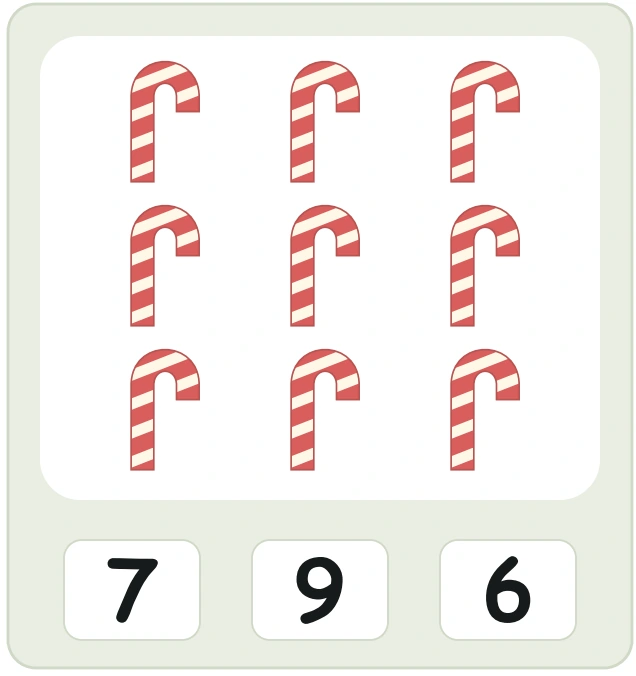
The upper-middle card contains nine candy canes arranged in three rows of three. Read its options as 7, 9 and 6. The correct selection is 9, found in the middle of that particular response row.
Every red-and-white stripe belongs to a cane drawing. Christmas Counting does not ask for a total of stripes, curved ends or colored sections. Point along the outline of a single cane if the repeated decoration captures the child's attention.
Next, count the entire collection with one touch for each complete cane. A row can help organize attention, but the learner still needs to include all three rows. Stop after the last picture and say what the final number describes.
An adult can ask, “Which cane did your nine belong to?” The learner can identify the final drawing without recounting every stripe. Christmas Counting becomes easier to discuss when a spoken number has a visible object behind it.
Set up a classroom Christmas Counting demonstration
Before distributing pencils, display a card where everyone can see its pictures. Invite one learner to identify the whole object that should receive a count. For the bell card, that means one complete bell with its attached details, rather than separate counts for the ribbon and bell body.
Use a short demonstration with the three bells. Two sit above another bell. Count all three, then locate 3 among the printed choices 3, 2 and 6. Ask a second learner to explain what the selected digit describes.
At tables, Christmas Counting partners can take different speaking turns. One names the unit and indicates the pictures; the other reports the resulting amount with its object name. Both should be able to inspect the same card before anyone records a choice.
Swap responsibilities for a later card. Give an adult the pencil when a learner wants to participate orally or by pointing. Christmas Counting discussion can stay focused on mathematical meaning while the physical response receives suitable support.
Four Christmas Counting parcel-label investigations
1. Give a Christmas Counting label its object name
Choose the hat card and establish that it contains one hat. Ask the learner to dictate a pretend label saying both the amount and the object. An adult can write the words on separate scrap paper.
Bring the label back beside the source card. Christmas Counting makes “one hat” more useful than “one” alone because a listener can tell which collection the report concerns. The pompom and brim remain parts of that single drawing.
2. Inspect a Christmas Counting bell description
Let an adult deliberately describe a pictured ribbon as though it were an extra object to count. Invite the child to explain which complete bell includes that ribbon, then establish the amount using whole bells.
Keep the exchange playful and visible. Christmas Counting correction should arise from the illustration, rather than from guessing whether an adult statement sounds right. A simple gesture around the full drawing can communicate the explanation.
3. Check a Christmas Counting snowflake boundary
Select the eight-snowflake card and ask the learner to indicate one entire snowflake. Notice its branching arms without counting those arms as extra snowflakes. Count the eight separate drawings and inspect 8, 7 and 9.
For another visit, let the child teach the counting unit to a puppet. Christmas Counting vocabulary such as “whole snowflake” helps explain why a detailed shape still receives just one number in this task.
4. Deliver a Christmas Counting wreath report
The wreath card shows five separate wreaths. A pretend messenger can report the amount to a partner, who checks the pictures and finds 5 among the choices 5, 4 and 2. Then exchange the messenger and checker jobs.
Use the object name in the spoken delivery. Christmas Counting does not require counting the bows or decorations inside each wreath. If two reports differ, identify the drawings that each messenger included before changing a label.
Match Christmas Counting support to ages three through six
For a preschool child beginning to coordinate number words and pointing, start with the single hat or two snowmen. Identify the unit together and share the count. A kindergarten learner may be ready to explain why decorations do not alter the number of whole pictures.
The age range of three to six is a guide for choosing support, not a demand to finish every card. Christmas Counting contains quantities up to nine, and a child comfortable with two objects may need help maintaining attention through the larger collections.
Use specific recognition: “You included the mitten on the lowest level.” That describes a useful action the child can repeat. Seasonal pictures provide conversation starters, while an adult's patient listening makes room for uncertainty and another look.
A Christmas Counting card list for the adult's check
| Location | Whole drawings | Printed alternatives |
|---|---|---|
| Top left | 1 hat | 3 / 1 / 7 |
| Top center | 9 candy canes | 7 / 9 / 6 |
| Top right | 3 bells | 3 / 2 / 6 |
| Middle left | 8 snowflakes | 8 / 7 / 9 |
| Middle center | 2 snowmen | 5 / 2 / 3 |
| Middle right | 7 mittens | 7 / 6 / 8 |
| Bottom left | 6 candles | 5 / 7 / 6 |
| Bottom center | 5 wreaths | 5 / 4 / 2 |
| Bottom right | 4 wrapped candies | 5 / 4 / 3 |
These are quantities of the individual pictures. A candle and its flame form one candle illustration; each wrapped candy is one object including its twisted wrapper. The reference supports Christmas Counting feedback after the child has had an opportunity to inspect and explain a collection.
When Christmas Counting needs a smaller next step
If a child counts the same snowman twice, locate the two complete figures and agree on a starting picture. If the child counts a snowman's body sections, return to naming one whole snowman. Those difficulties require different demonstrations.
A learner who correctly says six candles but circles 5 may need help reading or locating 6. Read the alternatives aloud and invite a pointed response. Christmas Counting practice is more informative when an adult checks the spoken amount before interpreting the recorded mark.
For another short visit, select a different object category and repeat the unit-naming conversation. One whole picture receives one count. Keep the session brief enough for a thoughtful report, and allow the learner to choose which festive object to inspect next.
Connect Christmas Counting with the five-focused tracing and quantity sheet when numeral meaning needs attention. Explore ten varied line patterns for separate pencil practice. Later, fruit groups combined into totals introduces a new reason to count pictures.
Prepare a printable Christmas Counting copy for your learner
Choose the original free sample or use an active, eligible membership to obtain the clean premium PDF. The premium Christmas Counting printable has no website-name or domain watermark, and the file contains no added advertisements. Member download access supplies that separate clean edition.
Select US Letter paper and a portrait layout in the print dialog. Check the preview against the full sheet and fit within your printer's printable area when necessary. One trial copy should preserve the bottom candies, every option row and the outside page boundary before you produce more copies.
Place the Christmas Counting page on a steady surface and invite the learner to name a starting object. A clear object name gives the first number somewhere to belong. Listen to that first explanation before deciding how many cards to offer today.
Popular Worksheets
Printable resources families and teachers are downloading now.
 Free
 Free
 Free
 Free