
Count to Nine: 6 Brilliant Winter Games for Happy Kids
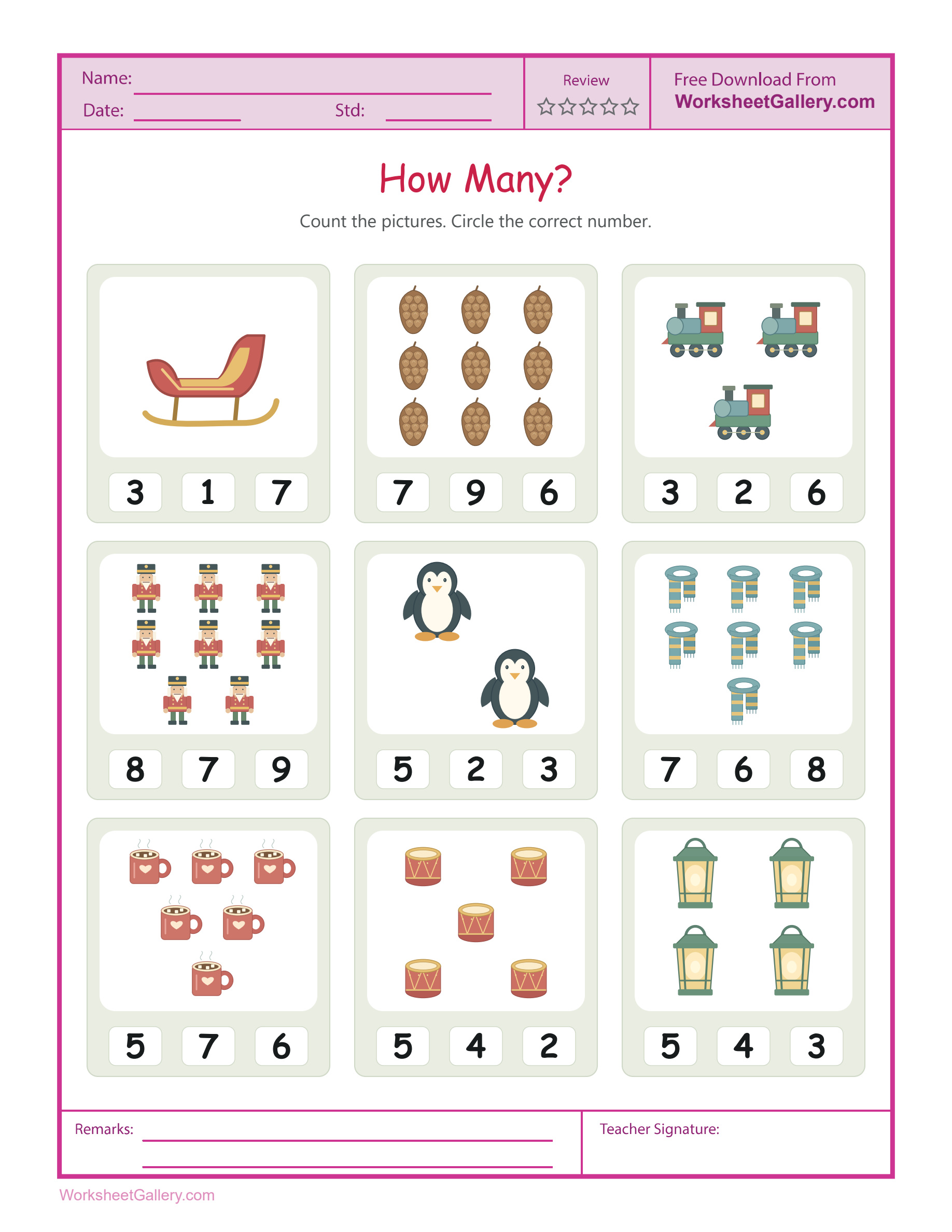
A good counting route remembers where the eyes have already been. Count to Nine brings that idea to a winter page of pinecones, toy trains, penguins and other illustrated collections. Some pictures form even rows; others leave a shorter level at the bottom. Children count each collection, inspect three printed numerals and circle the amount they found. Use Count to Nine as a little reporting desk: show where the count began, include every picture once, and announce a number that a listener can check.
Follow the pinecones as you Count to Nine
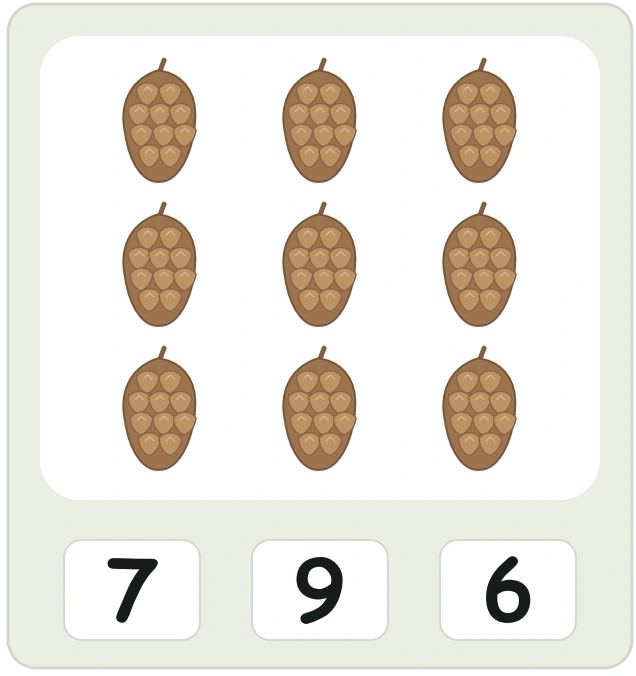
The pinecone card is at the top center of the sheet. Its nine drawings form a square arrangement with three pictures across and three levels down. The response choices read 7, 9 and 6, making 9 the matching option.
To Count to Nine through this collection, select a starting cone and move through the first row before continuing below. Pointing makes the route available to a partner, who can notice whether the count includes each separate cone.
The many small scales decorate each pinecone. They do not receive separate counts in this activity. Name the whole object first if the details distract from following the collection.
There is no requirement to memorize a route or count rapidly. Count to Nine offers a reason to choose an orderly path, then use the final spoken number to describe the entire pictured group. The answer belongs to the collection, rather than to the last row alone.
Three route cues for a Count to Nine report
Indicate the particular picture where counting will start. A visible starting place makes an accidental restart easier to notice.
After an upper row, move to pictures below it. Short lower rows still belong to the collection.
Point to the final picture and report how many objects the whole card contains before inspecting its numeral choices.
A child may use another systematic route. Count to Nine does not depend on everyone's finger following an identical direction; the important check is whether every object receives one count and none receives two.
Dina's Count to Nine broadcast from the kitchen table
Dina and her older brother turn a scrap-paper tube into a pretend microphone. Dina becomes the winter picture reporter, and her brother asks how she will keep track of the pinecones. She indicates the top row before beginning her report.

She counts down through the rows, then announces nine pinecones. Her brother repeats the amount and asks her to locate its numeral. Dina circles 9 in the response strip and explains that her last count reached the final lower cone.
For another Count to Nine report, they choose the mugs. This time the picture levels contain three, then two, then one. Dina explains the change in arrangement before counting, so the previous route becomes a useful idea rather than a rigid rule.
The illustrated penguin radio desk is story material, not a solved example to copy. Count to Nine evidence stays on the worksheet. An adult can be the listener, write down a dictated report or help move the pencil while the learner supplies the object count.
Seven things a Count to Nine listener can notice
- Count to Nine planning: Choosing a first picture and an order gives attention a specific path instead of leaving the eyes to jump between attractive drawings.
- Count to Nine correspondence: Pairing a number word with one pointed object makes double counts and skipped pictures easier to detect.
- Count to Nine completion: Including the short bottom level develops the habit of checking the entire collection before reporting its quantity.
- Count to Nine symbols: Selecting the printed numeral after counting connects an observed amount with a written representation.
- Count to Nine communication: Explaining a route uses location words such as above, below, next and last in a concrete shared setting.
- Count to Nine coordination: Pointing and circling offer different hand-control tasks; support either movement without taking over the child's explanation.
- Count to Nine revision: Finding a specific omitted drawing makes a correction understandable, giving the learner an action to change on the next attempt.
Treat these as observations, rather than promises about a child's progress. One report can reveal a secure count alongside unfamiliar numeral shapes. Listen for the method as well as the amount.
The Count to Nine nutcracker report stops at eight
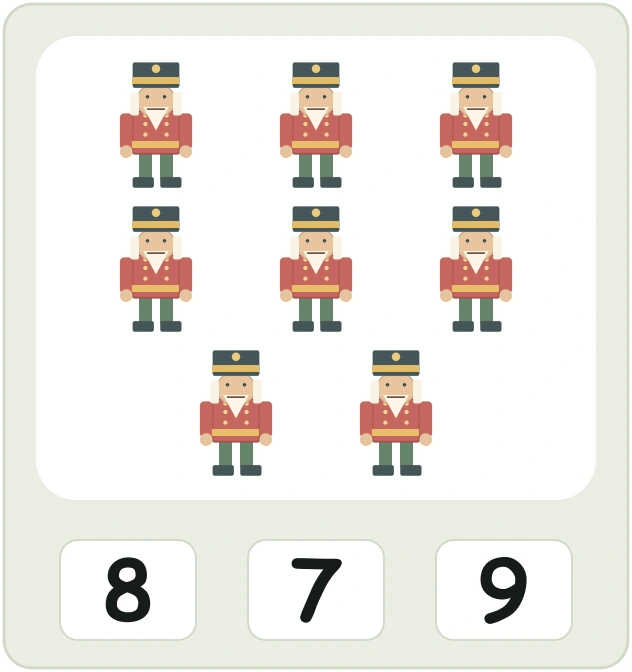
Despite the lesson's name, each card has its own quantity. Eight nutcrackers occupy the middle-left card: three above, three beneath them and two at the bottom. Its choices are 8, 7 and 9, with 8 appearing first.
A Count to Nine route must respect the pictures actually present. Do not invent a ninth figure to complete the bottom level or choose 9 because it appears in the page title. The complete pictured collection determines the answer.
If a child says six, ask which figures have already received a count. The upper two rows may be accounted for while the lowest pair remains untouched. Point to that pair and rebuild a count that includes them.
Use the end of the picture group as the stopping rule. Count to Nine means exploring collections up to nine on this sheet, not forcing every collection to reach the same ending number.
Put a Count to Nine listener beside the classroom pointer
Demonstrate with the trains before learners work independently. Two locomotives appear above a third. Ask a volunteer to show a route that reaches all three, then ask the class where that route ends. Wheels and windows belong to their train drawings.
Let the pointer speak the count while a listener follows the indicated objects. Afterward, the listener describes the route and the reporter finds 3 among 3, 2 and 6. This Count to Nine partnership gives both children a meaningful mathematical job.
Switch speakers and listeners on a different card. If a listener notices a gap, invite a location description: “the picture under those two.” That is more actionable than simply announcing that an answer is wrong.
For learners aged three to six, choose a suitable collection and amount of help. Preschool beginners can start with one sleigh or two penguins; kindergarten learners may describe the longer pinecone route. Count to Nine participation does not require finishing the entire page during one sitting.
Six Count to Nine jobs for the pretend radio crew
1. Open a Count to Nine report with a location
Choose a card and describe its starting picture before saying any counting words. A partner points to the proposed starting place so both people know where the route begins.
Then count and report the amount. Count to Nine location language gives a listener something visible to follow; it should support the count without turning into a complicated set of directions to memorize.
2. Give a Count to Nine scarf update
Inspect the seven scarves, arranged three, three and one. Ask the reporter to explain what happens after the second full level. Include the last scarf and choose 7 from the printed options 7, 6 and 8.
Each complete scarf receives one number. Count to Nine does not count its hanging ends as separate scarves, even when those ends are the most noticeable features of the drawing.
3. Describe a Count to Nine lantern square
Four lanterns form two upper and two lower pictures. Let one learner describe a row route and another propose a column route. Check that either approach reaches four separate lanterns exactly once.
Compare the methods after establishing the amount. Count to Nine can make room for different routes that produce the same supported quantity, with 4 selected among 5, 4 and 3.
4. Repair a Count to Nine drum omission
The five drums have two pictures above, one in the middle and two below. An adult can point to only the outer four, inviting the learner to identify the central drum that was missed.
Recount the complete collection before choosing 5 from 5, 4 and 2. The Count to Nine repair concerns a visible omission; the adult should make the demonstration easy to inspect rather than conceal a trick.
5. Start a fresh Count to Nine penguin bulletin
After reporting another card, move to the two penguins and start a new count at one. Explain that the new card asks about a different collection. Its answer does not continue the previous card's total.
Count to Nine cards are independent tasks. Establish two penguins and find 2 between 5 and 3, keeping the two quantities separate even if the pretend broadcast mentions both collections.
6. Let a Count to Nine partner check the ending
After counting a chosen card, point again to the picture that received the final number. Invite the listener to check whether any drawing remains outside the route.
A confident listener can explain why the group is complete. Count to Nine checking is an opportunity to inspect a method, with time for the reporter to make a correction before announcing the numeral.
A Count to Nine cocoa route with three levels
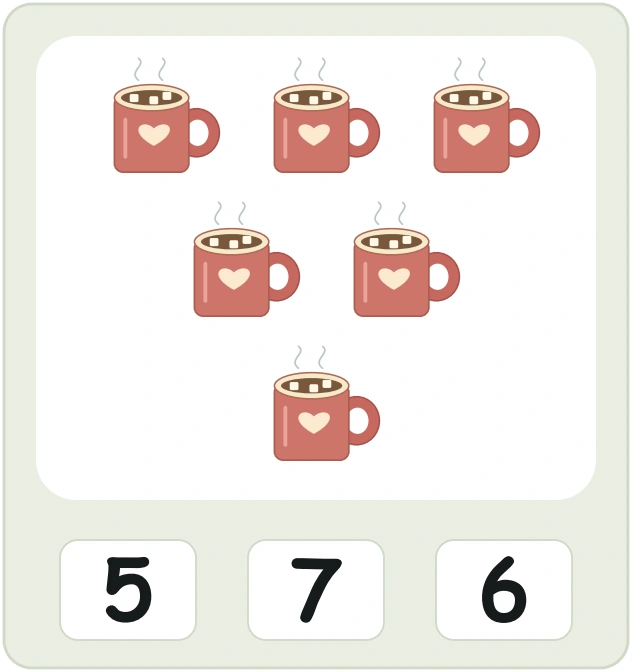
Six mugs occupy the lower-left card in levels of three, two and one. Following each level in order reaches the lowest single mug last. Its correct option, 6, follows 5 and 7 in the response strip.
Hearts, handles and steam are parts or details of the mug pictures. Count to Nine follows the six whole drawings. If the bottom mug is missed, name its location and include it in a new complete check of the collection.
Keep this Count to Nine reference beside the adult
| Sheet area | Collection amount | Choices from left |
|---|---|---|
| Upper left panel | 1 sleigh | 3, 1, 7 |
| Upper central panel | 9 pinecones | 7, 9, 6 |
| Upper right panel | 3 trains | 3, 2, 6 |
| Center left panel | 8 nutcrackers | 8, 7, 9 |
| Central panel | 2 penguins | 5, 2, 3 |
| Center right panel | 7 scarves | 7, 6, 8 |
| Lower left panel | 6 cocoa mugs | 5, 7, 6 |
| Lower central panel | 5 drums | 5, 4, 2 |
| Lower right panel | 4 lanterns | 5, 4, 3 |
Use the reference to check a report after observing its route. The correct response occupies different places among the three choices, so a position-based shortcut cannot reliably answer the page.
Make Count to Nine practice worth returning to
When the voice outruns the finger, slow the pointing and share the number words. When a route circles back, agree on a clear next row. When the spoken amount is right but the digit is unfamiliar, read the options with the child before asking for a mark.
Offer another brief broadcast on a later day, perhaps letting the learner choose a collection that was previously left untouched. Name an observed success: “Your route reached the lone mug below.” Specific feedback makes the achievement easier to recognize and repeat.
For a separate numeral connection, visit the quantity-and-writing activity for five. The beginning hand-control routes give pencil movements their own practice. When combining collections becomes appropriate, explore the picture-group addition ideas with an adult.
Print Count to Nine before opening the microphone
The free download supplies the uploaded original with its branding. Members whose eligible plan is currently active can download the separate premium Count to Nine PDF. That printable removes website credits and domain watermarks and carries no added ads inside the file.
Use a portrait US Letter print setup and retain the complete worksheet boundary. Inspect a trial print for legible response digits and the small lower pictures. If a printer clips an edge, adjust its scaling to keep the entire page within the printable margins.
Set out a pencil and invite a first report when the learner is ready. A listener should be able to follow the count, not just hear its ending.
Popular Worksheets
Printable resources families and teachers are downloading now.
 Free
 Free
 Free
 Free