
Classroom Equal Totals: 5 Brilliant Same-Value Games
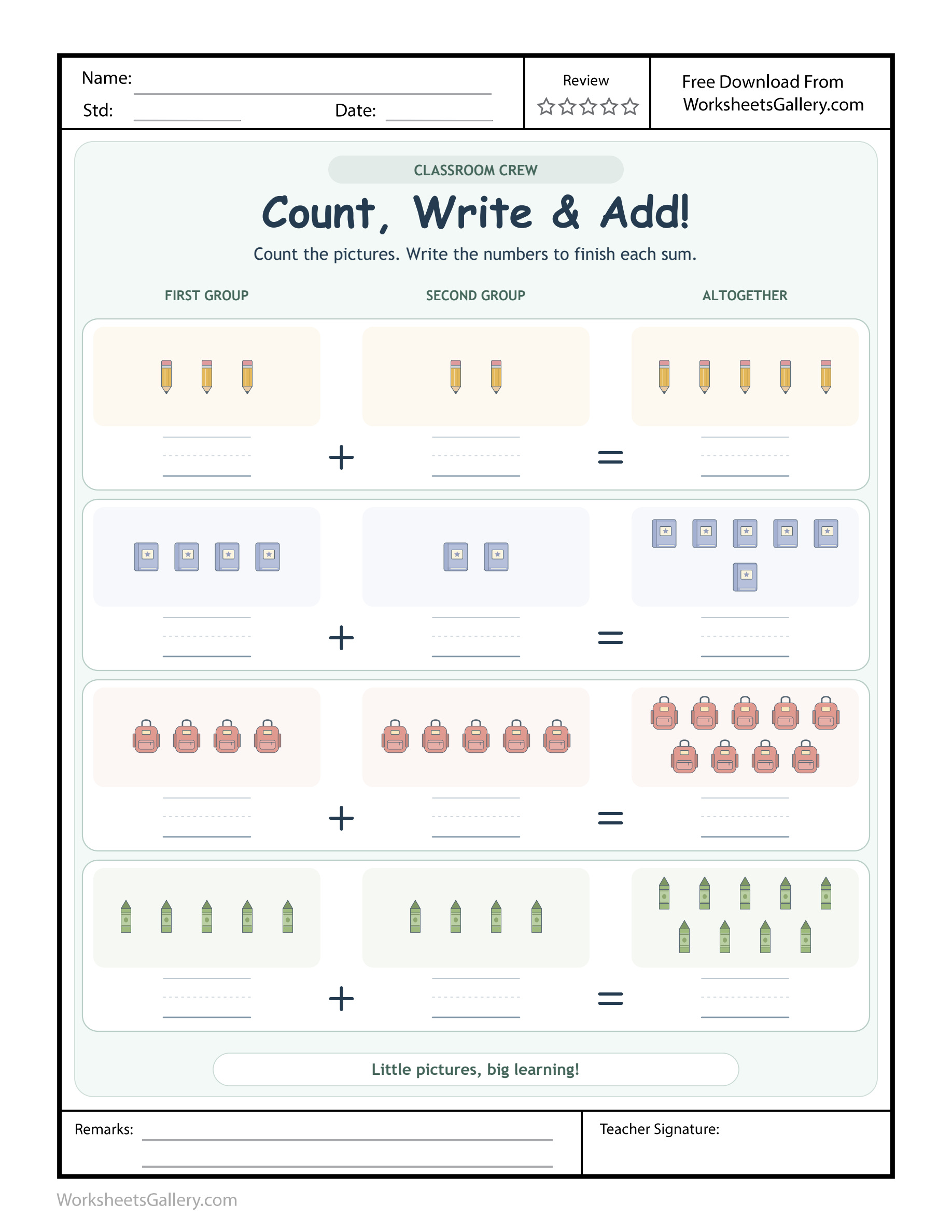
Two classroom reports can end with nine and both be correct. Classroom Equal Totals makes that possibility visible through backpacks and crayons, after smaller pencil and book equations. Children count the first group, the second group and their pictured whole, then write the three quantities. The final two rows use four and five in reversed order, so their matching totals deserve an explanation rather than an automatic correction. Ask the learner what each report's pictures support. A familiar school-supply setting gives those explanations a purpose while keeping the evidence close at hand.
Classroom Equal Totals can begin with a doubtful nine
Ada shows her teacher a nine below the backpacks and another below the crayons. She hesitates because the preceding totals were five and six. She expects each later answer to grow. Her Classroom Equal Totals teacher asks whether a worksheet row must have a larger whole just because it appears lower on the page.
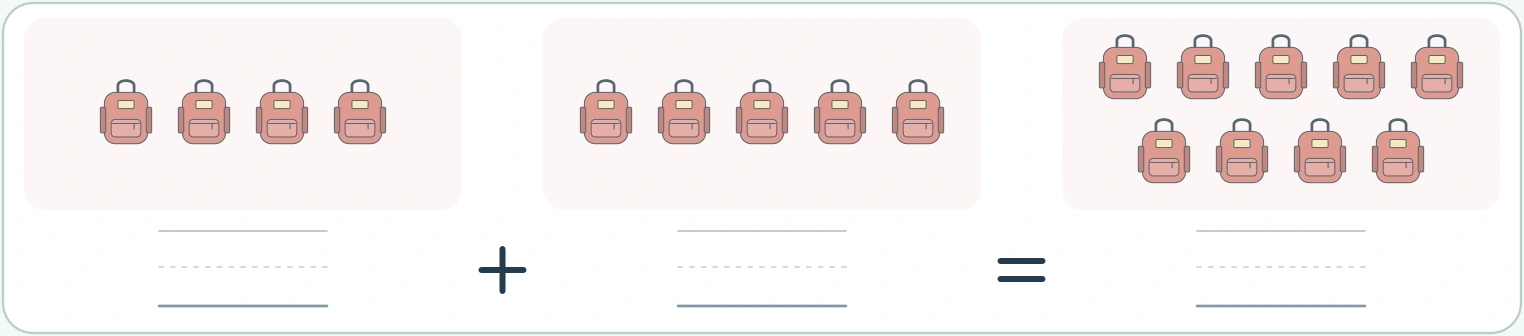
Together they inspect Classroom Equal Totals backpacks: four in the first group, five in the second, nine altogether. The crayons show five, four and nine. Ada says, “The parts changed places.” The teacher asks her to check both wholes rather than accepting that observation alone. The pictured groups supply evidence for keeping both nines.
Read Classroom Equal Totals as separate quantity reports
Each Classroom Equal Totals equation describes its own supply collection. FIRST GROUP and SECOND GROUP give the parts, while ALTOGETHER shows the whole represented by those two parts jointly. The learner writes a numeral beneath every panel. Four equations therefore require twelve number records.
Classroom Equal Totals does not supply numeral shapes to trace. Its guides have solid and dotted lines, and its mathematical signs are already printed. Every written value should describe its own pictures. The last panel is not another addend, even though it depicts the combined quantity again. Count the first two parts together and use that final representation to check agreement.
Classroom Equal Totals crayons explain the repeated result
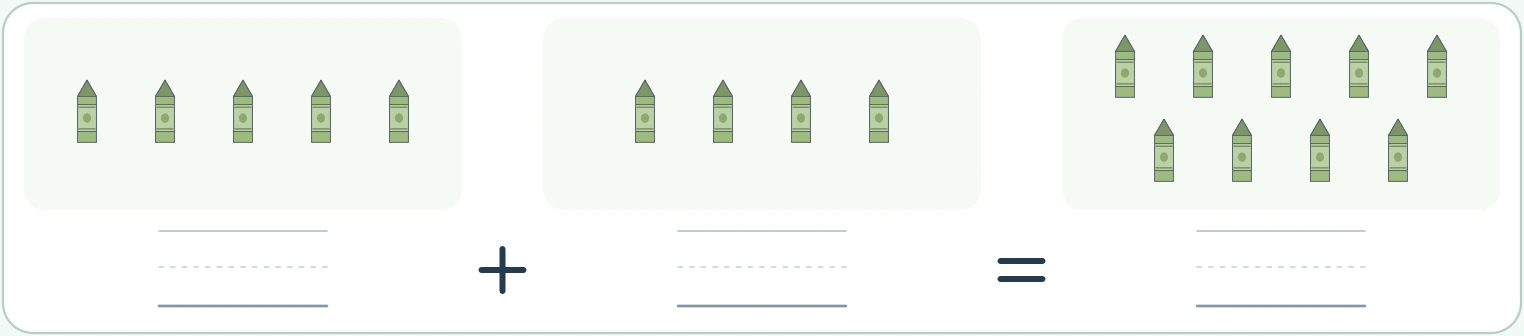
Five crayons and four crayons give nine. That whole matches the backpack row's four plus five, although the first and second records change places. Young learners can explore the relationship through counting before learning formal terminology. Ask what stayed the same after the parts switched.
Classroom Equal Totals offers an example of addition's order property, but understanding need not depend on naming that property. “Five and four make the same whole as four and five” is a meaningful explanation when the child can connect it to the collections. Let them verify with objects if the printed panels feel too crowded.
A Classroom Equal Totals reference for supply checks
The Classroom Equal Totals table gives adult preparation values in the printed order. Let children use the pictures during their own attempt rather than placing this answer reference beside their pencil as a copying task.
| Supply report | First amount | Second amount | Whole |
|---|---|---|---|
| Pencils | 3 | 2 | 5 |
| Books | 4 | 2 | 6 |
| Backpacks | 4 | 5 | 9 |
| Crayons | 5 | 4 | 9 |
Classroom Equal Totals begins with two different smaller results, then repeats nine for a numerical reason. The sheet does not ask learners to extend a sequence of totals. Checking each equation protects a justified answer from being replaced by an assumed next number.
Six Classroom Equal Totals learning signs to watch
- Independent row reading: a learner looks at the present supply groups instead of borrowing an answer pattern from the preceding row.
- Part-whole reasoning: both starting amounts belong in the represented whole, while the whole panel itself is not added again.
- Order awareness: the child notices when four and five change first and second positions.
- Equality language: explaining “the same whole” connects a comparison with the meaning of the equals sign.
- Controlled visual tracking: complete supply pictures receive one count each, including those below an upper line.
- Written communication: selected numerals report the quantities, combining small hand movements with an established counting decision.
Classroom Equal Totals may reveal a strong spoken explanation alongside developing handwriting. Ask what number was intended before interpreting an unclear mark. Likewise, neat numerals alone cannot tell whether a child counted independently or copied an adult's model.
Start Classroom Equal Totals at home with five pencils
Prepare a flat surface, the worksheet and a manageable pencil. Read the directions, name the supplies and count the three pencils in the first panel. Record three beneath them. Count the two in the next panel and record two. Then establish five together and inspect the pictured whole before writing it.
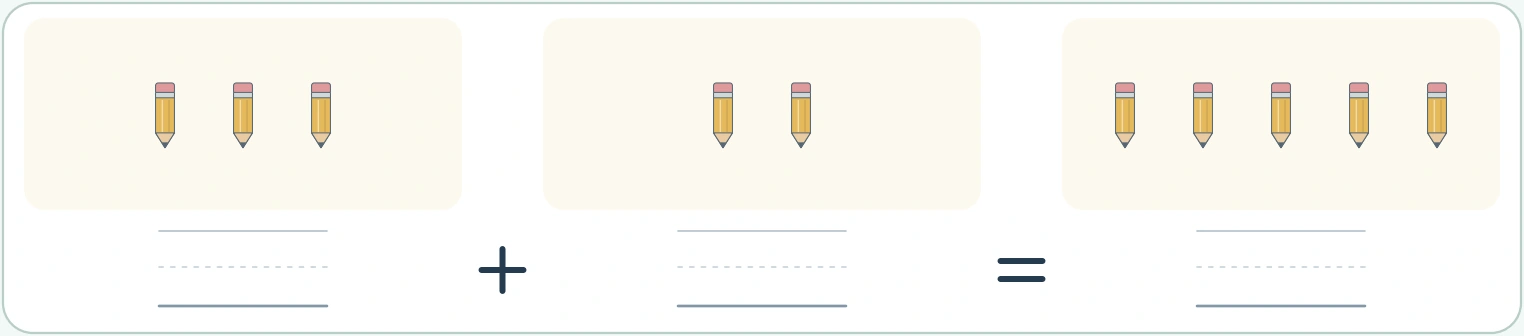
For Classroom Equal Totals, a physical model can use five large counters standing for pencils. Explain the substitution, separate three from two and then bring them together. The Classroom Equal Totals learner can count all five, or retain a secure three while continuing through the two additions. Choose the route they can explain rather than imposing a faster method.
Classroom Equal Totals books need their lower picture
The book equation is four plus two equals six. Its whole has five books above one. If a learner records five, ask them to show exactly which books were counted. The lower picture may have been missed even when joining the starting groups was understood.
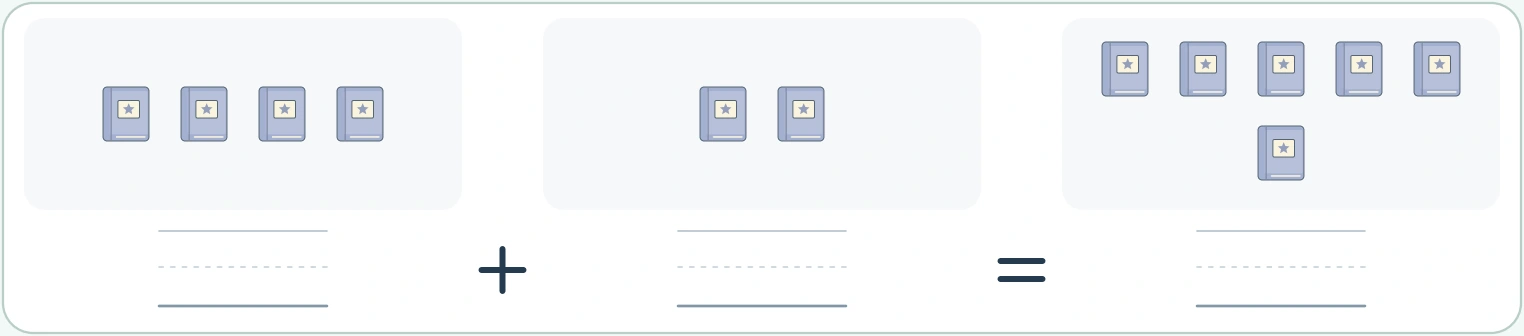
Classroom Equal Totals uses complete supply items as its unit. Cover emblems, backpack pockets, crayon wrappers and pencil erasers remain parts of their objects. A simple touch near each object's centre can keep attention on the counted unit. If tracking becomes difficult, use a separate model in one straight line, then return to the printed arrangement for comparison.
Give Classroom Equal Totals a classroom reporting routine
Divide the work into roles: one learner checks a first group, another checks the second, and a third verifies the pictured whole. After they agree, a recorder writes the three values. Rotate jobs on a different row so no learner always supplies only the final total.
A Classroom Equal Totals teacher can place the backpack and crayon reports side by side for discussion. Ask whether matching final numbers mean that someone copied. Children can show evidence that both rows total nine. That conversation encourages checking a surprising result rather than treating surprise itself as proof of an error.
Five Classroom Equal Totals games for a supply desk
1. Give Classroom Equal Totals two honest reports
Use four large counters and five more to represent backpacks. Count the whole and write 9 on a separate card. Rearrange the same-size parts as five and four to represent crayons, then count again. Classroom Equal Totals invites the child to defend two matching reports with evidence. Keep the source writing guides available for their later independent records.
2. Audit a Classroom Equal Totals growing-answer claim
An adult says the crayon total must be ten because the backpack total was nine. Ask the child which pictures would need to support that claim. Count the five and four crayons jointly and inspect the nine pictured together. Classroom Equal Totals makes it reasonable to reject an expected pattern when the current relationship does not fit it.
3. Read Classroom Equal Totals with number cards
After counting the pencil panels, offer cards for 2, 3 and 5. Invite the learner to arrange them on separate practice paper in the printed three-then-two order. Classroom Equal Totals can then reveal whether numeral selection is secure before handwriting begins. The correct whole does not excuse reversed first and second records; each card should describe its panel.
4. Become the Classroom Equal Totals questioner
Let a child choose a row and ask an adult how the whole was established. The adult demonstrates a pointing path and explains the two parts. Classroom Equal Totals gives the learner an inspecting role rather than making them answer every question. Invite them to notice a deliberate missed lower book only if that challenge feels playful and manageable.
5. Make a Classroom Equal Totals changed-order display
Build two small groups with suitable large objects and establish their combined quantity. Swap the groups' positions without adding or removing anything. Ask whether the first amount, second amount and whole all stayed unchanged. The parts' positions change, while the whole remains the same. Relate this new demonstration to the backpack-and-crayon comparison without claiming it is an extra printed worksheet problem.
A Classroom Equal Totals supporting image for the first report
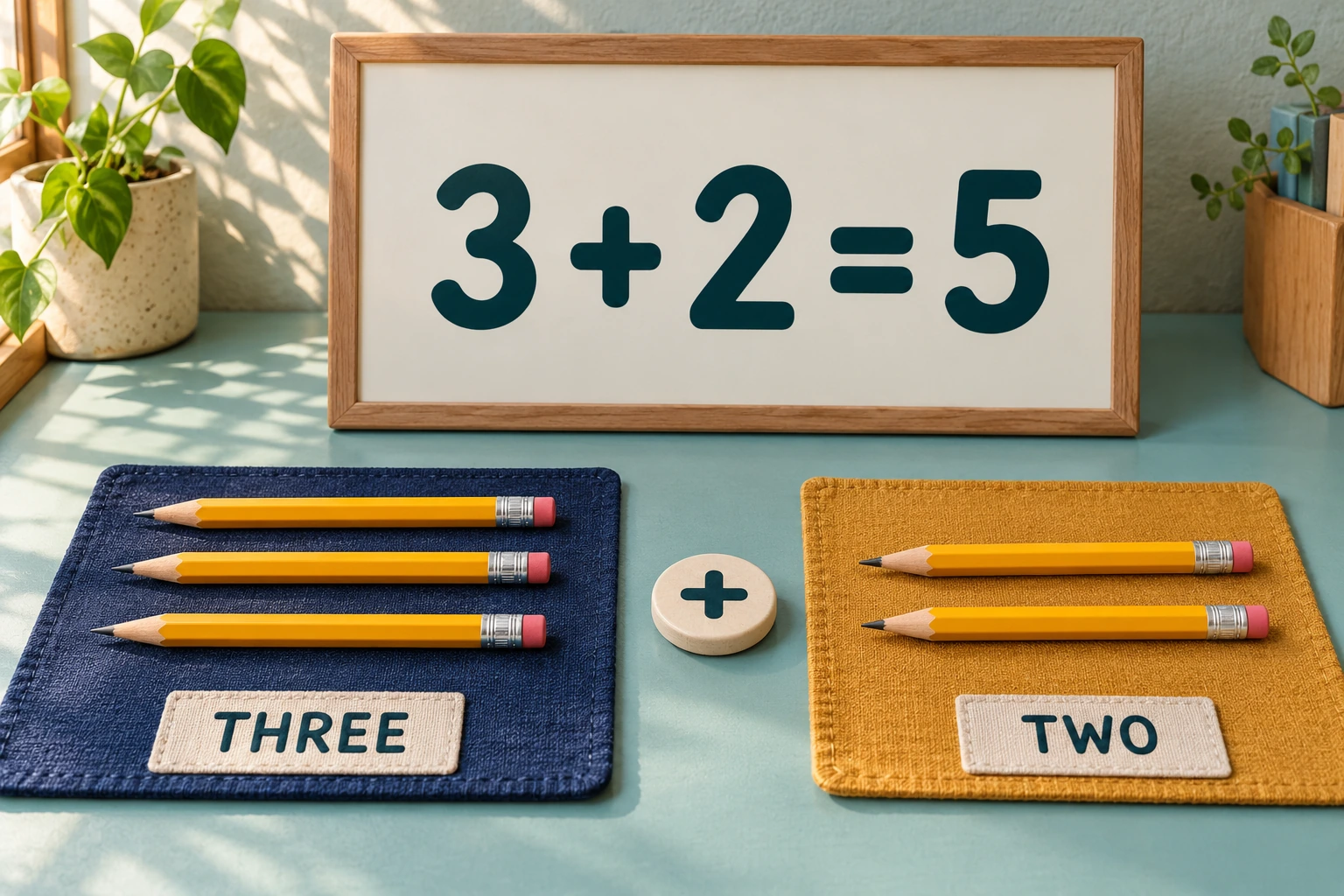
The separate Classroom Equal Totals illustration shows three pencils on one mat and two on another, with a readable three-plus-two equation. It offers a smaller demonstration before the two nine-total reports. Classroom Equal Totals keeps the faithful source previews and clean PDF unanswered; the equation board belongs to a supporting learning scene.
Match Classroom Equal Totals to a learner's readiness
Around ages four to six, preschool and kindergarten learners can use the worksheet with varying support. Begin when the child can count small collections and attend to a brief panel comparison. Read the instructions aloud, cover unused rows and offer a spoken answer before requiring every numeral to be written.
Classroom Equal Totals calls on attention to hold quantities, language to explain a comparison and hand control to produce readable symbols. A child may need more support in one of these areas than another. The learning-five worksheet and six-tracing practice provide separate numeral experiences when that is the relevant next step.
Keep Classroom Equal Totals mistakes specific
Watch for copying the previous row's starting values, insisting every total must increase, counting small object features or adding the whole panel again. Ask the learner which collection supports a written number. Give them time to point and recount before offering an explanation of your own.
For Classroom Equal Totals, a repeated result is a reason to check, not a reason to erase. Try “Both nines have picture evidence” when the child verifies them. If a numeral is hard to form, model it separately after establishing the quantity. Stop or switch to an oral explanation when fatigue makes the pencil task dominate the mathematical conversation.
Return to Classroom Equal Totals with a different role
One session might establish the pencil relationship; another might compare the two nines. On a later visit, the child can question a partner's report or dictate the three values without writing. Brief varied purposes keep practice meaningful without requiring repeated full-page completion. Let the learner choose which report deserves another look.
The nine-formation activity connects with the final two wholes. Adults seeking everyday number talk can explore NAEYC's family mathematics ideas and the age-five maths resources at PBS Parents. Classroom Equal Totals is one opportunity to explain quantities among a range of object play, conversation and short written tasks.
Download Classroom Equal Totals for a fresh writing attempt
Choose the original sample for the uploaded presentation, which can retain source branding. The clean premium file is a separate attachment accessed through this page's premium control after login with an eligible current membership. Its worksheet contains no watermark, website-name or domain promotion, and no ads embedded in the printable activity.
Classroom Equal Totals is a single-page US Letter PDF. Save the file, inspect all four equations in print preview and choose appropriate scaling if your paper differs in size. Retain the full frame and all twelve writing guides. Website advertisements, if present, are separate from the downloaded sheet. Leave the response spaces clear, invite a careful count, and let the two nines remain when the child can explain the quantities that justify them.
Popular Worksheets
Printable resources families and teachers are downloading now.
 Free
 Free
 Free
 Free