
Cozy Addition Notes: 6 Powerful Single-Garment Games
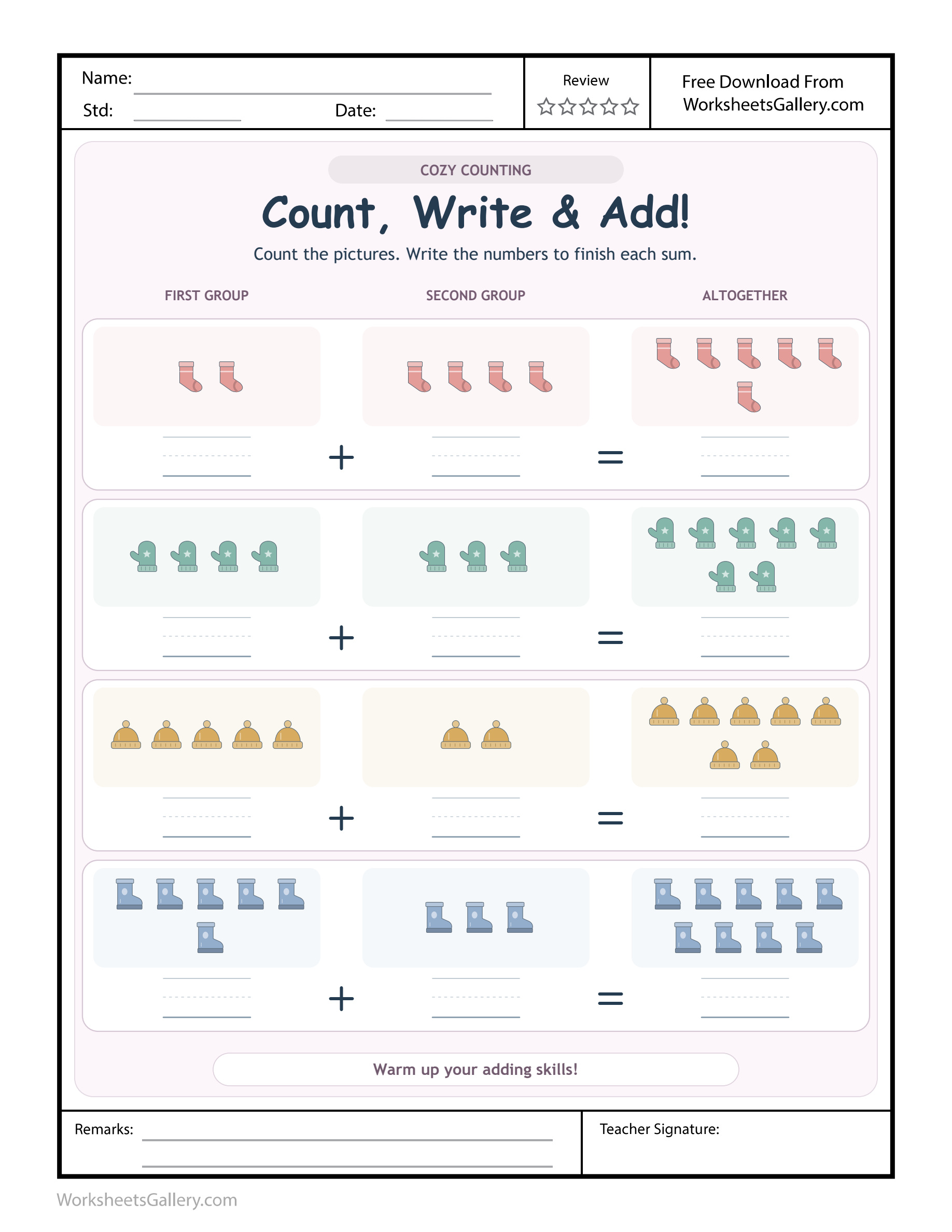
Seven mittens are seven individual items, even when a learner expects mittens to come in pairs. Cozy Addition Notes uses that small surprise to keep the counting unit clear. Four illustrated rows join socks, mittens, hats and boots, with pictures of the two parts and their whole. Children count each garment once, then write three numbers for the relationship. The clothing context invites familiar conversation, but matching pairs is a different task. Agree on what counts as one item before adding, and an odd result can become a sensible report rather than a problem to fix.
Cozy Addition Notes names the unit before the number
Point to a single sock and call it one sock. Do the same with a mitten or boot. A garment drawing includes details such as a cuff, thumb or sole; those details do not become extra clothing items. The Cozy Addition Notes unit remains one complete pictured garment throughout its row.
Cozy Addition Notes does not ask how many people could wear the clothing or how many matching pairs can be made. Its question concerns the number of individual pictures. A single unmatched mitten still belongs in the count. That agreement allows four mittens and three more to form a legitimate whole of seven.
Start Cozy Addition Notes with a sock relationship
Two socks appear in the first panel and four in the second. Their pictured whole contains six. Count each starting collection, name its quantity and write the corresponding numeral below it. Then establish the joined amount and compare it with the right-hand panel before recording the total.
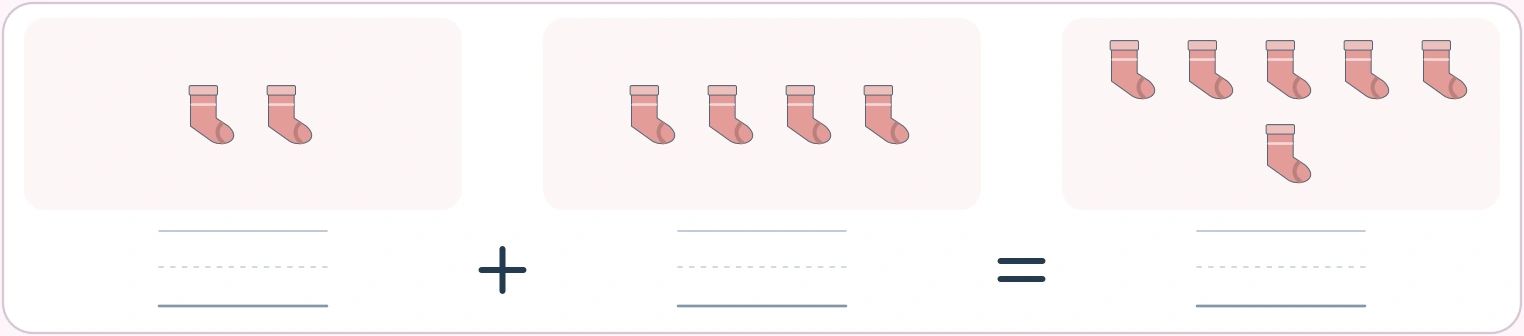
Cozy Addition Notes uses FIRST GROUP, SECOND GROUP and ALTOGETHER labels. The last panel represents the two parts combined; it is not another six socks to add. Each row has three writing guides, so four equations require twelve numeral records. Solid and dotted lines guide the writing space without supplying numeral shapes for tracing.
Rohan's Cozy Addition Notes mitten question
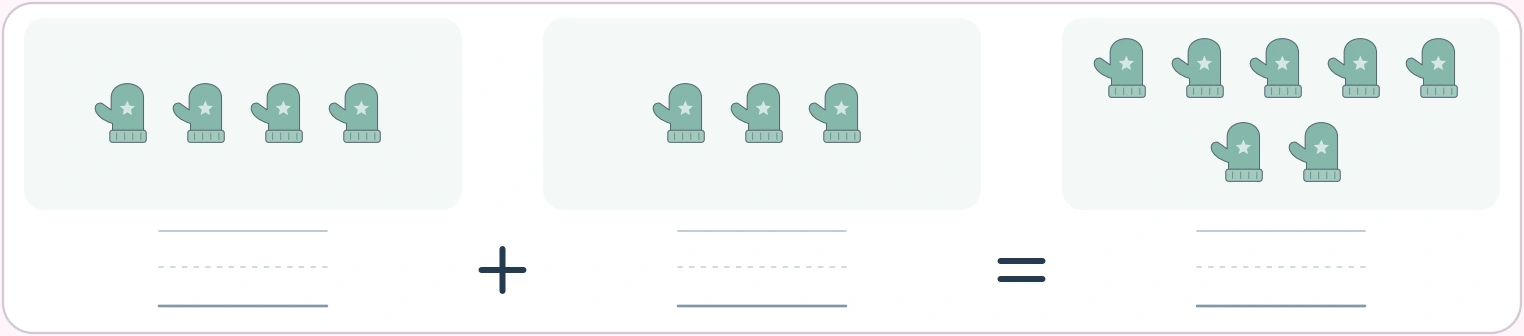
Rohan tells his mother that seven mittens cannot be right because “one has no partner.” She agrees that an unmatched mitten would matter when getting dressed, then asks a more precise question: how many individual mittens are shown? Together they touch four in the first panel and three in the next.
For Cozy Addition Notes, the whole of seven includes every one of those items. Rohan's mother does not remove a mitten to make an even total. They count the right-hand panel to check, and he explains that pairing would answer another question. His observation about clothing remains sensible while the mathematical report follows the unit the activity actually asks them to count.
Six Cozy Addition Notes games about individual items
1. Give Cozy Addition Notes a single-item introduction
Lay out two large paper sock shapes and four more on separate mats. Ask the child to touch one complete sock per count, then bring the same six together. Cozy Addition Notes connects the model to the source row while preserving the single-item unit. The learner can point to cuffs or heels afterwards and explain why they were not additional socks.
2. Keep the Cozy Addition Notes unmatched mitten
Build four and three with large mitten-shaped cards or counters explicitly standing for mittens. Count all seven and invite the child to explain whether an unmatched item should disappear from the report. Cozy Addition Notes makes room for an odd quantity. Keep any pairing discussion separate, returning to the instruction to count each individual picture before writing the total.
3. Speak a Cozy Addition Notes wardrobe message
One partner describes the hat row: five first, two more, seven together. Another makes the two groups with suitable counters and checks them. Cozy Addition Notes practises a clear message that contains both amounts, not just the final seven. Swap the roles so the original speaker also listens and builds a quantity from someone else's description.
4. Challenge a Cozy Addition Notes cuff count
An adult touches a sock and then its cuff, saying two. Invite the child to decide whether those touches named two garments or two parts of one garment. Cozy Addition Notes provides a useful correction: count complete socks for this task. Ask the learner to show a better touching route, then recount the selected group with one touch per item.
5. Compare Cozy Addition Notes sevens
Use counters to show four and three, then rearrange them into five and two. Count the whole after each arrangement. The mitten and hat rows both reach seven even though their parts differ. Discuss the changed grouping without requiring the child to memorize a fact family. The seven counters are the same-size whole in both demonstrations.
6. Give Cozy Addition Notes a nine-boot report
Prepare six large counters and three more to stand for boots. Have a learner announce the first amount, the joining amount and the whole. Then compare the model with the printed final row. Cozy Addition Notes includes the lower boot in the first panel's six and all nine in the whole; neither picture line creates a new equation.
Five Cozy Addition Notes benefits to observe
- A stable unit: the learner agrees to count individual garments, making both even and odd totals meaningful.
- Accurate picture tracking: touches follow complete items and continue through lower picture lines without skipping or restarting.
- Part-whole understanding: two starting collections are considered together and compared with a separately pictured representation of their whole.
- Mathematical conversation: explaining why seven mittens count as seven gives number language a specific communicative purpose.
- Purposeful written control: selecting and forming each numeral turns an established quantity into a report another person can read.
Cozy Addition Notes can involve memory and attention as well as counting. Holding a spoken quantity while looking down to its guide is one small challenge. If that transition is difficult, let the child repeat the number aloud while an adult points to the correct recording place.
Cozy Addition Notes reference amounts for adults
These are the four printed Cozy Addition Notes relationships. Read the table as quantities of individual garments; none of its entries is a count of wearable pairs. Allow the learner to establish the values through the pictures during the actual activity.
| Single-item unit | First part | Second part | Whole |
|---|---|---|---|
| Socks | 2 | 4 | 6 |
| Mittens | 4 | 3 | 7 |
| Hats | 5 | 2 | 7 |
| Boots | 6 | 3 | 9 |
In Cozy Addition Notes, seven occurs twice because four plus three and five plus two have equal wholes. There is no requirement for successive row totals to grow. A repeated answer should be checked against its own pictures rather than changed simply to make the records look different.
Try Cozy Addition Notes with a home laundry conversation
Choose a quiet surface, read the directions and agree to count single items. Ask the child to find a comfortable starting row. Count the first group and record it, repeat for the second, then join those quantities and check the whole. Read the finished equation before moving on.
Cozy Addition Notes can connect with putting away clothing, provided the question remains precise. A family might count two single socks in one small pile and four in another before combining them. Do not quietly switch to counting pairs midway. If the learner wants to match pairs afterwards, name that as a new activity with a different question.
Cozy Addition Notes in a classroom clothing shop
At a pretend shop, one learner reports the first mitten batch and another reports the second. A third acts as the inventory checker and counts the seven pictured on the right. The teacher asks what unit all three reports use. Partners should agree on individual mittens before comparing their results.
A Cozy Addition Notes child might report three because they made three pairs and left one item aside. Ask them to show the excluded mitten and restate the inventory question. Count all seven individuals, then distinguish that report from the number of pairs they formed. The correction respects the child's pairing idea while reconnecting it to the current task.
Cozy Addition Notes boots extend the whole to nine
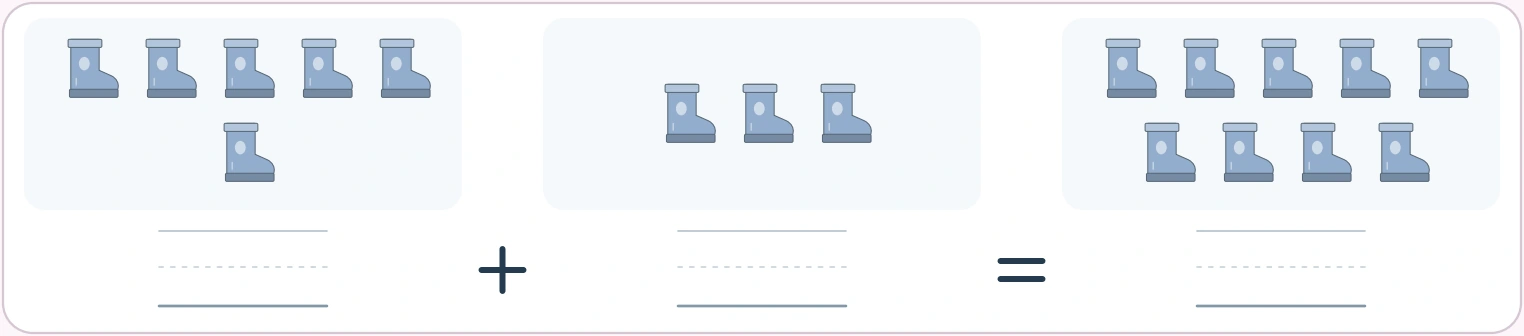
The first boot group contains six, displayed as five above one. The second contains three. Their whole is nine, with five on its upper line and four below. A consistent path across each line can keep the learner from skipping the isolated boot or counting it twice.
For Cozy Addition Notes writing support, the number-nine tracing activity offers a separate opportunity to rehearse the final numeral. Explain nine with the pictures first. A readable pencil mark communicates the count, but copying a model alone does not establish that the quantity was understood.
A Cozy Addition Notes illustration with seven clear mittens
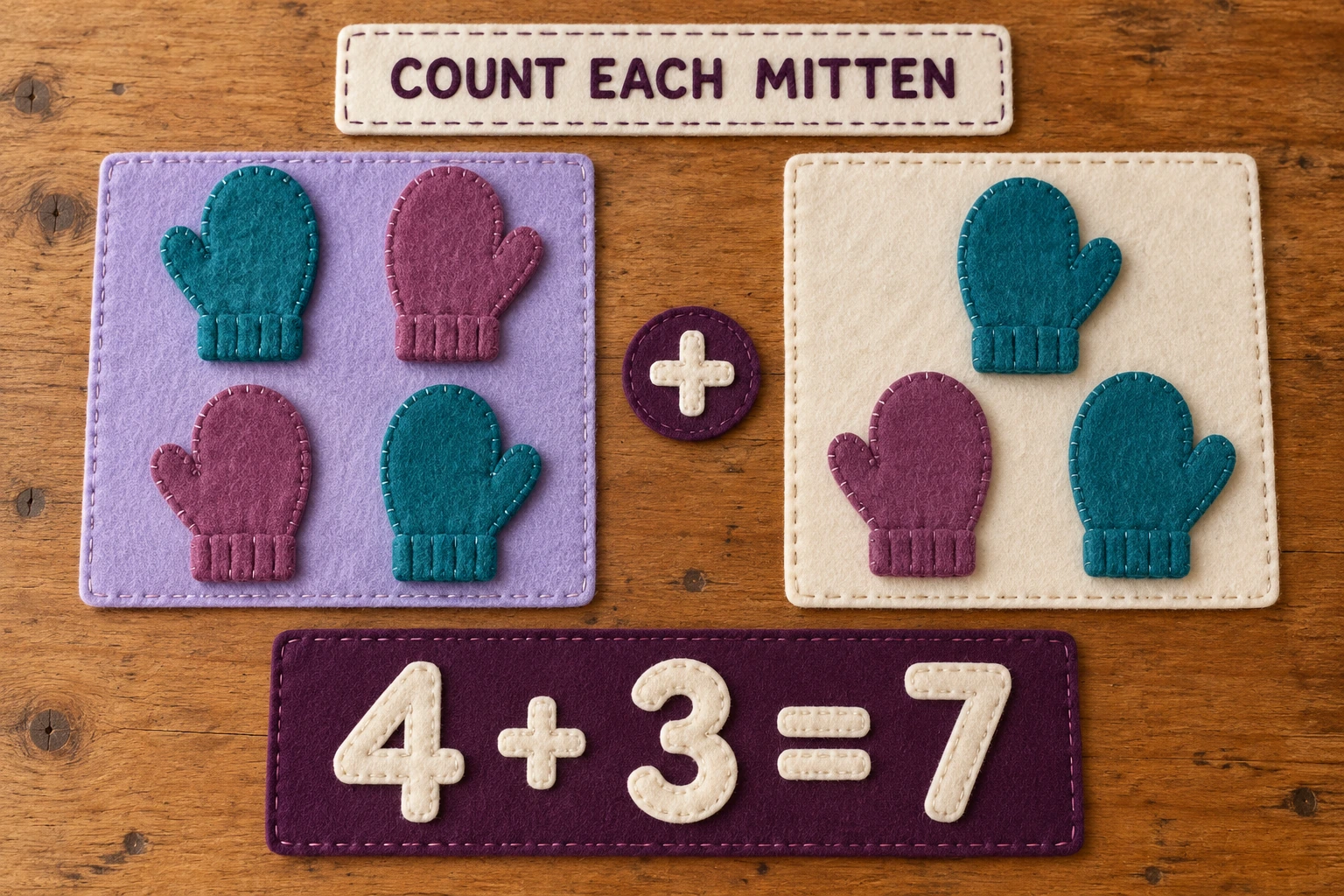
The additional Cozy Addition Notes crafted scene shows four mittens beside three, with “COUNT EACH MITTEN” and a readable equation. It models the individual-item question. Cozy Addition Notes retains the source worksheet's intentional unanswered spaces; this separate image is a discussion aid rather than a completed version of those exercise guides.
Fit Cozy Addition Notes to the learner's current skills
Supported use often suits preschool and kindergarten children around four to six. The useful entry point is a manageable count and a willingness to compare two groups, not a birthday alone. An adult can read the column labels and allow oral answers before expecting all twelve written numerals.
Cozy Addition Notes may be easier when adjacent rows are covered, especially if the child keeps moving between different clothing types. Use numeral cards or a separate large writing model when hand control needs support. For broader formation practice, the one-to-ten tracing worksheet offers another format without changing the counting task here.
Correct Cozy Addition Notes with a question about evidence
Besides pairing errors, watch for counting garment decorations, recording a whole under a starting group or adding the whole panel again. Ask, “Which collection does this number describe?” Give the learner a chance to point and recount. That explanation can identify the specific source of the mismatch.
Cozy Addition Notes feedback can be concrete: “You kept the unmatched mitten in your count.” Odd totals do not need to be made even. Avoid repeating the same correction rapidly if the child is upset. Return to a small movable model, allow a different response method or pause the session after one meaningful piece of reasoning.
Give Cozy Addition Notes a changing practice purpose
Revisit the sheet to name a counting unit, compare the two sevens, or dictate a garment report. Those are different jobs, even when they use familiar pictures. A short return can be more useful than completing every row repeatedly. Let the child choose one relationship they would like to explain to another person.
The six-writing worksheet connects with the sock whole. For adults planning everyday activities, explore maths ideas for age five from PBS Parents and the NAEYC family maths resources. Cozy Addition Notes can sit alongside practical sorting, spoken comparisons and other number play rather than becoming a daily full-sheet requirement.
Print Cozy Addition Notes with its writing guides clear
The original sample preserves the supplied version and may show its original branding. The clean premium edition is attached separately. Log into an account whose eligible membership is active, then select this page's premium download to obtain that unbranded file. Its printable worksheet has no watermark, domain promotion or ads embedded in the activity.
Cozy Addition Notes uses a single US Letter page. Save the PDF, inspect its border in print preview and choose scaling that fits your paper without losing any panel. The website's possible advertising is separate from the downloaded PDF. Leave the response guides open for the learner, decide together what one counted item is, and let each written number report the garments actually shown.
Popular Worksheets
Printable resources families and teachers are downloading now.
 Free
 Free
 Free
 Free