
Travel Sum Partners: 4 Brilliant Order-Switch Games
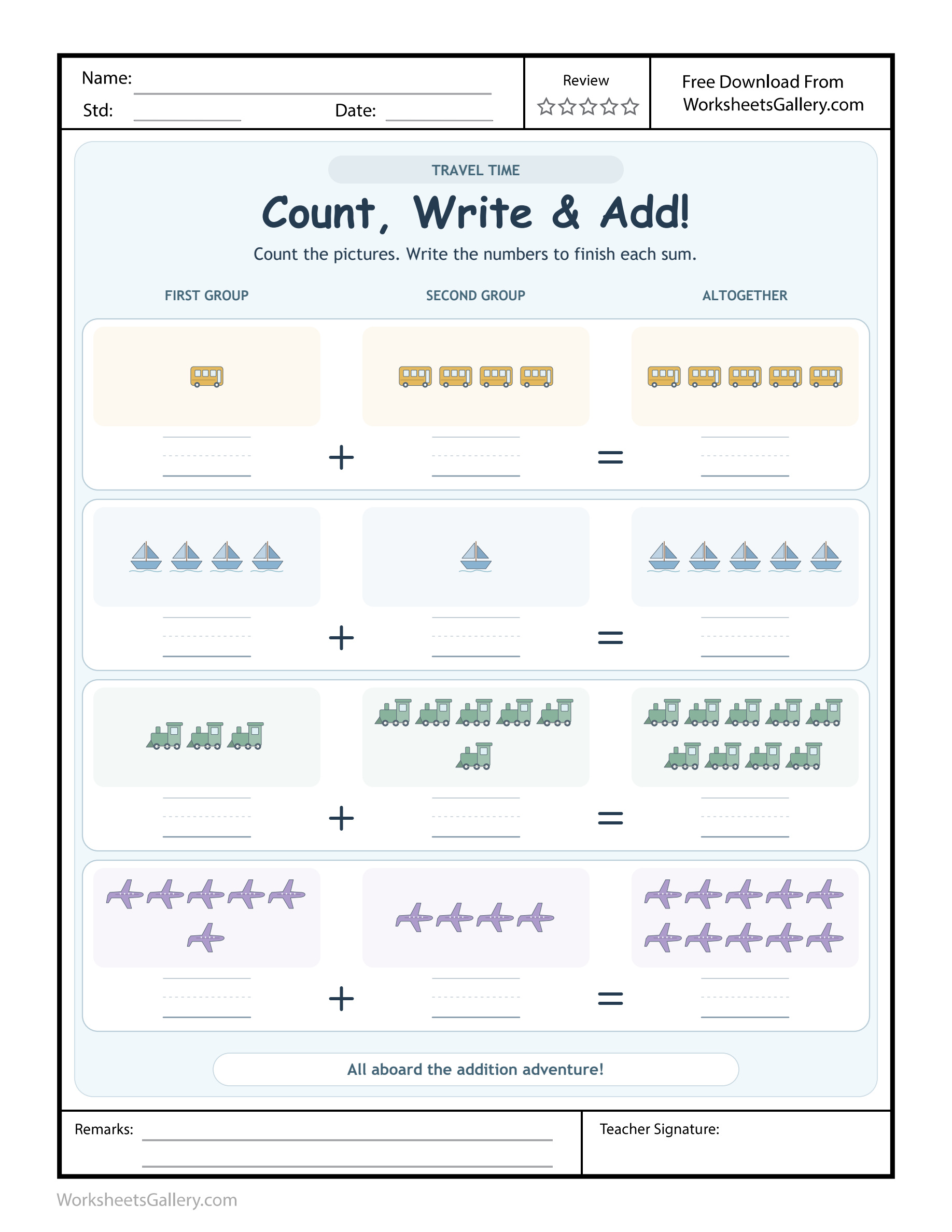
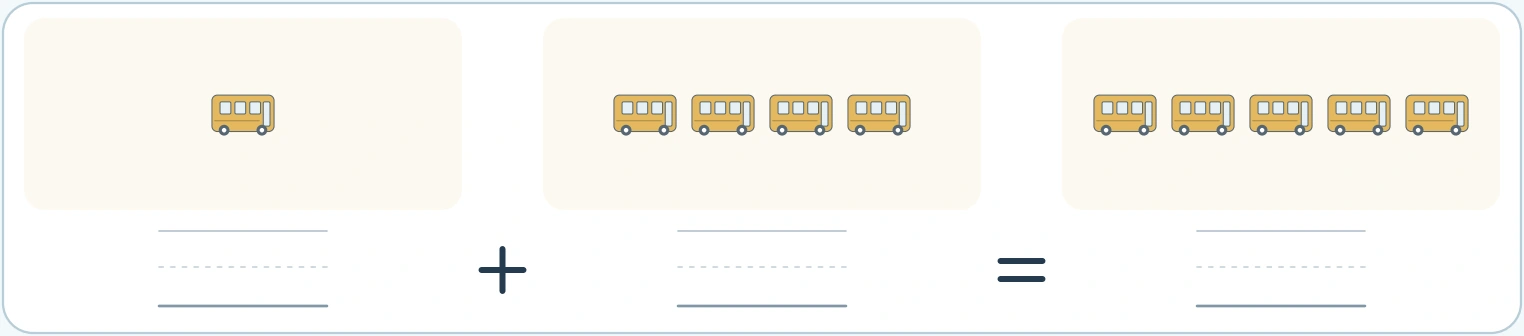
One bus joins four buses, while four boats join one boat. Travel Sum Partners places those relationships one below the other, inviting children to notice that the starting quantities have switched but the whole remains five. The sheet continues with engines and planes for two larger sums. Each row asks for three written numbers supported by visible picture groups. Explore the matching totals through counting before naming a rule, and preserve the order shown on the paper when recording the two starting values. A changed counting route need not change what each panel represents.
Compare the first Travel Sum Partners departure reports
Begin Travel Sum Partners by finding the bus row and boat row. Count one and four for buses, then four and one for boats. Both whole panels show five. Ask what changed and what stayed the same. The learner may initially notice the vehicle type; acknowledge that observation before focusing on the numerical relationship.
Travel Sum Partners offers a concrete example of changing the order of two addends while keeping their sum. Young learners do not need formal vocabulary before exploring that idea. “The parts switched places, and there are still five together” gives a clear description grounded in these particular pictures.
Travel Sum Partners still needs the printed group order
The Travel Sum Partners learner may find four and then one easier to count mentally for both rows. That is a possible strategy, but the written records must describe the panels above them. Under the first bus panel, record one. Under the second, record four. The boat row reverses those records because its panels are reversed in quantity.

Travel Sum Partners uses the column labels FIRST GROUP, SECOND GROUP and ALTOGETHER. A convenient mental starting point does not rename those columns. The supplied plus and equals signs connect the three values. Four equations give twelve number-writing spaces with solid and dotted guides, not preprinted numeral answers to trace.
Take Travel Sum Partners to Talia's floor mat
Talia and her brother set out five large blocks as pretend buses. They separate one from four, count the total, and then move the groups so four are first and one is second. No blocks are removed or added. Talia says the whole is still five, although the first group looks different.
They return to Travel Sum Partners boats and find the four-then-one arrangement. Her brother asks what should be written beneath the first boat panel. Talia chooses four by referring to its pictures, not by copying the first bus record. Their Travel Sum Partners physical model explains the equal totals while the source panels decide the location of each written value.
A Travel Sum Partners home routine in five actions
Choose a pair of related rows rather than requiring the whole sheet at once. First read the directions and name the vehicles. Second count and record the first panel. Third count and record the second panel. Fourth establish the joined quantity and compare it with the whole picture. Fifth read the completed equation aloud.
For Travel Sum Partners, pause between the two rows to ask about the equal fives. If the learner is busy managing pencil strokes, postpone that comparison until the numbers are recorded. An adult can model a numeral on spare paper after the child names the quantity. The original guides remain the learner's place to report the pictured amounts.
Six Travel Sum Partners ideas worth noticing
- Order and amount differ. A group can occupy a new position without changing how many items it contains.
- Totals can remain equal. One and four, then four and one, each represent a whole of five.
- Written location matters. A correct quantity still needs to sit under the panel it describes.
- Counting strategies can vary. Children may count all objects or retain a secure amount while counting additions.
- Reasoning can be spoken. Explaining a shared total practises words such as first, second, switched and together.
- Hands make an evidence-based record. Numeral formation follows selecting a value from pictures, giving small pencil movements a communicative purpose.
Travel Sum Partners can reveal these skills unevenly. A child might understand the switched parts but need help writing 4, or write both equations neatly without noticing their relationship. Ask for a brief explanation rather than inferring everything from the finished marks.
Read larger Travel Sum Partners trips independently
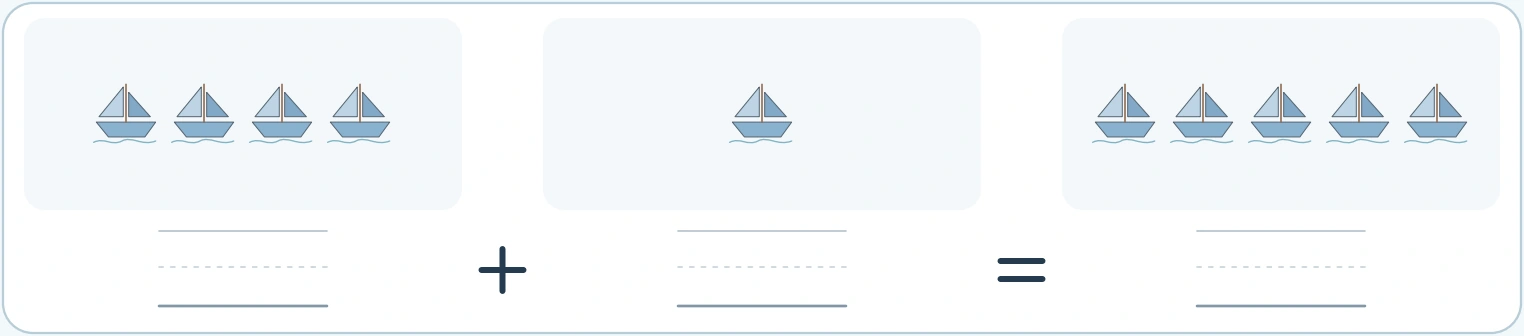
The engine row shows three plus six, making nine. The plane row shows six plus four, making ten. Neither is another one-and-four example. Once the first pair has been compared, return attention to the actual starting groups in each later row.
In Travel Sum Partners, the second engine group has five on its upper line and one below. Count the lower engine as part of that same six. Each whole vehicle counts once; wheels, windows and chimneys remain parts of their vehicle drawings. A consistent unit keeps the longer count connected to the intended objects.
Travel Sum Partners reference values for adults
The table records the printed order as well as the whole. Use this Travel Sum Partners reference to prepare your own checking questions, allowing children to establish the numbers through the pictures instead of copying the reference.
| Vehicle row | First plus second | Whole | Useful observation |
|---|---|---|---|
| Buses | 1 + 4 | 5 | One is printed first |
| Sailboats | 4 + 1 | 5 | Four is printed first |
| Engines | 3 + 6 | 9 | Include the sixth second-group engine |
| Planes | 6 + 4 | 10 | Write both digits for ten |
Travel Sum Partners provides its whole in pictures on the right. Those pictures verify the first two groups together. They are not a third set to add, even though the page contains additional drawings to represent the whole again.
Four Travel Sum Partners games about switched parts
1. Move the Travel Sum Partners group mats
Place one large counter on one mat and four on another. Count all five, then swap the mats without changing their contents. Travel Sum Partners gives a reason to ask whether the total changed. Let the child recount to justify the answer. Describe the first and second amounts again after the swap, keeping position separate from quantity.
2. Give Travel Sum Partners two boarding announcements
One speaker announces “one first, four second, five together.” Another announces “four first, one second, five together.” Match each announcement to the appropriate source row. Travel Sum Partners now requires listening to the order as well as the final number. The vehicle type can help identify the row after the quantities have been described.
3. Check a Travel Sum Partners reversed label
On separate practice paper, an adult puts 4 beneath a single-bus model and 1 beneath a four-bus model. The whole label remains 5. Ask whether all the records describe their panels correctly. Travel Sum Partners reveals that a correct total does not make misplaced starting records correct. Repair each label by counting its corresponding group.
4. Invent another Travel Sum Partners swap
Choose two small quantities, such as two and three, using large objects. Establish their whole, switch the group positions and check again. Relate the new model to the one-and-four comparison while saying that it is an extra play example. The worksheet's printed engine and plane groups remain unchanged; the learner's new model belongs on separate paper or the play surface.
Travel Sum Partners can prompt a classroom comparison board
Invite one pair to explain buses and another to explain boats. Ask the group whether the two written equations can both be true. Partners show their counts and point to the two five-picture whole panels. The Travel Sum Partners teacher can gather different explanations without requiring a formal rule to be recited.
One Travel Sum Partners learner may protest that the second answer should be six because the previous answer was five. Ask what the boat pictures support. Count four and one together, then inspect the five boats on the right. The evidence can correct an assumed growing-answer pattern while preserving the child's useful willingness to look for relationships.
Travel Sum Partners planes reach a whole of ten
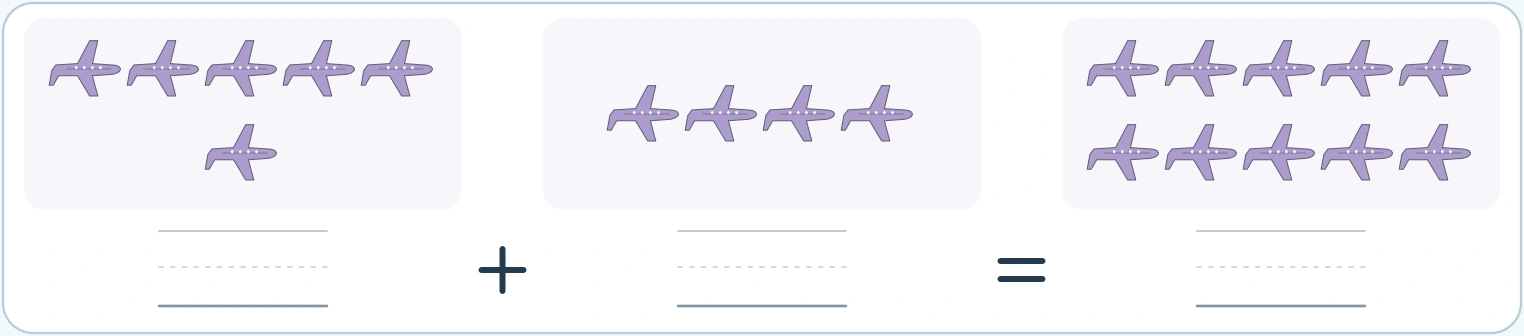
Six planes are shown as five above one in the first panel. Four form the second part. The whole is ten, arranged as two five-plane lines. Include both picture levels before writing 6 in the first guide. The final 10 is one numeral made from two digits in the whole's writing space.
For Travel Sum Partners pencil support, explore the number-ten writing activity separately. The number-five learning page connects with the repeated five totals. Choose the relevant next task instead of assigning more writing simply because the learner found the comparison interesting.
A Travel Sum Partners image shows both number sentences
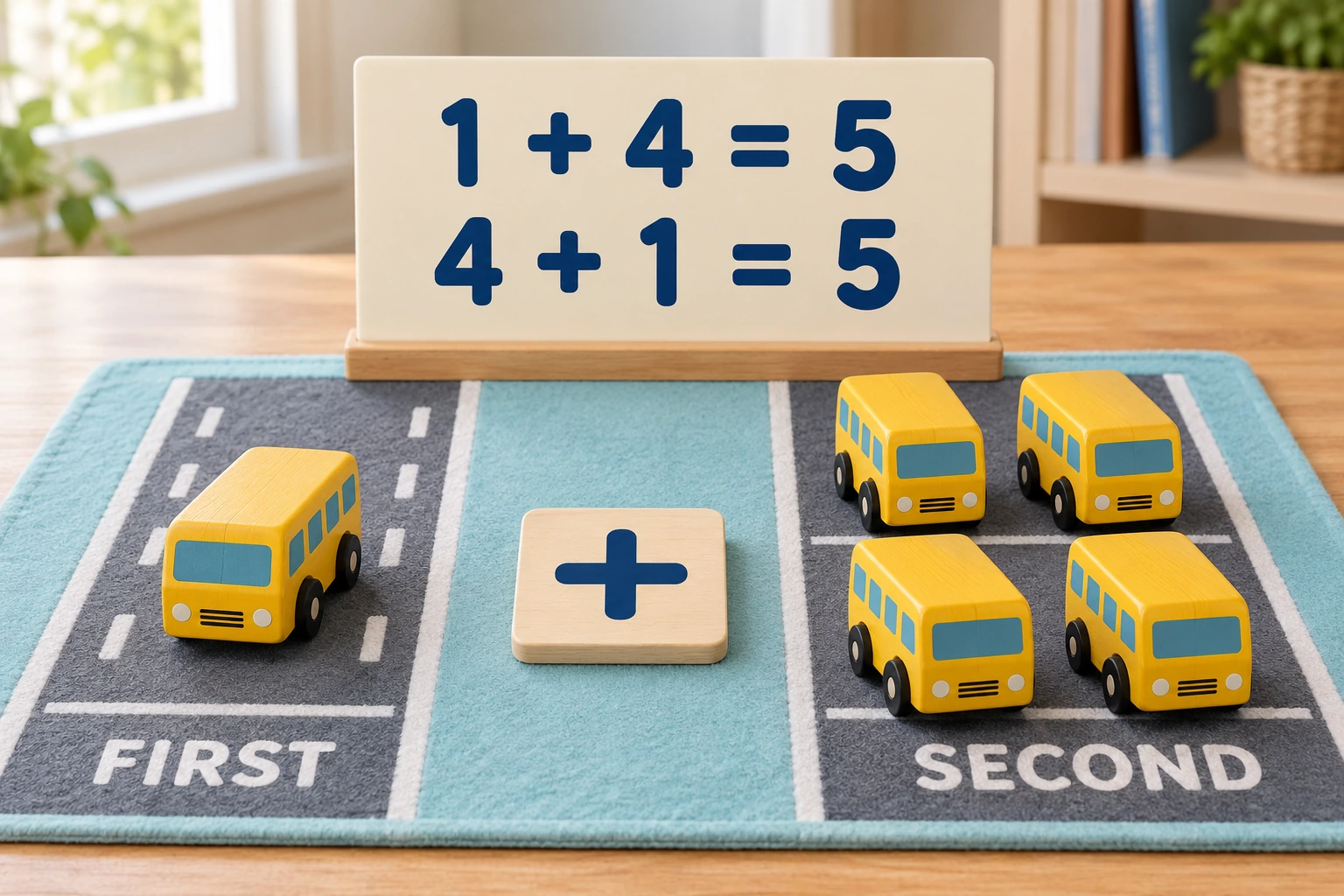
The generated Travel Sum Partners transport scene has one physical bus group and another of four. Its board displays the two reversed equations, each totaling five. Travel Sum Partners uses this illustration as a separate comparison aid; it does not reproduce a completed worksheet or change the intentional response guides in faithful previews.
Match Travel Sum Partners to readiness and attention
Many children around four to six can explore the activity with an adult in preschool or kindergarten. Begin with the two rows totaling five if larger counts are tiring. Support direction-reading and numeral formation separately. The Travel Sum Partners learner should have a chance to establish the amounts before an adult supplies written models.
Travel Sum Partners uses working attention to retain two values, language to explain a comparison, visual tracking to follow panels and motor control to record numerals. A learner need not manage all those demands independently at once. Cover unused rows, allow pointing or offer a short break when the combined demands become too much.
Keep Travel Sum Partners corrections local and kind
Common errors include copying the bus order into the boat row, assuming the repeated five is wrong, counting a lower-line vehicle twice, or adding the right panel again. Ask which panel a written numeral describes. That precise question can identify whether the issue concerns amount, placement or the meaning of the whole.
With Travel Sum Partners, repeat totals deserve evidence rather than automatic suspicion. Let the child say, “I checked both trips and both have five.” Recognize the comparison itself. Returning later to switch the speaking roles or demonstrate a new small swap can keep practice meaningful without repeatedly filling all twelve spaces on fresh copies.
Save Travel Sum Partners and choose a next stop
For another number experience, the one-to-six dice game changes the activity format. Adults can browse family number-play resources from NAEYC and PBS Parents' mathematics collection for age five for informal extensions suited to the learner.
Choose the original sample to retain its source presentation. The separate clean premium attachment is available after account login with an eligible membership currently active. Travel Sum Partners member printing has no watermark, website-domain branding or ads within the PDF. Save the single US Letter page, open print preview and preserve its full border with appropriate scaling for your paper. Any website advertising is outside that printable file. Leave the guides clear for the child's own counts, records and explanation of the two shared fives.
Popular Worksheets
Printable resources families and teachers are downloading now.
 Free
 Free
 Free
 Free