
Toy Count-On Bridge: 5 Brilliant Add-More Play Tasks
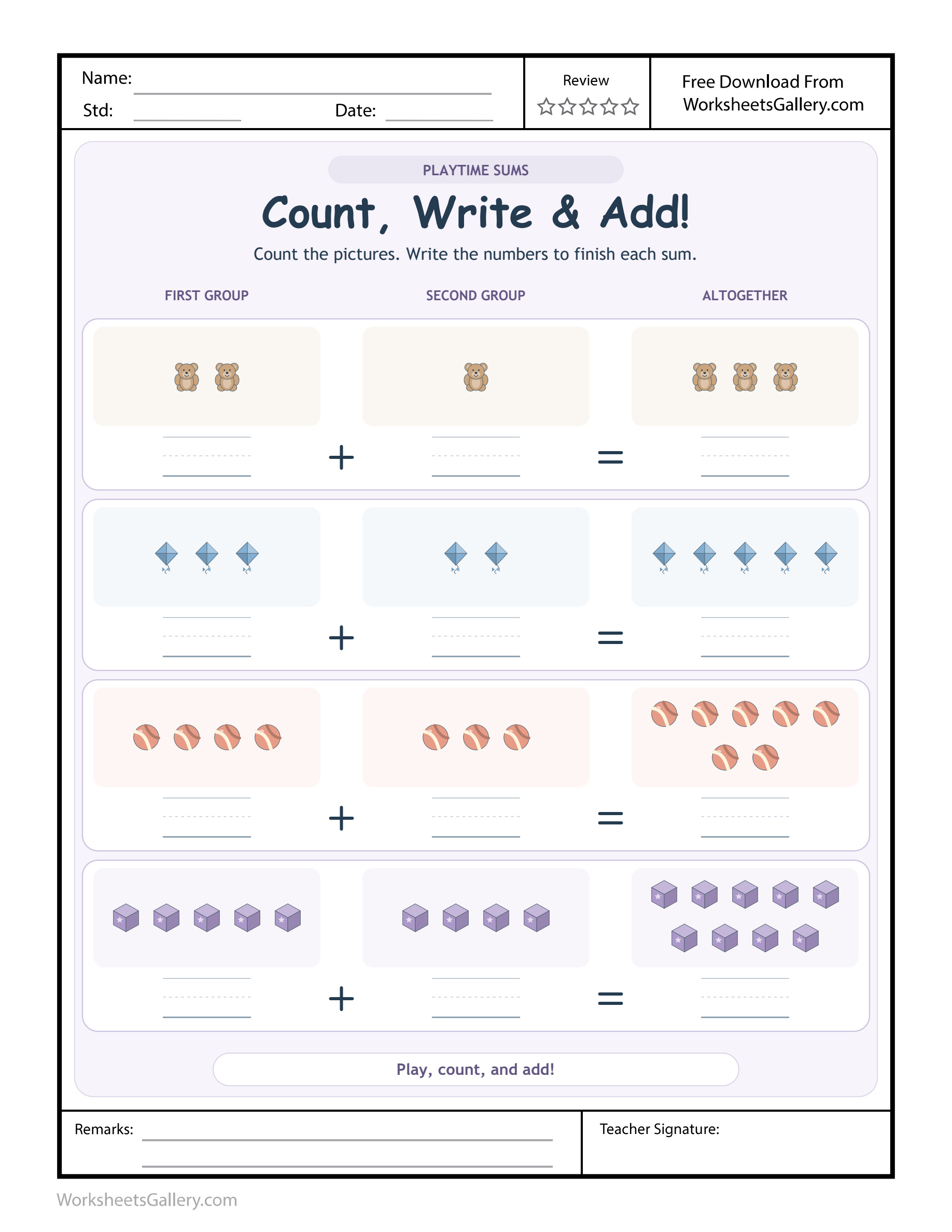
“I know there are two bears. What happens when one more joins?” Toy Count-On Bridge uses that small question to connect a known quantity with a growing count. The Playtime Sums sheet includes bears, kites, balls and blocks, each arranged as two starting groups and a pictured whole. Children can count all the objects, or, when ready, remember the first amount and count only the added group. Both routes can make sense. Choose the route the child can explain, and let the writing follow a quantity they have actually established.
Toy Count-On Bridge begins with a known amount
Counting on means retaining an established starting quantity while assigning the next counting words to new objects. For two bears plus one bear, hold two and touch the new bear while saying three. The Toy Count-On Bridge starting two is not spoken again as though the first extra bear were number two.
Toy Count-On Bridge is an invitation to try this strategy when the child already knows the first amount reliably. If the child needs to count both groups from one, allow that. Recounting every object is a valid way to establish the whole; a strategy should support understanding rather than become an additional rule the learner cannot yet follow.
Read Toy Count-On Bridge headings before choosing a method

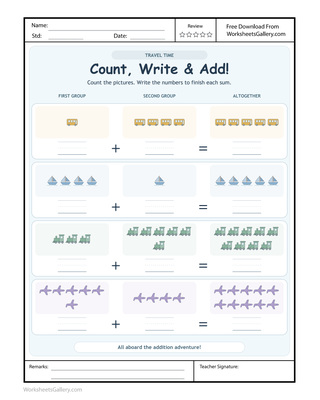
FIRST GROUP gives the starting amount in the printed order. SECOND GROUP gives the amount to join. ALTOGETHER represents their whole. The right panel can check a result, but its pictures are not a third collection to include in the addition. There are four equations, with a writing guide for each of three values.
Toy Count-On Bridge therefore involves twelve numeral decisions, not four traced answers. The plus and equals signs are already printed. Count and record each starting collection, establish the joined total and check it against the right panel. Keep the source's intentional number spaces available for the child's own records.
Fara tries Toy Count-On Bridge with three bears
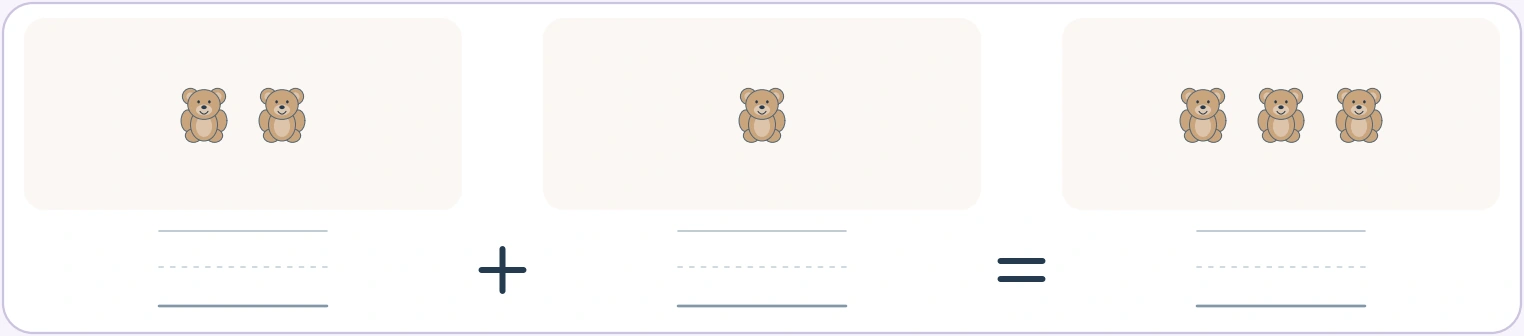
Fara's father places two soft toy bears on a mat. After she counts them, he adds one. She begins again at one, touching all three. He accepts the total and asks whether she would like to try holding two in mind while touching just the new bear. She says three as it arrives.
Toy Count-On Bridge offers her two routes to compare. Her father does not remove the first two bears or insist that she hide them. They remain available Toy Count-On Bridge evidence. When Fara forgets the starting amount on a later turn, they recount it. Remembering a quantity is part of the strategy, not a test of whether she deserves to use the toys.
Five Toy Count-On Bridge benefits with observable signs
- A retained starting quantity: listen for the child naming the first amount before directing attention to the added group.
- A purposeful next word: the first new object receives the word after the known amount, making the count's continuation explicit.
- Controlled tracking: one touch on each extra object keeps a spoken sequence aligned with the pictures.
- A reason to compare strategies: counting all and counting on can lead to the same whole, giving the child two checkable routes.
- A readable mathematical report: three numerals and the supplied signs communicate the relationship another person can verify.
Toy Count-On Bridge also draws on attention, language and hand control. Those demands may develop unevenly. A child who understands the spoken count may still need a separate model for a written 7, or help keeping the paper steady while recording it.
Follow the Toy Count-On Bridge kite continuation
The kite equation is three plus two equals five. Count the first three if necessary, then pause: “We have three.” Touch the first new kite while saying four and the next while saying five. The Toy Count-On Bridge number words belong to the added objects, not to empty spaces between them.
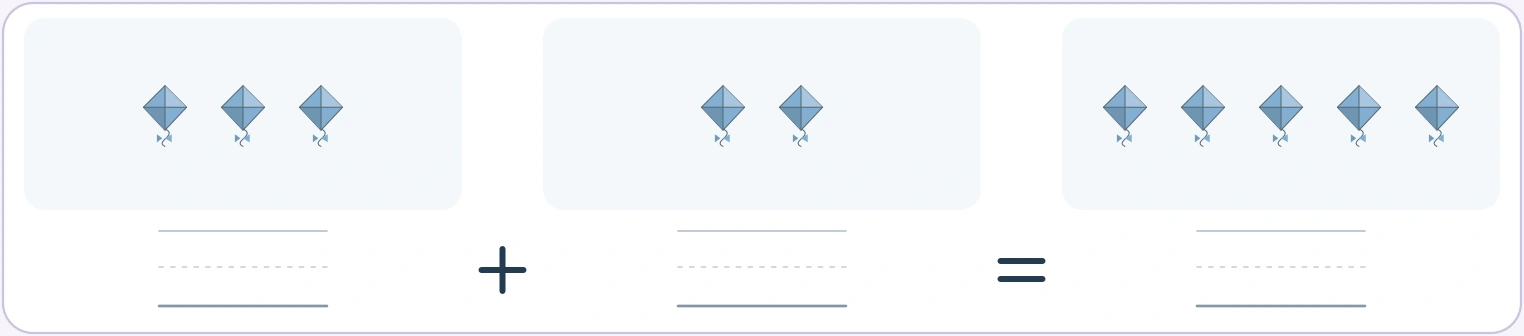
For Toy Count-On Bridge, ask the child what the final five describes. It represents both starting groups together, not just the pair they last touched. If that distinction is unclear, count the entire collection again. The strategy is useful only while the child understands which objects the resulting number includes.
Keep a Toy Count-On Bridge adult reference nearby
Use these Toy Count-On Bridge relationships to prepare prompts. The table's continuation words show one possible route from the printed first amount; learners do not need to recite the table or copy its values before counting.
| Toys | Equation | Count-on words for the extra group |
|---|---|---|
| Bears | 2 + 1 = 3 | Three |
| Kites | 3 + 2 = 5 | Four, five |
| Balls | 4 + 3 = 7 | Five, six, seven |
| Blocks | 5 + 4 = 9 | Six, seven, eight, nine |
In Toy Count-On Bridge the first amounts happen to grow from two through five. Still inspect every group. A remembered row pattern cannot replace counting the particular objects shown, and the larger final rows may need more support than the bears.
Try Toy Count-On Bridge at home in two short stages
Prepare the page, a comfortable pencil and a few suitably large objects if the child likes a movable model. First discuss a single equation orally. Count the starting group and ask whether its amount feels secure enough to remember. Try continuing through the added group, or count everything from one if preferred.
During the second Toy Count-On Bridge stage, write the first amount under its pictures and the added amount under theirs. Check the whole and record it. Read the number sentence together. Stop after that relationship if attention is fading; using one well-understood equation is more productive than forcing a method through four increasingly tiring attempts.
Toy Count-On Bridge ball talk in a classroom pair
One learner identifies four balls in the first panel. A partner points to the three new balls while they say five, six and seven. Then they count the pictured whole independently to see whether it agrees. The Toy Count-On Bridge teacher asks who can explain what was remembered and what was newly counted.
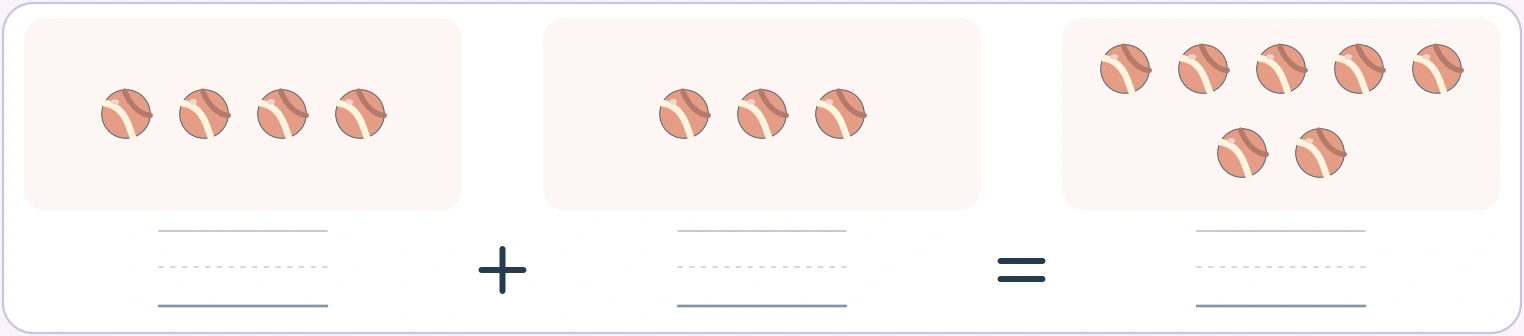
A Toy Count-On Bridge child might say four, five, six over those three new balls. Rather than supplying seven immediately, ask where the original four went in that explanation. Model “four already, then five” on the first extra ball. If the child remains unsure, return to counting all before revisiting the shortened route another day.
Five Toy Count-On Bridge invitations for playful rehearsal
1. Announce a Toy Count-On Bridge starting number
Give the child a group of two large toys to count. After they state two, invite an adult to add one toy while the child announces its continuing count. Toy Count-On Bridge can begin with this single new-object turn. Swap the roles so the child controls the arrival and hears whether the adult's spoken count matches the objects.
2. Give Toy Count-On Bridge a pause signal
Use a spoken “hold” after establishing three counters. The adult adds two slowly, one at a time. The child says four and five at the arrivals. Toy Count-On Bridge now makes the starting pause visible in the interaction. If a count is lost, leave the counters still and recover the quantity together; there is no penalty for checking.
3. Compare Toy Count-On Bridge routes aloud
Build the four-plus-three ball relationship with counters. One partner counts all seven from one; the other begins from four and counts the three additions. Ask what stayed the same in Toy Count-On Bridge. Toy Count-On Bridge draws attention to a shared whole despite different counting routes. Do not require the child to announce which route is universally better; usefulness depends on what they can follow reliably.
4. Repair a Toy Count-On Bridge early start
On a separate model, an adult intentionally says three over the first new object after a known group of three. Ask the child whether that object should have the same count as the old group's last object. Demonstrate again using four and five for two additions. The correction concerns the next counting word, not the learner's overall ability to add.
5. Make Toy Count-On Bridge block announcements
Start with five large blocks and invite four more to arrive singly. The child announces six, seven, eight and nine. Then group the nine without changing their number. Relate the model to the last worksheet row and check its pictured whole. This longer invitation is optional; a child comfortable with the bear example does not have to tackle four additions immediately.
Toy Count-On Bridge blocks need a complete visual check
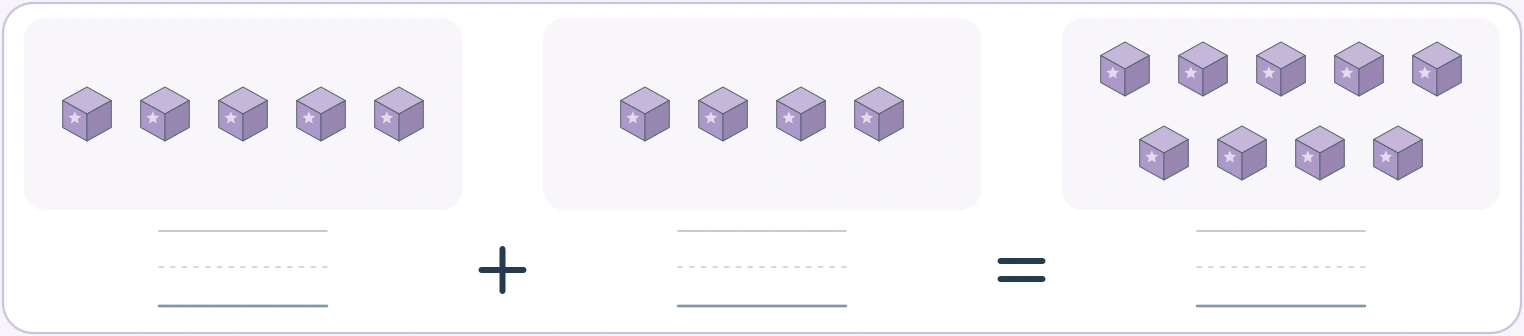
The final Toy Count-On Bridge whole has nine blocks. Count every complete block even when the arrangement occupies more than one picture line. Different visible faces belong to the same block and do not supply more objects. Keep the final model and the source panel distinct: one is a play demonstration, the other a printed representation.
Toy Count-On Bridge practice can include separate numeral work with the seven-tracing page or nine-tracing activities. Choose one when writing, rather than counting, is the specific difficulty. Let the learner explain the amount first.
A Toy Count-On Bridge scene for a gentler start
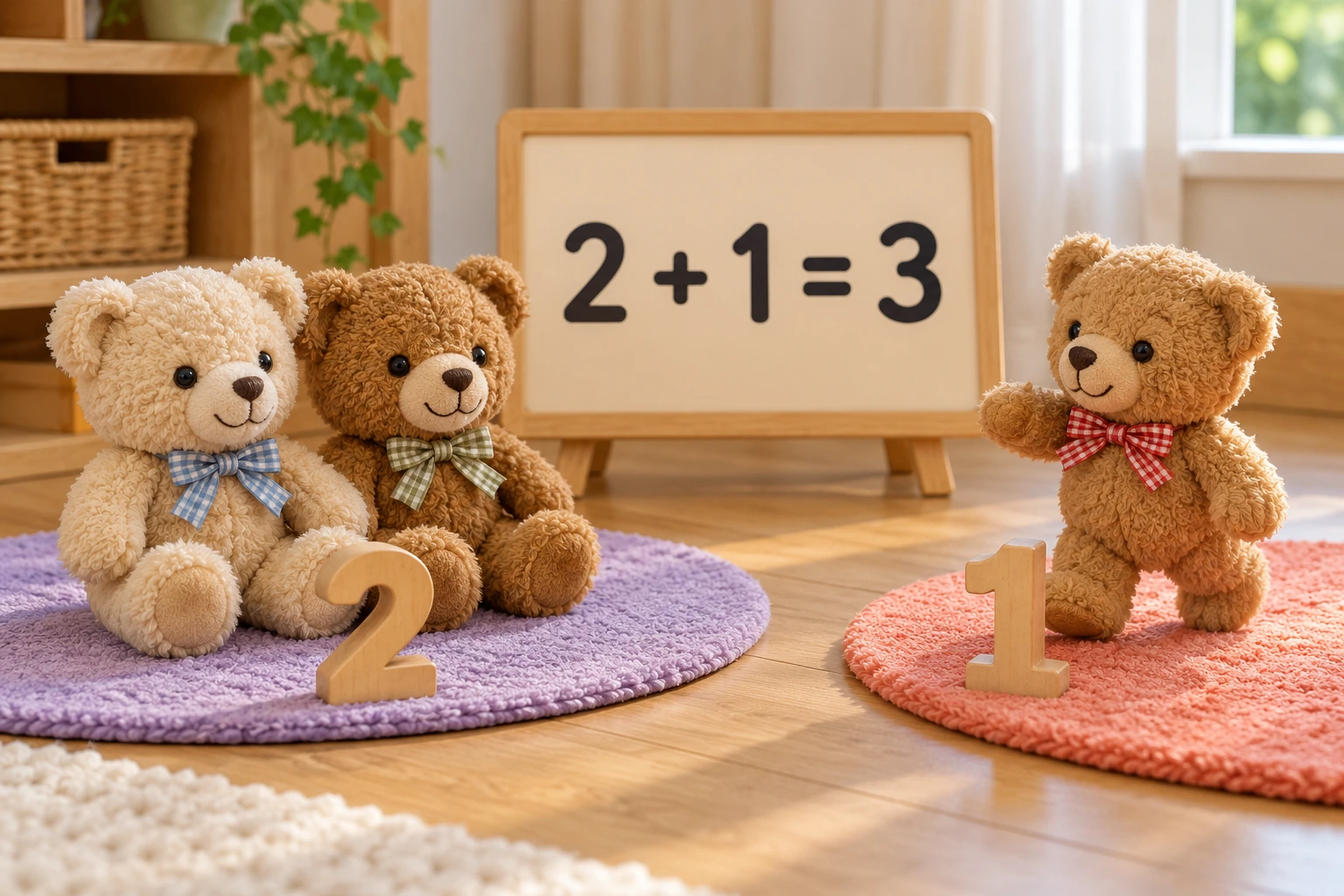
The additional bear illustration provides two and one with a readable equation. It models a starting quantity small enough to discuss without a long count. Toy Count-On Bridge does not require identical plush toys at home; three large safe counters can represent the same relationship when the adult explains the substitution.
Toy Count-On Bridge readiness, mistakes and confidence
Around ages four to six, many preschool and kindergarten learners can explore these sums with an adult. Counting on asks more than reciting number words: the child must retain one amount and continue accurately. Begin with counting all if that is the secure route today. An oral response is acceptable before independent numeral writing.
Common Toy Count-On Bridge slips include restarting at the known number, counting a toy twice, adding the whole panel again, or treating a remembered amount as a guess. Check the first group before asking the child to retain it. Encourage with specific observations such as “You touched each new kite once.” A tired learner may prefer one careful row and a return visit to a full-page demand.
Keep Toy Count-On Bridge practice varied and printable
Return with a new purpose: hear the continuation, compare methods, or write one justified total. Use the dice-number game for a different number experience. Adults may explore PBS Parents' five-year maths activities and NAEYC's maths suggestions for families when planning informal play.
Download the original sample for its source presentation or use the premium control after signing into an account with a current eligible membership. The separate clean member PDF removes website branding and watermark and contains no ads. Toy Count-On Bridge is one printable US Letter page. Save it, preview the outer frame and select suitable paper scaling before printing. Site advertisements are separate from the file. Keep the supplied writing spaces open for the learner; no printed numeral answers are added to the clean worksheet.
Popular Worksheets
Printable resources families and teachers are downloading now.
 Free
 Free
 Free
 Free