
Farm Joining Stories: 5 Wonderful Animal Arrival Games
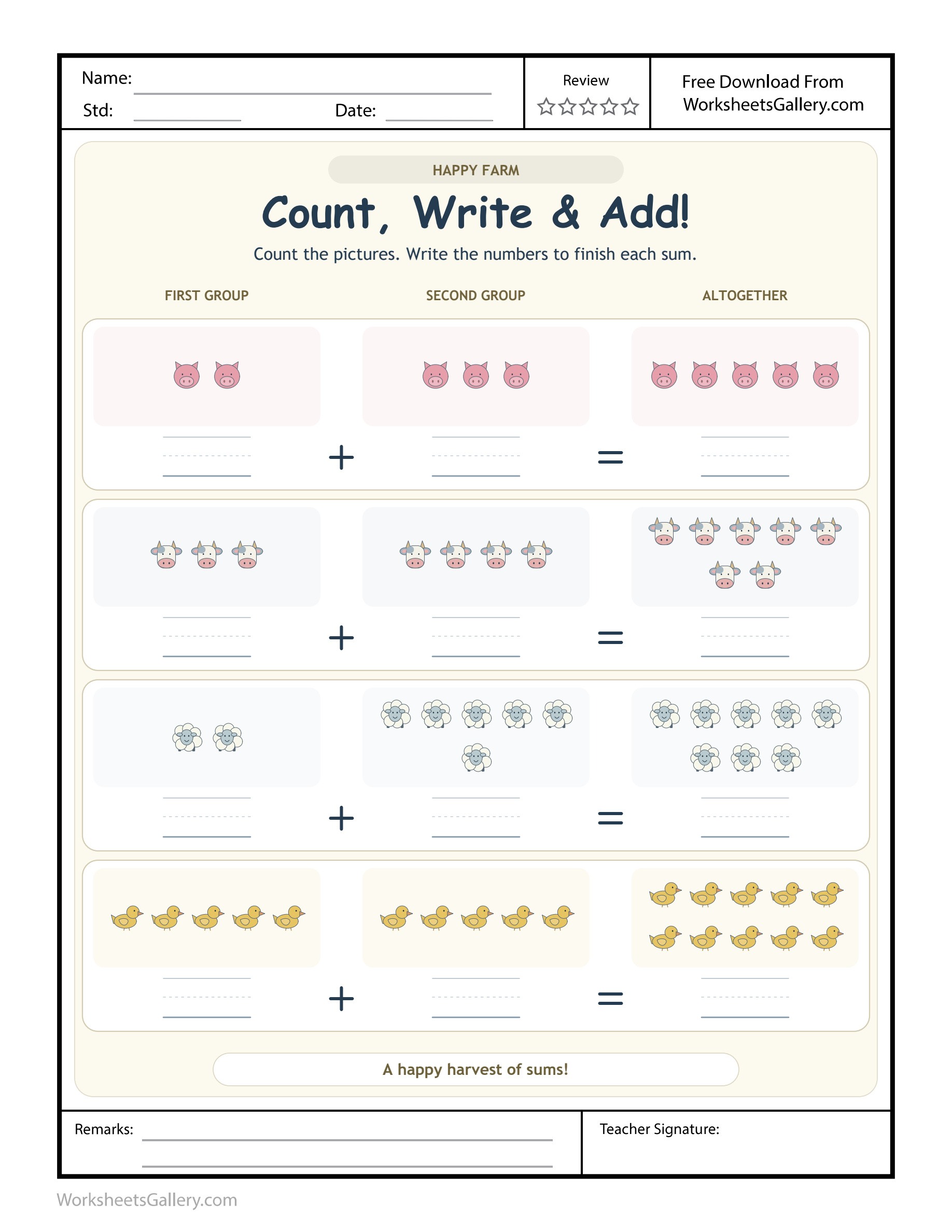
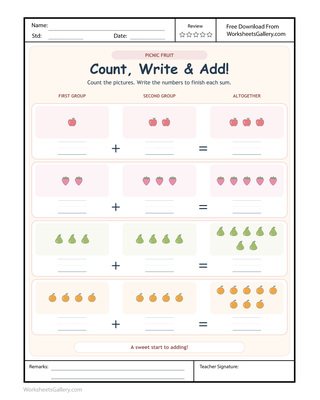
Oren gives two pictured pigs a story: they are waiting when three more arrive. Farm Joining Stories uses that imagined action to explain a static addition sheet, where first and second animal groups sit beside a pictured whole. Nothing moves on the paper, but a child can describe how the quantities belong together. Pig faces, cow faces, sheep and ducks provide four relationships to count and record. The adult's job is to keep the invented story faithful to the visible amounts, so lively farm talk remains connected to a clear mathematical sentence.
Oren turns Farm Joining Stories into a spoken event
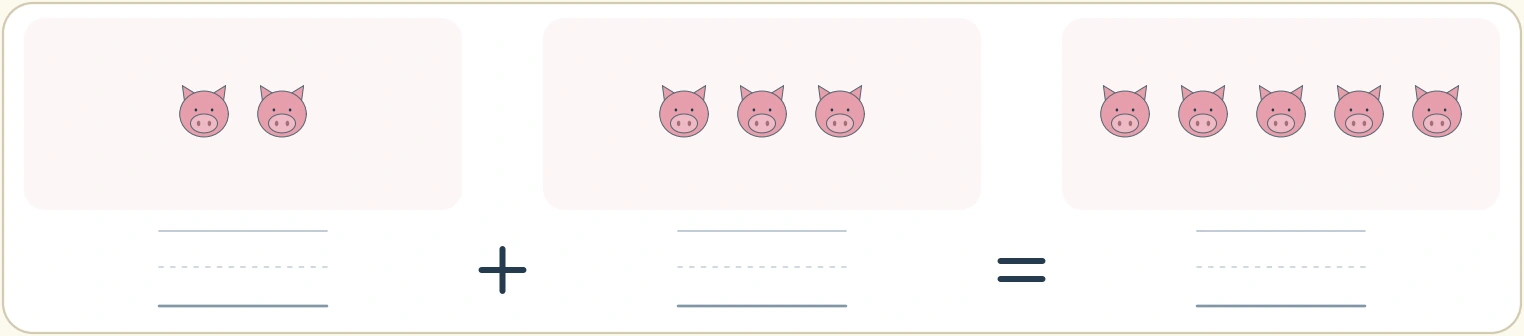
Oren's grandfather asks how many pigs were there before the arrival. Oren points to two faces in the first panel. He then points to the three faces in the second panel and calls them the visitors. Five pig faces on the right show the whole quantity their story describes.
Farm Joining Stories gives those panels temporary narrative roles: before, more and now altogether. The story is a teaching interpretation, not a claim that the worksheet contains a moving sequence. Oren's grandfather repeats the quantities in order, then asks Oren to explain which pictures support each part. That keeps the story from drifting into extra animals the page does not show.
Farm Joining Stories needs an accurate arrival sentence
Try “Two pigs were there; three more joined; five pigs are together.” The first Farm Joining Stories clause describes a starting part, the second another part, and the ending describes both. The ending includes the earlier animals. It does not introduce five additional pigs to add once more.
Farm Joining Stories works with short language before longer storytelling. A child may point and say “two, three more, five” while an adult expands the sentence. Leave room for the learner's own wording. The important features are the quantities, their joining relationship and the whole they form, rather than a particular memorized sentence.
Prepare Farm Joining Stories at a home play corner
Set out the page with a comfortable pencil and a few suitable large counters. Read the Farm Joining Stories labels FIRST GROUP, SECOND GROUP and ALTOGETHER, then choose one animal row. Count the first panel and name it as the story's beginning. Count the next panel and describe that quantity as joining.
For Farm Joining Stories, bring the model's two starting groups together if a physical demonstration is useful. Check the whole and compare it with the printed right-hand panel. Write each of the three values under its own pictures, then read the equation. The page contains four such relationships and twelve number guides; the supplied signs do not need to be redrawn.
Five Farm Joining Stories games with different storytellers
1. Give Farm Joining Stories a before-and-more exchange
One partner speaks for the first pig panel, saying how many were already there. Another speaks for the second panel, saying how many joined. Together they explain the five-pig whole. Farm Joining Stories makes both starting amounts necessary to the explanation. Swap speaking roles so a child can practise more than simply announcing the final number each time.
2. Build Farm Joining Stories with an animal substitute
Use two large blocks to stand for sheep already in a field and six more for newcomers. State that the blocks represent sheep, then count and join them. Farm Joining Stories can use ordinary materials without pretending that the source contains block pictures. Compare the eight-object model with the printed sheep whole, including every lower-line animal in the count.
3. Repair a Farm Joining Stories extra-arrival claim
An adult reads the pig panels as “two, then three, then five more.” Invite the child to check that interpretation. Move the same five counters from two starting groups into one collection to show the intended whole. Farm Joining Stories gives the learner a reason to correct the adult with evidence. The last printed panel represents those five together, rather than another arrival.
4. Give Farm Joining Stories a duck ending
Ask a child to invent a short beginning for five ducks and an arrival of five more. Keep the ending tied to ten ducks together. They might describe a pond visit or a pretend field, but extra characters do not enter the counted duck groups. Check the two five-duck starting panels before reading the final ten; storytelling should preserve the actual quantities.
5. Send a Farm Joining Stories voice message
Without recording or sending anything digitally, pretend a farm helper must tell another helper about the cow groups. The child speaks a message giving three cows, four more and seven together. A partner builds it with counters and checks the model. Farm Joining Stories then practises listening as well as speaking, because the builder needs both quantities and their relationship.
Farm Joining Stories sheep continue below the first line
Two sheep form the first part and six form the second. The sixth sheep sits below the first five in its panel. If the narrator says only five arrived, ask them to show every sheep included in that claim. The overlooked lower picture can explain the discrepancy.
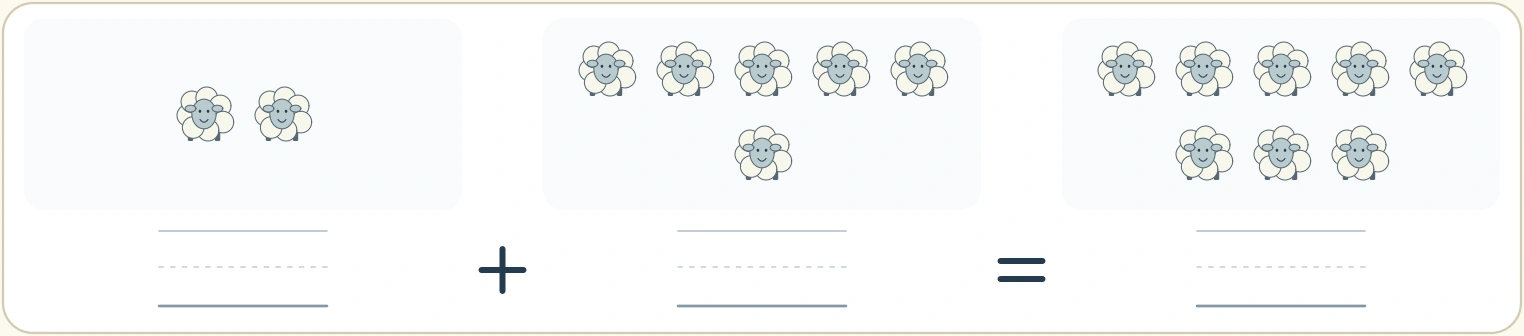
Farm Joining Stories requires all six newcomers to reach the whole of eight. Count the animals themselves rather than fleece circles, ears or feet. Each complete drawing represents one sheep. When the child follows that unit consistently, the spoken story can include the full second amount and finish with the correct whole.
Seven Farm Joining Stories learning opportunities
- Quantity order: naming the first and second groups gives the joining sentence an organized beginning.
- Whole-object counting: one complete animal or face represents one member, despite its many features.
- Part-whole thinking: the final quantity includes both starting groups, giving the story a coherent mathematical ending.
- Language sequencing: before, more and altogether help a partner follow the imagined event without extra unexplained animals.
- Symbol connection: plus and equals translate the spoken relationship into a readable number sentence.
- Purposeful pencil movements: written numerals report counted groups rather than serving as unrelated handwriting marks.
- Shared reasoning: partners can question whether a narrated arrival matches the pictures and revise it together.
Farm Joining Stories can reveal strengths in some areas and needs in others. A fluent storyteller may skip an animal while counting, and a quiet child may show an accurate relationship through pointing. Invite more than one way to explain.
A Farm Joining Stories reference for the adult narrator
Use the Farm Joining Stories table to check your own prompts. It reflects the printed animal relationships, not additional problems hidden elsewhere on the worksheet. Keep the quantities available for preparation while allowing the child to count the page.
| Farm pictures | Before | More | Whole together |
|---|---|---|---|
| Pig faces | 2 | 3 | 5 |
| Cow faces | 3 | 4 | 7 |
| Sheep | 2 | 6 | 8 |
| Ducks | 5 | 5 | 10 |
Farm Joining Stories does not require drawing new animals or selecting from multiple-choice numerals. Its solid and dotted writing guides await the learner's three number records per row. A difficult numeral can be modelled separately after the child has identified its quantity.
Farm Joining Stories can organize a classroom story circle
At a classroom maths station, ask one learner to point to the cow beginning, another to the joining group and a third to the whole. Together they construct a sentence. The Farm Joining Stories teacher listens for three, four and seven in the correct roles, then asks what the equals sign connects.
Farm Joining Stories might reveal a child saying “four altogether” because that was the last starting quantity spoken. Instead of repeating the full answer, ask which group four describes and which panel shows all the cows. A short counter model can make the distinction visible. Rotate the roles so every learner can describe a starting group and a whole.
Farm Joining Stories ducks make a two-digit ending
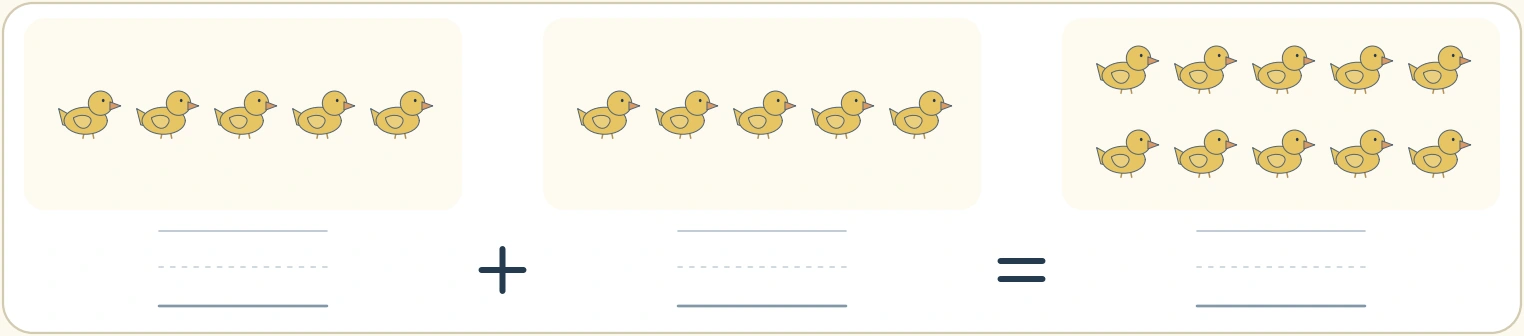
Five plus five gives ten, shown in two complete lines of five duck pictures. A child may count all ten or recognize the two fives and then verify them. Either way, the final written numeral uses both 1 and 0 in one place to name the whole quantity.
For Farm Joining Stories handwriting support, the ten-formation worksheet offers a separate task. The seven-tracing page matches the cow whole. Choose one related activity when needed rather than adding both as automatic homework after a farm conversation.
A Farm Joining Stories model with two visible starting pens
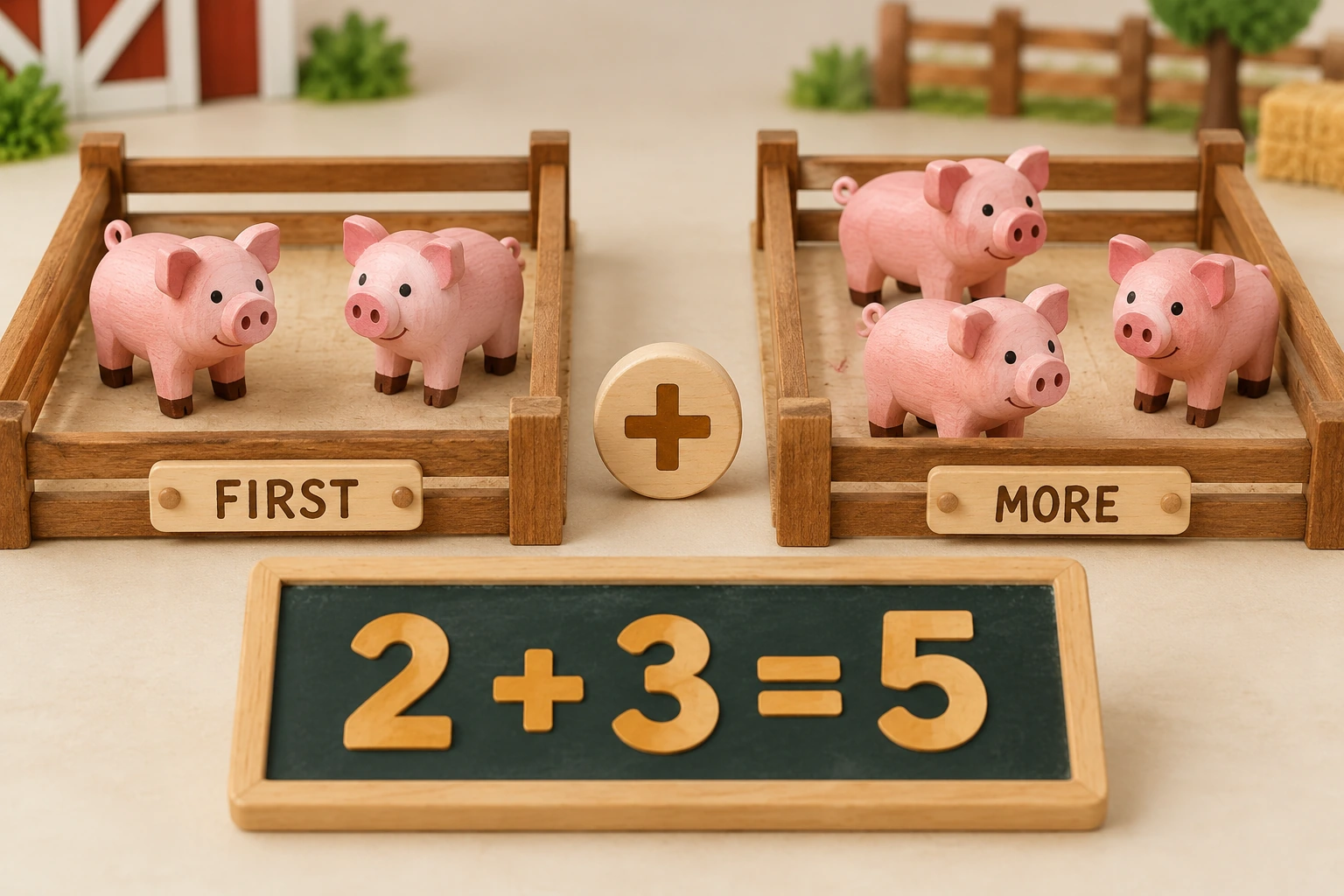
The additional Farm Joining Stories miniature scene has two wooden pigs in one pen and three in another, with a readable two-plus-three equation. It illustrates the pig relationship separately from the source. Farm Joining Stories keeps the worksheet's response spaces unanswered; the supporting board is a demonstration, not a completed copy of those guides.
Farm Joining Stories suitability and common detours
This supported task suits many learners around four to six in preschool or kindergarten. Look for counting readiness rather than assuming every child of that age can independently record twelve numerals. Read the directions, let a child begin with five pigs, and shorten the number of rows when attention or hand stamina is limited.
Common Farm Joining Stories detours include counting ears, adding the whole panel again, inventing extra arrivals or switching the first and second records. Ask the child to connect each phrase to a visible panel. Keep the counted animals stable while the story grows around them. A playful setting can change without changing the numerical evidence.
Let Farm Joining Stories stay enjoyable over repeat visits
Some children enjoy animal voices; others prefer a straightforward farm report. Follow that preference. An adult can say, “Your ending included both groups,” to recognize a specific success. Avoid making a shy child perform a story for the group before accepting their pointing or written explanation.
Return to Farm Joining Stories with a different speaking role, one larger relationship or a fresh counter arrangement. A few purposeful turns are enough for a session. If the child loses interest, save the unused rows. Regular practice can mean brief revisits separated by other activities rather than daily completion of an identical sheet.
Find a Farm Joining Stories follow-up that fits
The learning-number-five activity offers another use for the pig whole. Adults planning informal number conversations can consult NAEYC's maths resources for home learning or PBS Parents' mathematics ideas at age five. Select according to the learner's interest and current support need.
Farm Joining Stories can also continue away from the page when two groups of large toys are brought together. Ask for the beginning, the addition and the whole, keeping the amounts small enough to count comfortably. The point is an understandable joining relationship, not a longer or more elaborate performance.
Choose a Farm Joining Stories printable and leave room for answers
Use the original sample if you want the supplied version with its source markings. For an unbranded member copy, log into your account with an eligible plan currently active, then choose the premium PDF attachment on this page. The clean file has no watermark or website-domain text and contains no ads within the worksheet.
Farm Joining Stories is a one-page US Letter printable. Save it and check the PDF print preview before producing a copy. Adjust scaling for a different paper size so the complete border and all equations remain visible. Advertising on the website is separate from the printable. Offer the learner a clear page, a manageable pencil and the freedom to explain one animal relationship carefully before attempting another.
Popular Worksheets
Printable resources families and teachers are downloading now.
 Free
 Free
 Free
 Free