
Garden Sum Records: 6 Wonderful Picture-to-Number Tasks
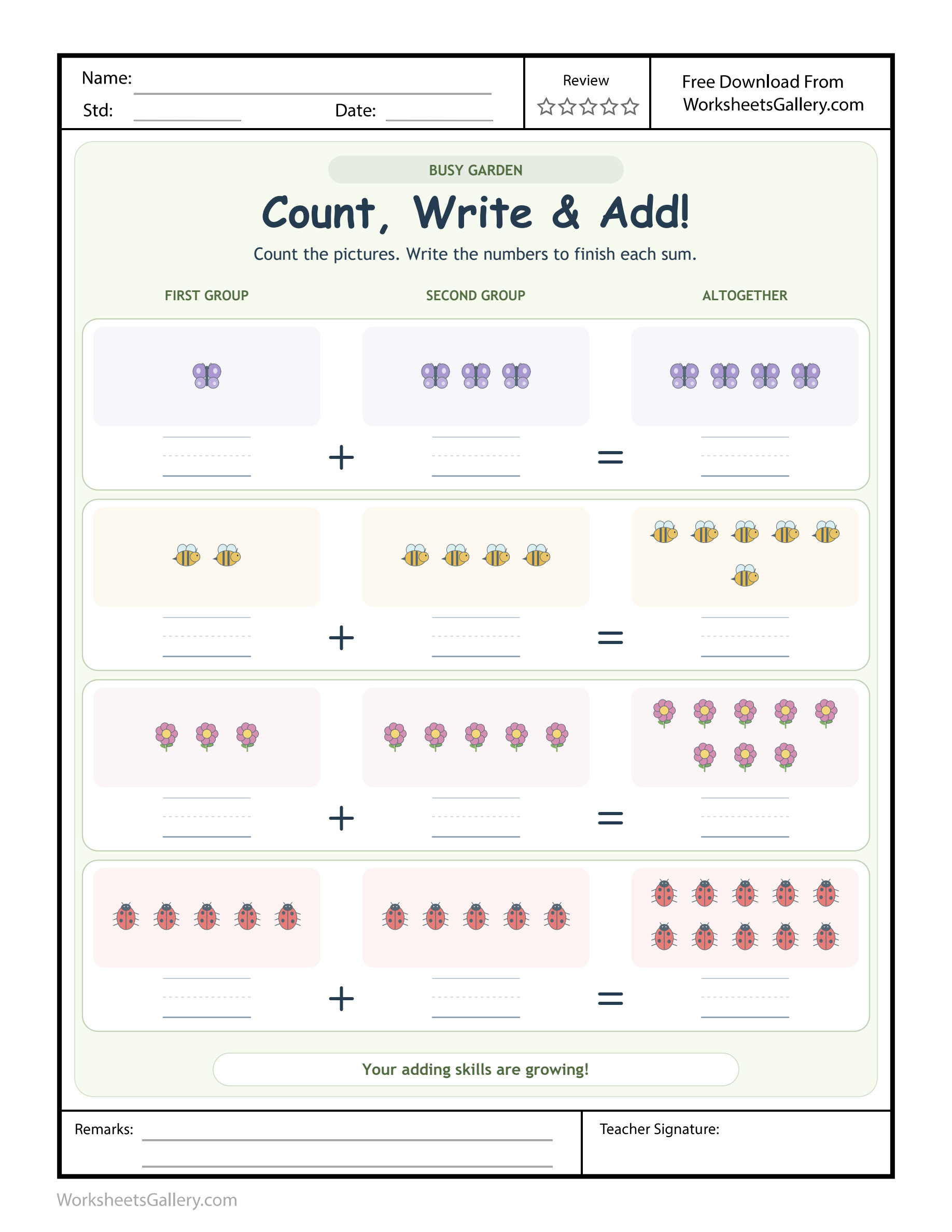
Knowing a garden has four butterflies and writing the numeral four are related achievements, but they are not the same action. Garden Sum Records gives both a place through four illustrated addition rows. For each relationship, learners establish both starting amounts and the represented total, assigning every quantity its own written record. Butterflies, bees, flowers and ladybugs keep the decisions visible. Listen to the counted amount before assessing the pencil marks, and a wobbly numeral can become a manageable handwriting task instead of obscuring sound mathematical thinking.
Garden Sum Records separates deciding from forming
A useful Garden Sum Records sequence is count, name, choose, write, check. First establish the quantity. Say the number aloud, choose its numeral, then make the marks. Finally compare the written record with the panel it describes. These small steps need not become a lengthy chant; they simply help the adult notice where support is needed.
Garden Sum Records has twelve places to write because every one of its four equations records three values. The existing guides have solid and dotted lines, not dotted numeral shapes. Children supply their own numbers. An adult who labels the activity “tracing” may accidentally set up the wrong expectation before the first butterfly is counted.
A Garden Sum Records butterfly decision
The opening row shows one butterfly, three butterflies and four butterflies altogether. Ask the learner to point to the first panel and say how many it contains. That spoken one is evidence about counting even before the pencil moves. Next locate its writing guide directly underneath.

Garden Sum Records then asks the same question of the second panel and the whole. The whole illustrates the first two groups combined. It is not a fresh group to add onto four. Once the values are recorded, read “one plus three equals four,” with a finger connecting each numeral to its own picture evidence.
Eli's Garden Sum Records page needs a writing pause
Eli counts the butterflies correctly for his grandmother. He says four, but his final pencil mark looks more like an open triangle. She asks what number he intended and accepts his spoken answer as evidence of his quantity decision. Then they practise a large 4 on scrap paper before returning to the smaller guide.
Their Garden Sum Records session does not restart every count just because one mark needs attention. Eli chooses whether to write the improved numeral himself or dictate it while his grandmother models alongside. She keeps the original exercise space available for his own later attempt. Counting accuracy and numeral formation remain connected, yet neither is used to dismiss the other.
Six Garden Sum Records gains adults can describe precisely
- Quantities have written partners. A counted group of six bees can be represented by 6 rather than six separate marks.
- Position carries information. Each numeral belongs under a particular collection, making placement part of the mathematical record.
- Attention follows a short sequence. Moving from pictures to speech to writing offers an orderly task with a visible purpose.
- Hand control serves communication. A legible stroke lets another person read the number the learner intended.
- Language clarifies decisions. “This four belongs to the second bee group” says more than naming an isolated number.
- Checking can be specific. A child can repair one mistaken record while keeping other justified records intact.
Garden Sum Records is useful for noticing these behaviours during practice. It is not a test of every early maths skill, and a single neat page cannot show how independently the decisions were made.
Map Garden Sum Records before checking the pencil marks
This Garden Sum Records adult reference lists the actual values in the source order. Each entry is tied to a panel rather than merely a final sum. The flower row, for example, needs three and five as well as eight.
| Garden pictures | First record | Second record | Whole record |
|---|---|---|---|
| Butterflies | 1 | 3 | 4 |
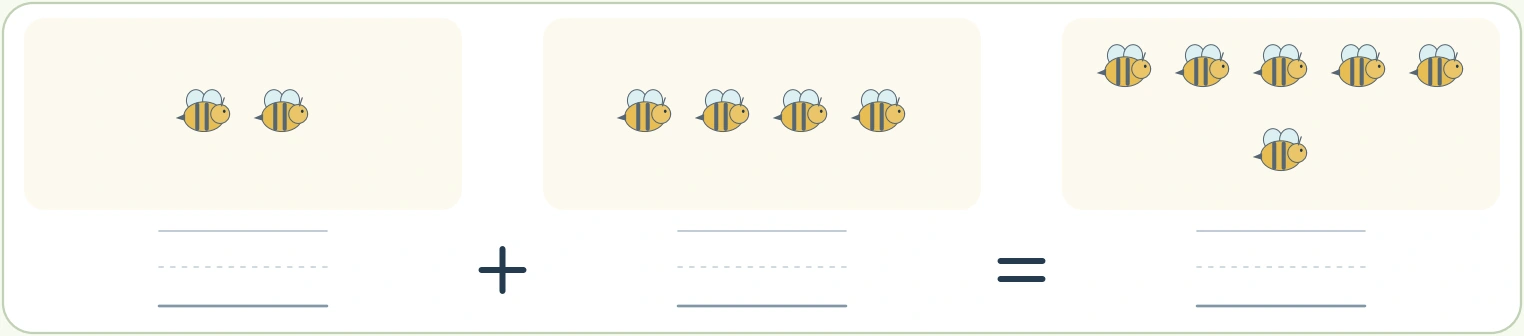
| Bees | 2 | 4 | 6 |
| Flowers | 3 | 5 | 8 |
| Ladybugs | 5 | 5 | 10 |
For Garden Sum Records checking, ask which picture group justifies each written value. If the child has placed a correct numeral under the wrong collection, the quantity knowledge may be sound while the recording location needs correction. Covering adjacent rows can make that relationship easier to see.
Garden Sum Records bees offer a manageable home routine
After preparing paper and pencil, let the child choose a row. Read the group labels together and count the selected pictures. In the bee row, keep two and four separate while finding their amounts, then join those amounts to establish six. Compare that result with the pictured whole before recording it.
Garden Sum Records may involve an adult writing a model on separate paper when a numeral is unfamiliar. Avoid completing the guide before the learner has made the quantity decision. If the adult writes all three values first, the activity becomes copying and no longer shows whether the child could select the numbers from the pictures.
At school, Garden Sum Records can reveal different support needs
Imagine two learners both produce an unclear 6. One says six and accurately points to all six bees. The other says five and stops at the upper picture line. The first may benefit from a formation demonstration; the second needs another look at the collection. Their pencil products look similar, but their next steps differ.
A Garden Sum Records teacher can ask for a short explanation before correcting. Record a private observation such as “count secure; numeral model requested” or “missed lower bee.” Use it to choose a later activity. Avoid public comparisons of handwriting, and let partners take turns explaining a panel without turning the task into a race.
Six Garden Sum Records tasks beyond a finished sheet
1. Give Garden Sum Records a numeral-card rehearsal
Offer large cards showing 1, 3 and 4 after the child counts the butterfly panels. Ask them to place the cards on separate practice paper in the same order. Garden Sum Records now checks number selection without requiring pencil formation. Discuss any change the learner makes before offering another set of cards; the reasoning matters more than a swift arrangement.
2. Speak a Garden Sum Records message for a scribe
One partner counts a selected panel and dictates its quantity. The other writes that numeral on a separate card, then asks where it belongs. Swap jobs. Garden Sum Records becomes a communication task in which the speaker must identify both a value and a location. A clear message might be “four for the second bee group,” not simply “four.”
3. Build a Garden Sum Records butterfly display
Place one large paper butterfly on a cloth and three on another. Count each group and then all four. Match the separate demonstration with the source row before considering any written symbols. Garden Sum Records can then return to the question of which numerals describe those collections. No extra group of four is needed alongside the original four props.
4. Audit one Garden Sum Records misplaced label
On spare paper, an adult puts a numeral 2 below the four-bee model. Ask the child to examine that specific label. They can count the four objects, select a better record and explain the change. Garden Sum Records makes revision purposeful, because the label has to communicate an observed quantity rather than look tidy or please the adult.
5. Enlarge a Garden Sum Records writing movement
After choosing a correct numeral, let the child draw it large with a finger on a tabletop or with a broad crayon on scrap paper. Then decide whether to try the smaller guide. The large movement is an optional rehearsal for a known number; it should not replace counting or become a demand for repeated perfect strokes before the maths continues.
6. Explain the Garden Sum Records ten
Gather ten suitable counters and divide them into two groups of five to match the ladybugs. Ask how many belong in the whole, then show a numeral card marked 10. Garden Sum Records introduces a single total written with two digits. Keep both digits in the final record's space; do not distribute 1 and 0 across different picture panels.
Garden Sum Records reaches a two-digit whole
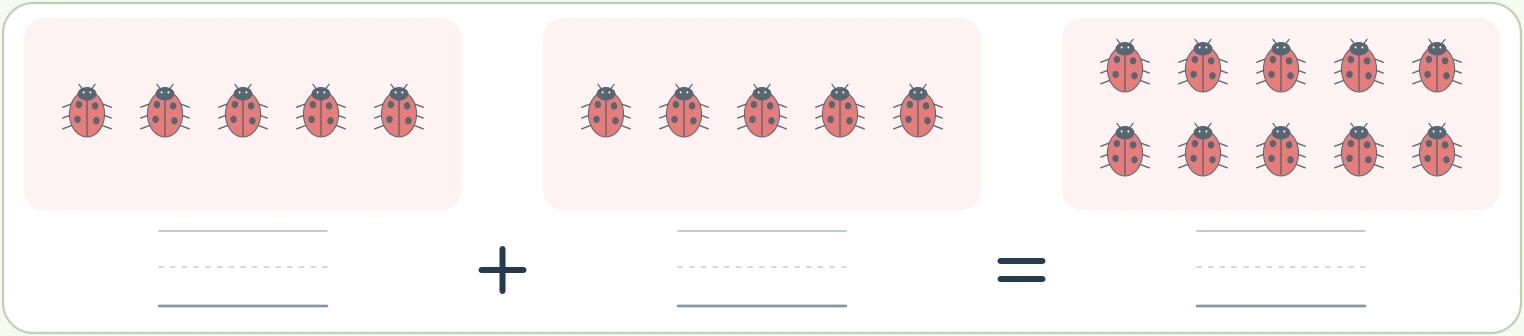
Ten can bring a new recording challenge even when the count is comfortable. The whole panel contains ten ladybugs in two lines of five. Its Garden Sum Records numeral needs a 1 and a 0 working together. Saying “ten” while pointing to both digits can connect the complete written numeral with the complete collection.
For Garden Sum Records support, the ten-tracing worksheet provides separate handwriting practice. Return to this row afterwards only if the learner still wants to record the relationship. No amount of formation rehearsal should require changing a mathematically justified total.
A Garden Sum Records scene to rehearse before writing
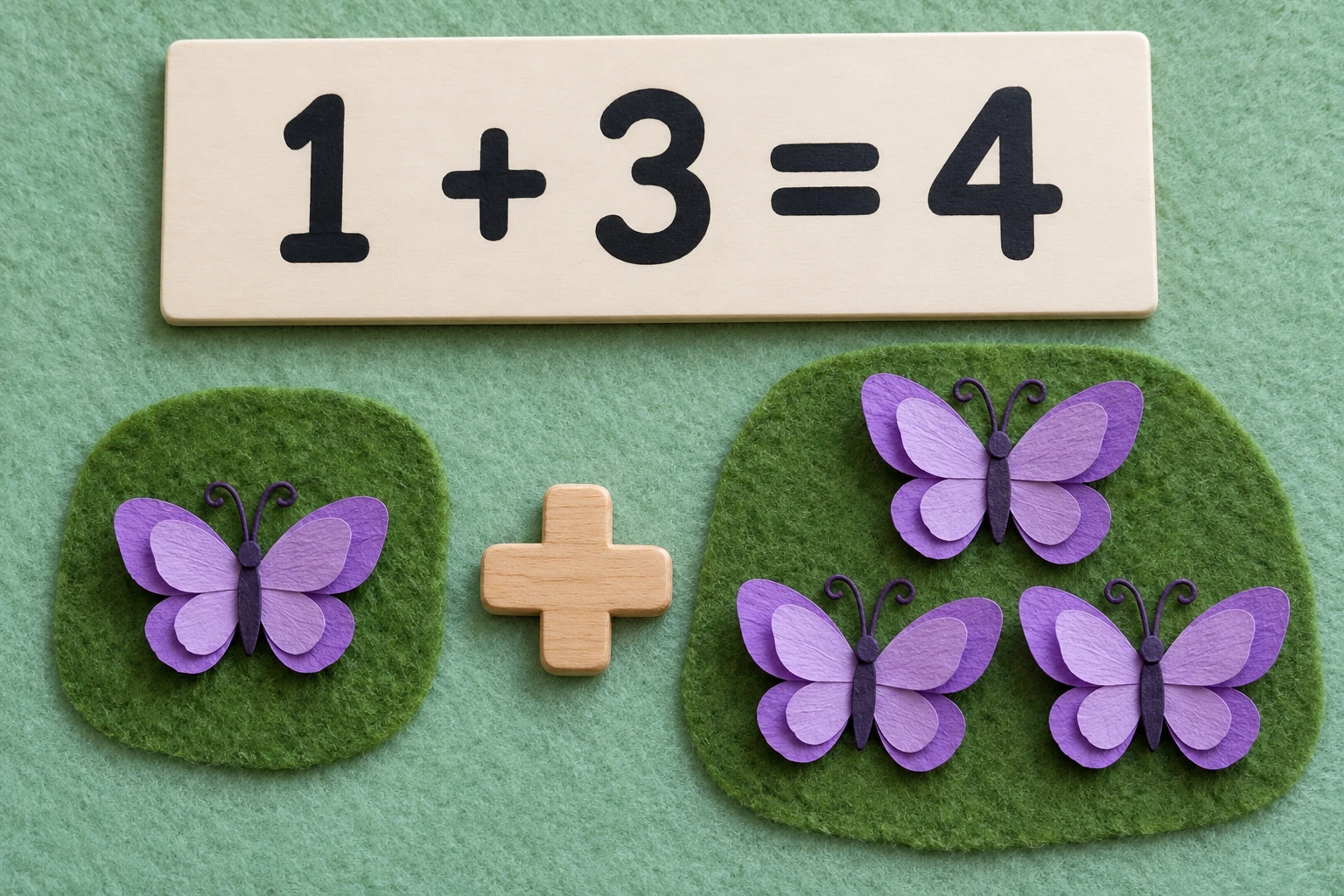
The separate Garden Sum Records illustration pairs one butterfly with three others and a readable equation. It models a small quantity-to-numeral connection while the source worksheet retains every intentional answer space.
Garden Sum Records readiness includes more than age
The sheet is suited to supported preschool and kindergarten practice, commonly around ages four to six. Begin Garden Sum Records where the learner can count with reasonable confidence. An adult may read the headings, and the child can answer orally before attempting written records. The smallest butterfly relationship is a sensible starting point.
Garden Sum Records calls on working attention, visual tracking, number vocabulary and fine motor control. If holding a pencil overshadows the mathematical discussion, shorten that part. If spoken number words are unfamiliar, pair them patiently with touches on the pictures. These adjustments preserve a real counting decision while keeping the experience accessible.
Keep Garden Sum Records revision encouraging
Common slips include counting butterfly wings, writing the whole under a starting group, copying a neighbour's record, or assuming the dotted line is a numeral to trace. Name what happened and reconnect the record to its evidence. “Your four describes these butterflies” is a useful observation; “be neater” gives little mathematical direction.
Let Garden Sum Records sessions end after a meaningful success. One explained equation can be enough today. Return later with a different role, such as checking the bee records or writing the final ladybug value. A child who is frustrated can continue with pointing or take a break rather than being required to finish twelve entries.
Take Garden Sum Records into another kind of practice
Choose a nearby skill deliberately. The eight-formation activity can support the flower total, while one-to-ten tracing offers broader numeral work. Neither replaces explaining what the garden groups represent.
For adults seeking informal activities, family maths ideas from NAEYC and the PBS Parents five-year maths collection provide places to explore. Garden Sum Records can be one part of a varied week involving talk, objects and short pencil tasks. Keep practice responsive to the decision that actually needs help.
Print the Garden Sum Records version you need
The original sample and the clean member download are distinct PDF attachments. Choose the original for its retained source presentation. To obtain the premium edition, enter your account, ensure an eligible membership is active and select the premium file on this worksheet page. The member worksheet has no watermark, website-domain promotion or embedded ads.
Garden Sum Records occupies one portrait sheet at US Letter dimensions. Before printing your saved file, inspect its frame, garden panels and numeral guides in the viewer. Use scaling appropriate for your paper if it is not Letter size. The download's advertisement-free worksheet is separate from any advertising on the website itself. Leave the original exercise gaps clear, give the learner time to count, and use the records to understand their choices rather than merely to collect a finished page.
Popular Worksheets
Printable resources families and teachers are downloading now.
 Free
 Free
 Free
 Free