
Sea Addition Stories: 4 Powerful Ways to Read Equals
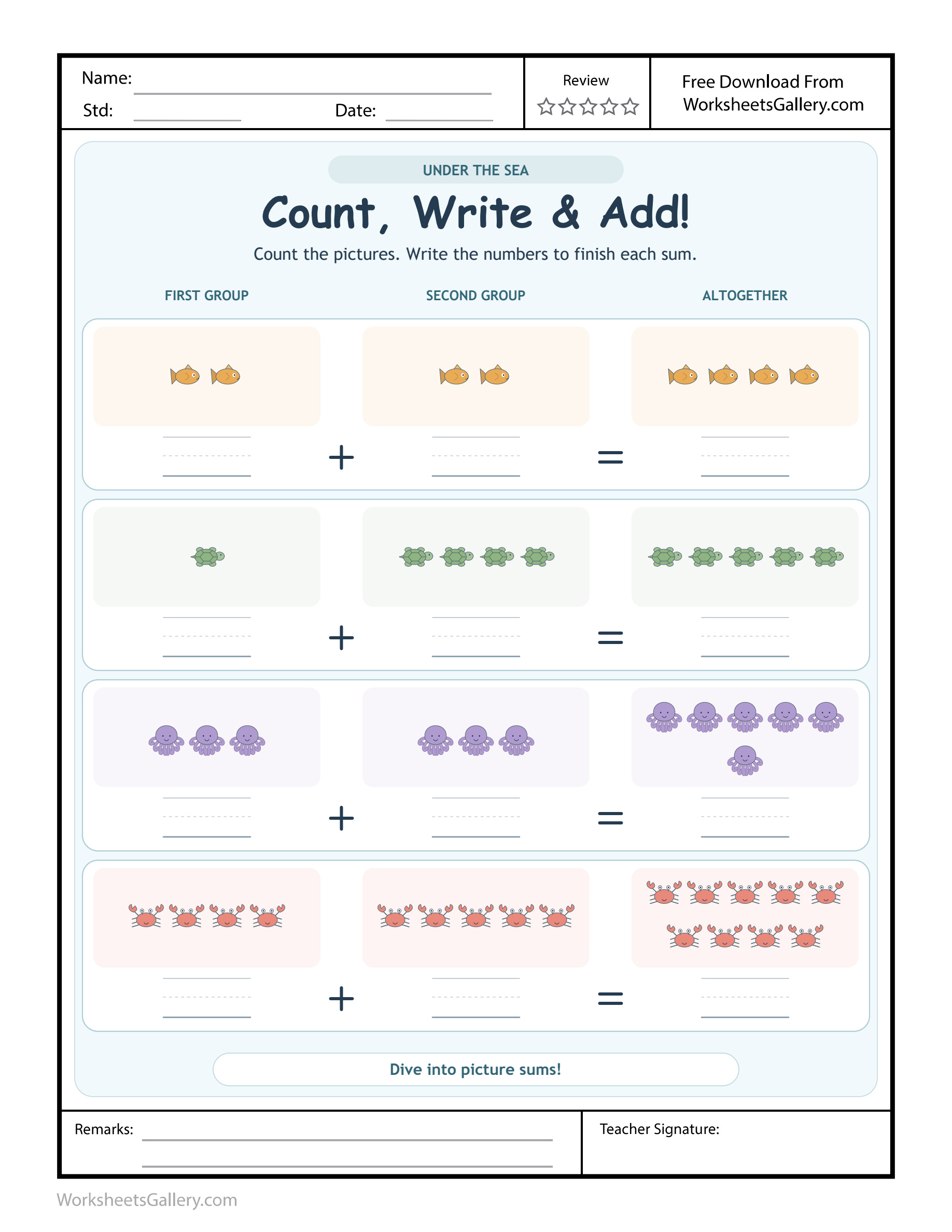
What does the equals sign promise a young reader? Sea Addition Stories turns that question into a conversation about fish, turtles, jellyfish and crabs. Two starting picture groups sit to its left; a pictured whole appears to its right. Children count and write three values for each relationship, discovering that the amounts agree across the sign. The ocean theme supplies something concrete to discuss, while the task remains about quantities. Try an oral explanation before pencil work so a child can tell you what the symbols mean in this particular row.
Hear Sea Addition Stories as statements that agree
Read “two fish plus two fish equals four fish” while pointing across the opening row. Pause at the Sea Addition Stories equals sign. Its job is to connect two ways of describing four: two parts together on one side, a whole collection on the other. It does not mean “now count everything else on the page.”
For Sea Addition Stories, same quantity is a useful phrase to revisit. The panels look different because one side has two groups and the other has one. Their layouts do not need to look identical for their represented amounts to agree. Count the fish to establish that agreement instead of treating the sign as an unexplained signal to write.
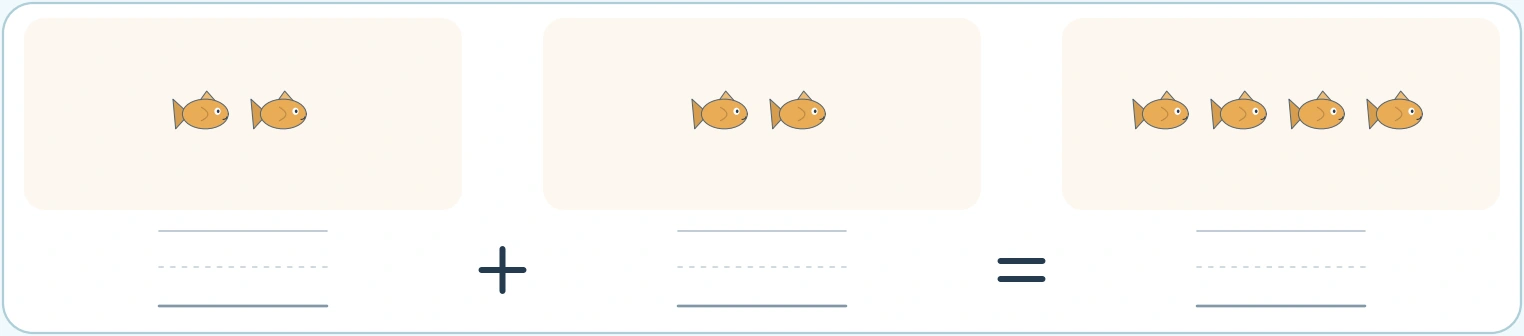
Nabil asks Sea Addition Stories about five turtles
Nabil notices one turtle and then four turtles. His mother asks what the final five-turtle picture is saying. He answers, “Another five came.” They try a model with five large counters, initially separating one from four. Then they bring the same counters together without bringing any new ones from the box.
Sea Addition Stories now describes an unchanged collection in a different arrangement. Nabil says, “These five are those ones together.” His mother repeats the idea using the equals sign. She leaves the counters available while he chooses his numerals. The model clarifies the relationship without requiring him to remember an adult's entire verbal explanation at once.
Prepare a Sea Addition Stories listening turn
At home, find a place where the learner can see the entire row without twisting the paper. Read FIRST GROUP, SECOND GROUP and ALTOGETHER aloud. Ask the child to name the sea creatures before introducing quantities. A familiar word can make a numerical explanation easier to follow.
During Sea Addition Stories, count each starting panel separately and record its amount beneath it. Next count the two parts as a joined quantity. Finally inspect the whole panel and ask whether it represents that amount. The last written numeral belongs below that whole. The supplied plus and equals signs stay as they are; the child supplies twelve number records across four equations.
Six Sea Addition Stories skills behind one explanation
- Relational thinking: the learner compares what two sides represent instead of viewing the equals sign as a command with no meaning.
- Reliable enumeration: each complete creature receives one count, including creatures on a lower picture line.
- Spoken mathematical language: words such as part, together and same amount give a partner a way to follow the reasoning.
- Symbol interpretation: the child connects plus with joining and equals with a statement about matching quantities.
- Numeral placement: a written value goes beneath the correct panel, coordinating eye movement with a small controlled hand action.
- Evidence-based revision: recounting can explain a disagreement and support a changed answer without relying solely on adult approval.
Sea Addition Stories offers practice in these areas at different levels. A learner may explain a quantity clearly while still needing help forming the written 6. Treat that difference as useful information rather than a contradiction.
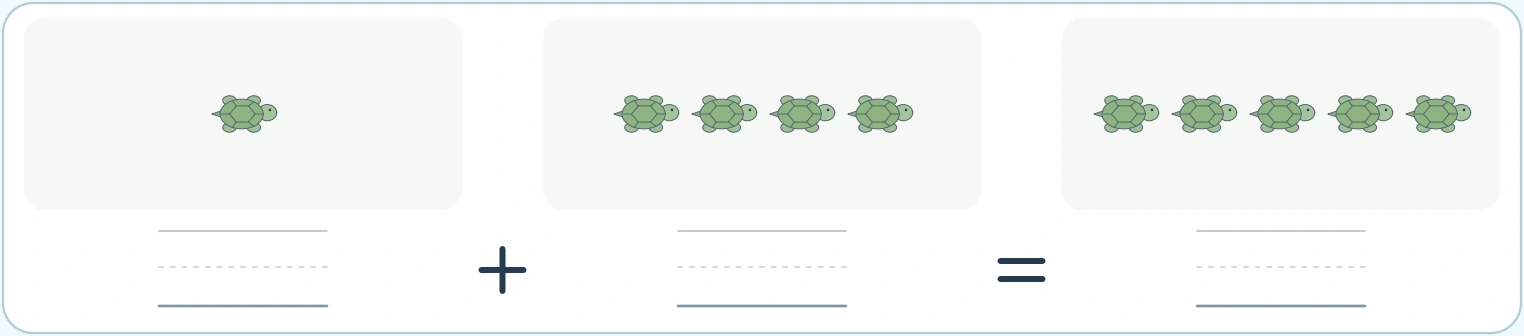
Read Sea Addition Stories jellyfish beyond the upper line
The jellyfish equation begins with three and three. Its Sea Addition Stories whole is six, shown as five above one. A learner who counts only the upper line may conclude that the statement does not match. Ask where their finger stopped before introducing another addition strategy.
Sea Addition Stories keeps every picture within its own panel's group. The lower jellyfish is not a new equation. Continue the count to six, then compare it with the combined three and three. If the child still finds the layout difficult, model six counters in one line before rearranging them as five and one.
A Sea Addition Stories reference for adult checking
These Sea Addition Stories values describe the four printed rows in order. Use the table to prepare a discussion, rather than reading it aloud while the child is trying to count independently.
| Sea creature | Starting expression | Same whole quantity |
|---|---|---|
| Fish | 2 + 2 | 4 |
| Turtles | 1 + 4 | 5 |
| Jellyfish | 3 + 3 | 6 |
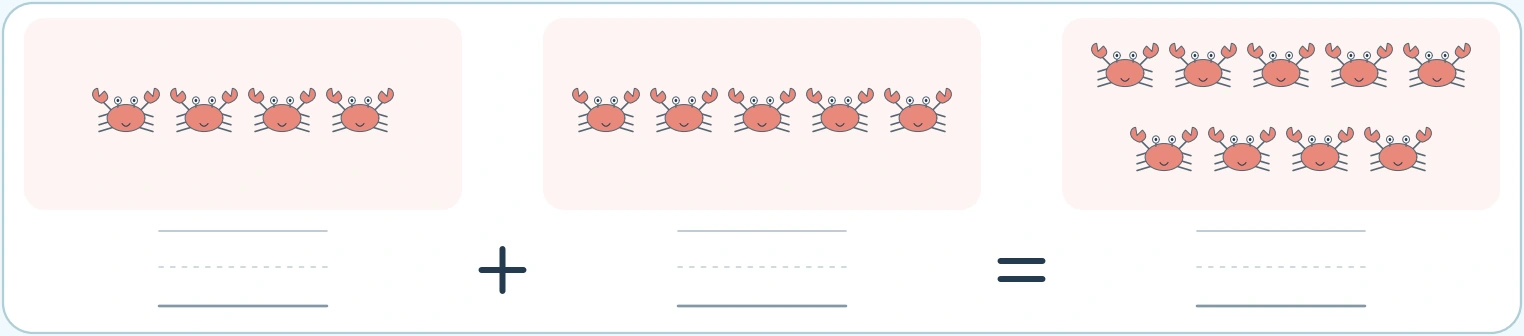
| Crabs | 4 + 5 | 9 |
In Sea Addition Stories the right-hand panel shows the result already in pictures. Children still need to establish the counts and write numerals. The guides contain no numeral shapes to trace, and there are no answer choices to circle. Calling it a count-write-add activity keeps expectations aligned with the actual sheet.
Let Sea Addition Stories become a classroom explanation circle
Give a pair of learners one row to discuss. One describes the two parts; the other checks the whole panel. Then ask them to agree on a sentence that includes “same amount.” The Sea Addition Stories teacher can listen to whether the partners explain their agreement or simply announce a final number.
For example, Sea Addition Stories crabs may produce a report of nine from one partner and eight from another. Invite them to point along the right panel together. It contains five crabs above four. A missed lower crab can explain the disagreement. The pair can correct that tracking step before rereading “four plus five equals nine.”
Four Sea Addition Stories games about equality
1. Give Sea Addition Stories an equals voice
Choose the fish row and let the child speak for the equals sign: “Both sides tell about four.” An adult speaks for the plus sign: “Join these two parts.” Swap roles for turtles. Sea Addition Stories turns mathematical symbols into short spoken jobs while keeping their meanings accurate. The Sea Addition Stories goal is an explanation the learner understands, not a theatrical performance or a memorized definition.
2. Make a Sea Addition Stories two-view display
Arrange two counters and two more on separate cloth patches. Photograph or sketch that view, then bring the same four counters together for another view. Compare the Sea Addition Stories records. Sea Addition Stories can now refer to two representations of one quantity. Ask whether the second image means new counters arrived. The physical Sea Addition Stories movement makes clear why the whole is not a third addend.
3. Check a Sea Addition Stories doubtful claim
Set out one token and four tokens, but place a numeral 6 beside them on separate practice paper. Invite the child to decide whether the statement agrees with the objects. Sea Addition Stories becomes a reason to question a written claim. Recount together if needed, replacing the label only after the learner explains why five describes the collection more accurately.
4. Translate Sea Addition Stories into a partner message
One learner describes a row without saying its final number; a partner builds the two starting groups with large counters and finds their whole. Compare that model with the selected printed row. Keep creature names as context and quantities as the essential information. This game adds careful listening: the builder must retain both starting amounts rather than copying only the last number heard.
Sea Addition Stories can begin with four physical fish
The generated felt scene is an additional teaching illustration, not a completed worksheet answer key. Its two groups each contain two wooden fish, and the board states their relationship. Ask the child which toys each 2 describes before discussing the 4.
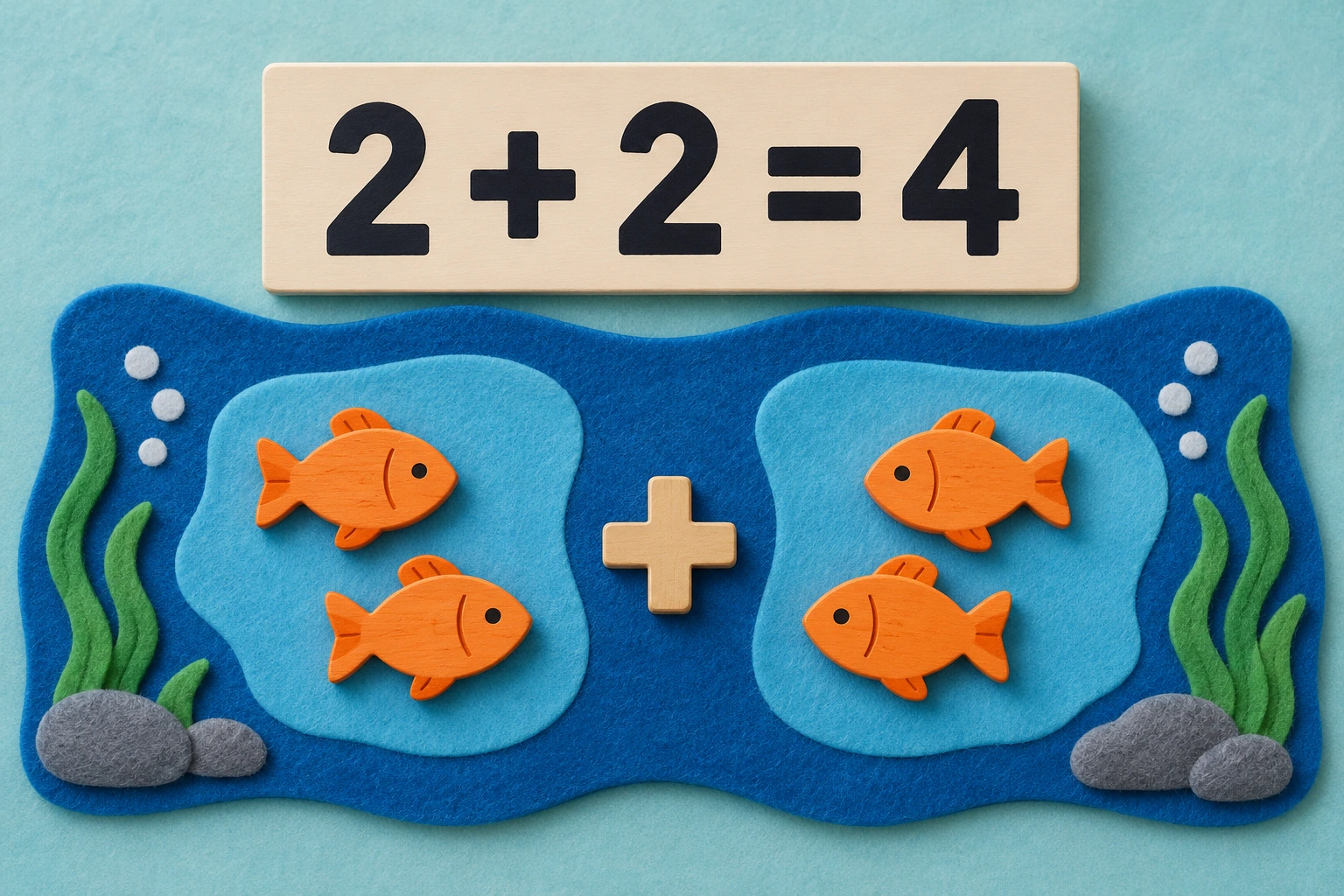
Sea Addition Stories benefits from a demonstration that can be handled with real materials afterwards. Four suitably sized blocks can stand for the fish if sea toys are unavailable. Tell the child what the substitutes represent so the relationship stays clear even when the materials differ from the drawings.
Choose a Sea Addition Stories challenge that fits today
Children roughly four to six years old may use the sheet with an adult, especially when they already count small groups. Some kindergarten learners may record the equations independently; others need an adult to read the headings and hold a spoken total in mind. Readiness can vary across counting, language and handwriting.
For Sea Addition Stories support, start with the four fish and postpone nine crabs. Invite pointing, spoken answers or numeral-card selection before handwriting if necessary. Rehearse a difficult written number separately with the number-six tracing page. Do not assume that fluent counting automatically supplies comfortable pencil control.
Respond when Sea Addition Stories stops making sense
If a child adds the whole panel again, return to the two-view counter demonstration. If they write the total under the first group, point to that group's own pictures and ask what quantity belongs there. These difficulties need different responses. An error in recording location is not necessarily confusion about the whole.
Sea Addition Stories can also become tiring when an adult requests several explanations after the child has already demonstrated understanding. Accept a clear short answer. Use “show me the matching amounts” as an invitation, then allow quiet counting time. A slower explanation is still an explanation; speed does not decide whether the relationship is understood.
Keep Sea Addition Stories practice conversational
Return for one new purpose: naming parts, checking the whole, or recording values. A five-minute conversation around one row may be enough for a particular day. Let the Sea Addition Stories learner choose a creature and ask a family member to explain its equation. Being the questioner can make a familiar sheet feel useful again.
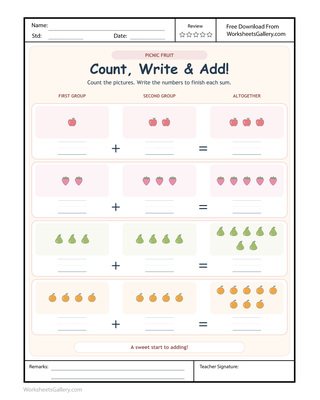
For later practice, the nine-writing activity addresses the largest sea total, while fruit picture sums offer another context. For adults planning everyday number talk, browse PBS Parents' maths ideas for five-year-olds or NAEYC's family mathematics collection. Pick resources according to the child's current question.
Obtain the Sea Addition Stories printable edition
Choose between the separately retained original sample and the clean premium file. The sample can retain its original website marking. To access the member edition, open your account, check that your eligible membership is current, and choose this page's premium PDF download.
The premium printable has no watermark, domain promotion or ads within the worksheet. Save the file, inspect its one-page US Letter layout in a PDF viewer, and choose printer scaling that retains the complete border. Another paper size may need a fit-to-page adjustment. The web page is a separate viewing surface from that printable file. Keep the twelve writing guides clear for the child's responses and use the illustrations as prompts for a calm mathematical conversation.
Popular Worksheets
Printable resources families and teachers are downloading now.
 Free
 Free
 Free
 Free