
Galaxy Addition Check: 4 Powerful Mission Proof Games
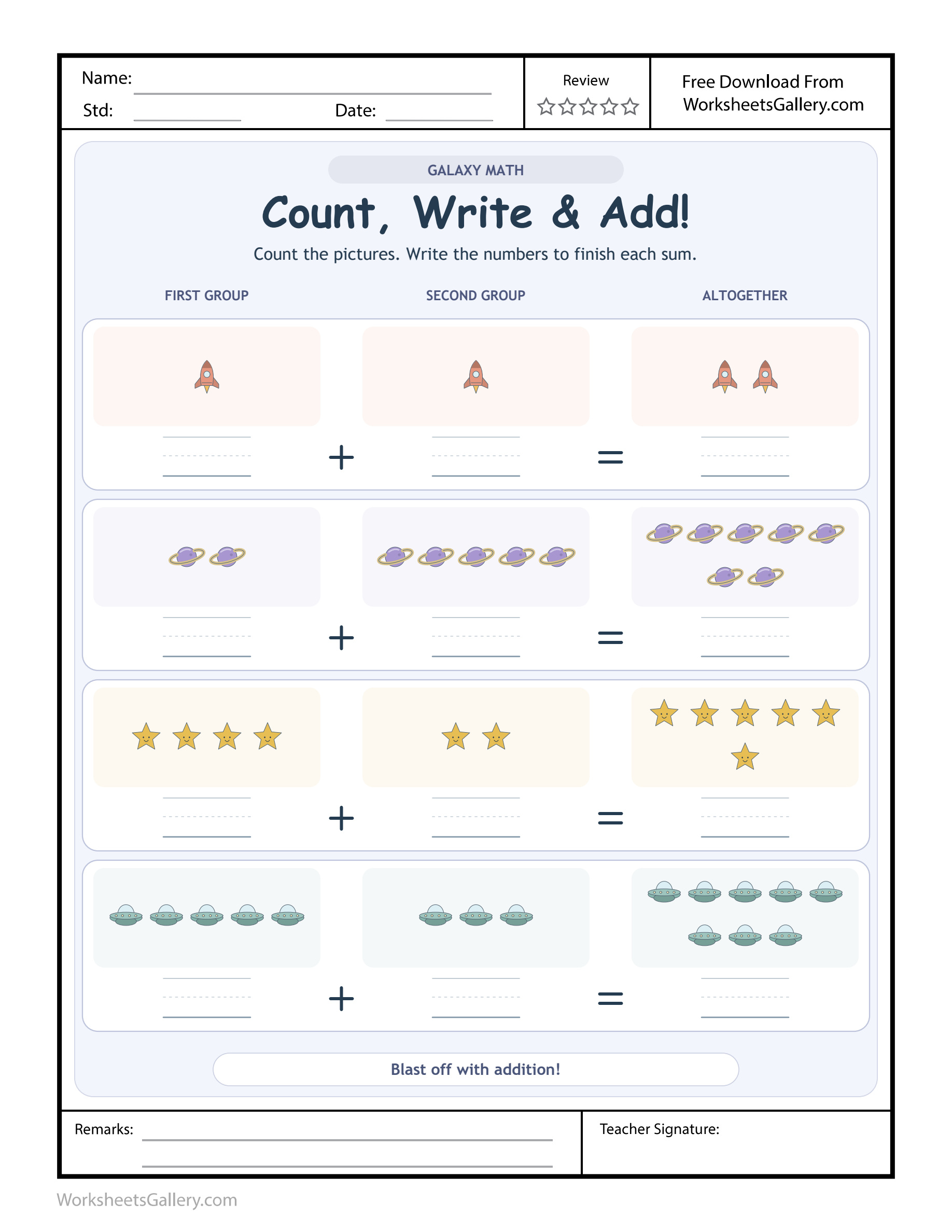
Mission control wants evidence before accepting a number report. Galaxy Addition Check gives that pretend job a concrete form: establish the two starting quantities, combine them, and independently inspect the pictured total. Four equations use rockets, planets, stars and flying saucers, with three number-writing places in every row. The mission is not to guess a pattern down the page. Its totals change from two to seven, back to six and then to eight. A separate count of the whole can confirm a result or reveal exactly where another look is needed.
Galaxy Addition Check uses two routes to one result
The first Galaxy Addition Check route counts the starting panels together. The second counts the ALTOGETHER panel separately. Compare the results after finishing each route. They describe the same combined quantity, so agreement gives the learner a visible reason to accept the written number sentence.
Galaxy Addition Check does not ask children to add the whole panel onto the first two. That would count its represented amount again. Use “check against” rather than “add on” when turning to the right panel. Its purpose here is a second view of the whole, while the two earlier panels supply the parts being combined.
Prepare Galaxy Addition Check as a short mission briefing
Read the printed column labels and count one rocket in each starting group. Together those parts make two. The right panel shows two rockets, providing a small first check. The Galaxy Addition Check learner records 1, 1 and 2 on the guides below their corresponding panels.
For Galaxy Addition Check, no numeral answers are printed for tracing. The solid and dotted lines provide a writing space, and the plus and equals signs are supplied. Across the entire sheet there are four equations and twelve numeral records to make. An adult can read directions without choosing those numbers on the learner's behalf.
Milo discovers a Galaxy Addition Check mismatch
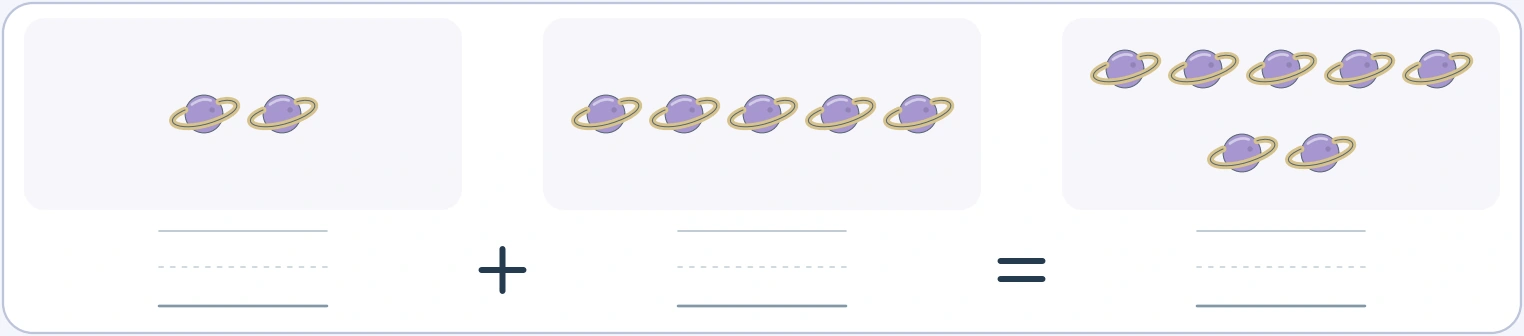
Milo tells his aunt that the planets total six. She asks how he counted, and he shows two in the first group plus only four of the five in the second. They do not begin by looking up an answer. Instead, they count the whole panel independently and find seven.
The Galaxy Addition Check disagreement gives them a reason to inspect the starting groups again. Milo discovers the missed planet and changes the second quantity to five. His aunt asks him to read the repaired relationship aloud. He can now explain why two plus five and the seven-planet whole agree. The Galaxy Addition Check revision follows picture evidence rather than an instruction to erase a wrong number.
Six Galaxy Addition Check habits to encourage
- Finish before comparing. Establish one route's result before switching panels, so two unfinished counts do not become tangled.
- Track complete objects. Planet rings, rocket fins and saucer lights belong to their objects; they do not add separate mission items.
- Keep the counting unit stable. A single whole star remains one star even though it has several points.
- Use a deliberate return. Looking back at a doubtful panel can reveal a skipped object rather than signalling failure.
- Read the symbols meaningfully. The equals sign connects two representations of the same quantity, allowing the report to be checked.
- Record what the evidence says. A numeral communicates a particular panel's amount, not the number the learner expects next in a sequence.
Galaxy Addition Check offers a way to practise these habits through talk and small hand movements. Their value depends on the learner doing the counting; a fully adult-completed page cannot demonstrate independent verification.
The Galaxy Addition Check star row changes direction
Seven planets are followed by six stars. That decrease is correct. A child who expects each answer to be larger may try to write eight without inspecting the objects. Ask what this row itself shows, setting aside the previous report for a moment.

Galaxy Addition Check stars begin as four and two. Count those parts jointly, then verify the six-star whole. Five stars appear on its upper line and one below. A careful count includes that lower star but does not include the planet pictures from the preceding row. Each equation is its own relationship.
Keep a Galaxy Addition Check reference for discussion
The following Galaxy Addition Check mission records match the source pictures. Adults can consult them while preparing a prompt, then allow the learner to reach a value through the images rather than copying this table.
| Mission pictures | First part | Second part | Verified whole |
|---|---|---|---|
| Rockets | 1 | 1 | 2 |
| Planets | 2 | 5 | 7 |
| Stars | 4 | 2 | 6 |
| Saucers | 5 | 3 | 8 |
In Galaxy Addition Check, the right-hand quantity is a checkable representation already printed in pictures. The child is not being asked to draw that whole from scratch. Keeping the task description accurate helps an adult decide whether the learner needs counting, numeral-selection or handwriting support.
Run Galaxy Addition Check at a home launch table
Choose one row and set out the worksheet flat. Read its picture name, then invite the child to count the first and second groups. Write those values only after the learner can connect them to their panels. A pencil and optional large counters are sufficient; elaborate space props are unnecessary.
For the Galaxy Addition Check whole, use one route first and pause to name its result. Then count the total panel separately. If the results match, record the total and read the equation. If they differ, leave both results in conversation while checking the touching route. Avoid repeatedly asking “Are you sure?” without giving a concrete way to investigate.
Galaxy Addition Check in a classroom mission partnership
Assign one learner the starting-group report and another the whole-panel report. They count quietly in turn, announce their results and compare them. Partners should exchange roles on the next mission. Their Galaxy Addition Check discussion can focus on whether both reports describe the same amount, rather than which child spoke first.
A Galaxy Addition Check teacher might hear eight from the saucer checker but seven from the starting-group reporter. Ask each learner to show a pointing path. The class can locate the omitted saucer without turning the disagreement into a contest. Note whether the difficulty involved tracking, joining amounts or reading a written numeral; each suggests a different later practice choice.
Four Galaxy Addition Check proof games
1. Give Galaxy Addition Check two launch-pad reports
Place one large rocket substitute on each of two mats. Count the parts jointly, then move those same two objects together and count again. Galaxy Addition Check compares two reports about an unchanged collection. The Galaxy Addition Check learner can explain why moving the pieces did not create another pair. Use the model as a rehearsal before pointing at the source's separate total representation.
2. Audit a Galaxy Addition Check star announcement
An adult claims that four star tokens and two more make seven. Invite a child to inspect the tokens and decide what report the objects support. Galaxy Addition Check makes the adult's claim something that can be questioned. Count with a clear touch sequence, state six, and explain the revised report without demanding that the learner recite a formal rule.
3. Swap Galaxy Addition Check verification jobs
One partner arranges two counters beside five. Another counts the seven together and writes a numeral on a separate card. Change jobs with a four-and-two arrangement. Galaxy Addition Check practice then includes both constructing a relationship and assessing it. Each partner should have access to the objects, so the checking role requires evidence rather than trust in the other person's answer.
4. Compare Galaxy Addition Check mission sizes
Make models for the planet and star relationships, one at a time. Ask which whole is greater and how the child knows. Seven planets and six stars show that moving down the sheet does not promise a growing total. Keep the comparison secondary: first verify each individual equation, then compare the two established quantities. Use counters if the picture layouts distract from the numbers.
The Galaxy Addition Check rocket scene stays small
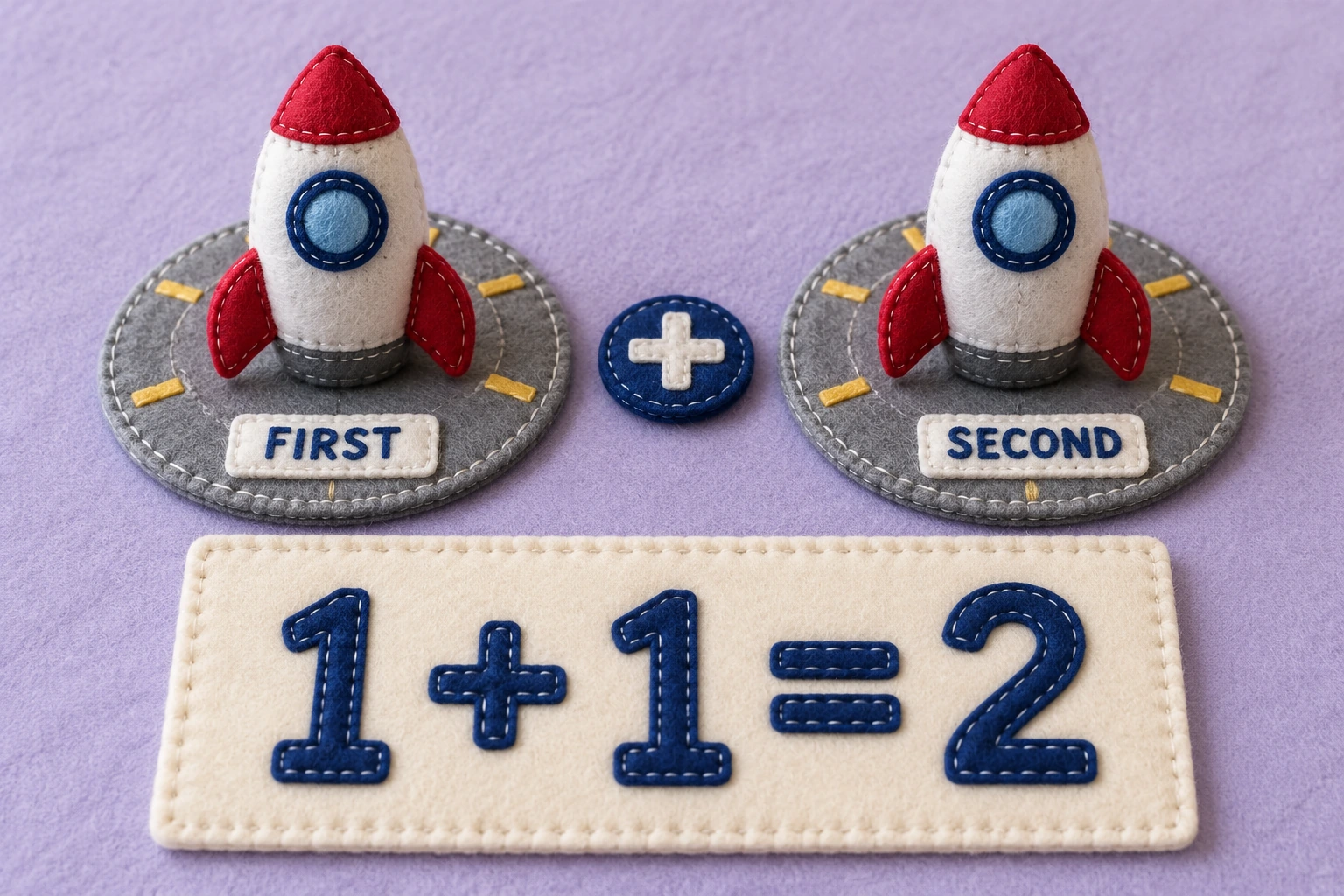
The generated launch-pad illustration shows one rocket plus one rocket and a readable result of two. It provides a separate visual rehearsal with only two physical starting groups. The source worksheet retains its intentional response spaces. Galaxy Addition Check can use this smaller model when a seven-planet verification is currently too demanding.
Choose Galaxy Addition Check support by readiness
The activity fits supported preschool or kindergarten use, commonly around ages four to six. Begin when the learner can touch-count small groups and tolerate a short comparison. Some children can explain two plus one long before writing the digits comfortably; others need more language support to describe what the panels mean.
Galaxy Addition Check can remain oral while those other skills develop. Let the child point, use numeral cards or dictate a record. For separate formation work, the number-two tracing activity matches the rocket whole, while seven-tracing practice matches the planets. Choose the support for the actual difficulty rather than treating an age label as a fixed requirement.
When Galaxy Addition Check evidence disagrees
Look for a skipped lower picture, a repeated touch or a count of small decorative features. Also ask whether the child counted all three panels as separate addends. Correcting the numeral alone will not resolve that conceptual misunderstanding. Model the same objects as parts and then a whole before returning to the printed representations.
Galaxy Addition Check should leave room for a learner to say, “My first report needs another look.” That is a useful mathematical response. Make checking an ordinary part of the job, not a punishment reserved for wrong answers. Praise a specific action, such as noticing the lower star, and stop if repeated recounts turn into frustration.
Revisit Galaxy Addition Check without replaying every task
At a later session, choose a different mission or reverse the reporting roles. A short check of one equation may be sufficient. Let the child explain a familiar row to someone new; teaching its relationship can be more interesting than writing the same twelve values again.
The eight-writing page can accompany the saucer result. Adults can look at NAEYC's family maths activity collection and PBS Parents' ideas for maths at five for further informal practice. Galaxy Addition Check works best as one focused experience among conversations, object play and other kinds of number work.
Save the Galaxy Addition Check worksheet for printing
Select the original sample to keep its uploaded presentation, including any source branding. The separate clean premium edition is available through the premium control when your signed-in account has an eligible current membership. That member PDF has no watermark, website-domain markings or advertising within the worksheet itself.
Galaxy Addition Check is laid out at US Letter size on one sheet. View the saved file before printing; if your paper has other dimensions, choose scaling that retains every edge of the frame. Keep all four equations and the twelve number guides visible. Website advertising is separate from the printable file. Start with a clear small mission, let the child establish its values, and accept the report because the quantities agree.
Popular Worksheets
Printable resources families and teachers are downloading now.
 Free
 Free
 Free
 Free