
Picnic Picture Addition: 5 Brilliant Three-Panel Games
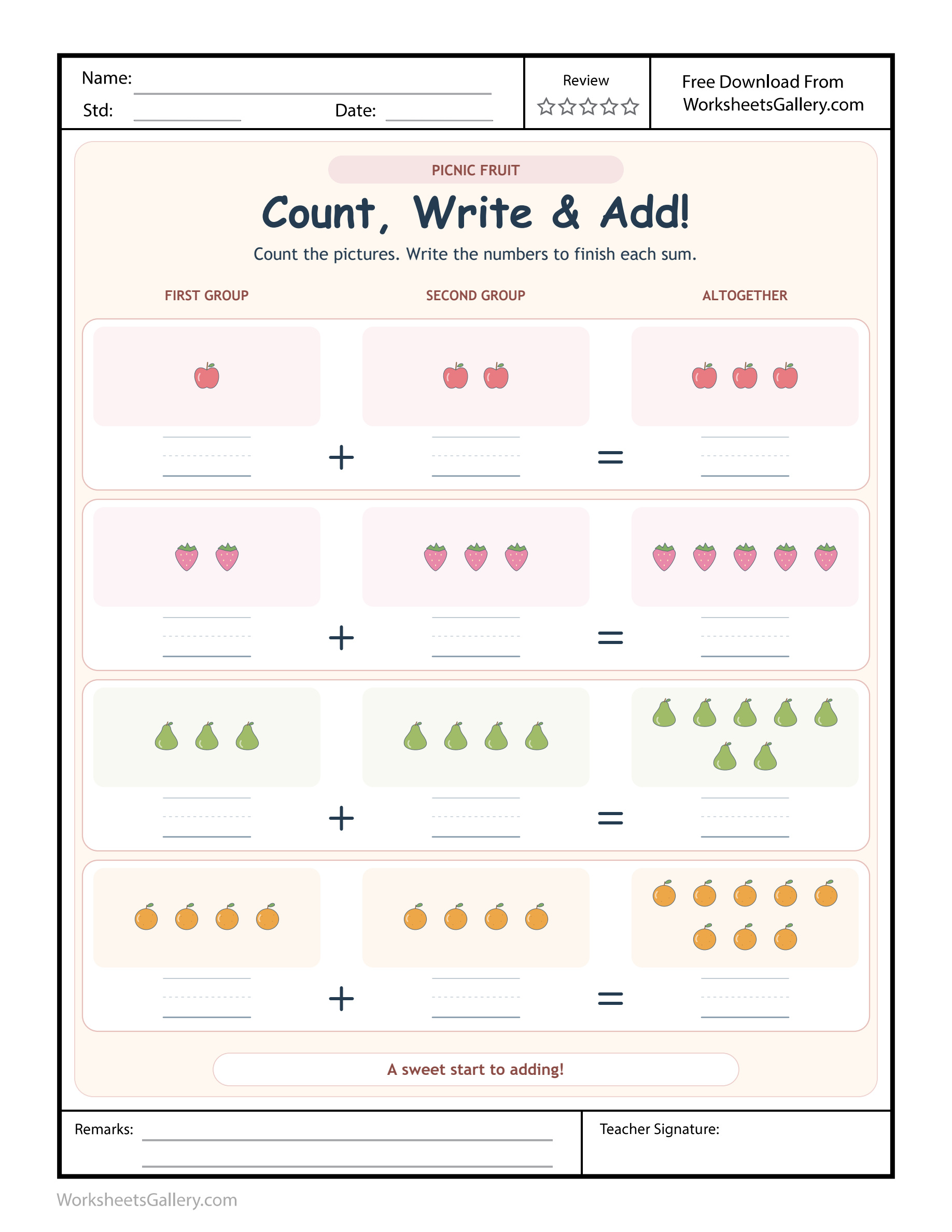
Three picture panels can describe one picnic without supplying three separate piles to add. Picnic Picture Addition introduces that distinction through apples, strawberries, pears and oranges. Each row shows a first group, a second group and their pictured whole, followed by spaces for three numerals. The child counts, connects and records rather than merely filling a final answer box. Begin with the apples and let the right panel become evidence for the total. A careful explanation of what that panel means matters more than racing through all four fruit rows.
Picnic Picture Addition starts with a panel tour
Before handing over a pencil, run a finger beneath the column names. FIRST GROUP identifies one part. SECOND GROUP supplies another part. ALTOGETHER shows how many those two parts represent when considered jointly. Its pictures are a new representation of the quantity, not an extra delivery of fruit.
In Picnic Picture Addition, the plus sign joins the two starting amounts. The equals sign connects that expression with its whole. Say, “One apple and two apples make three apples.” Then point at the three apples already shown on the right. The sentence and the panels should tell the same story.

A small Picnic Picture Addition misunderstanding worth catching
A child may reasonably notice six apple drawings across the entire first row. There is one in the first panel, two in the next and three in the last. Counting every drawing answers “How many apple drawings were printed here?” That is a different question from the addition relationship.
Bring Picnic Picture Addition back to its labels rather than declaring the child careless. Explain that the last panel illustrates the same three apples together. Use actual toys once: place one on a plate and two on another, then bring those same three together. Do not fetch three extra toys to imitate the printed total panel.
Four Picnic Picture Addition records to read independently
This Picnic Picture Addition table gives an adult reference for checking the pictured relationships. Keep it away from the child's immediate writing area if independent counting is the goal. Reading a supplied answer can disguise uncertainty about the panels.
| Fruit row | First part | Second part | Pictured whole |
|---|---|---|---|
| Apples | 1 | 2 | 3 |
| Strawberries | 2 | 3 | 5 |
| Pears | 3 | 4 | 7 |
| Oranges | 4 | 4 | 8 |
Picnic Picture Addition has four equations and twelve numeral-writing places. There are no printed numeral models to trace. The solid and dotted guides organize handwriting; they do not supply the values. Each Picnic Picture Addition numeral should describe the pictures directly above its own guide.
Seven Picnic Picture Addition discoveries to notice
- Two parts, one whole. The child distinguishes starting groups from their result, giving the page a mathematical purpose beyond naming fruit.
- One touch per object. Deliberate pointing can reveal whether a missed strawberry caused a mistaken second-part record.
- Quantity becomes a numeral. Saying seven and choosing 7 connect spoken counting with the written pear total.
- Symbols carry meaning. Plus joins the first two quantities, while equals says that the represented amounts agree.
- Eyes move with a purpose. Comparing panels requires returning to the relevant fruit rather than scanning the page randomly.
- Hands record a decision. Controlled numeral strokes follow a counted quantity; neatness remains separate from mathematical understanding.
- An explanation can be checked. A partner can follow the same pictures and discuss why the two starting amounts match the whole.
Picnic Picture Addition offers occasions to observe these skills, not a guarantee that one completed sheet establishes mastery. Listen for the child's reasoning as well as looking at the numerals.
Leela gives Picnic Picture Addition a picnic-table meaning
At home, Leela tells her uncle that the apple row “has six.” He asks her to show the route her finger took. She includes all three panels. Instead of erasing her work immediately, he sets out one large play apple and two more. Together they move those same objects onto one plate.
Now Picnic Picture Addition makes a different claim: the right panel is a picture of their three together. Leela points to the separate parts, then the whole. Her uncle records a short observation on spare paper: “Explained total panel after moving objects.” That note is more useful than judging the entire session by an initially incorrect answer.
Set up Picnic Picture Addition for a comfortable home attempt
Choose a flat surface and a pencil the child can manage. Read the title and instructions aloud, then ask which fruit feels easiest. Starting with apples is sensible, but the sheet need not become a compulsory top-to-bottom test. An adult can cover the unused lower rows with plain paper.
For Picnic Picture Addition, count the first part, say its amount, and write that numeral. Repeat for the second part. Join those quantities using pictures, fingers or suitable large counters, then verify against the whole panel. Write the final numeral only after discussing what it records. Finish by reading the complete equation with the child.
Use the Picnic Picture Addition pear row for a classroom conversation
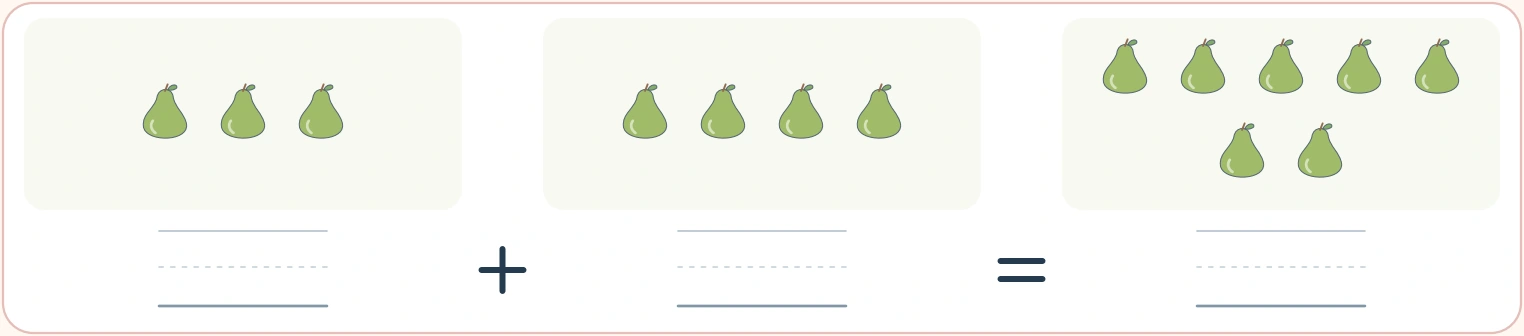
In a classroom Picnic Picture Addition discussion, invite one learner to take the role of describing the first pear panel and another the second. A third explains what the seven pears represent. These Picnic Picture Addition roles invite speaking, not a competition for the quickest answer. Let children change roles for another row.
One Picnic Picture Addition group might disagree between six and seven. Ask each speaker to point to every pear they counted. If someone stops at the first picture line, the lower pictures explain the difference. The teacher can then distinguish a tracking error from confusion about adding, instead of giving the same correction to both.
Five Picnic Picture Addition games with different questions
Use the following invitations after a short paper attempt, or choose one as preparation. They change the child's job while retaining the distinction between the two parts and their whole. Keep the objects large enough for the learners using them.
1. Narrate a Picnic Picture Addition photograph
Arrange one play fruit beside two others and pretend to take a photograph after bringing them together. Ask what the before pictures and the after picture would show. Picnic Picture Addition then becomes a conversation about representations: several pictures can document the same objects at different moments. The actual Picnic Picture Addition worksheet remains unchanged and unanswered until the child is ready to record.
2. Become the Picnic Picture Addition panel guide
An adult deliberately points at the whole and calls it “the second part.” Invite the child to correct the tour using the column headings. A confident guide might explain that the second part appears before the equals sign. Picnic Picture Addition gives the child permission to challenge an adult's description with visible evidence rather than simply agreeing with a grown-up voice.
3. Build a Picnic Picture Addition pear model
Use three large counters for the first pear group and four for the next. Move them into one clear cluster without adding any counters from the supply. Count seven together, then separate the same seven back into three and four. Relate that model to the pear row, saying explicitly that the counters stand for fruit even though they look different.
4. Give Picnic Picture Addition a spoken-only turn
Leave pencils aside for one row. The child says the two quantities and their whole while pointing to the appropriate panels. A partner repeats the explanation in their own words. This turn can show understanding when handwriting is tiring. Afterwards the child may select numeral cards, dictate a record, or choose to write one of the three values independently.
5. Test a Picnic Picture Addition orange claim
Ask whether four oranges and four more should give the same whole as one group of four. Invite a demonstration with eight suitable objects arranged in two groups. Picnic Picture Addition uses the equal-sized orange parts to distinguish “same size groups” from “same total as one group.” Let the child recount rather than requiring a memorized doubles answer.
A Picnic Picture Addition prop scene for later play
The supporting scene below is a separate demonstration using two plates and a readable equation. It does not replace the source worksheet or fill its answer spaces. Describe the physical groups first and the written number sentence afterwards.
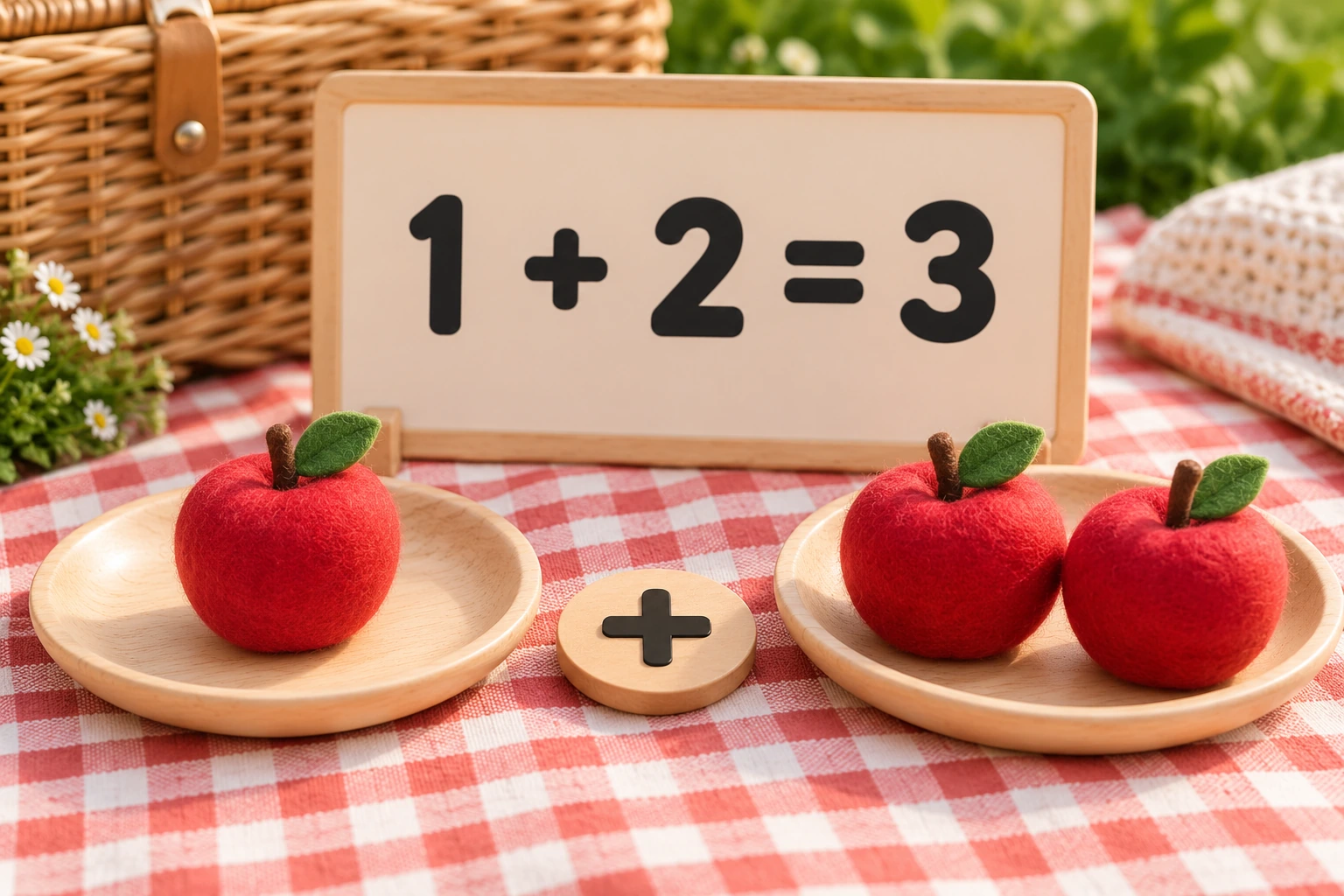
Picnic Picture Addition practice can transfer to preparing napkins or sorting large toy pieces. Keep the question precise: two starting groups are being considered together. Avoid changing fruit names and quantities simultaneously when the learner is still figuring out the meaning of the final panel.
Match Picnic Picture Addition to the learner's readiness
Preschool and kindergarten children around ages four to six may enjoy these tasks with support. Age alone is not the entry requirement. Look for a willingness to count small groups and follow a short pointing demonstration. A Picnic Picture Addition learner who reliably counts to three can begin with apples before attempting seven or eight.
If Picnic Picture Addition writing causes strain, model the chosen numeral on separate paper after the child has stated the amount. Offer a wider practice space first. A reversed numeral can be a handwriting issue even when the child counted correctly. For broader numeral rehearsal, try the three-tracing activity on another day.
Keep Picnic Picture Addition mistakes informative
Watch for a numeral copied under the wrong panel, a leaf counted as another fruit, or a lower picture line overlooked. Ask the child to show the collection their written number describes. That question often reveals the specific difficulty without a long explanation from the adult.
With Picnic Picture Addition, repair one relationship at a time. Recount the affected collection, reconsider its number, then reread the equation. Avoid replacing all twelve entries yourself. A short pause is appropriate if the child becomes upset. “You showed me where the three apples belong” names an observable success without pretending every response was correct.
Return to Picnic Picture Addition with a fresh purpose
Use a brief session today for panel meanings and a later visit for recording. Another visit might invite a spoken explanation to a family member. Picnic Picture Addition stays more interesting when the purpose changes; repeated full-sheet completion can become mechanical. Let the child choose whether to revisit a familiar row or attempt a larger fruit group.
For other experiences, explore a different fruit-addition sheet or the one-to-six dice activity. Adults can find more everyday maths ideas in NAEYC's family maths resources and PBS Parents' age-five maths suggestions. Choose one next experience rather than turning the links into extra assignments.
Download and print Picnic Picture Addition thoughtfully
Select the original sample if that is the version you want to inspect. To obtain the Picnic Picture Addition member file, log into your account, confirm an eligible plan is active, and select its premium control. Picnic Picture Addition provides these as separate PDF files: the retained original may contain website branding, while the member edition has that branding and watermark removed.
Save the PDF locally, open it in a PDF reader and check a single-page print preview. The worksheet uses US Letter proportions; choose an appropriate fit option if your paper size differs, checking that the outer border remains visible. The clean printable contains no ads. Website-page advertisements are separate from the downloaded worksheet. Leave the numeral guides unanswered for the learner's own count, and keep another fresh copy only if a later session would be useful.
Popular Worksheets
Printable resources families and teachers are downloading now.
 Free
 Free
 Free
 Free