
Red Light: Sight Word Stop in 4 Clever Commands
Continue the signal lab lesson with sheet 33 and the other first grade words in the $4 collection.
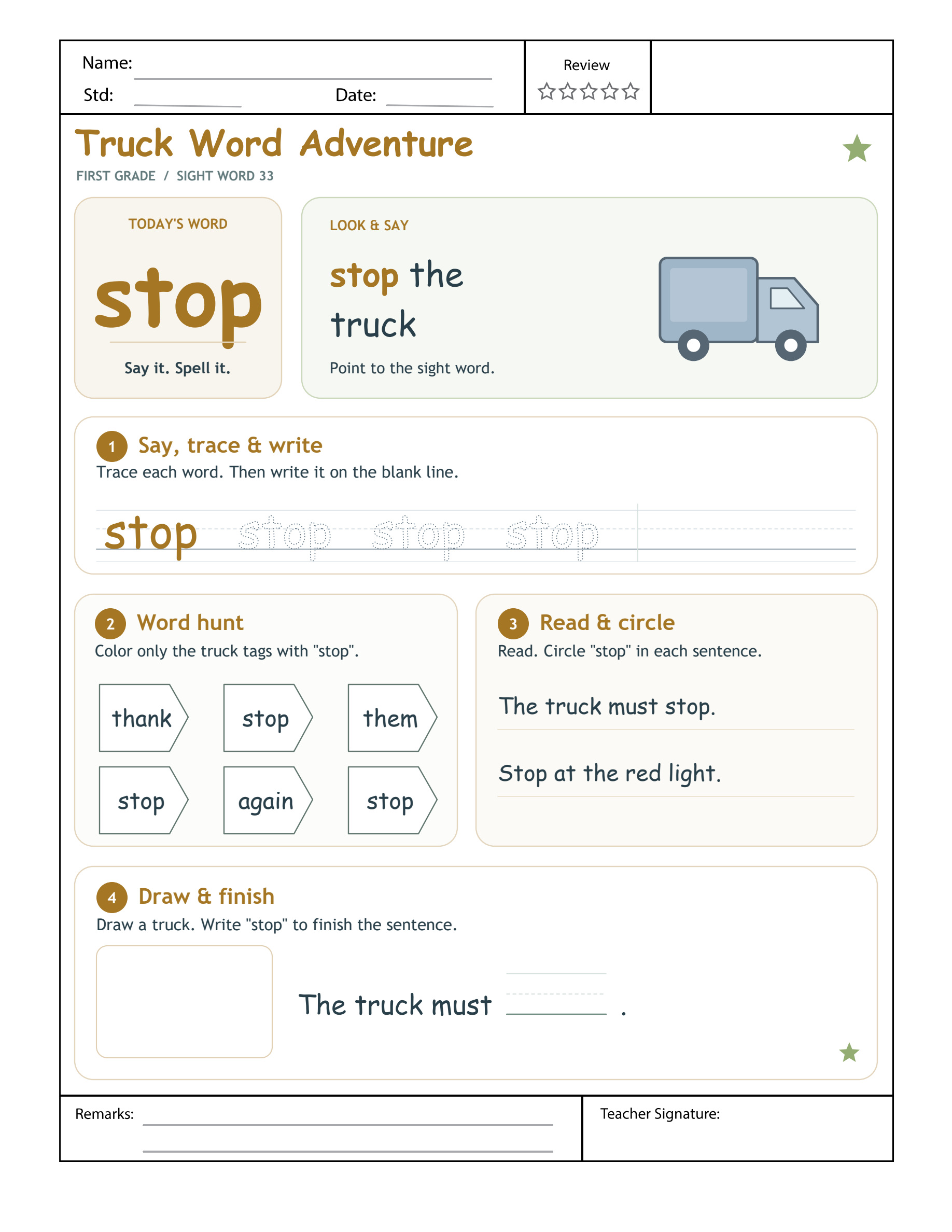
See the opening model and all four stop exercises inside the original frame.
The full 33 preview shows the illustration, handwriting guides, coloring hunt, sentence panel and finish line.
Signal lab
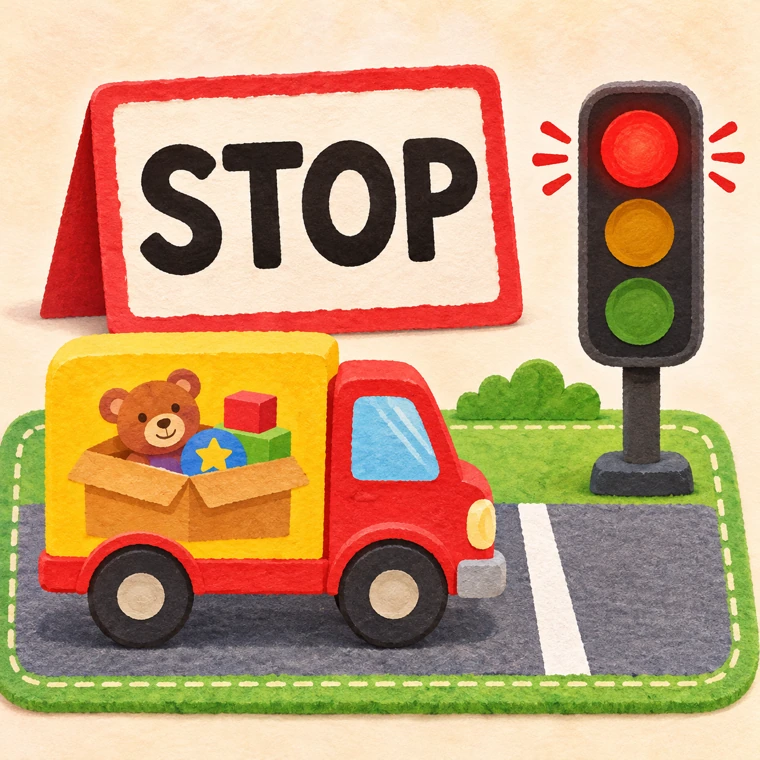
A traffic clue for a toy truck
A toy truck on a tabletop approaches a white line. The driver waits to hear a reader’s direction. A recorder at the next desk has a note describing what the truck must do. Bring out Sight Word Stop after settling that question. Set the picture beside the words and let the listener check the speaker’s message. In the signal lab, choose one short spoken exchange before the first pencil turn. Give the child a way to point, move a paper model, or read a caption back to a partner before asking for an explanation.
Test four signals on a paper road · Sight Word Stop
- Pause the vehicle
Use a simple command as the truck approaches. The student at the road pauses the model.
- Read the red light line
Have a helper point to the signal after the entire direction has been read.
- Offer a driver’s report
Say what the truck must do. Ask the class whether the wording gives an order or reports a requirement.
- Move the marker
Shift the painted line on the play mat and read a new direction with a more specific place.
Give one child a card with a red signal and one a printed instruction. The driver follows only the clue you name before the trial.
When should the driver pause?
| Try it | Read or do |
|---|---|
| Pause the vehicle | Use a simple command as the truck approaches. |
| Read the red light line | Have a helper point to the signal after the entire direction has been read. |
| Offer a driver’s report | Say what the truck must do. |
| Move the marker | Shift the painted line on the play mat and read a new direction with a more specific place. |
Put a small delivery truck by two lines on a tabletop road. Give the reader a note saying where the truck is supposed to stop. The driver checks the marked spot only after hearing the whole line. Move one line on a second turn and see if the driver's job changes. Have the reader restate the action without the original sign in front of them.
Look closely at the signal lab picture
Begin with s and t together without a vowel between them, then say o and close with p. A child can tap the stops in the spelling with four fingers while saying the continuous word. Notice the final letter when comparing the truck labels, then revisit the tall t in handwriting.
Pair the printed lines with a listener’s job · stop
The truck must stop.
Stop at the red light.
Stop means cease moving in these truck sentences. At the beginning of a line it can give a direct instruction. After must it names the required action. Give one learner the command and another the report. Keep the play on a table or floor mat, where everyone can look at the printed word without moving toward a real road.
Start by having a listener tell which line would help them act out part of the scene. A partner reads the other line and asks a different question about the message. When the words are clear, find the target and circle it. Give the reader one more turn to say the full line with stop included.
Two more turns from the signal lab
Make two pretend truck maps. In one, park a vehicle at a stop line; in the other, hold a vehicle a little before the line. Ask a child to read the instruction to each driver and say when the driver would carry it out. Clear the models and see if a partner can tell which word in the printed sentence signals the change from rolling to being still.
Make a pretend truck instruction the driver can follow
Give the next reader a fresh problem · signal lab
Make two pretend truck maps. In one, park a vehicle at a stop line; in the other, hold a vehicle a little before the line. Ask a child to read the instruction to each driver and say when the driver would carry it out. Clear the models and see if a partner can tell which word in the printed sentence signals the change from rolling to being still.
A print check before the crayon comes out · stop
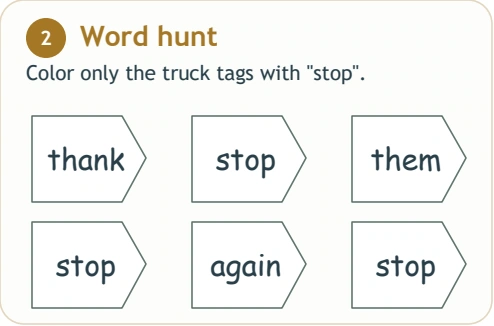
The printable offers these six choices: thank, stop, them, stop, again, stop. Have the reader read a candidate under their breath and then compare it with the big spelling. Keep a finger on the spot until the reader can explain the decision. The choices thank and again give the group two things to check before committing to a color.
Wait for three matches. If a child colors any good-looking shape without reading the word, give them a separate page for decoration and use a pointing turn here. Ask a new reader to verify one of the chosen stop labels afterward. The crayon should leave the word readable.
Give the driver two different distances to check
Draw a stop marker close to the toy truck and a second one near a loading dock. A reader gives a complete direction with stop and a place phrase. Move the truck only after hearing the whole line. On a repeat, ask a reporter to write what the driver must do on a card for a new reader.
Move the target marker to a different part of the tabletop. Have the writer check whether the old note still takes the truck to the intended spot. A partner can compare the color of a visual signal with the wording of the command. Invite a child to read the line with a voice a toy driver could hear clearly.
A handwriting sample worth keeping · stop
Blend the s and t closely at the beginning. When writing, remember that p reaches below the line in the form shown.
Find the heavy print of stop at the start of the guide. Read it once before putting a pencil down. Use a card under the guide if the other examples draw the eye away from the first copy. Let the learner give one copy all of their attention. Then ask what they would like a later reader to see more easily.
On a fresh slip, ask for one independent stop. Compare the direction, height and spacing of that attempt against the model. Bring the slip to a new reader afterward, since a good check is whether someone can read it without help from the writer.

Take the signal lab to a home or classroom table
At home. Build a miniature road on paper. Have a child read a direction for a toy vehicle. Move it only along the drawn lane and let a reader show where the truck should pause.
With classmates. Put a stop line on a play mat. One learner reads the command and a partner reports what the truck must do. The third learner listens for the same word serving both turns before reading the labels on the source.
Have one observer write a report of what the truck must do and one reader say a command directly to the driver. A child can point to which sentence tells the driver what to do now. They can reread the source light sentence once the play vehicles are put away.
Use the last line as a message to a new reader · stop
Draw a truck. Write "stop" to finish the sentence. The printed frame is The truck must ___ .. Give the illustrator a moment to pick one essential part of the picture. Have a partner say the finished line from start to finish before the child adds the missing spelling in pencil.
Bring the picture to a new reader and give them time to read the line unaided. Ask which marks in the signal lab scene support the sentence and which information is supplied by stop. Let the illustrator clarify the caption by reading it aloud.
What to listen for during stop practice
- Read the whole word. Ask the reader to distinguish stop from one nearby label without relying on the outline of its picture.
- Check a sound. Listen to stop in the spoken example. Pick one part to read slowly, then practice saying it with the other words at ordinary speed.
- Guide a movement. Help the child steady the worksheet, make a careful copy of stop, and look for a specific shape they can identify again later.
- Explain the message. Let a partner explain why the signal lab scene makes sense after hearing one printed line. Give the first reader a chance to adjust their interpretation.
- Give the reader a choice. Invite them to return tomorrow with an object, sketch, or message of their own that uses stop.
Suggested for first graders around six or seven. A child who can already use stop in conversation may want to read a sentence before tracing. Another child may want to point at the signal lab picture or try the word with an adult first. End a short visit after one clear read or copy. Let the learner choose what they want to show a family member or classroom partner the next time they see the page.
Print the original sheet 33 for another reading
Download the free worksheet for stop. Eligible members can get the clean PDF without site markings. In the printer dialog, check portrait US Letter and look at one copy for the readability of the pale guides.
The $4 collection has this page at position 13 in the combined file. Look for the matching printed number to select a single page for a later visit.
Choose another reading turn if time permits, or blend the short vowel in AT words. To compare a different sound or spelling, read and match the word eat or try a family of words with AP.
Teachers and families can browse the UF Literacy Institute’s word activities and the Reading Rockets guide for frequently used words.
Related Topics
Popular Worksheets
Printable resources families and teachers are downloading now.
 Free
 Free
 Free
 Free