
Our Sight Word: 5 Joyful Star-Team Discoveries
Explore our here, then choose the complete now-to-please Word Maps collection: 26 clean printable sheets together for $5.
The whole our map remains uncropped.
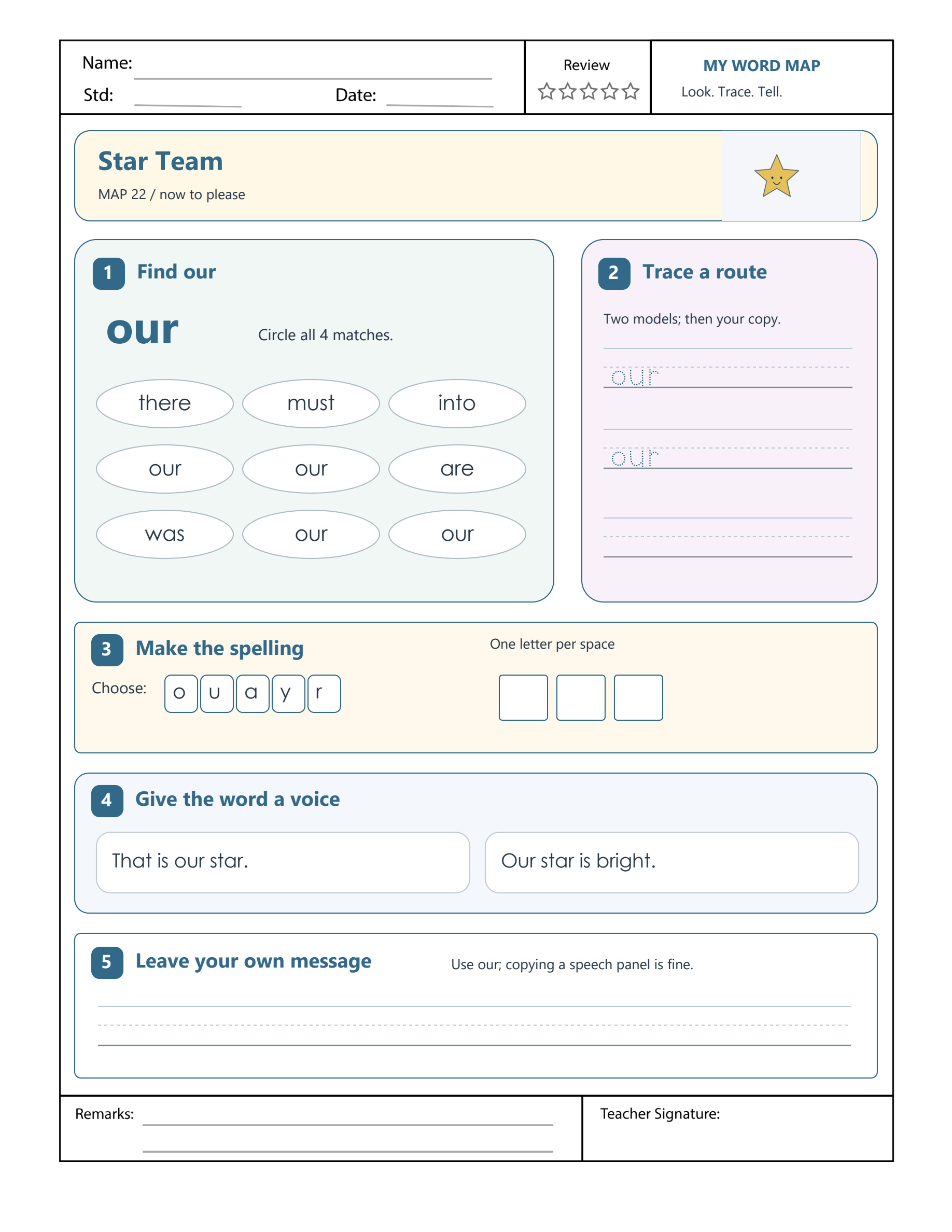
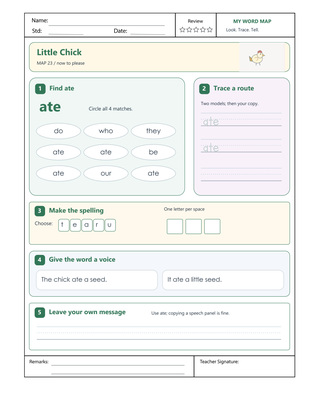
Star Team combines its our search hub, tracing side route, spelling rail, speech panels and message strip.
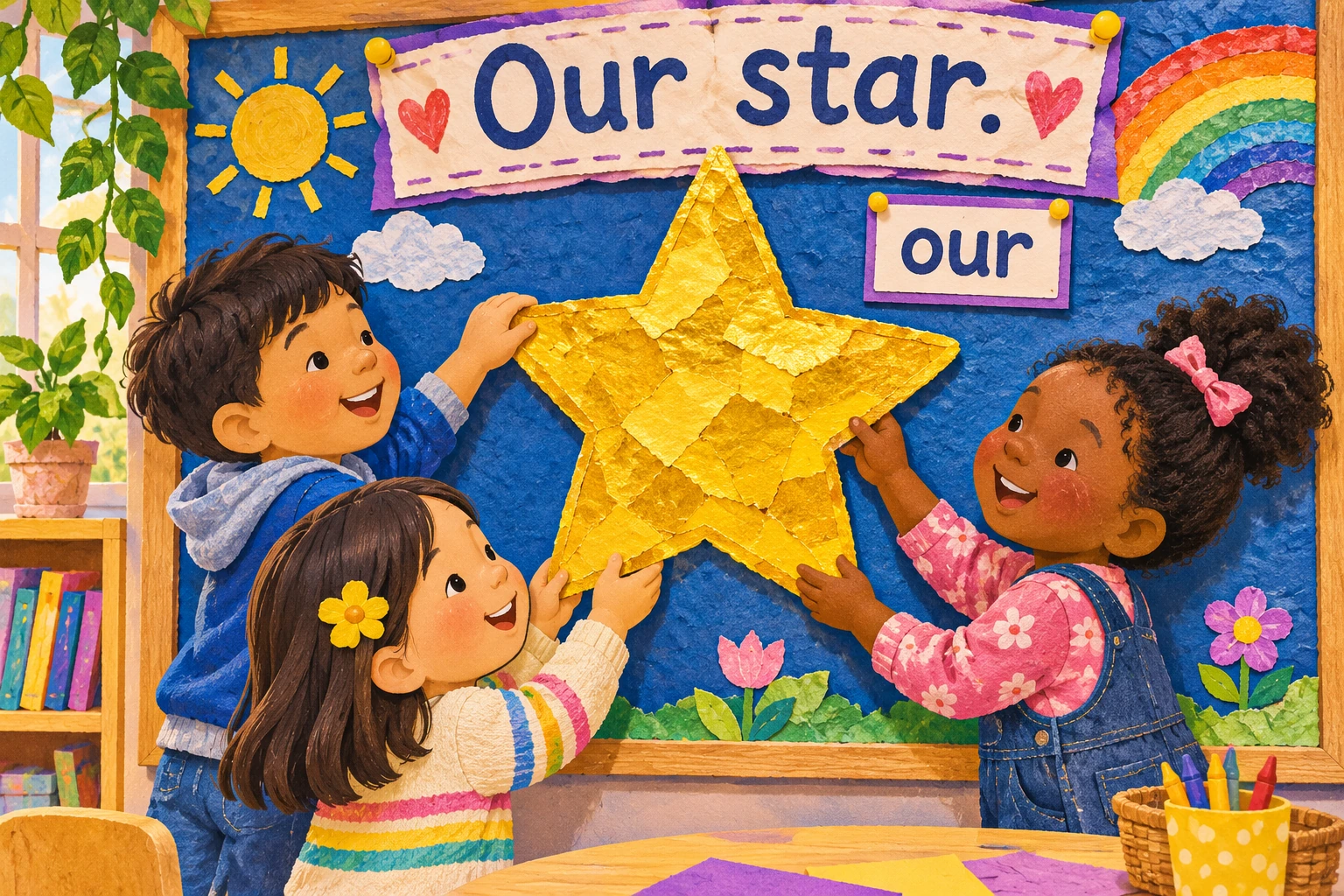
Xavi and two friends have made one paper star together, so a shared description fits their creation. Our connects the star with the speaking group rather than with just one child. The Our Sight Word worksheet brings that relationship into two messages, a three-letter spelling and supported handwriting. Its clean word map keeps all source activities inside the established frame while changing the interior arrangement. Begin by naming who belongs to the group, then use the printed target to support a clear shared reference without turning the star into a reward or a contest.
Establish the group before using our
The first source message identifies the group's star. The second describes its brightness. Ask Xavi who is included in the speaker's our, and make that group visible through named characters or participants. A single object can belong to or be associated with several people; the quantity of stars does not need to match the number of speakers.
Our and are can sound similar in some accents, but they do different work in a sentence and have different spellings. The search includes are as a contrast. Read each word naturally in context rather than claiming that every learner must hear an identical pronunciation distinction. Inspect o-u-r as the written target.
Capital Our begins the second printed sentence, while lowercase our appears inside the first. Connect those forms with the isolated model and bank. The capital marks a sentence opening; it does not change the shared-reference meaning or add a written position.
A home project with a genuine shared reference
Make one paper star with a child and a willing partner, or assign the project to two named puppets. Xavi explains who worked on it before the adult reads the identification message. Let each participant have a contribution to describe. The object need not be perfect or awarded to anyone for the target to have meaning.
Locate our in a speech panel and build o-u-r with movable pieces. Xavi can dictate a shared-drawing caption for an adult scribe, then decide whether an our trace or search explanation would help. Keep the group reference clear instead of requiring a polished written sentence before the learner can claim participation.
Six observations around one shared star
- Group reference: Xavi identifies the people included in the speaker's our.
- Shared association: one object can be described in relation to several participants.
- Sentence context: our is distinguished from a similar-sounding word by its meaning and spelling.
- Case awareness: capital Our is connected with the lowercase target.
- Ordered letters: o-u-r is selected from a bank containing spare options.
- Expression: a shared project can be described orally before a supported written message is attempted.
Our Sight Word inspection on the star team map
The star team search contains nine ovals. Begin at our's large model, then compare each our choice. For our, number the top row 1–3; continue the star team middle row 4–6, then the our bottom row 7–9. Review these star team notes after Xavi's own our attempt; reveal answers when that our comparison needs support.
| Our cell | Choice | Our check |
|---|---|---|
| 1 | there | Xavi: reject there when searching for our. there has t at position 1; our needs o there. Compare o-u-r before ruling out there on this star team map. |
| 2 | must | Xavi: reject must when searching for our. must has m at position 1; our needs o there. Compare o-u-r before ruling out must on this star team map. |
| 3 | into | Xavi: reject into when searching for our. into has i at position 1; our needs o there. Compare o-u-r before ruling out into on this star team map. |
| 4 | our | Our is complete at cell 4: o-u-r. Xavi can compare its final r with our's ending before making this star team circle. |
| 5 | our | Cell 5 holds another exact our. Let Xavi inspect our's neighbours too; one successful our find does not decide adjacent star team choices. |
Finish checking the star team choices
| Our cell | Choice | Our check |
|---|---|---|
| 6 | are | Xavi: reject are when searching for our. are has a at position 1; our needs o there. Compare o-u-r before ruling out are on this star team map. |
| 7 | was | Xavi: reject was when searching for our. was has w at position 1; our needs o there. Compare o-u-r before ruling out was on this star team map. |
| 8 | our | This o-u-r matches our. Ask Xavi to show each our position before circling the entry on the star team map. |
| 9 | our | The fourth matching our occupies cell 9. Its o-u-r agrees with the model; Xavi can point to every our position before including it. |
Four ovals match our. If Xavi circles a different quantity, revisit the star team choices. Compare each selection against o-u-r before adding a our circle. Ask Xavi to explain a selected our and a rejected star team candidate. Listen to Xavi's comparison as well as counting our marks.
The our speech windows
Read the first star team message: “That is our star.” Its our companion says “Our star is bright.” Share the star team meaning before asking Xavi to locate our in print. An adult may supply other star team vocabulary, leaving Xavi to inspect the our positions. If Xavi guesses our from the picture, cover that star team illustration briefly and point back to o-u-r.

A pencil route for the star team word
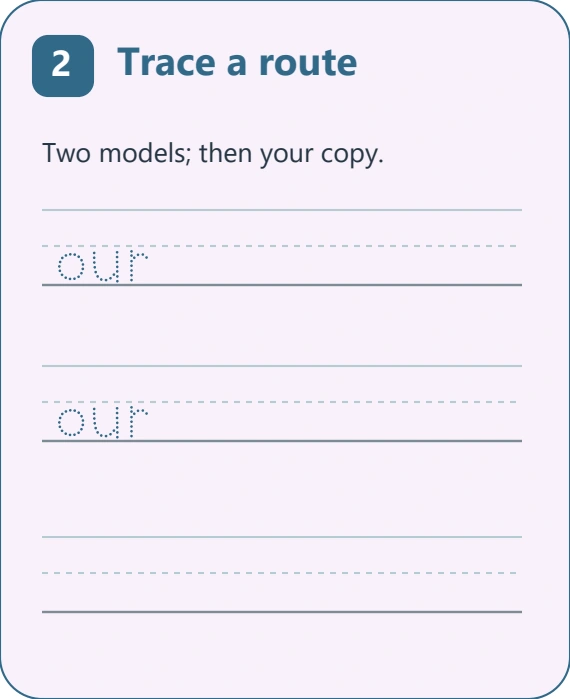
Two dotted our examples sit on separate star team guides. Follow o-u-r once while Xavi watches a useful demonstration. The third our band is for an untraced star team attempt. Choose a quantity of our practice that fits Xavi's hand control, rather than asking Xavi to fill the entire star team sidebar.
Understanding the star team message and writing our are different questions. Xavi may explain our correctly while its our letters still need motor support. Dictating our can preserve a star team idea when independent our writing is tiring. Keep our's model visible for Xavi; offer formation help on our separately instead of turning star team sentence practice into repeated correction.
Assemble o-u-r on the spelling rail
The our bank presents o, u, a, y, r. Make 3 positions for o-u-r; leave a and y unused. Xavi selects the our sequence rather than transcribing the star team display order. Movable our pieces can reduce Xavi's pencil load during this star team spelling decision.
Point from our's large model to each o-u-r position. If Xavi misplaces a our letter, move that piece while the star team materials remain adjustable. Name o-u-r for the written sequence; read our naturally within its star team message. Check Xavi's completed construction, then offer a our pencil copy.

A star team message using our
The our finish accepts a copied star team example or a new our sentence. Let Xavi speak the star team message before writing our. Check how the listener understands Xavi's idea. Supply unfamiliar spellings around our if Xavi needs them. Preserve this star team thought while helping Xavi with print. Provide Xavi with spelling help that preserves our.
A classroom creation that belongs to the named team
A teacher can invite a small group to decorate one large paper star and decide how to describe it. Name the participants included in our before reading the source message. Another learner can point to the target while a partner explains the shared reference. Rotate roles and allow a child to contribute through choosing, pointing or speaking.
If Xavi uses our for an unrelated person's object, clarify the group and ownership or association in the story. If the reference is clear but are is circled, compare the written sequences. A language relationship and a visual spelling decision can need different help. Neither should be turned into a public ranking of who contributed most to the project.
Five shared-reference conversations
1. Name the makers in a completed caption
Xavi dictates an our message about the group creation and identifies its participants. An adult records the sentence and reads it to another listener. The caption should make the reference understandable without suggesting that every object nearby belongs to the same group.
2. Change the speaking group
Use two pairs of named puppets with separate paper projects. Each pair describes its own creation using our. The printed word remains stable while the group reference changes, helping the learner listen to who is speaking rather than memorise one fixed set of names.
3. Compare the similar-sounding spellings
Place our beside are and read each in a suitable spoken sentence. Respect the learner's accent while inspecting the different letter sequences. The target's meaning and o-u-r spelling provide evidence even when pronunciation alone is not a reliable distinction.
4. Move from a star to a shared drawing
Keep the group the same but choose another jointly made object. Xavi explains what changes and what remains true of the our reference. This prevents the target from becoming a special label that belongs only to a gold star picture.
5. Let a listener ask who is included
A puppet hears an our caption and asks which people the speaker means. The child names or points to the participants before rereading the target. A clarification question gives the shared word a genuine communication purpose without demanding additional handwriting.
Keep belonging clear and participation inclusive
Xavi and peers aged roughly four to six may recognise a joint project while still needing help with an abstract possessive word. Make the people and object visible, then connect the relationship with print. A learner who can explain the reference may need a separate demonstration of r formation, while neat our copying does not establish whether Xavi knows the speaking group.
Avoid using the star as a prize for compliance, assuming a fixed pronunciation contrast with are or letting one confident child define the group's ownership for everyone. Revisit with another jointly made picture later. Notice a specific explanation or letter-order decision and preserve room for the actual collaborative activity.
Explore another kind of group word
The they group-reference page offers a related comparison. Earlier reading appears in the pre-primer beginning-word pack, and the prewriting concept lessons can support pencil movement separately. For other shared projects, see NAEYC's cooperative family-play ideas and PBS Parents' activities for learning together.
Download a map for the star team
Star Team retains a free source worksheet. A qualifying active membership also gives access to the redesigned our file through the account controls. The clean printable removes the site's branding, domain wording and advertisement area. To obtain the full now–please sequence together, select the $5 collection presented in the related card.
Inspect one US Letter test for the whole frame, capital Our in the second message and the lowercase dotted o-u-r. Keep the intended PDF available for another shared-reference conversation, choosing a small useful section rather than making every participant complete an identical amount of writing.
Related Topics
Popular Worksheets
Printable resources families and teachers are downloading now.
 Free
 Free
 Free
 Free