
All Sight Word: 6 Clever Complete-Collection Discoveries
Continue beyond all with twenty-six clean reading-first practice sheets in one $5 printable collection.
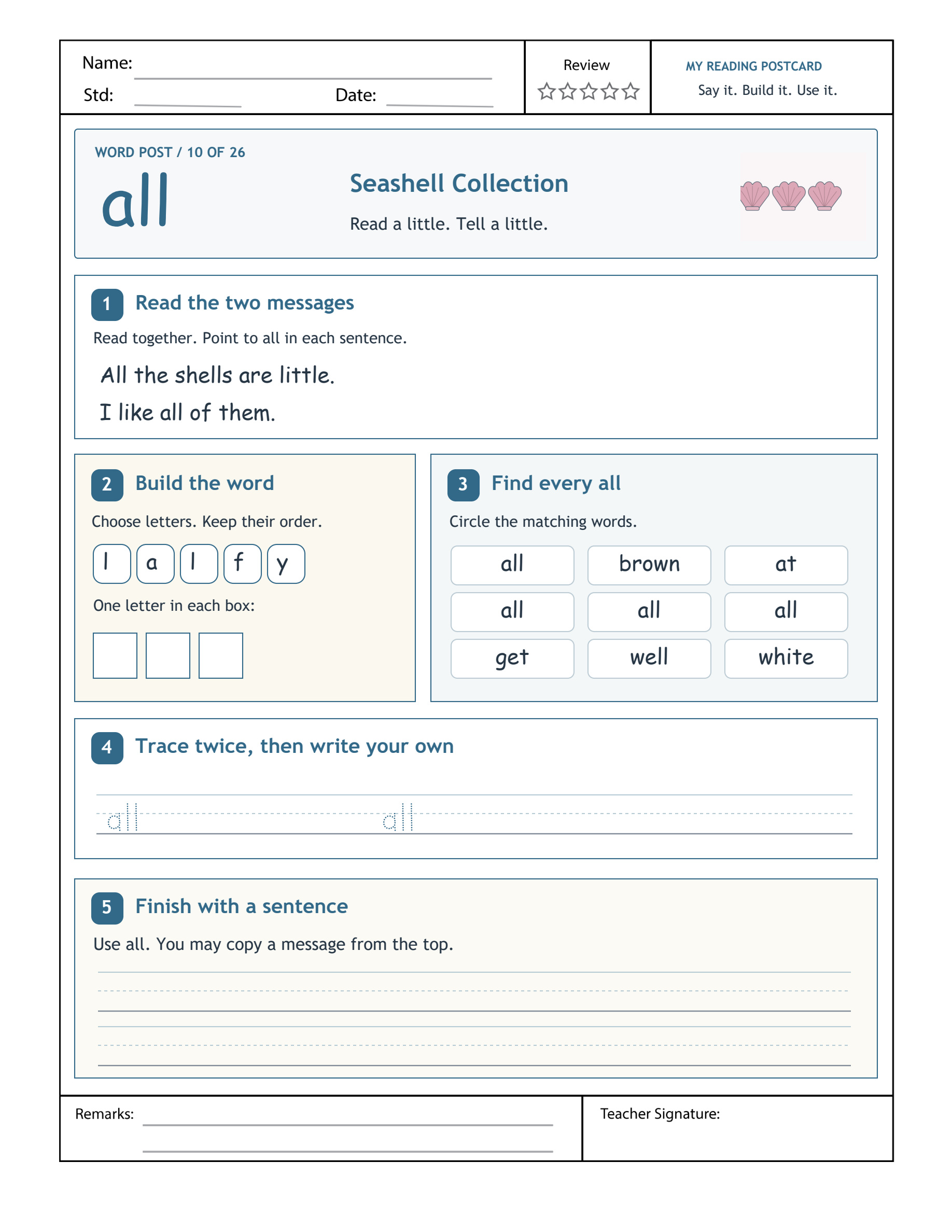
The full all sheet retains its US Letter frame.
Refer to every shell in one defined collection. The complete redesigned page appears without cropping.
Three shells form a small collection, and Zuri wants to include every one. The word all makes that intention clear without naming each shell separately. All Sight Word practice connects a complete group with two short reading messages, a repeated-letter spelling, matching choices and pencil work. Adults can introduce a defined set before the child opens the page, then return to its printed word after a simple demonstration. The shell statements open the clean page; its sample still offers the supplied tracing-first route. A short, thoughtful visit is enough to get started.
Define the collection before saying all
Place three paper shells inside a tray or a drawn boundary. Establish that these are the shells being discussed, then say that all of them belong to the collection. Touch each shell as you speak. The useful idea is inclusion of every member of this defined set, rather than a particular number that all always means.
You could use two shells or five in a later demonstration and still use all when every member is included. The supporting illustration shows three shells with a matching count label, but the target is a word about completeness, not another name for three. Keep that distinction visible during conversation.
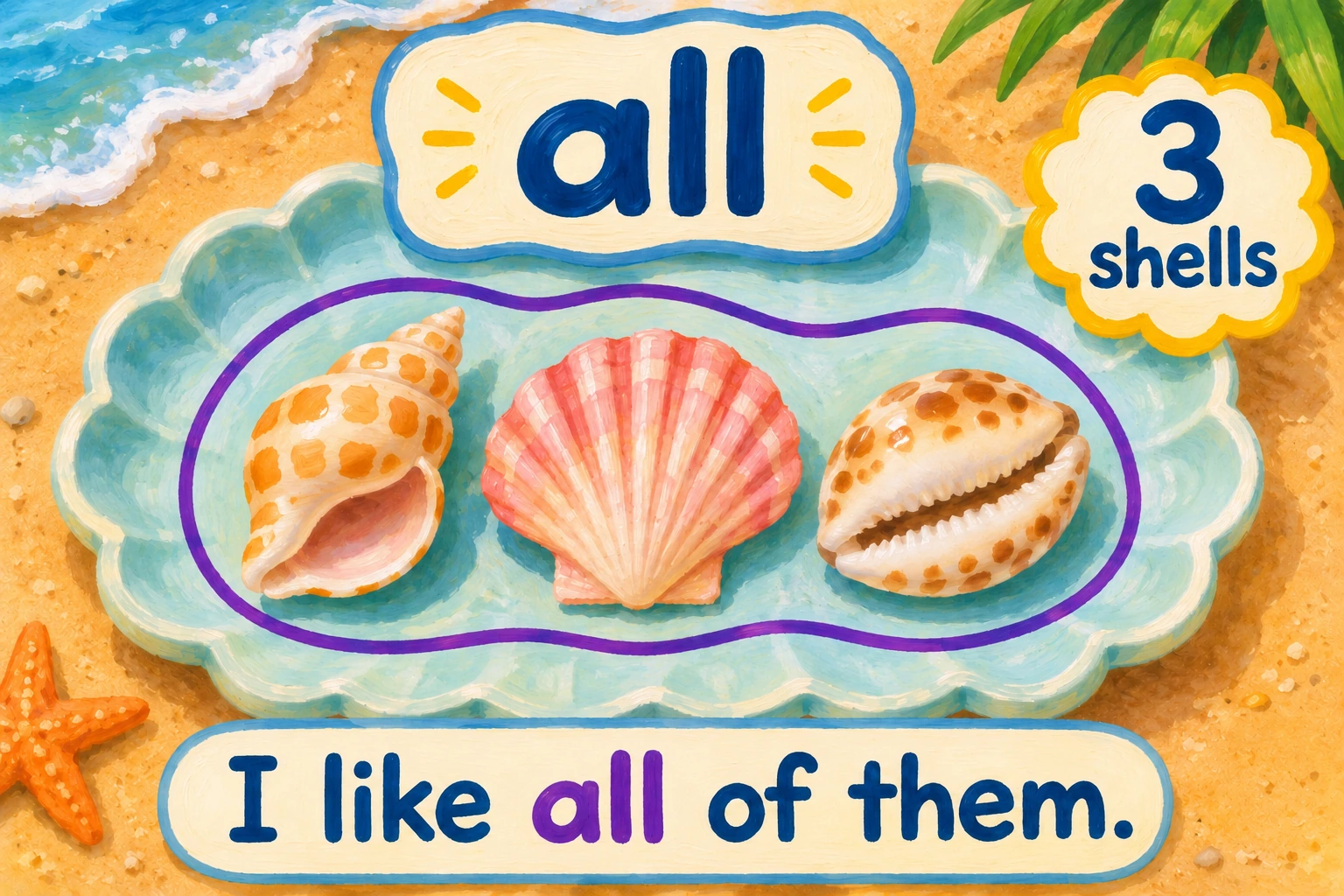
If you ask the child to place a counter beside all three shells, check that none is missed. Leaving one without a counter gives a reason to reconsider the instruction. Do not silently change the group boundary halfway through; the learner needs to know which objects the speaker means.
Read what the shell statements actually say
The source messages are “All the shells are little.” and “I like all of them.” The first describes every shell in the group. The second expresses a speaker's preference for the entire defined collection. Read both completely, then invite the child to identify all in each line.

Explain what them refers to in the preference statement. It concerns the shells just introduced, not an unlimited collection of every shell anywhere. A child may prefer only some shells personally; that does not prevent understanding what the printed speaker says. Distinguish the example character's preference from a required answer about the learner's own feelings.
Capital All opens the first message, while lowercase all appears in the second and in the word model. Compare A with a so that the case change does not obscure a familiar spelling. Adult help with shells, little or them is appropriate while attention stays on the target's use.
All Sight Word building needs both l letters
The five-letter bank contains l, a, l, f and y. Select a-l-l for the three boxes. Both printed l copies are needed; they are separate positions in the word even though they share a letter name. The spare f and y remain unused.
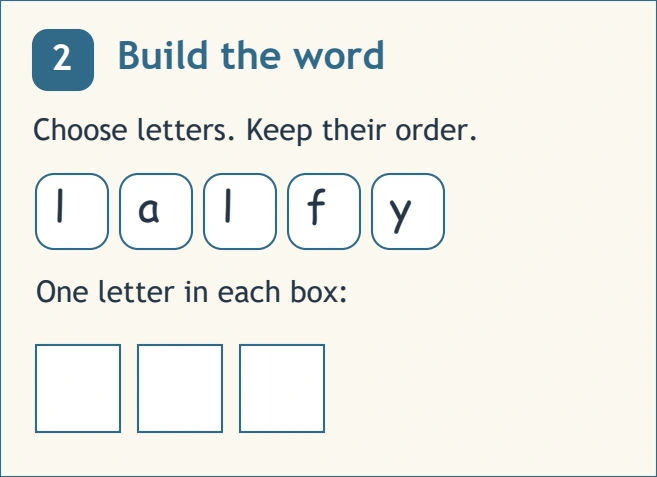
A learner who chooses a and one l may have found the different letter names but not the complete written sequence. Point along all three positions in the large model and move a second l piece into the final place. This makes the repeated-letter requirement concrete before the pencil is asked to reproduce it.
Say all naturally in your usual speech. Its vowel pronunciation should follow the spoken word rather than an invented rule that every a sounds the same. Letter names can support the spelling sequence while a complete spoken example keeps the reading meaningful.
Inspect the nine-cell collection of choices
The search rows contain all, brown, at; all, all, all; get, well, white. Four cells match the complete target. Adult all key: 1, 4, 5, 6. Adults can use that pattern to check an attempt after the learner has compared the spellings.
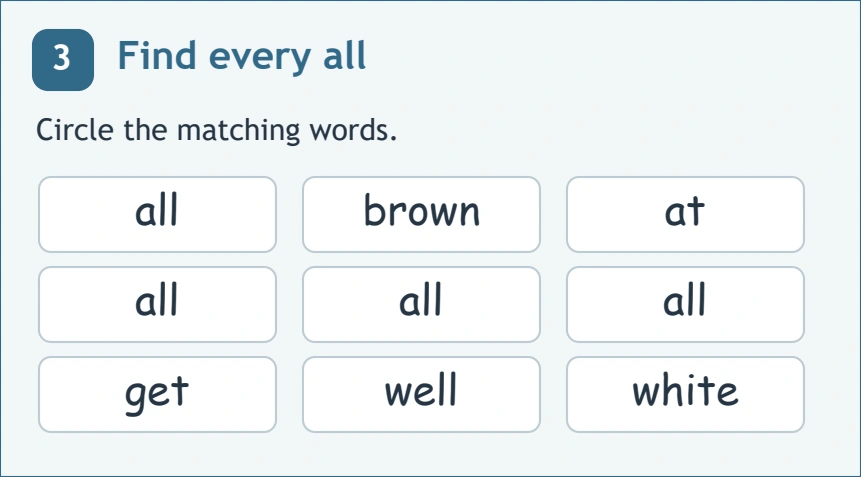
Well ends with two l letters but does not begin with a. At begins with a but has a different ending and only two written positions. These distractors make a whole-word check useful. Ask the reader to compare the beginning and the two final letters rather than relying on one familiar feature.
The middle row contains three matches. A child who expects only one answer per row may overlook two of them. Let each cell receive a separate decision. Counting four circles afterwards can confirm the amount, but it does not replace checking whether the circled spellings are correct.
Handwriting carries a complete spelling
Trace all without merging the two l marks, then preserve both positions in an independent version. The two l forms should remain separate written letters. Show their positions in the model before tracing so that the learner does not merge the ending into one long mark.

The sentence finish asks for all in a complete message and permits copying a printed example. A new idea can be spoken first: perhaps all the toy animals are resting. Establish the group being described and let an adult supply unfamiliar spellings if needed.
The clean shell lesson starts with messages about a complete collection. Its spelling bank and search occupy the middle, then the dotted all models lead towards a sentence. The source sample begins with tracing. All five activities remain on the established US Letter page, with its outer frame retained.
Six opportunities in an every-shell lesson
- A defined set: the learner knows which shells belong to the current discussion.
- Complete inclusion: an instruction involving all is checked for any missed member.
- Number flexibility: the same word can concern a different-sized group on another occasion.
- Repeated spelling positions: both l pieces are retained in a-l-l.
- Visual discrimination: the ending of well is considered alongside its different beginning.
- Clear written reference: a sentence about all supplies enough context for its reader to identify the group.
Keep a note about any missed shell in the group action and another about the final l in a-l-l. Completeness in meaning and completeness in spelling are related observations, not one score.
Zuri's possible home collection game
A family might put three paper shells on a tray and ask Zuri to give a toy visitor all of them. The adult watches whether every shell moves, then talks through any object left behind. The group stays clearly defined throughout the turn, and no real beach collection is necessary.
After the game, they read the two shell statements and locate all. Zuri chooses a and two l letters, then inspects the top search row. The adult can accept one careful written copy before returning to conversation. The visit need not become a demand to finish every task immediately.
For a final message, Zuri describes all the toys in a different small collection. The listener first sees which toys are meant. This possible activity sequence gives the word a practical purpose without claiming a recorded change in any child's reading ability.
Classroom possibility: make sure no object is missed
A teacher sets out a defined group of counters and gives a simple instruction involving all of them. One learner carries out the action while a partner checks whether each counter has been included. Change the group size on the next turn to show that the meaning is not tied to a fixed count.
Return to the shell worksheet and ask what collection the first sentence describes. The teacher can read the surrounding words while a learner points under All. Another child may explain the reference of them in the second message. These responses provide different ways to participate.
The bank and search then offer quiet individual work. A child who omits the second l needs a spelling-position check, while one who leaves a shell out of the group action needs a completeness demonstration. Choose an inclusion demonstration for the missed shell and a spelling-position check for the omitted l.
Match the adjustment to the response
| What you notice | A shell-lesson adjustment | What to hear or see next |
|---|---|---|
| Uses all as another word for three | Introduce a new defined group with two objects. | Every member included despite the changed count. |
| Builds only a-l | Count the three written positions in the model. | A second l in the final box. |
| Circles well after noticing ll | Compare its beginning with the target's a. | A full-spelling decision. |
| Cannot explain them | Point back to the established shell collection. | A clear reference for the preference message. |
Five invitations for complete-group talk
1. Ask a puppet to move all the objects from a small tray, then inspect the tray together. A deliberately overlooked item creates a reason to clarify the instruction.
2. Draw two different-sized collections and prepare a completed all caption for each. Discuss why the same word can fit both groups.
3. Make a-l-l with movable letters and let the learner explain why the second l is necessary. Keep the full model visible for checking.
4. Dictate a sentence about all the characters in a familiar picture. Introduce the pictured group before reading the caption to another person.
5. Compare a scene where every toy has a hat with one where a toy has none. Choose which scene fits a specific completed all statement and explain the decision.
Confidence, readiness and another look
With children near 4–6, choose a collection they can discuss comfortably and adjust a-l-l copying to the actual movement demands of their pencil work. Understanding complete inclusion may be easier than writing both l letters neatly. A confident tracer may still need help defining the group being discussed.
Avoid changing the set without telling the child, treating a personal preference as compulsory or teaching all as a number word. Keep the collection visible and the message clear. Praise an observed contribution, such as checking the overlooked shell or retaining the final l, rather than simply announcing that the page looks perfect.
Later review can happen during tidying or pretend play. Give a brief instruction concerning a defined group, then show all in a completed sentence. The starter collection for short-word reading provides other language visits. The beginning pencil discovery collection can support the motor side of the work. For a separate action focus, consider the eat worksheet for early readers.
Family activity prompts at PBS Parents and the play materials from NAEYC for families can suggest new everyday settings for complete-group conversation.
Download the shell page or the full primer file
The shell sample is available free in its supplied arrangement. Eligible members can download the separate clean PDF through the premium option. Its five source tasks begin with reading, and website domain text, watermarking and advertising are absent. Use that clean version when preparing a practice page to sit beside the clearly defined shell collection.
Test the shell worksheet on US Letter paper with its whole frame visible. Inspect the two separate l positions in each dotted model. Loose a-l-l pieces are optional additions to the pencil. The $5 collection linked here combines twenty-six clean primer lessons in one file, so the next group or sentence activity can be chosen without splitting the set across downloads.
Popular Worksheets
Printable resources families and teachers are downloading now.
 Free
 Free
 Free
 Free