
Little Word Study: 5 Brilliant Ladybug-Reading Games
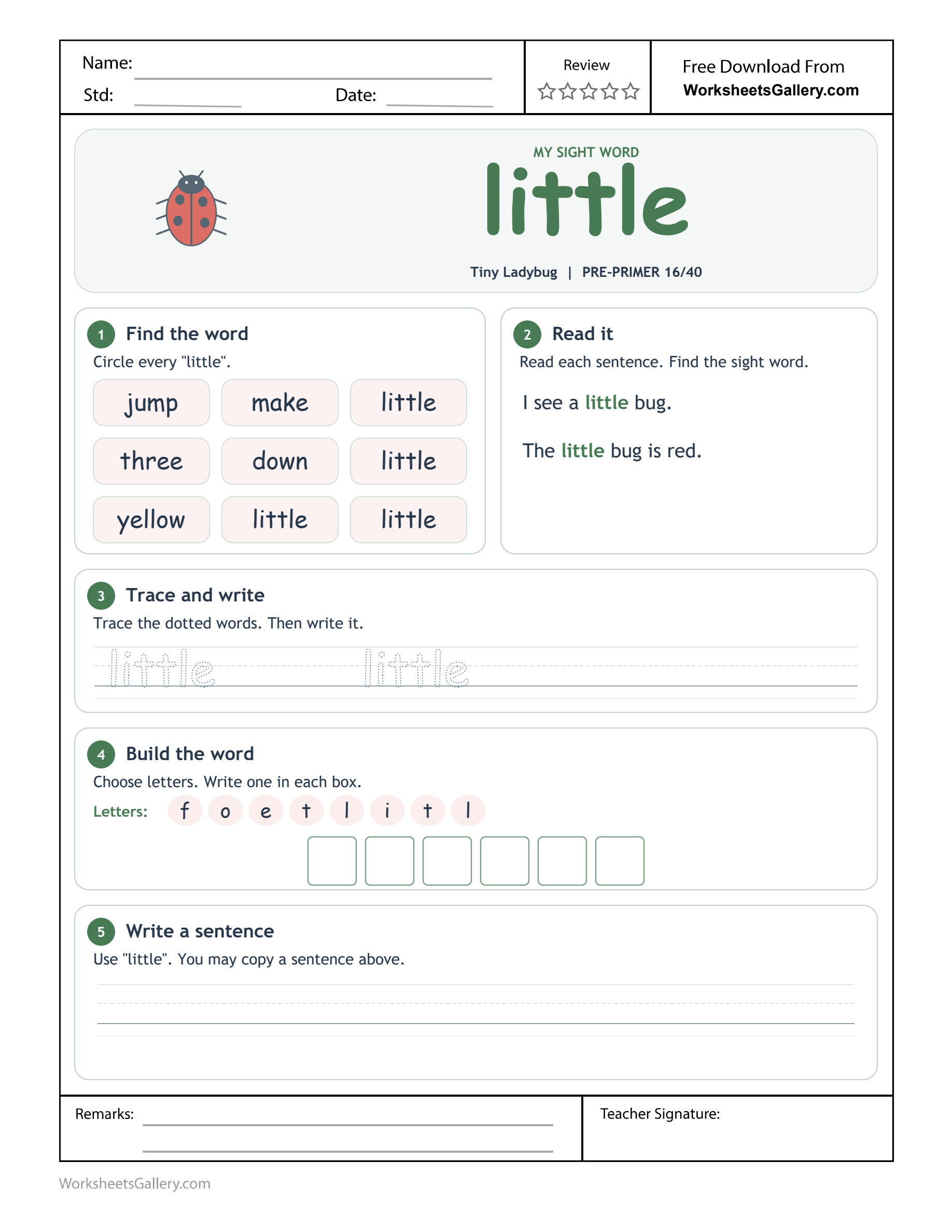
The six-letter ladybug target has shorter companions. ‘little’ is one of twenty word activities gathered into the clean collection. A $5 purchase provides the source-ordered pages together in a single printable PDF.
A small ladybug introduces a spelling with several details worth slowing down for. Little Word Study follows l-i-t-t-l-e on the Tiny Ladybug worksheet, connecting its descriptive meaning with a complete six-letter sequence. The source offers a search, two dotted examples, a mixed letter bank, reading lines and sentence writing. An adult can model the spoken word and support unfamiliar print while the learner notices both repeated letter types. The picture begins a conversation about the bug; accurate attention to the written target keeps that conversation from becoming a word-length guess or a hurried copying task.
Little Word Study gives six written positions a clear order
Follow the target from left to right: l, i, t, t, l, e. There are two l letters and two t letters, and the t pair is adjacent. A child can inspect these positions against the large model rather than try to recall the entire sequence after a brief glance.
Little Word Study keeps letter counting separate from pronunciation. Six letters do not mean six individually spoken sounds. An adult can model the whole word naturally, connect the parts with the learner's reading instruction and give direct help where the spelling is unfamiliar.
For Little Word Study, broad letter pieces can make repeated characters easier to track. Both copies of each repeated letter are needed. Choosing one l and one t because those letter names have already been mentioned would leave the written sequence incomplete.
Little Word Study connects the spelling with a description

The source model sits beside a ladybug under the Tiny Ladybug theme. Discuss what little contributes to a phrase about the bug. It describes size in this context; it is not the insect's name. The adult can explain that distinction through a simple spoken example.
Little Word Study need not demand a measurement or a live insect. A drawing supplies enough context for a supported sentence. Keep the learner's meaning response separate from the print check, returning to the written letters before interpreting a choice as reading.
Rohan's bug caption makes Little Word Study personal
Rohan draws a bug and dictates a short description to his aunt. She records his description in broad print and offers a supported reread before inviting him to locate the target. Together they compare the repeated t letters and the later l with the source model.
Their Little Word Study exchange can include a second bug drawing with a different size. Rohan chooses which description suits his intended picture. His aunt supplies the remaining spellings and keeps the six-letter target available rather than expecting independent reading of the complete caption.
Little Word Study can end with one clear comparison. Saving the caption gives Rohan a reason to return later, while the adult has evidence about both his descriptive language and his attention to spelling. Neither observation needs a full page of writing to become useful.
Little Word Study reads what size and color each contribute
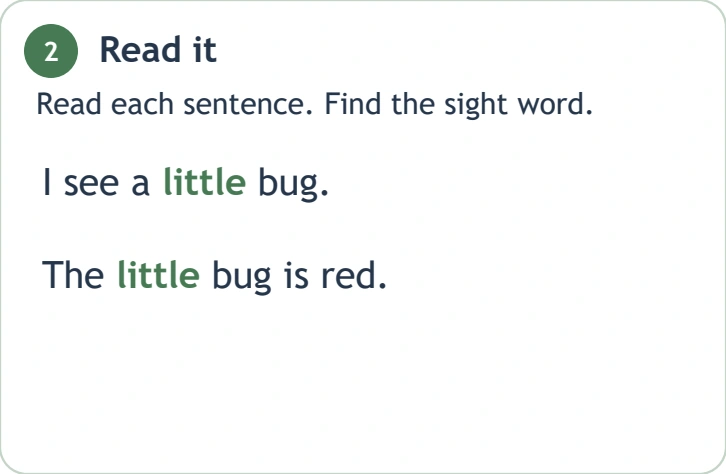
The first source line says “I see a little bug.” The second identifies that bug as red. Read both with suitable help and locate little before bug each time. Discuss how the second message adds color information without replacing the size description.
Little Word Study can ask the learner to indicate what the target tells the listener. A gesture or a short explanation is enough. Supply any unfamiliar sentence words directly rather than suggest that the child should infer their spellings from the illustration.
Little Word Study checks the whole search word
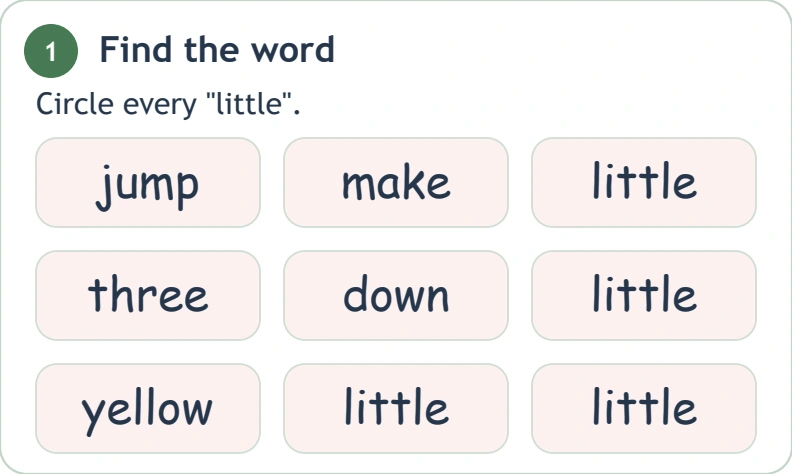
The nine choices contain four little matches. Jump, make, three, down and yellow are the other entries. A long-looking choice is not automatically correct: compare the full sequence with the model, including the repeated characters and the final e.
Little Word Study can use pointing before circles when small marking movements are awkward. The adult may retain the four-match total for review. Let the child make actual comparisons before discussing where the answers sit on the page.
Five Little Word Study games for a careful spelling desk
These optional invitations use separate completed cards or larger letter pieces. Choose one after an adult has modelled the target. Keep unfamiliar print under adult responsibility, making the learner's task specific rather than expanding every game into independent sentence writing.
1. Little Word Study builds a six-place display
Place the complete model above six broad positions on separate paper. Select l-i-t-t-l-e with enough copies of the repeated characters, then read the target together. Little Word Study makes each written position visible while the adult supplies a natural pronunciation.
For Little Word Study, the learner can direct an adult to move the pieces. Compare the third and fourth positions, then the first and fifth. The activity concerns accurate sequence, not the speed of collecting or manipulating small objects.
2. Little Word Study writes a bug-description label
The child chooses a drawing and dictates a phrase describing its small size. An adult records and reads the label. Little Word Study gives the target a communication job before the learner checks its repeated letters against the model.
Keep the Little Word Study description faithful to what the maker intended. The drawing need not meet an adult's artistic standard to support a meaningful caption. A short supported reread can be the entire activity.
3. Little Word Study repairs a missing repeated character
Prepare an incomplete build with one t omitted and show the correct model beside it. Explain that the sequence needs repair. Little Word Study invites the child to inspect the corresponding positions and add the missing letter with adult support.
During Little Word Study, read the corrected spelling as a whole word. Adding a written t does not require inventing an extra separately pronounced sound. Keep that explanation explicit if the learner is using letter count as a sound-counting rule.
4. Little Word Study compares two supported captions
An adult writes one caption that names a bug and another that includes the size description. Read both and locate the target in the longer message. Little Word Study lets the child discuss what information has been added without independently decoding every surrounding word.
The Little Word Study learner can answer through a gesture or a brief spoken phrase. After the meaning comparison, inspect l-i-t-t-l-e again. This keeps sentence understanding connected with print while recognising that the two tasks may need different assistance.
5. Little Word Study saves a message for a willing reader
Dictate a small-bug statement for a trusted listener, then have the adult write it and help read it aloud. Little Word Study offers a reason to keep the target's complete spelling accurate before someone else receives the message.
Return to the saved Little Word Study message on another willing visit. One six-position comparison or a supported reread can be enough. Ask for a new caption only when interest remains, rather than making each return longer than the last.
Little Word Study keeps two guided writing attempts available

The dotted source examples both preserve all six letters. Read before tracing and demonstrate the actual printed forms. A larger model beside the page can help if the source guides demand more fine-motor control than the learner can comfortably sustain.
Little Word Study does not need every pencil movement corrected during a meaning discussion. Choose whether today's observation concerns spelling, reading or writing control, and make that focus clear. A learner may recognise the sequence while still needing substantial help forming it.
Little Word Study selects six letters from eight choices

The bank is f, o, e, t, l, i, t, l. Select both l choices, both t choices, i and e, then arrange l-i-t-t-l-e across the six boxes. F and o remain unused. Copying the bank order would not form the source target.
Little Word Study can begin with a selection pile before any writing. Compare the chosen pieces with the model, then order them deliberately. This separates deciding which characters are needed from managing their sequence and the physical act of recording them.
Six Little Word Study benefits have different evidence
- Sequence awareness: track the six written positions through to the final e.
- Repeated-letter attention: include both copies of l and t rather than selecting each type only once.
- Spoken-word knowledge: hear a natural model without equating six letters with six sounds.
- Description: explain what size information the target adds to a supported message.
- Motor planning: trace, write or direct larger pieces according to current comfort.
- Communication: dictate a readable caption for a picture chosen by the learner.
Little Word Study brings reasoning, hand movement and language into the same setting without making one response a substitute for another. A strong description does not automatically establish secure spelling. Observe the help used and select a precise next prompt from that evidence.
Little Word Study in class can use a short individual conference
A teacher models the target, explains its repeated letters and reads one source sentence. Each child then checks a search candidate or selects letters on their own sheet. Record whether the learner needed a full model, a position reminder or a physical writing adjustment.
Little Word Study at home can begin with Rohan's simple drawing-and-caption routine. Return through the saved message when the child is interested. A comment such as “You noticed that the second l was still needed” acknowledges a specific action rather than speed or general cleverness.
A filled Little Word Study scene offers a separate demonstration
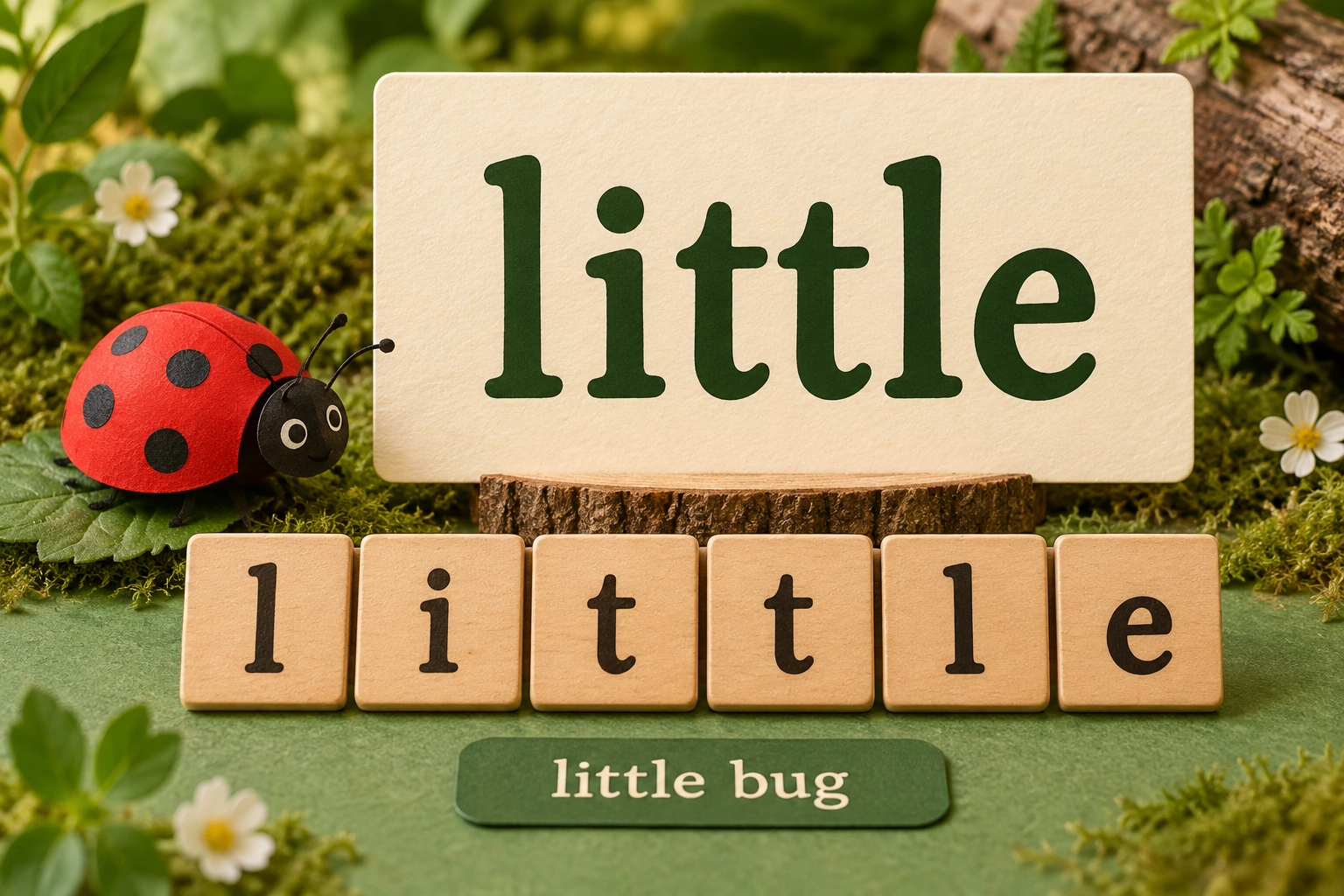
The companion still life shows a paper ladybug, a completed phrase and six ordered letter tiles. Its labels are filled to keep the written example explicit. The source worksheet retains its intended unanswered spaces and is not presented as a completed answer key.
Little Word Study often suits adult-supported preschool and early-school reading near ages four to six. Use current instruction and physical comfort to decide the size of an attempt. A short willing pause is appropriate when sustained spelling discussion or pencil work becomes demanding.
Little Word Study responds to common sequence mistakes
| What is missing? | Where to look next |
|---|---|
| Only one t is chosen. | Compare positions three and four. |
| The later l is omitted. | Check the fifth written position. |
| Six letters become six forced sounds. | Model the spoken word naturally. |
The final Little Word Study task permits copying a source sentence or creating another with help. Oral rehearsal can establish the meaning first. Dictation or a supported copy is a useful bridge when independent composition would add too many unfamiliar demands.
Choose a Little Word Study PDF before your next visit
The original-source option retains the uploaded worksheet. To obtain the separate clean attachment, sign in and select its protected download under a qualifying current membership. This edition removes the watermark along with the promotional website name and domain. The downloaded PDF carries no advertisements. Before printing, confirm that the complete Letter-size activity border stays within your printer's margins.
Little Word Study also appears in the twenty-sheet collection available for $5 through the related package card. A collection purchase provides one merged clean file, while this individual clean PDF follows membership access. Compare another description context on the pig statement page, a repeated vowel spelling on the butterfly word activity, or a single-letter article on the farm naming sheet.
For adult planning, UFLI's resources for teaching frequent spellings and Reading Rockets on linking word instruction with phonics knowledge offer background to use alongside the learner's current programme. Choose one manageable feature to revisit instead of expanding every practice opportunity into a longer session.
Popular Worksheets
Printable resources families and teachers are downloading now.
 Free
 Free
 Free
 Free