
It Word Clues: 5 Brilliant Ways to Follow a Ball
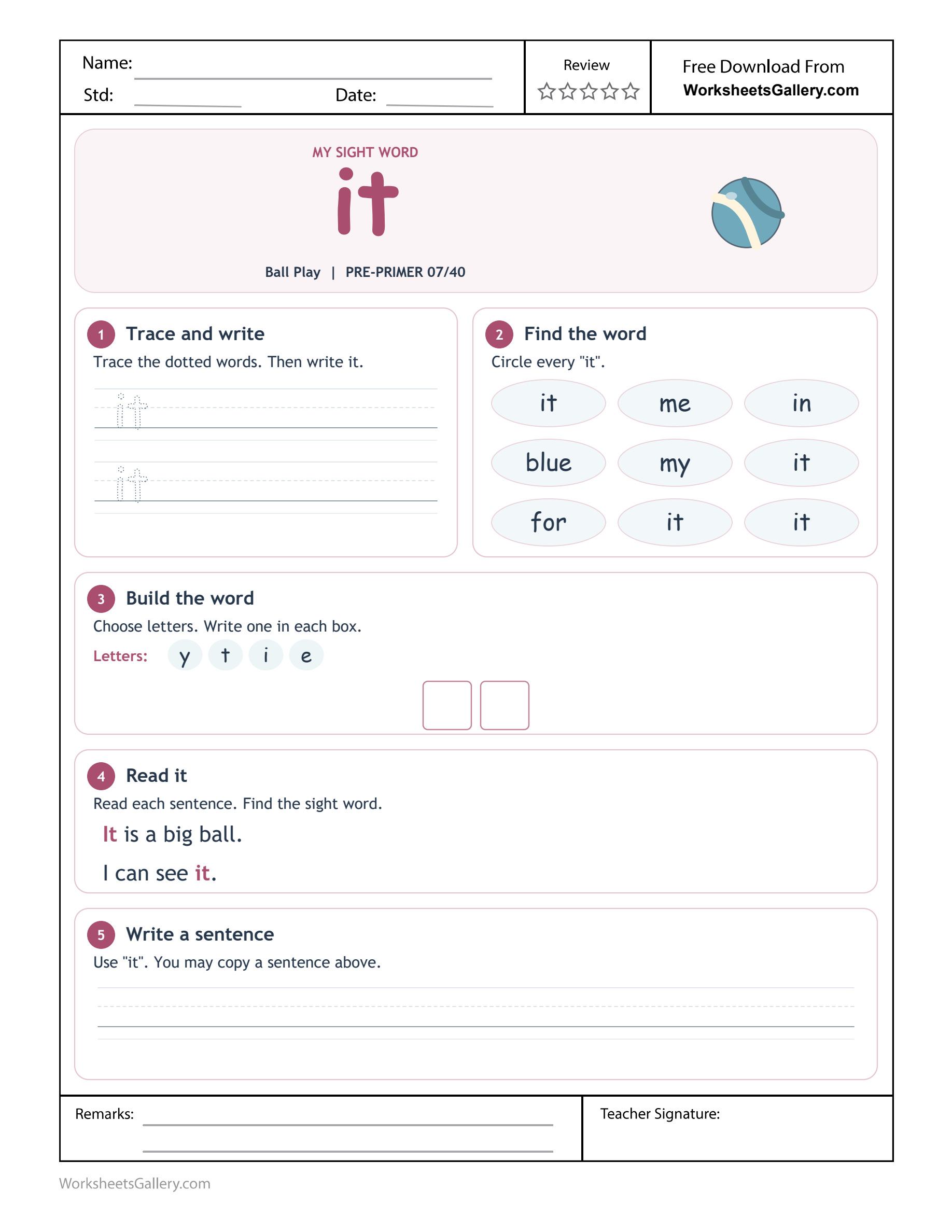
Follow the ball beyond this individual sheet. The ‘it’ activity is also part of the $5 premium collection: twenty source-ordered word pages combined into one printable PDF with promotional marks removed.
The ball has already been named. Can a smaller word carry the conversation forward? It Word Clues uses the Ball Play sheet to explore that connection while keeping i-t available for careful reading. Two sentences refer to a ball, and the surrounding tasks offer tracing, searching, letter selection and sentence writing. A child can discuss what the pronoun means before attempting a written response, with adult help for unfamiliar spellings. The aim is a readable word linked to a clear message, rather than a picture guess or a page completed against the clock.
It Word Clues follows a named ball through two messages

The first line says “It is a big ball.” The other says “I can see it.” In this shared setting, both uses concern the ball. Ask what the speaker means by the small word and accept a spoken explanation or a point toward the referent.
It Word Clues helps an adult separate two questions. What object is the sentence about? What word is printed here? The illustration can clarify the first, while i and t provide the evidence for the second. Understanding a ball picture does not automatically mean the learner recognised the target.
In It Word Clues, a clearer conversation can precede the reading attempt. Name the ball aloud, make a short statement containing the pronoun and then inspect the written word together. This establishes a reference without asking the child to decode unfamiliar surrounding text unaided.
It Word Clues reads i-t through taught sounds
An adult can connect the short vowel and final consonant with correspondences the learner already knows, then blend the word. Model any unfamiliar part directly. There is no need to present this regular short spelling as a special visual shape that can only be memorised.
It Word Clues also notices the source's capital It at a sentence beginning. The lowercase search target and the capitalised sentence form represent the same word. Explain that change explicitly, especially if the learner is treating the different first-character appearance as proof of a different meaning.
For It Word Clues, avoid confusing the pronoun with the standalone I introduced on another sheet. Read the complete two-letter spelling, including its ending. A shared beginning or a similar height on the page is not sufficient evidence for calling two words identical.
Mira's toy report gives It Word Clues a purpose
Mira puts a ball beside her father's chair and tells him one thing about it. He writes her message on a large card, names the ball in their conversation and reads the sentence back. She identifies the printed pronoun with the source model nearby.
Their It Word Clues exchange becomes interesting when he brings a cup into view. A new statement using the small word might now be unclear. Mira points to the intended object and names it again, helping her father understand the report before they return to the letters.
It Word Clues can stop after that clarification. The adult has seen how Mira handles meaning and how much help she needs with print. Those observations are more informative than asking her to repeat the same sentence until it sounds rehearsed.
Six It Word Clues achievements extend beyond a correct circle
- Reference: indicate the object meant by the pronoun in a shared message.
- Decoding: connect the two letters with taught sounds and blend with suitable support.
- Case awareness: recognise the sentence-initial capital form as the same word.
- Comparison: inspect the final character when another choice begins with i.
- Fine-motor control: trace or write the short form at a comfortable pace.
- Clarification: name the object again when a listener cannot tell what the sentence means.
It Word Clues brings reasoning, movement and language together without assuming equal readiness in all three. A learner who points accurately may still need a pronunciation model. A child who reads the target may prefer dictation when composing a complete message.
It Word Clues inspects the ending before making a match
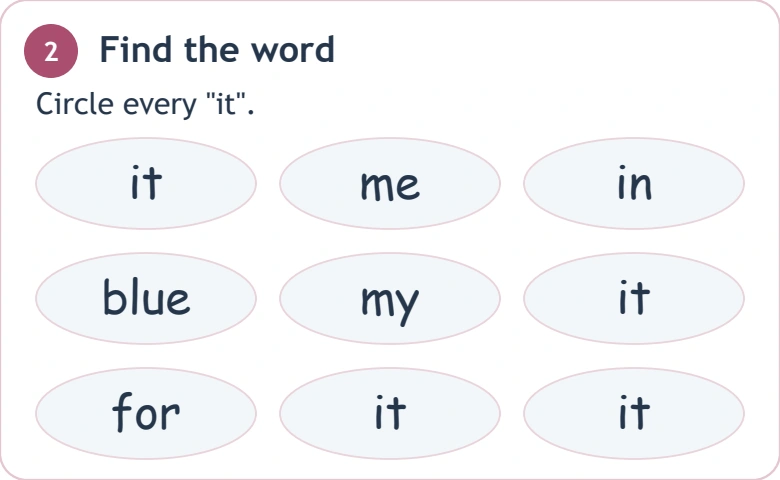
The nine entries include four it targets, alongside me, in, blue, my and for. The in choice provides a useful comparison because it begins with the same letter but ends differently. Keep the full model visible while the learner checks both positions.
It Word Clues can begin with one candidate at a time. Let the child point, compare and read with support before adding a circle. An adult may retain the total of four for checking, but announcing the answer locations would remove the need to inspect the print.
During It Word Clues, a wrong choice gives a specific teaching opportunity. Compare t with the actual ending of the chosen distractor, then model the target again. Avoid a string of increasingly vague hints or a demand to answer more quickly.
Five It Word Clues games for following a referent
Each game uses a small separate display or an adult-written message. Choose one after introducing the target. The source remains a five-task worksheet; these optional exchanges add practice opportunities rather than extra pages promised inside the download.
1. It Word Clues opens a toy-description desk
Name one toy and invite a short description containing it. Write the dictated message and read it together. It Word Clues gives the listener a clearly established object, while the child can locate i-t within the written sentence with help for the other words.
For It Word Clues, a simple fact such as color or position is enough. The learner need not invent an elaborate story. Ask the listener to identify the object afterward, keeping the clarification friendly if the first message leaves more than one possibility.
2. It Word Clues checks a ball-and-cup misunderstanding
Place a ball and cup apart, name the intended item, then make a supported statement using the pronoun. An adult deliberately points toward the other object and invites correction. It Word Clues gives the learner a meaningful reason to restore the intended reference.
The It Word Clues correction may be a gesture or a repeated object name. Once the meaning is clear, return to the written target and read it. Do not interpret solving the object puzzle alone as proof of independent word recognition.
3. It Word Clues pairs a label with a follow-up message
Write the name of an available object on one card and a short pronoun sentence on another. Read the label first, then the follow-up. It Word Clues makes the connection between naming something and referring to it again visible in a two-card arrangement.
During It Word Clues, the adult can supply the complete object label while the child takes responsibility for the introduced two-letter target. Change one meaningful detail in the second message and discuss it, keeping the spelling reference available.
4. It Word Clues repairs a letter ending
Build i-n beside the source model and explain that the ending needs checking for today's target. Invite the learner to replace n with t, then blend the repaired spelling using known correspondences. It Word Clues makes the difference inspectable rather than relying on a first-letter guess.
In It Word Clues, the adult should identify in accurately instead of calling it meaningless. These are different real words. If the comparison introduces too much unfamiliar work, model the target directly and return to a single clear build.
5. It Word Clues follows a family object report
The child dictates one true statement about a household object to a trusted adult. Name the object before reading the pronoun message to a willing listener. It Word Clues can end with the receiver explaining which thing the message concerned and why.
Save a satisfying It Word Clues report for another short reread. The adult can add a date privately to recall the context. Returning to one meaningful line offers a practical reason to practise again without requiring a new full worksheet every visit.
It Word Clues manages the pencil tasks separately
Two dotted word models introduce a guided writing attempt. The bank offers y, t, i and e above two boxes; choose i followed by t. A child can first arrange larger letters on the table and then attempt the source boxes if the writing size is comfortable.
It Word Clues ends with a sentence task that permits copying a supplied line. Rehearse the message aloud before deciding whether the learner will dictate, copy or compose with help. Writing control and sentence planning can each need support even after the two-letter target is recognised.
It Word Clues at home uses one object and one clear turn
Sit beside the child with the page, a comfortable writing tool and an available ball or picture. Name the referent, model the target and read one source line together. Invite either a search comparison or one word build next, stopping before the request becomes repetitive.
For It Word Clues, praise a visible decision: “You checked the t instead of stopping at i.” This names the reading action that mattered. On another day, use the saved report or a different familiar object to make a short return feel purposeful.
It Word Clues in class can reveal different kinds of understanding
A teacher presents a named classroom object and a short adult-read statement about it. Learners indicate the referent, then inspect the target on their individual sheets. The teacher records whether meaning, spelling or handwriting required the most assistance before deciding what to revisit.
It Word Clues can include a partner who listens while the learner dictates a new description. Provide adult support for unfamiliar print and allow a gesture instead of an extended explanation. A correct reference and an accurate written-word choice deserve separate notes when they do not yet coincide.
It Word Clues has a filled companion display
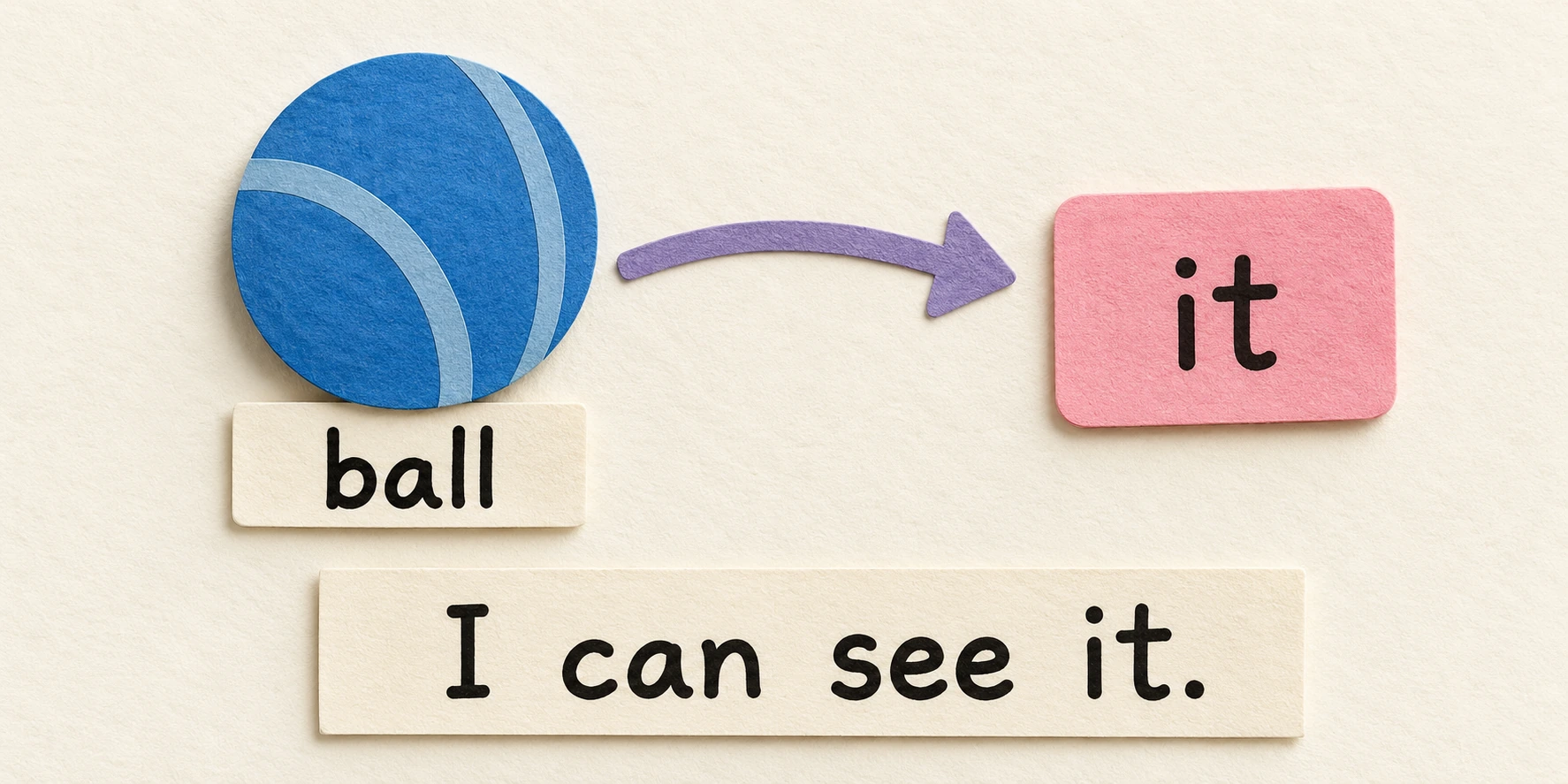
The supporting still life shows a ball, an it tile and a completed sentence strip. It is a separate demonstration image, not a photograph of a completed source exercise. The pointer clarifies an intended referent so an adult can begin a conversation before checking the actual letters.
It Word Clues may appeal to learners who like explaining a small misunderstanding. Keep that exchange cooperative, with the adult openly modelling and repairing mistakes. The child is helping a listener understand, while receiving the reading support needed to inspect print.
It Word Clues changes the task when effort becomes unhelpful
| Observed obstacle | A smaller next step |
|---|---|
| Two objects seem possible. | Name the intended referent again. |
| Only the first letter is used. | Compare the ending directly. |
| The written line feels too long. | Dictate first and write the target only. |
It Word Clues generally fits children aged roughly four to six during supported preschool or beginning-school reading. Judge the amount of help by current instruction and comfort. Avoid forced guessing from the ball illustration, unmodelled sound demands or repeated correction of every pencil mark during a meaning discussion.
Save It Word Clues as an individual or part of the collection
The retained original is available through its source-download option. For the clean individual edition, use the member download while signed in with a qualifying active membership. That PDF excludes the worksheet watermark, promotional website name and domain. Its downloaded activity page carries no embedded ads. Preview the complete US Letter layout before printing within your printer's margins.
It Word Clues also appears in the twenty-page $5 collection linked through this page's package card. Purchasing the collection obtains a single merged clean PDF; the individual attachment remains a separate membership benefit. Choose the desired file route before saving rather than expecting one button to provide both editions.
Follow a different pronoun role on the first-person star sheet or the listener-switch activity. A shared-object discussion can continue with the train article printable. For adult background, UFLI's frequent-word teaching resources and Reading Rockets' approach to high-frequency print can inform support alongside the child's existing reading lessons.
Popular Worksheets
Printable resources families and teachers are downloading now.
 Free
 Free
 Free
 Free