
Said Word Stories: 6 Wonderful Teddy-Talk Activities
The teddy report belongs to a broader word set. ‘said’ appears among the twenty included sheets in the $5 collection. Purchase that package to receive every supplied activity as a combined clean PDF.
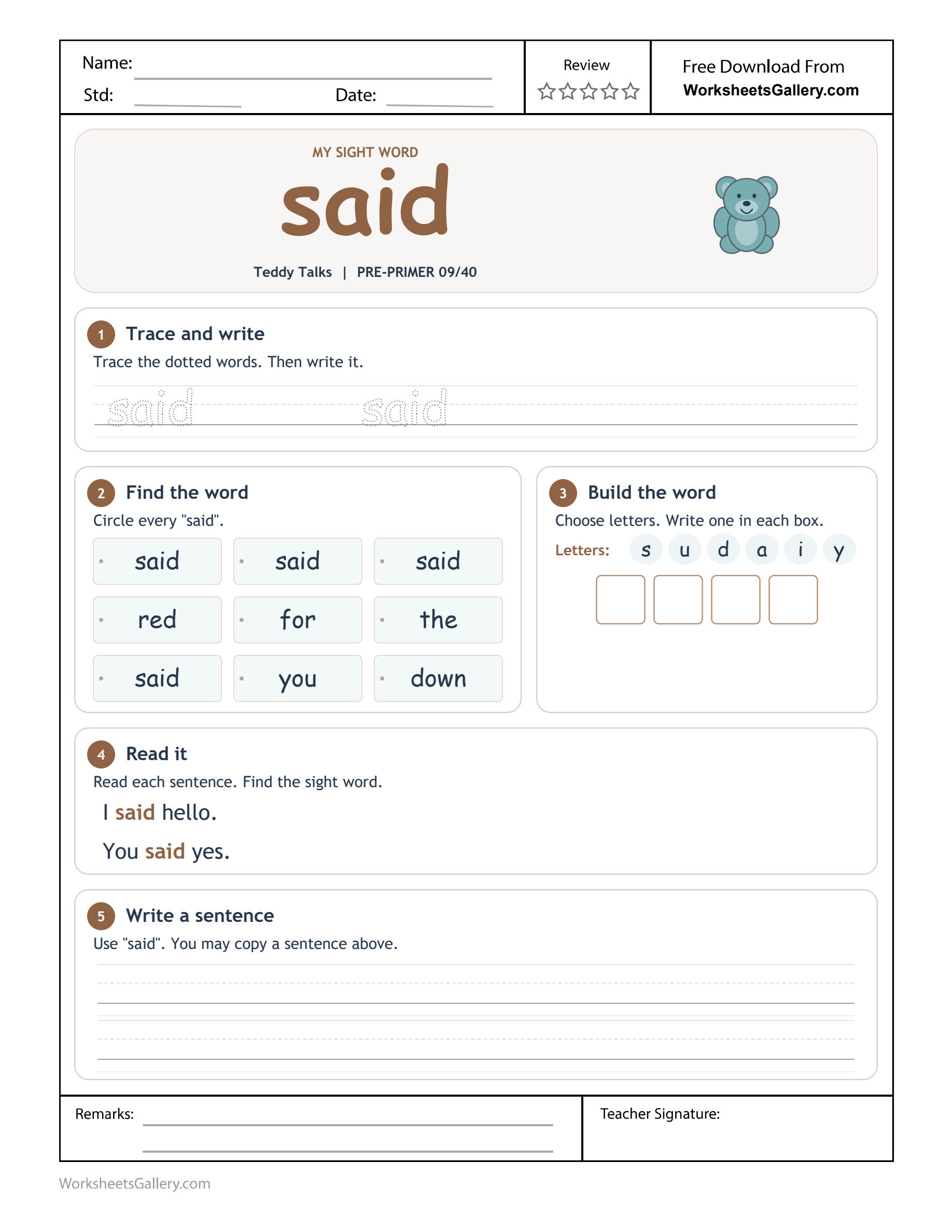
Hello is the greeting; telling someone about that greeting is another message. Said Word Stories explores the difference through the Teddy Talks worksheet. A child can hear a friendly exchange, report what happened and inspect the spelling s-a-i-d with an adult. The sheet combines tracing, a search, letter building, two short sentences and space for a written response. Its middle spelling needs explicit attention rather than a guess from the teddy picture. Meaningful conversation gives the word a purpose while a clear model keeps its less predictable letter-sound connection available for learning.
Said Word Stories reports a message that already happened
An adult greets a toy, then tells the learner what was said. Compare the original greeting with the report about it. The reporting word connects a speaker with an earlier message, so the conversation has a simple event to remember and describe.
Said Word Stories need not become a lesson in punctuation or formal reported-speech terminology. The child can understand “I said hello” through an actual friendly greeting. The adult can introduce more complex conventions later while keeping today's target clear and useful.
In Said Word Stories, the teddy supplies a character for conversation. It does not reveal which written word appears in a search cell. After discussing the exchange, point to s-a-i-d and read it together so the meaning work leads back to inspectable print.
Said Word Stories gives ai a specific explanation
The written word has four letters but is commonly pronounced with three sounds: /s/, the short-e vowel and /d/. In this word, ai represents that short-e sound. An adult should identify the middle spelling directly instead of insisting that the learner apply a long-a reading and somehow arrive at the correct result.
Said Word Stories can connect the first and final letters with known correspondences while explicitly teaching the unfamiliar middle. This is more informative than labelling the entire word impossible to sound out. Use the pronunciation natural to the learner's instruction and model it clearly.
For Said Word Stories, letter naming remains useful for ordering s, a, i and d. It answers a spelling question rather than a sound-counting question. Keep both purposes distinct when the child moves from a four-box build to reading the completed target.
Tara's greeting becomes Said Word Stories at home
Tara tells her grandmother that a toy bear said hello. Her grandmother writes a short report on a large card and reads it back, making the reporting word visible. Tara inspects the beginning and ending while her grandmother explains the middle spelling.
Their Said Word Stories conversation can include a second greeting from another toy. Tara chooses which exchange to report, dictates the message and locates the target in the adult's writing. The story belongs to their pretend play; the spelling comes from the accurate model.
Said Word Stories can stay with one report if the longer sentence feels demanding. The grandmother handles unfamiliar words and gives Tara a precise contribution, such as choosing a-i for the middle. This allows meaningful participation before independent sentence reading or composition is established.
Two Said Word Stories models offer guided movement

The dotted examples both show the complete s-a-i-d sequence. Read the target before following a model, keeping its pronunciation and spelling connected. Demonstrate the actual printed forms at a comfortable size rather than adding a handwriting system that the source does not specify.
Said Word Stories permits a larger separate copy when the narrow guides are tiring. A child can point to the middle pair, arrange letters or dictate while the adult writes. Reducing pencil demand does not require removing the spelling explanation.
Said Word Stories selects letters before filling four boxes
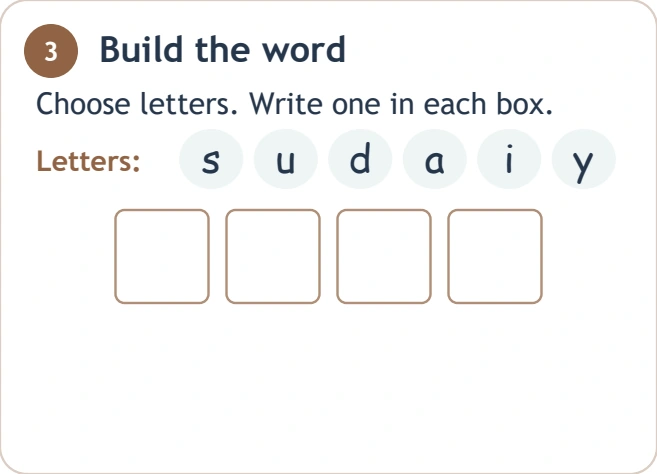
The bank provides s, u, d, a, i and y. Select s, a, i and d and arrange them in written order. The printed bank is a set of options; copying its first four entries would not produce the target. Leave u and y unused.
During Said Word Stories, ask the learner to inspect the adjacent a and i before writing. Those two letters work together in the adult's explanation of the vowel spelling. Four answer boxes represent written letters, not a demand to invent four speech sounds.
Six Said Word Stories games for a small reporting desk
These additions use separate cards and simple spoken events. Choose an inviting exchange, supply unfamiliar print and stop after an accurate short report. They are optional uses around the worksheet rather than extra pages included in the download.
1. Said Word Stories records a teddy greeting
Give the bear a clear hello, then dictate a sentence reporting the greeting. The adult writes and reads it aloud. Said Word Stories lets the child locate the reporting word and explain what happened without needing to spell every part of the message.
Keep the Said Word Stories greeting predictable. The purpose is a connection between an event, a report and a written target, rather than a memory challenge involving several toys speaking at once. Read the final card together before putting it aside.
2. Said Word Stories keeps two speakers distinct
Use two paper portraits with different simple greetings supplied by the adult. Ask which person produced the message being reported. Said Word Stories gives the learner a reason to identify the speaker and then inspect the same reporting word in two supported captions.
For Said Word Stories, a pointed choice can replace a full spoken explanation. The adult can clarify the sequence openly and reread the relevant card. Avoid treating an uncertain memory of the pretend exchange as a failure to recognise s-a-i-d.
3. Said Word Stories repairs the middle letter pair
Place s and d apart with the correct model visible, then offer a and i as the missing written middle. Build and read the complete word. Said Word Stories makes the less predictable spelling a taught feature rather than a concealed answer to guess.
An adult leads the Said Word Stories pronunciation and invites a careful comparison. The child can direct where the letters go if manipulating them is difficult. End after one accurate build, keeping the explanation more important than speed.
4. Said Word Stories makes a classroom greeting archive
Invite a willing adult to give a brief greeting, then record a supported report on a separate card. Said Word Stories can preserve one ordinary exchange in writing. The child locates the target while the adult reads the remaining words and identifies the speaker clearly.
Save the Said Word Stories card only if everyone involved is comfortable with it. A written pretend exchange works equally well, and no audio recording is necessary. Reread the report later to revisit both the spelling and its connection with the event.
5. Said Word Stories checks an adult's mixed-up report
After one clear pretend greeting, the adult reports a different message and explains that something went wrong. Invite the learner to correct what happened. Said Word Stories uses a transparent adult mistake to make the meaning of a report worth checking.
Return to the Said Word Stories target after the spoken correction. Clarifying the event demonstrates comprehension, while inspecting s-a-i-d demonstrates attention to print. Both are valuable, and one does not need to stand in for the other.
6. Said Word Stories chooses a message for a family listener
The learner dictates a short report about a friendly exchange with a toy. An adult writes it, reads it back and helps identify the target. Said Word Stories gives the child a reason to share a comprehensible message with a willing listener.
Let the Said Word Stories listener ask who spoke if that is unclear. The child can answer by naming or pointing, then check the written word once more. A successfully clarified message is a sensible stopping place for the activity.
Said Word Stories finds four complete matches
The nine-cell search includes four said entries. Its other words are red, for, the, you and down. Compare the whole target, including the middle pair, before circling. An adult may use the count privately when reviewing the work without announcing the answer positions beforehand.
Said Word Stories is not solved by choosing every entry that ends with d. If the child selects red, compare the complete spellings and model their pronunciations. They can share a sound feature while still being different words on the page.
Said Word Stories reads two reports before making another

The source reports a hello in its first line and a yes in its second. Read the lines with adult help, identify the target and discuss what each speaker contributed. The learner does not need to independently decode every surrounding word to participate in that comparison.
Said Word Stories ends with a sentence task that allows copying one above. Oral rehearsal or dictation can establish the message before pencil work. A copied sentence can still invite a meaningful check of who spoke and which word reports the event.
Six Said Word Stories benefits have different evidence
- Event language: describe something spoken rather than merely repeat an isolated greeting.
- Spelling knowledge: notice ai as the taught vowel spelling in this particular word.
- Sound attention: connect familiar beginning and ending correspondences with a clear adult model.
- Sequence: order four letters without confusing letter boxes with speech sounds.
- Motor participation: attempt tracing or writing at a suitable size and pace.
- Listening: identify whose message a supported report concerns.
Said Word Stories can reveal a strong spoken explanation alongside emerging spelling knowledge. Notice each skill separately and adjust the next prompt accordingly. A child's willingness to invent a toy dialogue is not a reliable measure of whether the target has been recognised.
Said Word Stories in class can be a brief adult-led conference
The teacher models the unusual middle spelling, reads one report and invites individual learners to locate the target. A child then selects bank letters or checks one search entry on their own sheet. The teacher records which prompt made the response possible.
Said Word Stories should avoid unmodelled guessing, repeated demands for a long-a pronunciation or excessive erasing during a meaning discussion. Learners near four to six years may use the page with different levels of support, depending on their current reading lessons and hand comfort.
| What needs explaining? | An explicit response |
|---|---|
| The vowel is guessed as long a. | Model the short-e sound spelled ai here. |
| The report's speaker is unclear. | Identify who gave the greeting. |
A labelled Said Word Stories scene keeps play connected to print
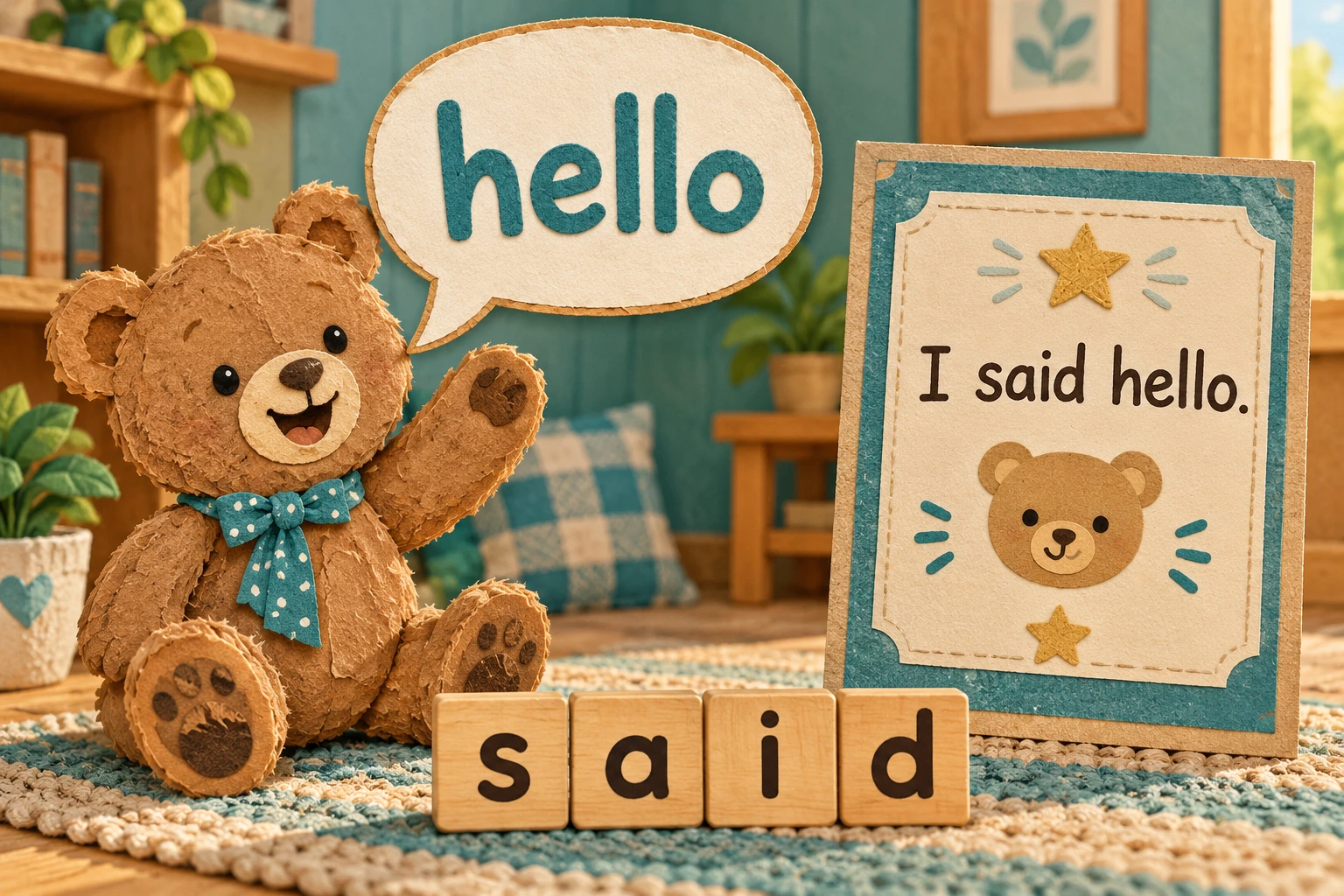
The invented display shows a teddy, a hello speech bubble, ordered letters and a completed report strip. The filled text gives an adult an explicit demonstration. The actual PDF retains its unanswered practice spaces and its original task sequence.
Return to Said Word Stories when a new short greeting creates interest. Offer an observation such as “You remembered to keep a and i together in the spelling.” A precise acknowledgement makes the next step clearer than praise for finishing quickly. One willing reread can be enough.
Obtain Said Word Stories in the edition you intend to use
The source option retains the original worksheet. A separate clean individual PDF is available through the member download to a signed-in user with an eligible active plan. That file removes the watermark, website promotion and domain marking; its downloaded page contains no advertisements. Preview the US Letter sheet so the full border fits the printable area.
Said Word Stories is included in the twenty-sheet $5 package linked on this page. Its purchase supplies the single combined clean file, while the individual member attachment follows the membership route. Check which edition you selected before printing or saving it for another visit.
An earlier speaker can be identified through the capital-pronoun star page, and a listener change appears in the fish conversation sheet. For a different spoken-message context, choose the eat word printable. Adult planning can consult UFLI's guidance for irregular frequent-word spellings and Reading Rockets on connecting word learning with phonics alongside the child's established teaching programme.
Popular Worksheets
Printable resources families and teachers are downloading now.
 Free
 Free
 Free
 Free