
Up Word Action: 4 Powerful Kite-Sentence Reading Games
The kite direction is one collection choice. The ‘up’ sheet is one choice in the twenty-page clean package. Its $5 merged PDF keeps the supplied learning activities together and removes their website branding.
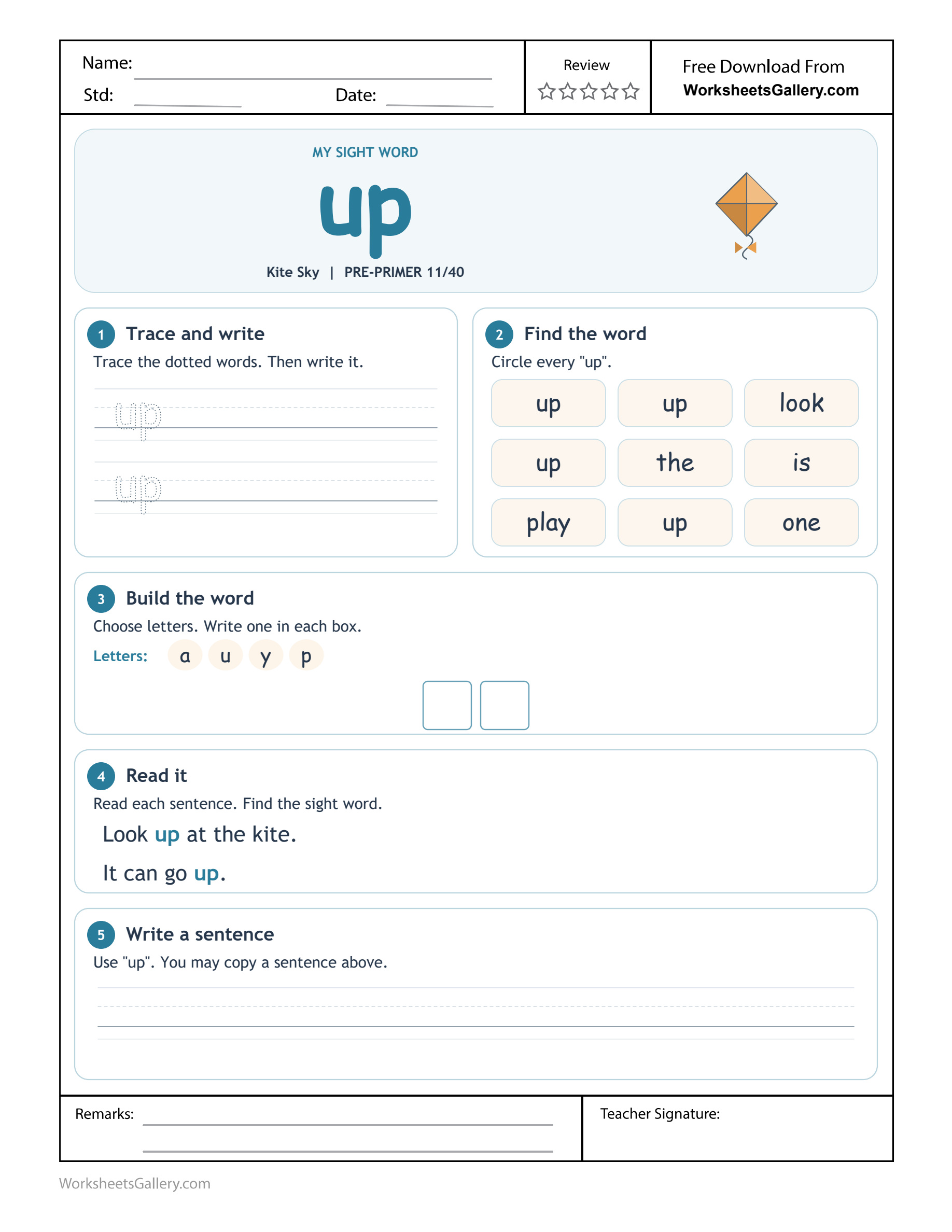
Look higher: there is a kite to talk about. Up Word Action connects that directional invitation with u-p on the Kite Sky worksheet. A learner can hear the word, demonstrate its meaning and return to the two printed letters before trying the source activities. The page offers a search, dotted writing models, letter selection, two reading lines and a sentence-writing space. Adult guidance keeps the task accessible when surrounding words or pencil movements are still unfamiliar. A paper kite is enough; the reading conversation can happen comfortably indoors without an outdoor flying lesson.
Up Word Action compares two messages about one direction

“Look up at the kite.” is a request to direct attention. The other line says that it can go up. Read both with help for unfamiliar spellings, then locate the target. Discuss what changes in the complete messages while the direction stays related.
Up Word Action gives the child two positions to inspect: the target appears within one sentence and at the end of another. Its identity does not depend on being the last printed item. Use the actual u-p spelling as the comparison reference.
For Up Word Action, an adult may demonstrate a comfortable upward gesture rather than ask the child to tilt their head or raise an arm. The movement clarifies meaning; reading still involves the printed word. A suitable gesture can be small, seated or made by the adult.
Naina gives Up Word Action a kite-message job
Naina puts a paper kite higher than a toy house on a large drawing. Her brother helps an adult record a short message about its position. The adult reads the message aloud and asks Naina to find the small directional word by comparing it with the worksheet model.
Their Up Word Action exchange can continue with a second position on the drawing. Naina explains what moved, while the adult supplies any unfamiliar sentence words. Her brother can listen rather than answer for her, leaving the print decision as her supported contribution.
Up Word Action works with one satisfying message. There is no need to build a long pretend adventure or finish every source panel in that visit. Save the drawing and its written clue if Naina wants a purposeful reason to reread later.
Up Word Action links known sounds before adding pencil work
The target contains u followed by p. When these correspondences are familiar, an adult can guide a blend using the short vowel sound and final consonant. If the sounds are not established, model them explicitly instead of assuming the word's short length makes it automatically easy.
Up Word Action keeps letter names available for discussing written order while using sounds for the reading explanation. Those are different jobs. Invite the learner to read the completed word after naming or arranging its letters so the activity reaches beyond a spelling recital.
Six Up Word Action gains can be observed separately
- Directional meaning: show or describe an upward relationship in the current scene.
- Blending: connect the two written letters with taught sounds.
- Position independence: locate the same word in different places within a sentence.
- Visual checking: compare an entire search entry before marking it.
- Motor control: trace or attempt the short spelling with appropriate physical support.
- Message making: dictate a clear instruction or statement for someone else.
Up Word Action combines attention, language and small hand movements, but success may appear differently in each. A confident directional demonstration can coexist with an emerging blend. Notice the particular support used rather than judging understanding from a finished page alone.
Up Word Action chooses two letters from four options
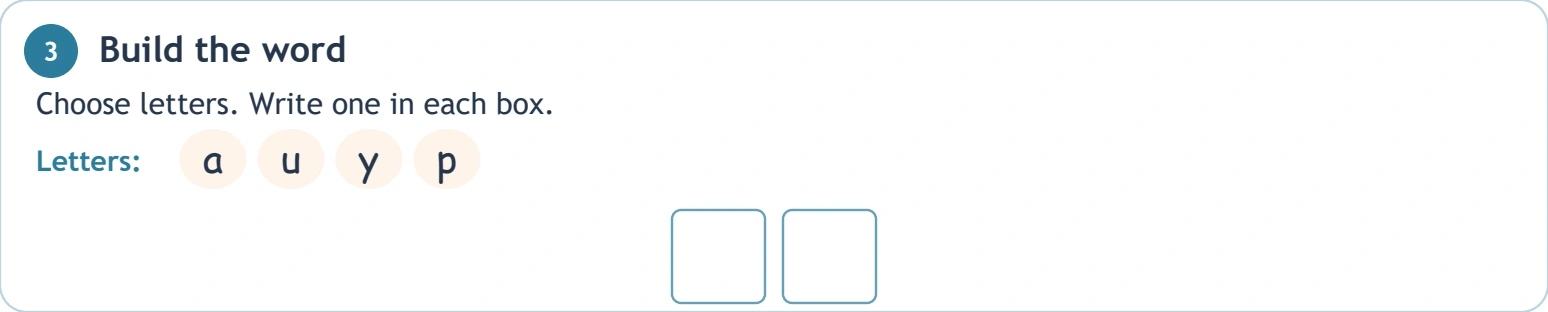
The bank lists a, u, y and p. Two answer boxes require u then p, leaving the other characters unused. A child can select larger homemade pieces first, compare their sequence with the model and then decide whether a box-writing attempt is comfortable.
Up Word Action also supplies two dotted word models and writing guides. Demonstrate the source's actual letter forms. If a narrow guide is tiring, a larger separate model or a shorter attempt can maintain the reading purpose while reducing the movement demand.
Four Up Word Action activities for a small direction desk
Choose an optional exchange once the adult has modelled u-p. Prepare a separate direction card beside an ordinary drawing or object. Supply unfamiliar print for the learner, leaving a manageable target to inspect within a meaningful message.
1. Up Word Action sends a kite-position note
Place a paper kite on a drawing above another familiar object and dictate a short note about it. An adult records the message and helps read it. Up Word Action makes the directional target useful to a willing listener who wants to check the scene.
During Up Word Action, the listener can point toward the intended position. Return to the two letters after clarifying the direction. A correct gesture explains meaning, while an accurate print check shows which word the child has recognised.
2. Up Word Action directs an adult's paper pointer
An adult holds a broad pointer on a drawing and follows a supported written direction containing the target. The learner locates the word and decides whether the movement matches. Up Word Action lets the adult do the physical action while the child makes the reading decision.
Keep the Up Word Action movement slow and visible. The child can correct an obvious mismatch through speech or pointing. There is no need to make the instruction fast, surprising or physically demanding in order for it to have a useful purpose.
3. Up Word Action builds a direction label
Arrange u and p beside the model, then attach the completed word to an adult-drawn upward arrow. Read the label and discuss the relationship. Up Word Action combines spelling and meaning without suggesting that the arrow alone identifies the written word.
For Up Word Action, briefly move the arrow away and inspect the same letters. The label still reads the target because its spelling is unchanged. This comparison makes a useful distinction between recognising print and interpreting a visual symbol.
4. Up Word Action repairs an adult's scene description
The adult reads a clearly written upward message but points below the named object. Explain that the demonstration went wrong and invite the learner to help. Up Word Action makes an obvious mismatch available for cooperative checking against a written direction.
After the Up Word Action repair, reread the target together and confirm the intended direction. The adult can supply the entire sentence if necessary. The activity should leave the learner feeling like a helpful partner rather than someone tested by a concealed trick.
Up Word Action searches for four complete matches
The nine-cell search contains four up entries. Look, the, is, play and one provide the other choices. An adult can keep the four-match total for checking while the child compares each whole word against the model, reading the target with support before circling.
Up Word Action should not reward choosing any short entry or guessing from the kite. If the response is uncertain, inspect u and p directly and contrast the actual candidate. Offer an accurate model rather than repeated prompts to be quicker or more confident.
Up Word Action at home follows a short, flexible sequence
First establish the direction through a picture or comfortable demonstration. Next model the printed target and read one source sentence with assistance. Invite a search comparison or a letter build after that. Stop when one specific task has been practised successfully, leaving other panels for a later visit.
Up Word Action need not follow a daily full-page quota. Return through the saved kite note or one fresh supported sentence when the learner is interested. An observation such as “You checked both letters before reading that label” identifies the action that made the attempt useful.
Up Word Action in class gives the teacher an inspectable response
A teacher demonstrates the target, then asks individual learners to identify it on their own source sheets. One child may point within a sentence, another may order letter pieces and another may write a model. The teacher records the kind of help required for that response.
Up Word Action can give a willing classmate the job of receiving a supported direction. Clarify that listening responsibility so a stronger reader does not take over the target-word decisions. Meaning, print recognition and handwriting can each be observed without comparing how quickly children finish.
A filled Up Word Action scene keeps its labels readable

The companion picture places a paper kite above an arrow, with completed up and Look up cards. It is a separate teaching display rather than another page in the PDF. The image offers a shared topic and a visible spelling reference for an adult-led exchange.
Up Word Action can use a much simpler home drawing. The learner's attention belongs on the written target when the question is about reading. A clear scene can support the conversation without becoming a shortcut that replaces inspection of u-p.
Up Word Action adjusts common sources of difficulty
| What needs support? | A practical adjustment |
|---|---|
| The meaning is unclear. | Show a comfortable upward relationship. |
| The vowel sound is unfamiliar. | Teach it before expecting a blend. |
| Writing guides feel too small. | Offer larger letters beside the source. |
Up Word Action often suits learners aged four to six with adult guidance matched to their present reading instruction. Avoid treating age as a promise of independent sentence reading. A willing pause is appropriate when sustained looking, talking or pencil work stops feeling comfortable.
Use Up Word Action in a sentence and save the desired edition
The final source panel permits a new sentence or a copy of a supplied line. Rehearse it orally, then choose dictation, supported copying or composition according to readiness. That choice lets the adult preserve the message while adjusting how much spelling and handwriting the learner handles.
Up Word Action has an original-source download and a separate clean member PDF. The protected clean attachment requires a signed-in user with an eligible active membership. Watermark text, website promotion and domain branding are absent from that edition, and the downloaded page has no embedded ads. Before printing, check that the entire Letter-size border fits your printer's available work area.
Up Word Action also belongs to the $5 twenty-sheet collection linked by the package card. Purchasing that collection supplies a merged clean PDF; the individual attachment uses membership access. A different direction relationship appears on the destination phrase page, an inside location on the school-bag sheet, and taught vowel work on the separate vowel printable.
Adults can plan explicit word support with UFLI's word activities for reading instruction and Reading Rockets' explanation of frequent-word teaching. Select material consistent with what the child is currently being taught, and use a brief meaningful reread rather than another demand to complete every panel.
Popular Worksheets
Printable resources families and teachers are downloading now.
 Free
 Free
 Free
 Free