
Down Word Direction: 4 Wonderful Plane-Reading Games
The plane direction connects with nineteen other lessons. Find ‘down’ in the merged premium collection, priced at $5 for all twenty uploaded sheets. Each included page retains its learning tasks and loses the website branding.
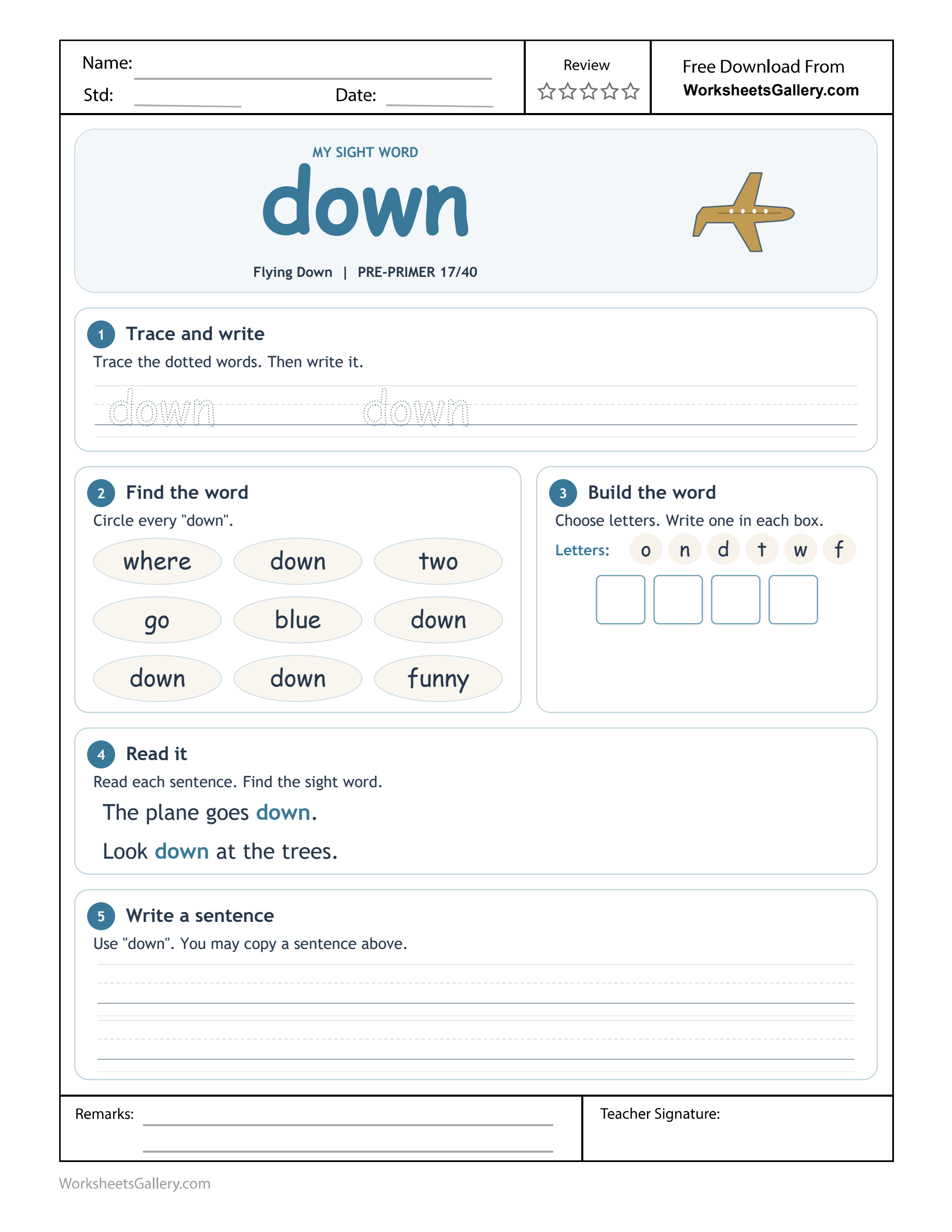
The plane in a drawing can change position while one written word explains the direction. Down Word Direction follows that idea on the Flying Down worksheet, connecting d-o-w-n with a supported movement statement and a viewing request. The learner also traces, searches, selects letters and attempts a sentence. Adult modelling makes the vowel spelling explicit before a reading decision is expected. A paper picture or a comfortable gesture can establish the meaning indoors. The important return is to the printed target, where the child can inspect a complete sequence instead of guessing from the plane.
Down Word Direction looks closely at its middle spelling
Read the target naturally and examine d, ow and n as useful sound-spelling parts. The o and w work together as the vowel spelling in this word. They are two written letters, but the adult should not require them to be pronounced as two independent letter sounds.
Down Word Direction can connect the beginning and ending with correspondences already taught while providing a clear model for the middle. If the learner knows another reading of ow, explain this example directly. Prior knowledge is a resource to extend, rather than something to dismiss.
For Down Word Direction, four letter boxes answer a written-spelling question. They do not establish four separate speech sounds. Name the characters when discussing their order, then read the whole word so letter naming and actual pronunciation each have a clear purpose.
Sia's paper-plane message begins Down Word Direction at home
Sia draws a plane above a row of trees and asks her father to move a paper marker lower on the picture. He records her message in large print, reads it and helps her locate the target. They compare its middle pair with the worksheet's model.
Their Down Word Direction exchange can remain entirely on the table. Sia directs the adult if moving a marker is awkward, or points toward the intended position. The action explains meaning while her father keeps the written d-o-w-n available for a separate reading check.
Down Word Direction can finish after one understood message. Save the picture if Sia wants to revisit it later. The activity does not need a flying model, a long pretend journey or a requirement to complete every printed task in the same visit.
Down Word Direction reads two different kinds of sentence

“The plane goes down.” states a movement. “Look down at the trees.” asks someone to direct attention. Read the actual lines with assistance for unfamiliar words, then locate the target and discuss what the complete message is doing.
Down Word Direction gives the adult a reason to distinguish interpreting a scene from reading a word. A learner can describe where trees are while needing help recognising the target. Supply the print model directly and observe the language explanation as a related, separate achievement.
In Down Word Direction, a comfortable adult gesture can replace any requested child movement. There is no need to insist on head turning, reaching or following an object physically. The lesson concerns a written direction in a meaningful setting, not a test of movement range.
Six Down Word Direction benefits have observable signs
- Directional language: describe or demonstrate a downward relationship in the shared scene.
- Vowel-spelling knowledge: notice ow as a paired written unit in this target.
- Sequence: arrange d-o-w-n after selecting the necessary characters.
- Print attention: inspect the full word before choosing a search match.
- Motor control: attempt guided writing or direct larger pieces with suitable support.
- Communication: dictate a message that a listener can understand and act on.
Down Word Direction combines reasoning, language and hand movement without expecting identical readiness in each. A child can give an accurate position explanation before mastering the vowel spelling. Record which prompt helped instead of making a finished page the only evidence of progress.
Down Word Direction follows two dotted examples at a manageable size

The source tracing panel presents two complete word models with guides. Read the target first, demonstrate the printed forms and allow a comfortable attempt. A larger separate example is useful when the available line height requires more control than the learner can sustain.
Down Word Direction can continue through pointing or letter selection while pencil work pauses. Keep the spelling explanation intact rather than add repeated copying to compensate for hand fatigue. The adult can observe reading knowledge even when writing remains the more difficult task.
Down Word Direction selects four bank letters in a new order
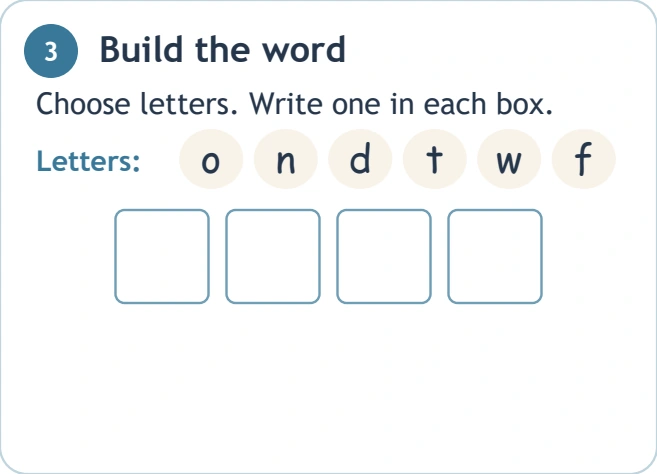
The bank lists o, n, d, t, w and f. Select d, o, w and n, leaving t and f unused. Arrange the chosen characters in the target order before attempting the four boxes. Copying the bank's first four entries would produce a different sequence.
Down Word Direction can use a broad ow piece for a reading demonstration and separate o and w pieces for the source's letter boxes. Explain the purpose of each representation. The word's spelling and pronunciation do not change when the teaching pieces change.
Four Down Word Direction invitations make a message useful
Choose one separate paper activity and model the target before asking the learner to inspect it. The adult supplies the unfamiliar words. These optional exchanges extend the conversation without claiming extra pages or tasks are included in the source download.
1. Down Word Direction writes a plane-position note
Place a paper marker on a simple scene and dictate a message describing a lower movement. An adult records the note and helps read it. Down Word Direction gives the learner a reason to locate the target before a willing listener follows the instruction.
For Down Word Direction, the child may direct the adult instead of moving the marker. Clarify where the message is intended to lead, then inspect d-o-w-n again. An understood action and a recognised spelling provide different useful observations.
2. Down Word Direction labels an adult-drawn arrow
Build the target beside its model, then place the completed word next to a downward arrow. Read the label and discuss its relationship with the symbol. Down Word Direction keeps the spelling explicit instead of treating arrow recognition as equivalent to reading.
The Down Word Direction adult can move the arrow away briefly and reread the unchanged letters. The target still has the same identity. This comparison helps distinguish information supplied by a visual cue from information contained in the written word.
3. Down Word Direction repairs a narrator's mismatch
An adult reads a clear downward instruction but points higher in the drawing. Explain the mismatch and invite a correction. Down Word Direction makes the whole message worth checking before returning to the target's beginning, middle pair and ending.
During Down Word Direction, keep the correction cooperative. The adult provides the pronunciation and any unfamiliar sentence print, while the learner clarifies the intended direction. One successful repair can close the exchange without repeated deliberate errors.
4. Down Word Direction saves a scene caption
The learner dictates one statement about a plane picture or another imagined object moving lower. An adult writes and rereads the caption. Down Word Direction offers a meaningful reason to preserve the full spelling before sharing the message with a willing listener.
A later Down Word Direction visit can use that saved caption for a single supported reread. Ask whether it still describes the picture accurately. Invite a new sentence only if interest remains, rather than requiring fresh composition at every return.
Down Word Direction searches through nine real choices
Four entries are down. The other printed choices are where, two, go, blue and funny. Compare each candidate with the large source model, including the middle ow. An adult can retain the count of four for review without disclosing the target locations beforehand.
Down Word Direction can be answered by pointing before circles are added. If a child chooses by length or by a familiar single letter, inspect the whole actual entry. A direct comparison is more useful than repeated instructions to look harder or respond quickly.
Down Word Direction in class can be a short individual check
A teacher introduces the vowel spelling and reads one source sentence with the group. Each learner then identifies the target on an individual sheet, selects bank letters or attempts a guided model. Record whether the child needed a pronunciation model, a position reminder or a physical adjustment.
Down Word Direction can include a partner who receives a dictated scene instruction after an adult has supplied the written message. Keep the listening role clear so the partner does not make the target-word decision. The teacher can observe comprehension and print attention separately.
Down Word Direction supports a sentence without demanding independence
The final task allows a new sentence using the target or a copy from the source lines. Oral rehearsal can establish the meaning before the pencil attempt. Dictation or supported copying can preserve the learner's message when independent spelling would add too many unfamiliar demands.
Down Word Direction may suit adult-supported children aged about four to six, with assistance based on current instruction and comfort. A comment such as “You kept o and w together in the spelling” identifies a specific achievement. Return through a saved note when the learner is willing, and pause when sustained effort becomes uncomfortable.
A filled Down Word Direction scene offers a clear companion example
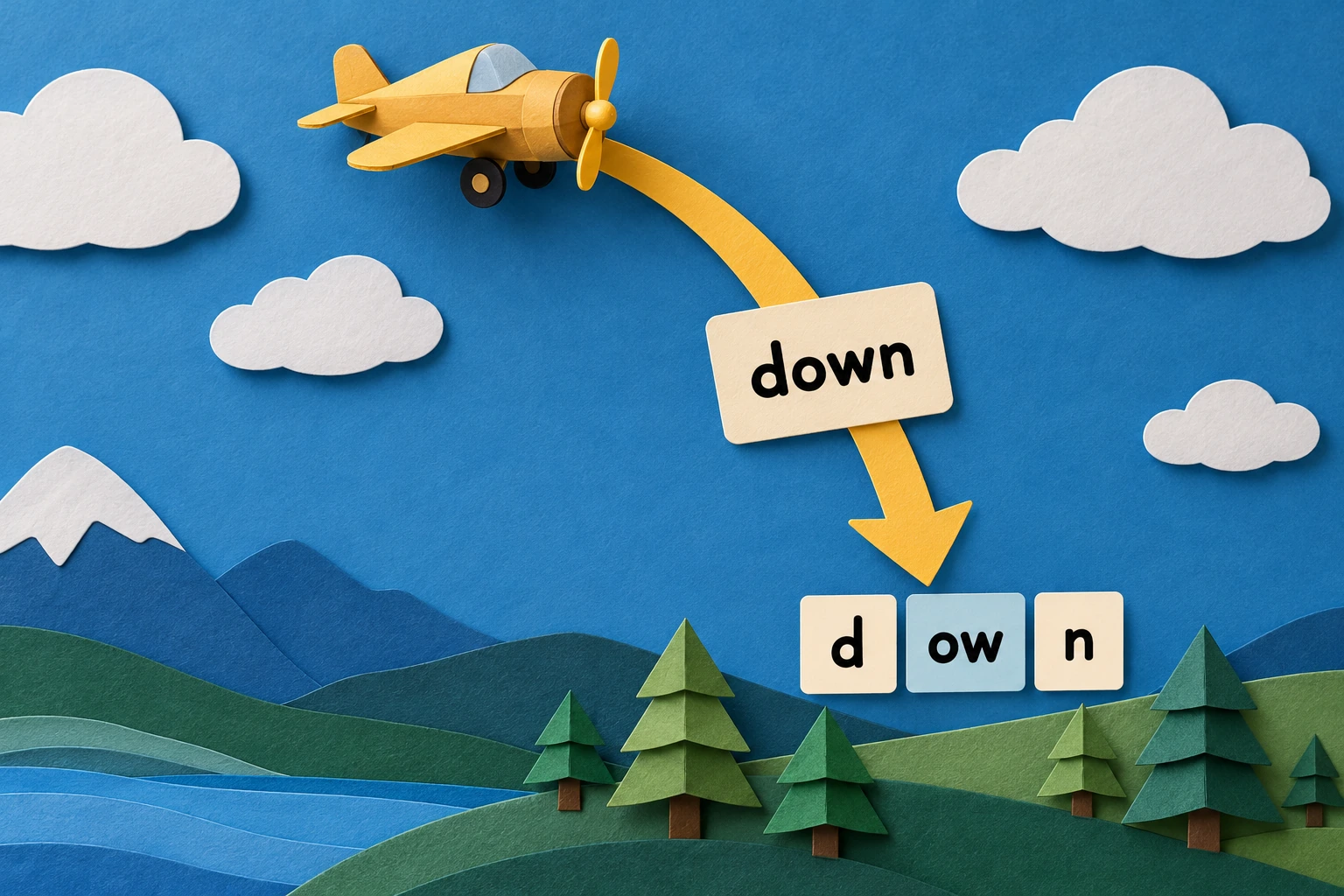
The separate still life shows a plane, downward arrow, completed word card and d-ow-n pieces. It is an invented demonstration arrangement, not an added source exercise. Its readable labels support the adult's explanation while the PDF retains its intentional answer spaces.
For Down Word Direction, use the scene to clarify meaning and the letters to establish the reading response. A learner's confident description of the picture is worth hearing, even when the printed target still needs a complete adult model.
Down Word Direction makes a useful adjustment explicit
| The uncertain step | A clear response |
|---|---|
| O and w are sounded separately. | Model the vowel spelling as a pair. |
| The picture replaces the print check. | Inspect all four written letters. |
| The bank is copied directly. | Select, then arrange d-o-w-n. |
Avoid making the plane theme into a technical aviation lesson or comparing children's completion speed. Down Word Direction has a narrower purpose: a supported word, a clear direction and a message that makes sense to someone else.
Print Down Word Direction from the desired file edition
The original-source download retains the supplied sheet. A qualifying active member can sign in to obtain the protected clean individual PDF. Its worksheet watermark and promotional website/domain marks have been removed, and the downloaded activity contains no advertisements. Before making a copy, check the Letter-size page border against your printer's available margins.
Down Word Direction is included in the $5 collection shown on this page's related package card. Purchasing the collection obtains a merged clean PDF containing all twenty supplied sheets; the individual clean option is delivered through membership access. Compare the opposite direction on the kite word page, a destination on the bus phrase sheet, or an observation request on the butterfly reading activity.
Adults can plan explicit spelling support using Reading Rockets' account of teaching frequent words through sound knowledge and UFLI's resources for word-level instruction. Keep those ideas aligned with the child's current programme when choosing the next manageable comparison.
Popular Worksheets
Printable resources families and teachers are downloading now.
 Free
 Free
 Free
 Free