
Can Word Confidence: 6 Brilliant Ability-Sentence Games
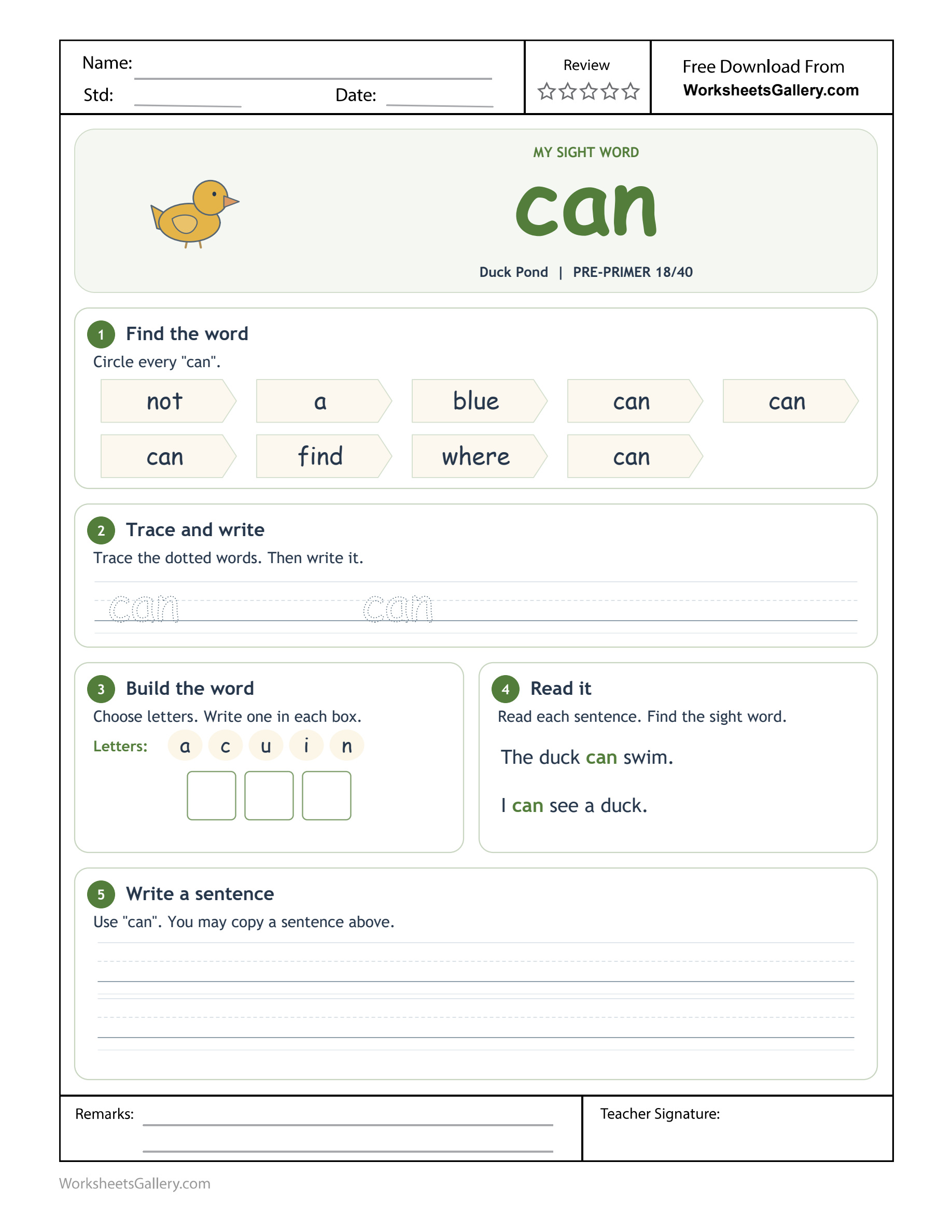
The duck statement belongs with the remaining supplied words. ‘can’ is included in the $5 clean collection download. One PDF contains twenty source pages, offering different word settings without worksheet promotional marks.
A duck's swimming and a speaker's seeing are different actions, yet the same small word appears in both messages. Can Word Confidence examines that relationship on the Duck Pond sheet. The learner can inspect c-a-n, find matching entries, follow dotted models, select letters and attempt a sentence with adult help. The theme offers a friendly conversation rather than a test of what a child is physically able to do. A clear reading model and a meaningful statement keep attention on the printed word, with unfamiliar surrounding spellings supplied by the adult when needed.
Can Word Confidence can begin in a classroom conversation
A teacher reads the two source statements aloud and asks which action belongs to which subject. Learners may point to a duck drawing or respond with a short phrase. The teacher then identifies the repeated target and models its spelling and pronunciation.
Can Word Confidence gives each child an individual sheet for the print response. One learner may identify the word within a sentence; another may select its bank letters. Record the assistance required instead of expecting a whole group to complete identical amounts at the same speed.
For Can Word Confidence, a child's own physical abilities are not a performance requirement. Keep the primary examples on the page or use an invented character. The learner can discuss the message through pointing, dictation or an adult-supported reply.
Can Word Confidence connects c-a-n with taught sounds
The written target has c, a and n. An adult can model the /k/ beginning, short-a vowel and final /n/, blending them when the learner knows those correspondences. Teach any unfamiliar part directly rather than assuming that a frequent word must be memorised without sound work.
Can Word Confidence also allows an adult to read a complete sentence naturally. Spoken emphasis can affect how the word sounds within connected speech, so provide a clear isolated model when explaining the spelling. Then return to a meaningful line rather than leaving the activity as sound practice alone.
In Can Word Confidence, naming the three letters helps discuss their positions. Reading the blended word is a different response. Invite an accurate complete pronunciation after the build, with enough assistance for the learner to connect the written sequence and spoken message.
Can Word Confidence reads what the source actually says
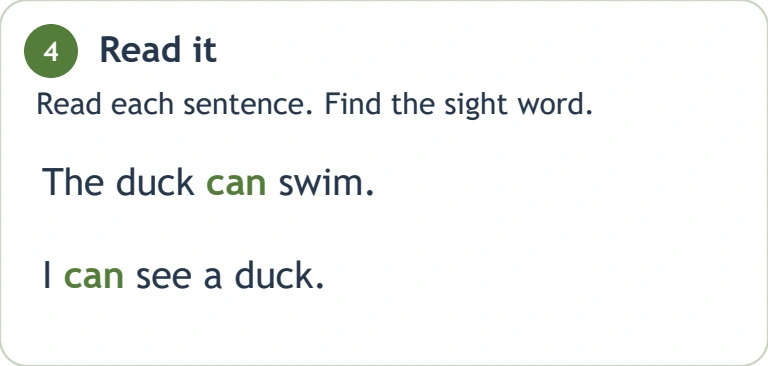
“The duck can swim.” describes the duck's ability in the worksheet setting. “I can see a duck.” describes the speaker's seeing. Read both lines with help, locate the target and discuss how the subjects and actions differ while can remains shared.
Can Word Confidence stays with this ability use rather than claiming that it explains every meaning of can. English also uses the word in other contexts. The adult can keep today's explanation specific to these source statements and introduce other uses when they become relevant.
Veer's pond caption gives Can Word Confidence a home purpose
Veer chooses a duck drawing and tells his mother what the pretend animal can do. She writes his dictated message, offers a supported reread and helps him locate the target. They inspect the c-a-n sequence against the large reference, then talk about the duck's action in his caption.
Their Can Word Confidence exchange can move to another invented animal if Veer is interested. His mother supplies the unfamiliar animal and action spellings. Veer's contribution can remain the target-word check, a spoken explanation or a supported writing attempt, rather than independent composition of the whole line.
Can Word Confidence can finish after one understood caption. Save it for a later willing visit, or leave the page aside if interest changes. A small successful communication is enough to make the word useful without adding a full-session quota.
Can Word Confidence searches for four complete c-a-n entries
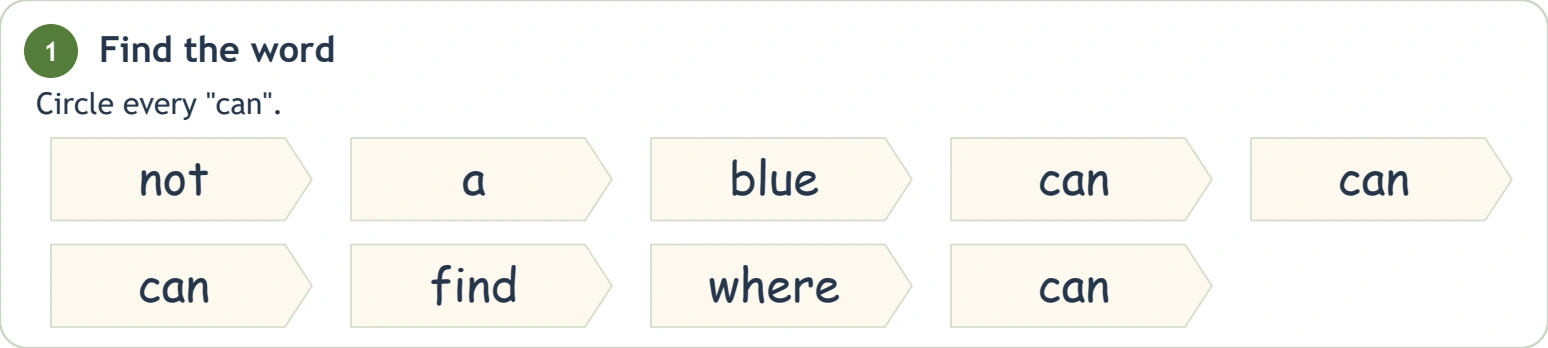
The source's nine choices include four can matches. Not, a, blue, find and where supply the other entries. Compare each whole candidate with the large model before deciding to circle it. The adult may use the answer total privately for review.
During Can Word Confidence, a child can point first if marking small cells is awkward. A familiar a inside another spelling does not make that complete entry the target. Inspect the beginning and ending as well as the vowel, and provide a direct model when uncertainty remains.
Seven Can Word Confidence benefits can show in different responses
- Meaning: explain what ability is described in a supported source statement.
- Blending: connect c-a-n with familiar correspondences and an accurate adult model.
- Sequence: preserve the written order when choosing letters from a mixed bank.
- Comparison: inspect all three letters rather than rely on the duck illustration.
- Subject attention: distinguish the duck's action from the speaker's action.
- Motor participation: trace or write with suitable size, pacing and practical assistance.
- Expression: dictate a message that conveys a specific idea to a listener.
Can Word Confidence brings cognitive, fine-motor and language tasks together without making one response prove mastery of the others. A child may explain the animal action clearly while needing the /k/ beginning modelled. Notice the actual evidence and plan a focused next prompt.
Can Word Confidence traces after reading the target

Two dotted examples provide the source's guided movement models. Read the target, demonstrate the actual printed forms and invite an attempt that suits the learner's current control. Use a comfortable tool and stabilise the page before asking for more writing.
Can Word Confidence can continue with larger letter pieces while the pencil rests. A broader separate model can also reduce the demand of narrow guide lines. Avoid adding repeated copies merely because handwriting is slower than the child's spoken understanding.
Can Word Confidence selects three letters from five choices
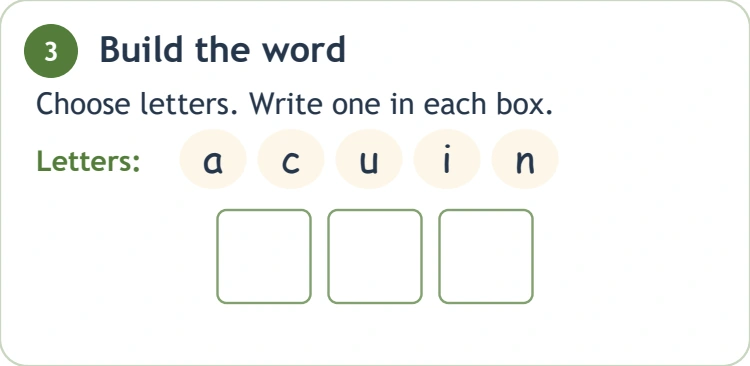
The bank lists a, c, u, i and n. Choose c, a and n, then arrange them in the target sequence across the three boxes. The unused u and i are distractors, and bank order is not the sequence to copy.
Can Word Confidence benefits from separating selection and ordering. The learner can first identify which pieces are needed, compare them with the model and then place them in order. Reading the completed build connects that spelling decision with the spoken word.
Six Can Word Confidence extensions make a statement useful
Choose a separate card activity that interests the learner. The adult writes and reads unfamiliar text while the child handles the introduced target at an appropriate level. These invitations supplement the source rather than describe extra pages included in the PDF.
1. Can Word Confidence opens an animal-caption desk
Dictate a statement about an imagined animal and an ordinary action. An adult records it and helps the learner find the target. Can Word Confidence gives a listening partner a clear animal message, with the introduced word available for a supported print comparison.
For Can Word Confidence, keep the statement within a clear pretend context. The adult can clarify what is imagined without making the child defend a scientific claim. Return to c-a-n after discussing the message.
2. Can Word Confidence compares two animal messages
Prepare two adult-written captions with different animals or actions and read them aloud. Locate the repeated target in both. Can Word Confidence lets the learner observe a stable spelling while the information around it changes.
The Can Word Confidence comparison can remain a pointed response. Supply the other words directly rather than expecting unfamiliar spellings to be inferred from animal pictures. One clear pair is enough before adding more choices.
3. Can Word Confidence builds an action-message label
Arrange c, a and n beside the source model, blend with support and place the build beside a completed caption. Can Word Confidence gives a small spelling task a purpose within a meaningful message.
During Can Word Confidence, a spoken or pointed instruction can guide the adult's placement of each piece. Physical manipulation and reading are different demands. Check each position and read the finished target before deciding whether to attempt its written form.
4. Can Word Confidence repairs a mixed-up action report
An adult reads a clear duck-swimming caption but points to a different pretend action in a drawing. Explain the mismatch and invite clarification. Can Word Confidence makes checking the message useful before returning attention to the target spelling.
Keep the Can Word Confidence repair cooperative and model all unfamiliar print. The learner may correct the adult through a gesture or a short phrase. Resolving the scene does not replace the separate c-a-n comparison.
5. Can Word Confidence records an invented character's choice
Choose a paper character and dictate a comfortable ability statement within the pretend story. An adult writes and reads the message. Can Word Confidence leaves the learner free to explore language without demonstrating the action personally.
For Can Word Confidence, the character can be as simple as a paper duck. A complex story is unnecessary. The introduced target remains the inspectable reading contribution while the adult supplies longer names and action words.
6. Can Word Confidence saves one caption for another day
Keep a satisfying dictated message with its drawing, then reread the target on a later willing visit. Can Word Confidence can return through a familiar communication rather than require a newly completed source sheet every time.
Ask the Can Word Confidence learner whether the caption still fits the intended scene. One supported blend or bank-letter comparison can be the whole return. Add another message only when that makes the exchange more engaging.
Can Word Confidence keeps a filled companion scene separate
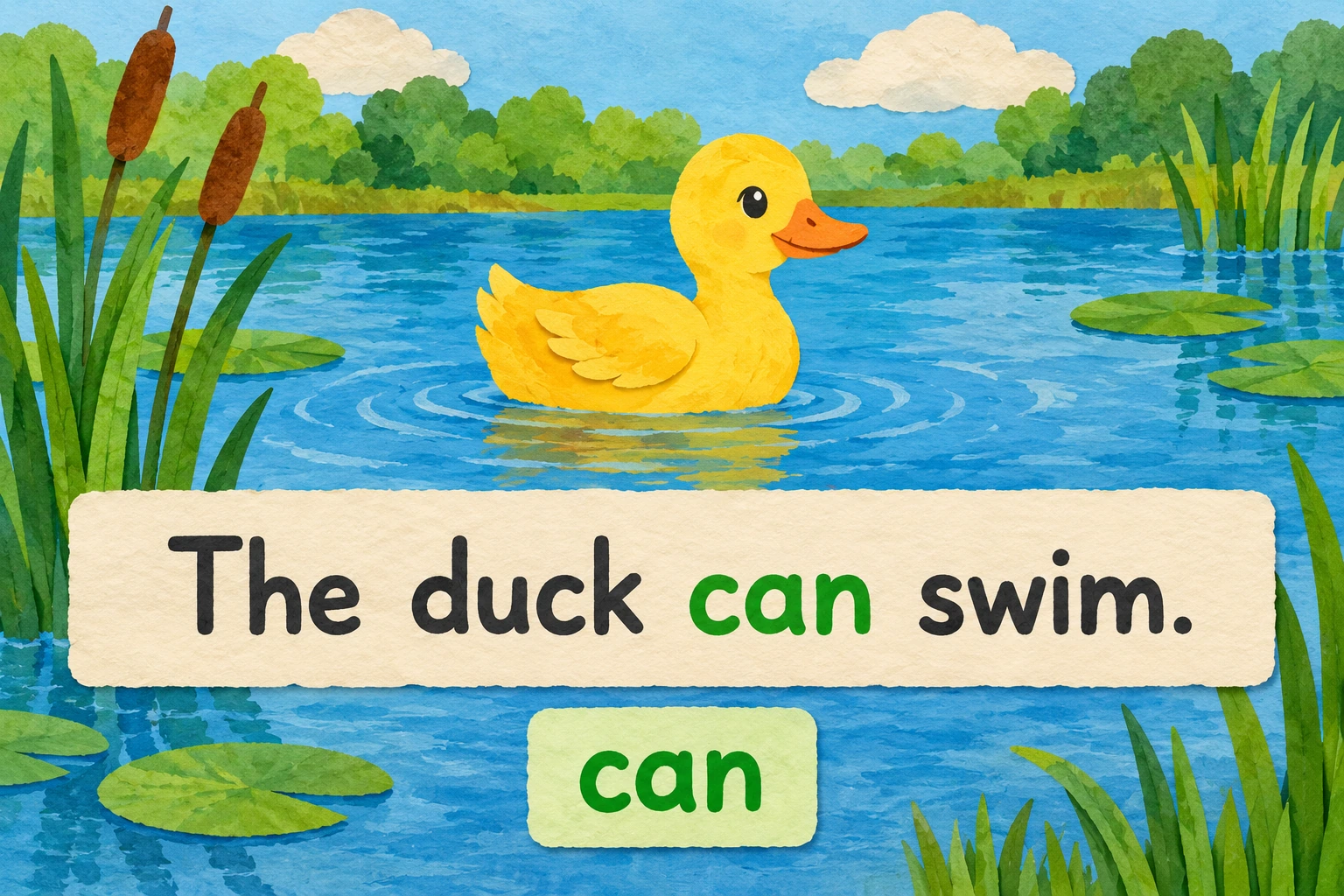
The supporting image shows a paper duck on a pond beside a can card and a complete swimming statement. The labels are filled and readable. This is a separate teaching example, while the actual worksheet keeps its own deliberate spaces for learner responses.
Can Word Confidence often suits adult-guided practice around four to six years, depending on taught sounds and hand comfort. Match the reading prompt to current knowledge rather than require a physical demonstration of ability. A precise comment such as “You checked c before blending the word” acknowledges a useful decision.
Can Word Confidence adjusts common sources of frustration
| What is uncertain? | A focused response |
|---|---|
| The c sound is unfamiliar. | Model /k/ in this target. |
| Only the middle letter is checked. | Compare beginning and ending too. |
| Writing dominates the conversation. | Use dictation or larger pieces. |
The final Can Word Confidence panel permits a sentence copied from above or another message using the target. Rehearse orally before writing and supply unfamiliar spellings. Pause when talking or handwork becomes uncomfortable, then return through one clear caption when interest comes back.
Save Can Word Confidence using the intended access option
The retained original is available through its source-file download. For the clean individual PDF, use the protected member option after signing in under a current eligible plan. This edition has no worksheet watermark, promotional website name or domain branding. The downloaded page contains no embedded advertisements. Inspect the full US Letter border and printer margins before printing.
Can Word Confidence is included in the twenty-sheet collection priced at $5 on the related package card. A purchase obtains that merged clean file, whereas this single-sheet edition is a member attachment. Continue sentence work on the pig-description page, shared action on the rocket group sheet, and short-vowel instruction on the separate vowel activity.
Adult planning can use UFLI's activities connecting frequent words and spelling and Reading Rockets' word-instruction model for early reading. Keep examples consistent with the learner's ongoing programme and choose a manageable next step rather than another demand to finish everything.
Popular Worksheets
Printable resources families and teachers are downloading now.
 Free
 Free
 Free
 Free