
We Word Teamwork: 6 Powerful Shared-Voice Activities
The rocket group shares a larger reading collection. ‘we’ accompanies nineteen further targets in the $5 premium package. Its twenty-page download merges the supplied sheets while removing their promotional website markings.
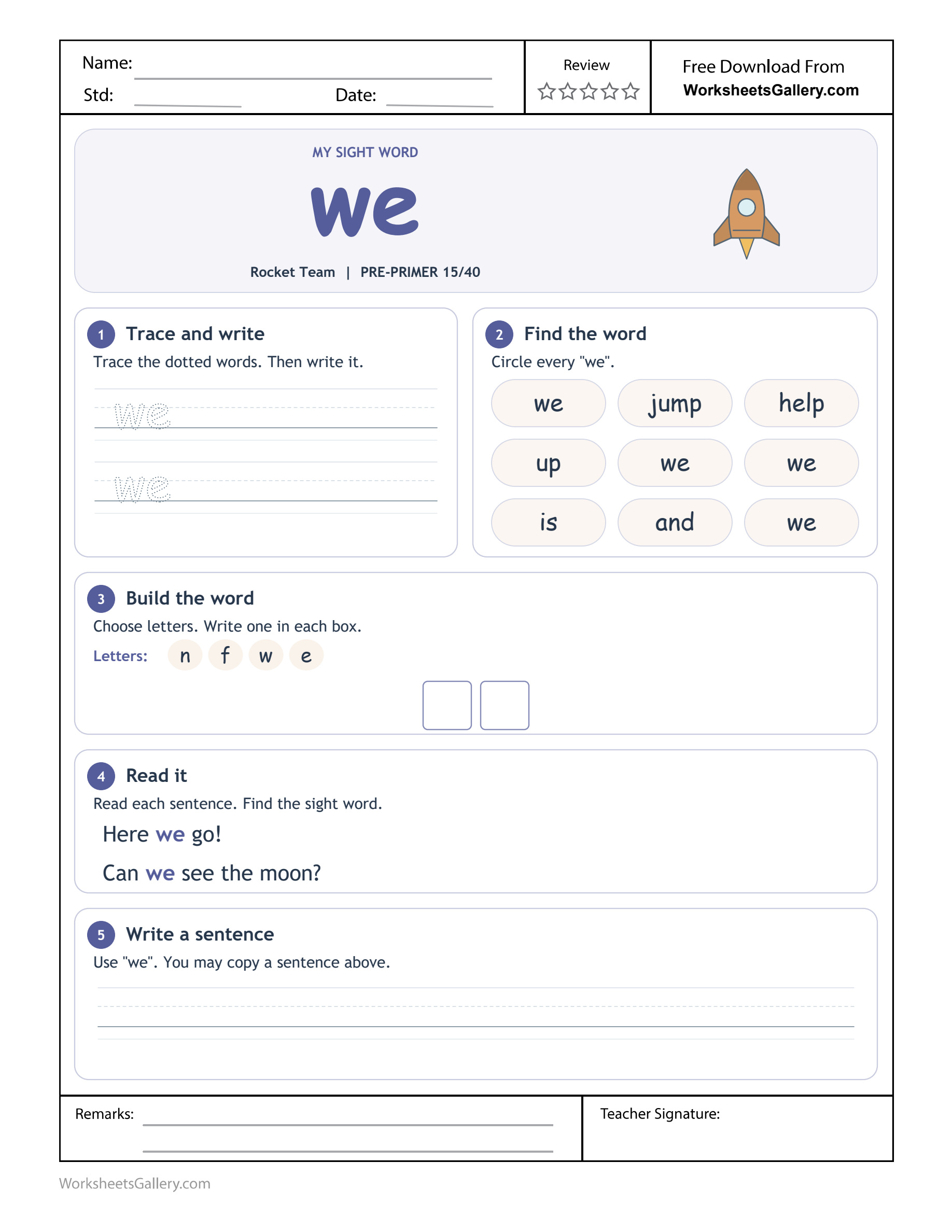
Two people can share a message without naming themselves separately each time. We Word Teamwork explores that idea through the Rocket Team worksheet, where w-e appears in an exclamation and a question. The learner also traces the target, checks search entries, chooses letters and attempts a sentence with adult support. Before reading, ask who is included in the speaker's we. After discussing the group, inspect the actual spelling. The rocket picture can start an imaginative conversation, while a clear word model keeps that conversation connected to print rather than a guess about the theme.
We Word Teamwork asks who belongs to the message
We includes the speaker and at least one other person in the current context. It does not automatically mean every person in the room. An adult can make the intended group clear by naming its members before using the shorter word in a shared statement.
We Word Teamwork gives that explanation a practical purpose. A child and uncle might describe something they are making together, while another relative watches. Ask who the speaker includes, accepting a gesture or a short spoken answer before turning to the target's letters.
In We Word Teamwork, an accurate group explanation is useful language evidence. Reading the written w-e remains another observation. Keep both available so a child who understands shared participation can still receive direct support for recognising and pronouncing the word.
Aditi's rocket craft starts We Word Teamwork at home
Aditi and her uncle arrange paper shapes into a pretend rocket. He writes a short shared message about their activity, reads it and helps Aditi identify the target. They name who belongs to the message before comparing the word with the source model.
Their We Word Teamwork exchange changes when Aditi invites another willing person into the pretend crew. The included group grows while the spelling stays w-e. Her uncle supplies unfamiliar written names and sentence words so the target remains a manageable reading contribution.
We Word Teamwork can use a drawing instead of a craft. The important choices concern a clear speaker, an understood group and an accurate printed word. Aditi does not need an elaborate rocket model or a long performance to participate meaningfully.
We Word Teamwork keeps the final vowel's reading explicit
The written target has w followed by e. In we, the vowel has its long-e pronunciation. An adult can model that directly and connect it with the learner's current sound-spelling instruction, rather than expecting a short-vowel reading simply because the spelling is brief.
We Word Teamwork can name the two letters when discussing order, then read the whole word in a sentence. Letter names and a spoken word serve different purposes. The adult should provide a clear pronunciation model if the learner can order the pieces but is not yet secure in reading them.
For We Word Teamwork, keep the spelling visible as the imagined crew changes. The word does not acquire extra letters when another person joins the group. That stable written form is worth inspecting after the child has explained the changed meaning in context.
We Word Teamwork reads an exclamation and a question

“Here we go!” announces a shared beginning. “Can we see the moon?” asks about a shared possibility. Read the source lines with support, locate the target and identify the group each speaker could mean. The surrounding words may require direct adult modelling.
We Word Teamwork does not require access to a real moon view or knowledge of space travel. The source supplies a pretend reading setting. A child can discuss the messages through the illustration while the adult makes their spelling and sentence purposes clear.
Six We Word Teamwork activities make inclusion visible
These invitations use separate completed cards or simple spoken turns. Choose one that the learner finds interesting. The adult writes unfamiliar text and offers a readable target model before inviting an independent decision about w-e.
1. We Word Teamwork names a two-person craft crew
Choose a shared paper activity and name the willing participants. Dictate a message using we, then have an adult write and read it. We Word Teamwork lets the child point to the included people before locating the same target in the completed sentence.
For We Word Teamwork, keep the group specific. A nearby observer is not included merely because they can see the craft. Clarify the speaker's intended membership openly rather than treating a potentially ambiguous social situation as a hidden test.
2. We Word Teamwork adds a new paper crew member
Use simple portraits to represent an invented speaker and companion. Add another portrait after explaining that the speaker now includes that person. We Word Teamwork shows a changed group beside an unchanged written target, with adult help for all other message words.
The We Word Teamwork child may direct which portrait joins rather than move pieces physically. Read w-e again after the change. This keeps meaning and print connected without requiring an elaborate story or a long explanation of pronoun terminology.
3. We Word Teamwork makes a shared-action caption
Dictate one comfortable action that the learner and adult are doing together, such as drawing. Write the complete sentence and read it back. We Word Teamwork gives the target a truthful use that does not depend on the worksheet's rocket theme.
Save the We Word Teamwork caption if the learner wants to revisit it. An ordinary joint activity supplies enough content. Avoid requiring an exciting achievement or comparing what different children are able or willing to do.
4. We Word Teamwork checks a narrator's group mix-up
An adult names two included paper characters, then points toward a different group while reading the message. Explain the mismatch and invite a correction. We Word Teamwork gives the child a reason to clarify the intended people before inspecting the target again.
During We Word Teamwork, the correction can be a gesture. The adult should model any unfamiliar print and resolve ambiguity directly. Clarifying the social meaning and reading w-e are two useful responses, each deserving its own support.
5. We Word Teamwork builds a group-message label
Arrange w and e beside the source model and read the target with a long vowel. Place it beside a completed adult-written group caption. We Word Teamwork makes the letter build useful within a message while keeping the written sequence easy to compare.
The We Word Teamwork build can stay in place during a reread. There is no need to hide the correct model or repeatedly shuffle pieces to make the activity harder. One carefully explained sequence may be the most suitable amount of work.
6. We Word Teamwork writes a note to a listener
The learner and adult dictate a short shared statement for a willing person to hear. Record it and identify who is speaking for the group. We Word Teamwork offers a natural reason to inspect the target before the note is read aloud.
Let the We Word Teamwork listener ask who is included if that is unclear. Answer through names or pointing, then reread the same spelling. The exchange can end once the message is understood, without requiring another written page.
We Word Teamwork inspects all nine search choices
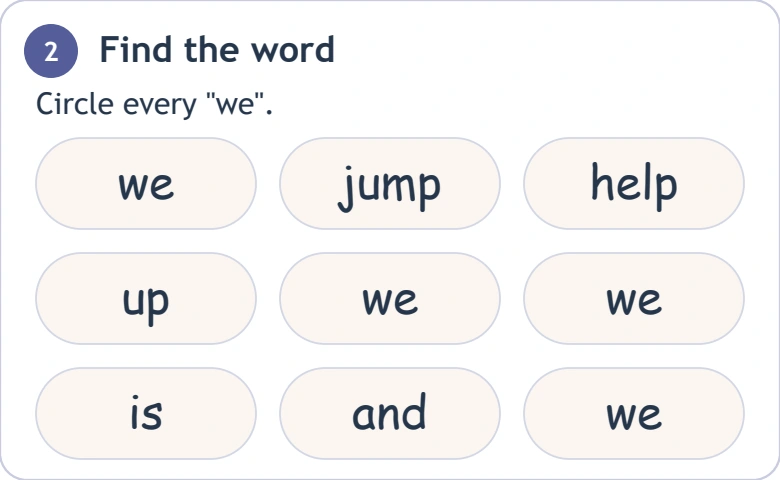
Four entries are we, while jump, help, up, is and and supply the nonmatches. Inspect each complete candidate against w-e. Keep the total of four as an adult review aid, allowing the learner to make print decisions before any answer locations are discussed.
We Word Teamwork can use pointing before marking. If a learner chooses a short distractor, inspect both letters and model the target again. Length, theme or a familiar beginning alone cannot establish a complete match.
We Word Teamwork keeps writing demands adjustable
Two dotted examples provide the source's tracing models. Its bank offers n, f, w and e above two boxes. Select w then e, leaving n and f unused. Larger pieces beside the sheet can demonstrate the sequence before a child attempts the smaller written space.
We Word Teamwork offers sentence writing as its final task, with permission to reuse a supplied line. Rehearse the message orally before deciding on dictation, supported copying or a new composition. The learner can contribute a meaningful group idea without independently managing every spelling and pencil movement.
Six We Word Teamwork benefits have distinct signs
- Perspective: identify the speaker and the companions included in a current message.
- Vowel learning: connect final e with the long-e reading in this word.
- Sequence: arrange w-e accurately from a larger set of choices.
- Attention: inspect whole printed entries before choosing a match.
- Motor planning: attempt guided writing or direct larger letter pieces.
- Expression: dictate a shared statement that a listener can understand.
We Word Teamwork brings thinking, language and hand control into contact without expecting them to develop at the same pace. A child can explain the crew while needing a vowel model, or recognise w-e while finding handwriting difficult. Describe that particular response when planning the next visit.
We Word Teamwork in class makes the intended group clear
A teacher models a statement for two named paper characters, reads the target and invites individual print responses. Learners locate w-e on their own sheets, select bank letters or attempt tracing with suitable assistance. The teacher records the prompt that made each response possible.
We Word Teamwork can continue through a willing pair's dictated classroom caption. Keep the adult responsible for unfamiliar print and clarify whose group the message concerns. Do not let one child's rapid response determine the pace or assistance offered to everyone else.
We Word Teamwork uses a labelled rocket scene honestly
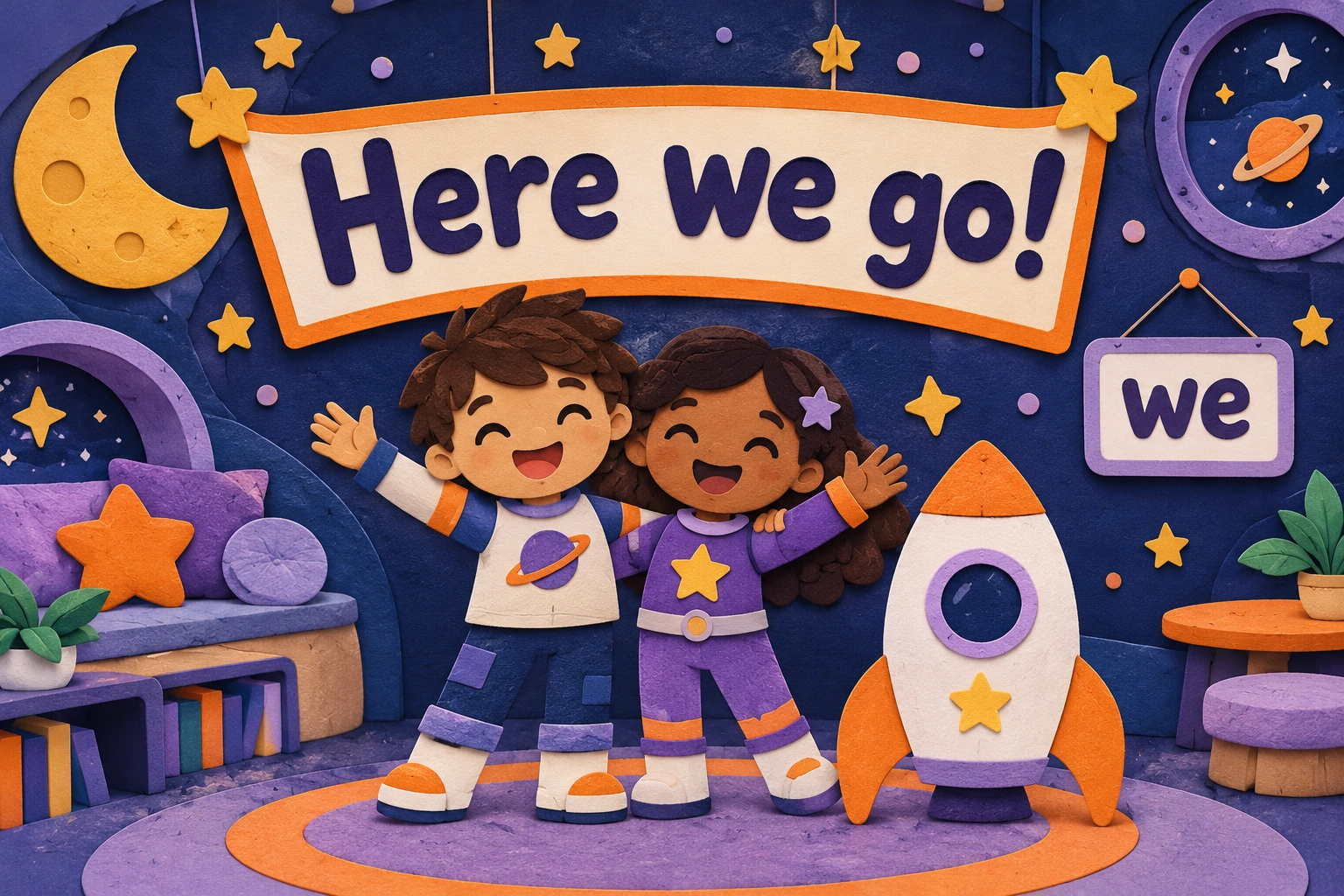
The supporting illustration shows two imagined children making a paper rocket, with a we card and a completed sentence strip. This separate scene demonstrates a possible shared message. It is not a claim that the PDF contains a craft project or a completed answer sheet.
We Word Teamwork often fits supported reading practice between roughly four and six years of age, with readiness assessed individually. A clear group meaning gives the word a purpose; the actual letters still need teaching. A precise comment such as “You explained who belonged to that we” acknowledges a useful response.
We Word Teamwork responds to predictable misunderstandings
| What is uncertain? | What to make explicit |
|---|---|
| Every nearby person is included. | Name the speaker's intended group. |
| The vowel is read as short e. | Model the long-e reading here. |
| The page feels too demanding. | Choose one supported response. |
Return to We Word Teamwork through a saved caption when interest reappears. A single reread or letter check can be the complete visit. Avoid a fixed full-sheet quota, and pause when speaking, looking or writing begins to feel uncomfortable.
Save We Word Teamwork through its individual or collection option
The source-download choice retains the supplied original. For a clean individual PDF, sign in under an eligible active membership and use the protected member attachment. That edition removes worksheet watermark text, domain promotion and website-name branding. There are no ads embedded in the downloaded page. Check that the US Letter border fits your printer's available area before printing.
We Word Teamwork is part of the twenty-page collection offered for $5 through this page's package card. Purchasing it provides one merged clean file; the individual edition remains a member download. Compare a single speaker on the star voice activity, a listener on the fish exchange page, and a journey action on the car reading sheet.
Adults can use Reading Rockets' discussion of explicit frequent-word learning and UFLI's practical spelling-and-reading activities when planning instruction consistent with the learner's existing programme. Select one clear target feature rather than expanding every return into a longer lesson.
Popular Worksheets
Printable resources families and teachers are downloading now.
 Free
 Free
 Free
 Free