
Sight Word Starter Pack: 20 Brilliant Reading Routes
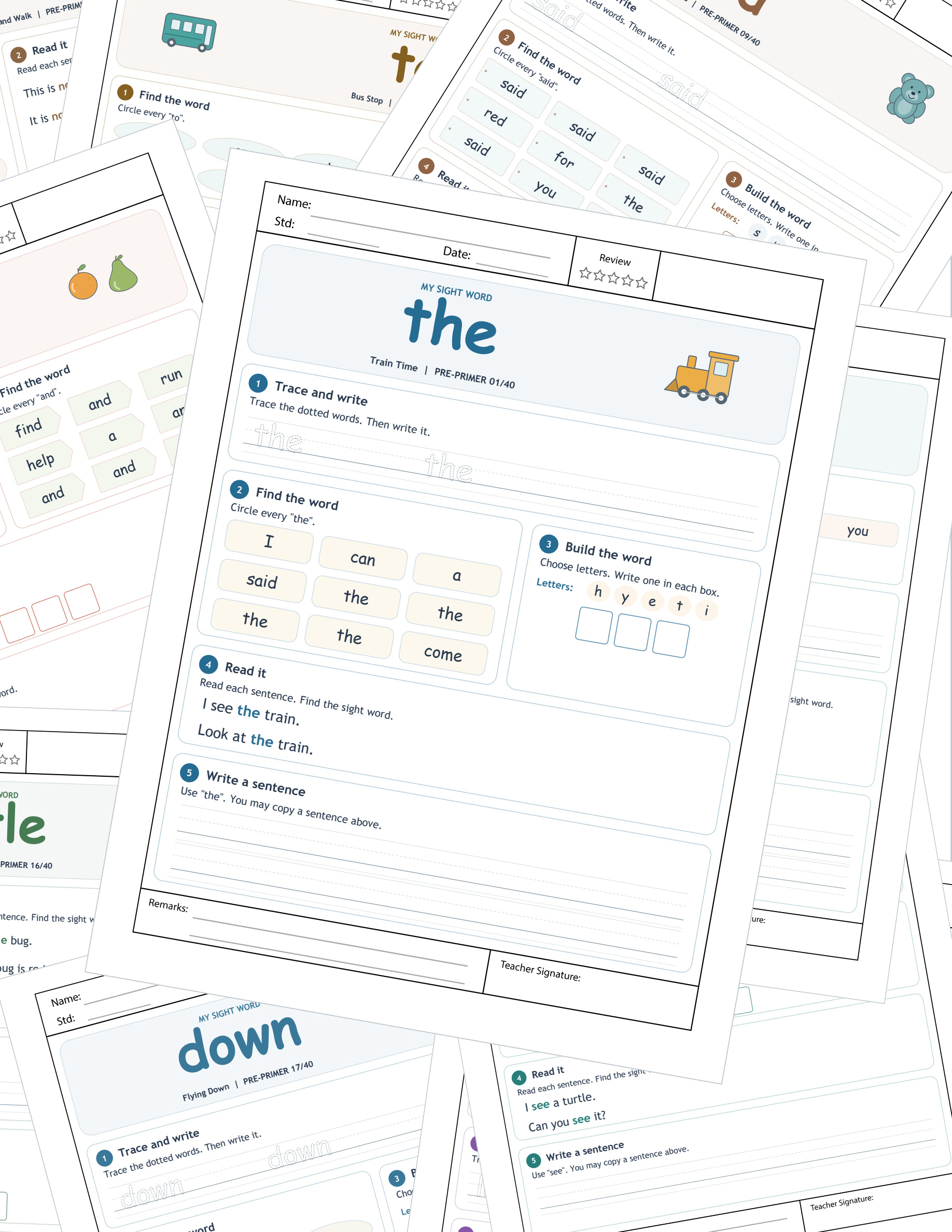
A small collection becomes useful when an adult knows which word to choose next. Sight Word Starter Pack brings twenty supplied Dolch pre-primer worksheets into one clean PDF, with a different pictured setting for each target. The $5 package includes sheets numbered 01 through 20 from a forty-sheet source series; it does not contain all forty words. Trace a model, inspect a spelling, read a short message and give that word a job in conversation. Select a manageable starting point with your learner, keeping the page order available as an organisational guide rather than a reading race.
Sight Word Starter Pack contains these twenty word routes
The download follows the supplied order: the, to, and, a, I, you, it, in, said, for, up, look, is, go, we, little, down, can, see, not. Each target occupies one US Letter page. The original series numbers remain visible so a family or teacher can identify a sheet accurately.
Sight Word Starter Pack uses trains, buses, fruit, farm animals and other familiar settings as conversation contexts. A picture can help explain a sentence's meaning, but it does not replace examining its printed word. An adult can supply unfamiliar surrounding words while the learner attends to the current target.
Sight Word Starter Pack connects a word with a message
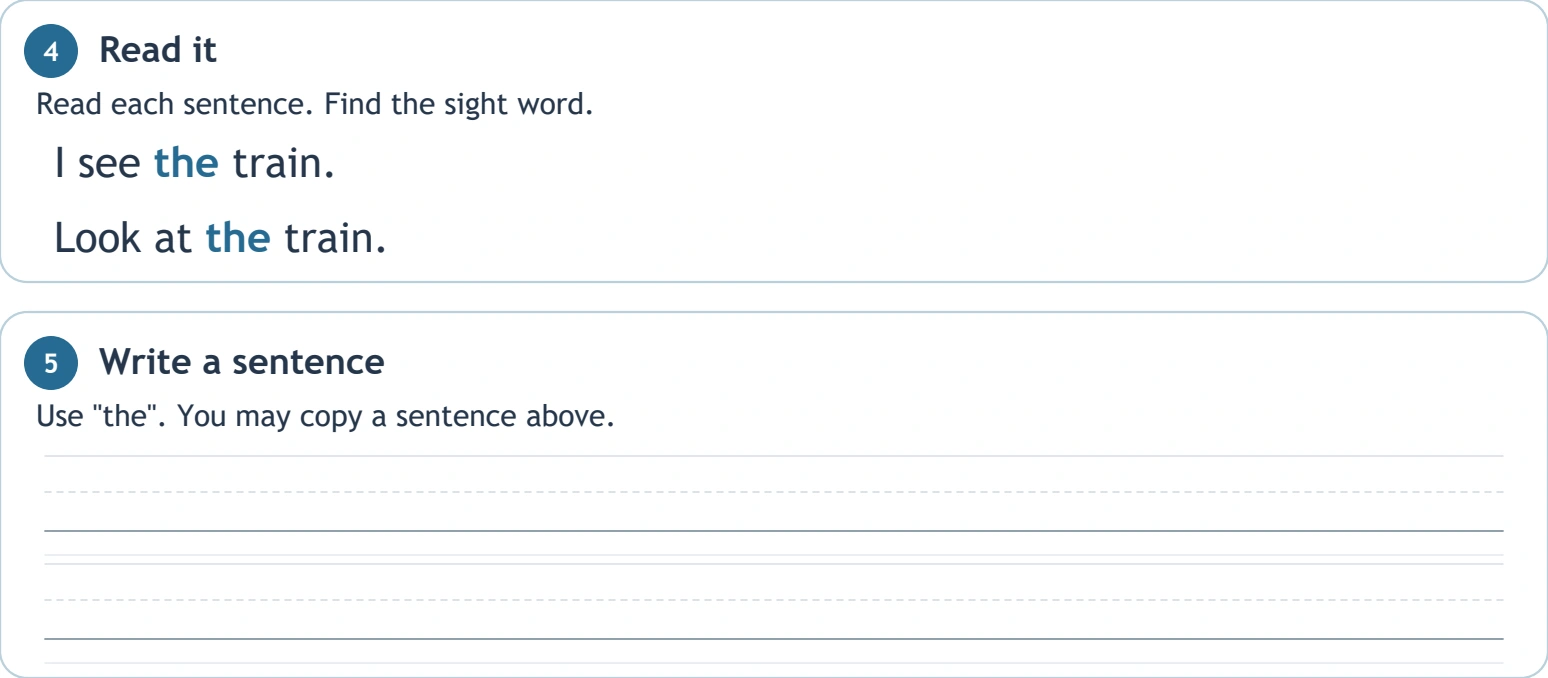
The train page includes “I see the train.” Another line asks a listener to look toward that object. Each message gives the small word a purpose before the noun. Read one together, locate its target and discuss which train the speaker means. Keep pronunciation attached to the actual spelling.
Sight Word Starter Pack can begin with this kind of shared reading instead of a long search. A child who can explain a sentence but finds writing tiring may point and speak first. Reading, handwriting and sentence composition can receive different amounts of adult support.
What changes from page to page in Sight Word Starter Pack?
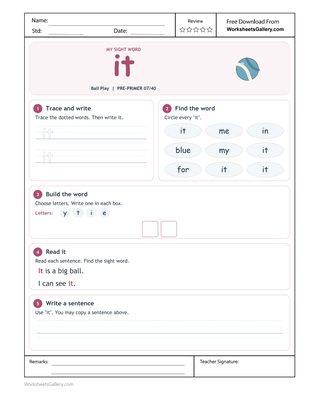
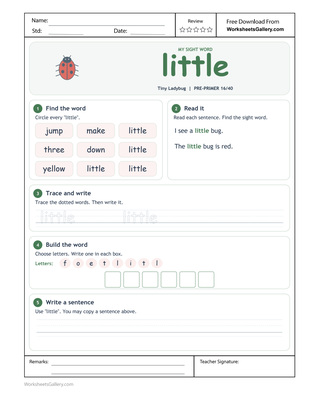
Every sheet contains five tasks, but the panel positions vary. There are two dotted word models, a search of nine printed choices, a letter bank with spelling boxes, two short reading sentences and space for a sentence. The writing direction permits copying one of the supplied sentences.
Sight Word Starter Pack therefore offers repeated task types without identical content. Some targets have one written letter, while little has six. The search areas use four target occurrences per sheet among distractors. An adult may keep that count as a checking aid rather than announce the answers before the learner looks.
Sight Word Starter Pack makes letter selection inspectable
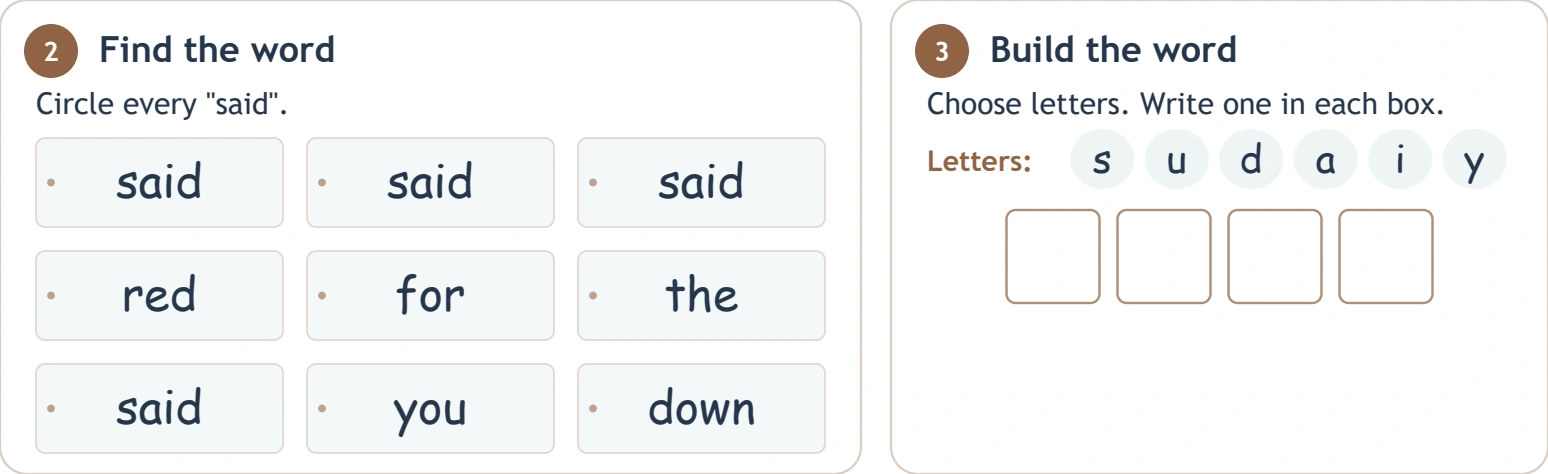
The said bank supplies s, u, d, a, i and y, with four boxes to complete. The useful arrangement is s-a-i-d. After building it, connect the spelling with the spoken word and explicitly identify any sound-spelling part the child has not yet learned.
Sight Word Starter Pack does not treat every high-frequency word as an indivisible picture. Some can be blended using familiar correspondences; others require an adult to explain a less predictable portion. Letter names help discuss order, while spoken sounds and meaning contribute different information.
Six Sight Word Starter Pack opportunities for an adult to notice
- Print attention: inspect a complete spelling instead of deciding from its first letter or nearby picture.
- Sound-spelling connection: link known correspondences and receive clear help for unfamiliar ones.
- Sequence control: select letters in the order needed for a target, including repeated letters.
- Supported handwriting: move from a dotted model toward a readable attempt at an appropriate scale.
- Sentence meaning: explain a word's role in a message rather than merely naming it on a card.
- Communication: dictate, copy or compose a sentence that another person can understand.
Sight Word Starter Pack combines thinking, hand movement and language, with flexible demands. A learner may read a target before producing comfortable handwriting, or explain an idea before decoding every surrounding word. Those differences suggest the next kind of support rather than a single score for the whole sheet.
Sight Word Starter Pack leaves room to examine double letters
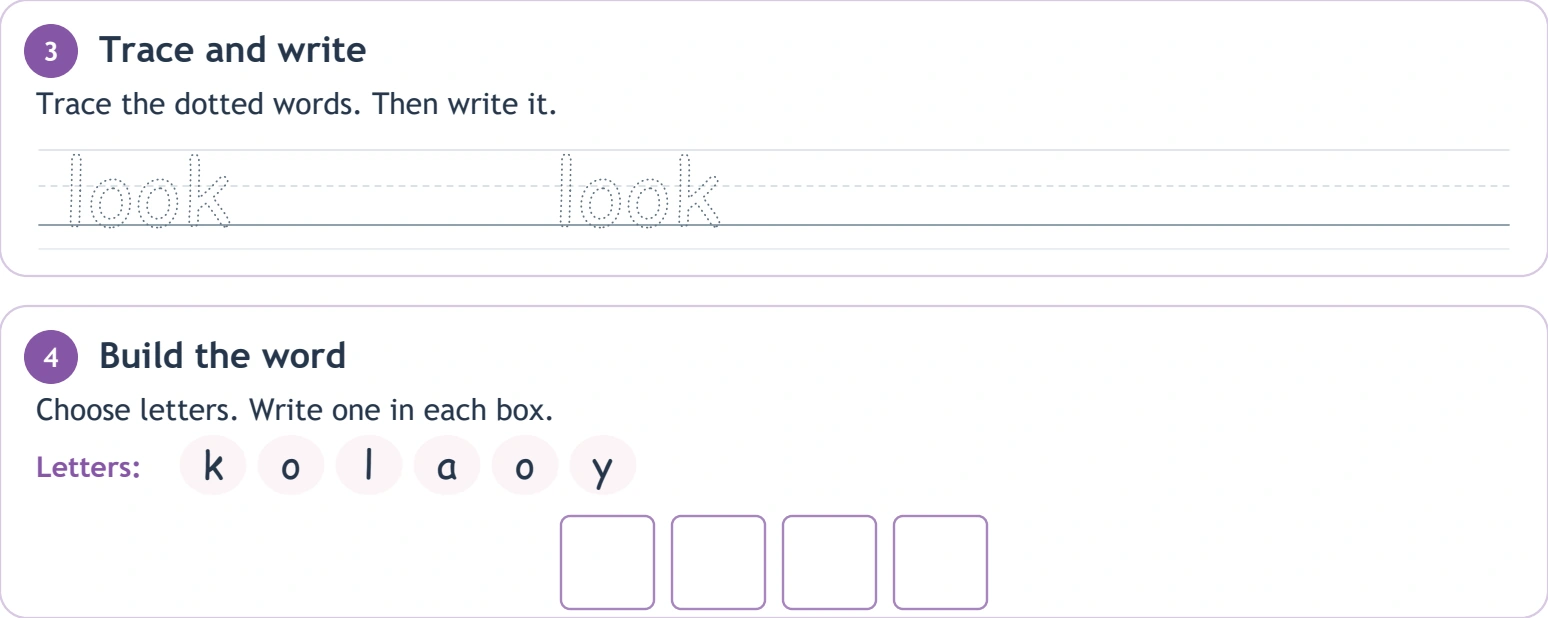
The look trace panel preserves two adjacent o letters in each four-letter model. An adult can discuss their vowel spelling before the child follows the dotted forms. Two written letters can work together for a sound; tracing alone does not explain that relationship.
Sight Word Starter Pack practice can move back to a larger word card if fine lines interrupt useful reading talk. Let the learner say, indicate or build the spelling before returning to a smaller pencil task. The actual sheet remains available without making handwriting the entrance requirement for word understanding.
A home Sight Word Starter Pack visit can follow one question
Asha's family begins with a word already introduced during shared reading. Her father prints that page, reads its instruction and asks her to locate the target in one sentence. They discuss its meaning, inspect the spelling and choose one further panel that fits her attention today.
Their Sight Word Starter Pack session might include a letter-bank trial and a dictated sentence before any independent writing. Her father supplies the words she has not learned to decode, keeping the target visible. He notes what kind of help was useful so another visit can begin with a concrete question.
Close a Sight Word Starter Pack visit by reading the child's selected message together. “You checked the second letter before changing your choice” identifies an observable strategy. Stop at a comfortable point instead of insisting that all five panels must be finished before the page has value.
A classroom Sight Word Starter Pack conference uses a small record
A teacher selects a recently introduced target for each learner or small group. Children work with individual copies, larger letter pieces and a sentence card. The adult listens for the target's pronunciation, checks its ordered letters and asks a short meaning question tied to the printed sentence.
Sight Word Starter Pack conferences can record the support actually given: adult model, sound reminder, letter-bank prompt or independent reread. Avoid comparing how rapidly children complete different words. A one-letter target and a six-letter target place different demands on memory and handwriting.
Five Sight Word Starter Pack extensions for purposeful return visits
These optional activities use separate cards and familiar objects. They add a reason to revisit a known target without creating another compulsory worksheet sequence. Choose one that answers a current reading or meaning question.
1. Sight Word Starter Pack makes a message pocket
The learner chooses an introduced target and dictates a short message containing it. An adult writes the complete sentence, then reads it while the child follows the words. Sight Word Starter Pack pockets can hold a message for a family member or a pretend character from the page.
Ask the Sight Word Starter Pack maker to locate the target by its letters, then explain its role in the message. The receiver can respond with a question about meaning. Independent spelling of every other word is not required for this shared composition.
2. Sight Word Starter Pack compares two complete spellings
Offer the known target beside one carefully chosen distractor on fresh cards. Inspect both from beginning to end and discuss the difference. Sight Word Starter Pack comparisons work best after the word has been taught, rather than asking a child to discover an unfamiliar pronunciation through guessing.
Let the Sight Word Starter Pack learner explain through letter names, sounds or pointing as appropriate. The adult supplies an accurate model when needed. Keep the pair small enough that the comparison remains clear without becoming a timed recognition drill.
3. Sight Word Starter Pack builds a repeated-letter check
Use loose letters for a target such as see, look or little and keep the printed model nearby. After arranging the spelling, compare each position with the model. Sight Word Starter Pack builders can notice a missing repeated letter before transferring the sequence to writing boxes.
For Sight Word Starter Pack, the number of letter pieces is not automatically the number of speech sounds. Talk about written positions and sound-spelling units separately. This keeps a useful construction activity from teaching an inaccurate one-letter-one-sound rule.
4. Sight Word Starter Pack changes one sentence meaning
Choose a familiar statement and an adult-supported variation using a meaningful target, such as adding not. Read both and discuss what each says. Sight Word Starter Pack contrast cards connect accurate print with an observable difference in the message.
The Sight Word Starter Pack adult can act out a simple example with paper props, then return to the sentence to check its wording. The action explains meaning; it does not provide permission to identify a printed word from a picture alone.
5. Sight Word Starter Pack keeps a useful rereading folder
Save a few introduced targets and their readable sentence cards in a small folder. Revisit one after a gap, offering help when the spelling is uncertain. Sight Word Starter Pack folders make earlier learning accessible without requiring the entire collection to be repeated on a fixed schedule.
Invite the Sight Word Starter Pack learner to choose a message they want to share again. A short supported reread can be the whole visit. The folder records interesting reading, not a competition over how many pages have been completed.
Sight Word Starter Pack gives a longer spelling enough room
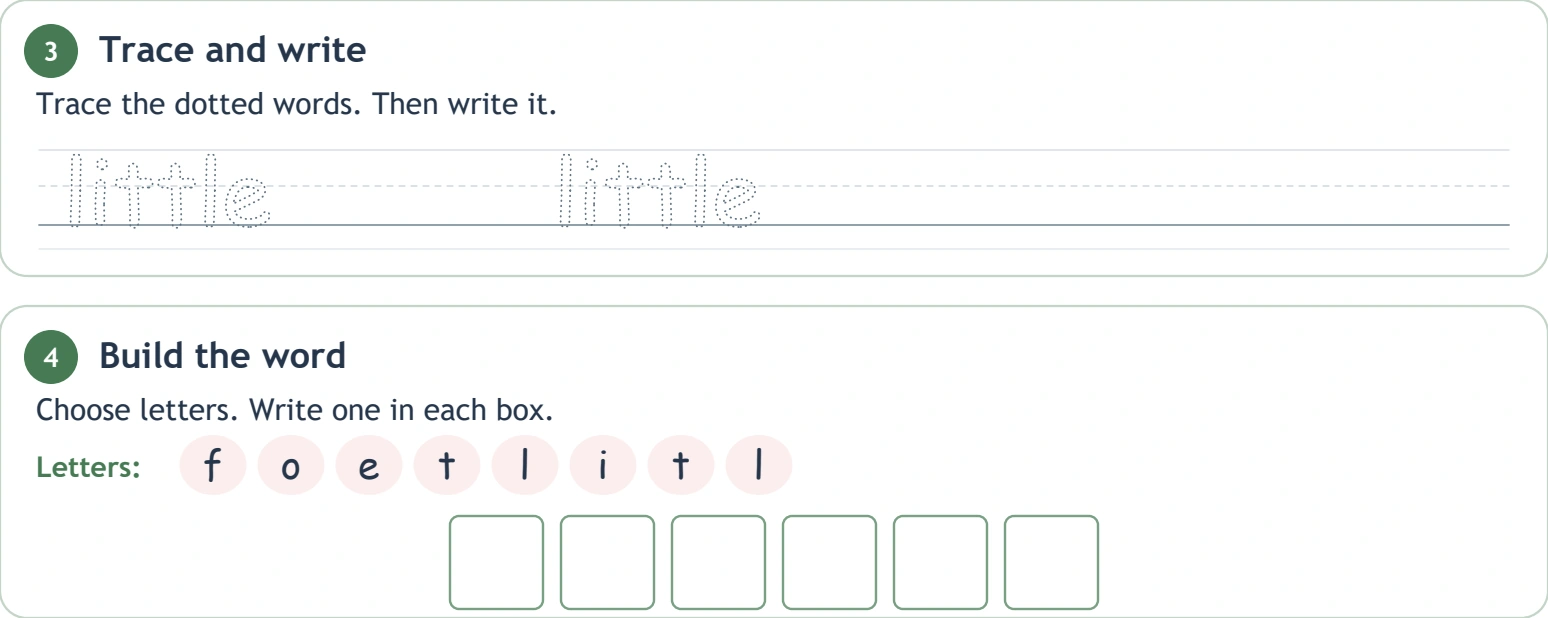
The little bank includes the two l choices and two t choices needed for l-i-t-t-l-e. Six boxes represent the written sequence. Point through the positions with the model nearby, allowing an adult to explain the spoken word without pretending each box contains an independent sound.
Sight Word Starter Pack can reduce the writing demand by using large letter pieces first. If a child reads little comfortably but tires during copying, choose a shorter writing amount while preserving the reading discussion. Physical endurance and word knowledge are different observations.
Sight Word Starter Pack can discuss a negative statement
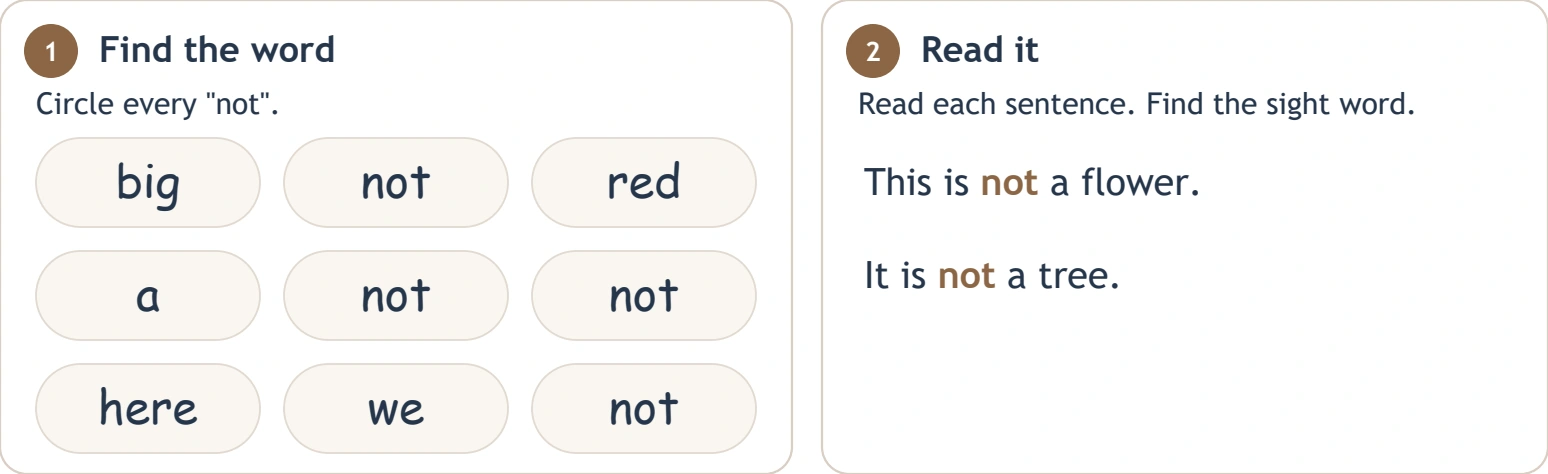
The woodland page says “This is not a flower.” and “It is not a tree.” Ask what each statement rules out, then look back at the complete printed word not. An adult can explain surrounding vocabulary and invite a positive description on a separate card.
Sight Word Starter Pack makes meaning checks brief and specific. A child who pronounces a sentence accurately may still need help explaining it. Conversely, a child can understand an adult-read message before independently decoding the whole line.
Sight Word Starter Pack stays comfortable for developing readers
This collection is intended for supported preschool readiness and beginning kindergarten work, often around ages four to six. Match it to the child's taught letter-sound knowledge and language experience. Younger children can join through listening or pointing, with writing and independent reading introduced when suitable.
Common Sight Word Starter Pack missteps include expecting mastery after one visit, rushing all twenty pages, treating pictures as word-reading cues or correcting every pencil mark during a reading task. Choose the skill you are observing before increasing the demand. A precise small success can make another visit more inviting.
Plan a Sight Word Starter Pack visit without a completion quota
| Current need | A possible focus |
|---|---|
| The spelling is unfamiliar. | Teach the word before a search. |
| Handwriting feels tiring. | Build with larger letters. |
| Reading sounds fluent. | Ask what the sentence means. |
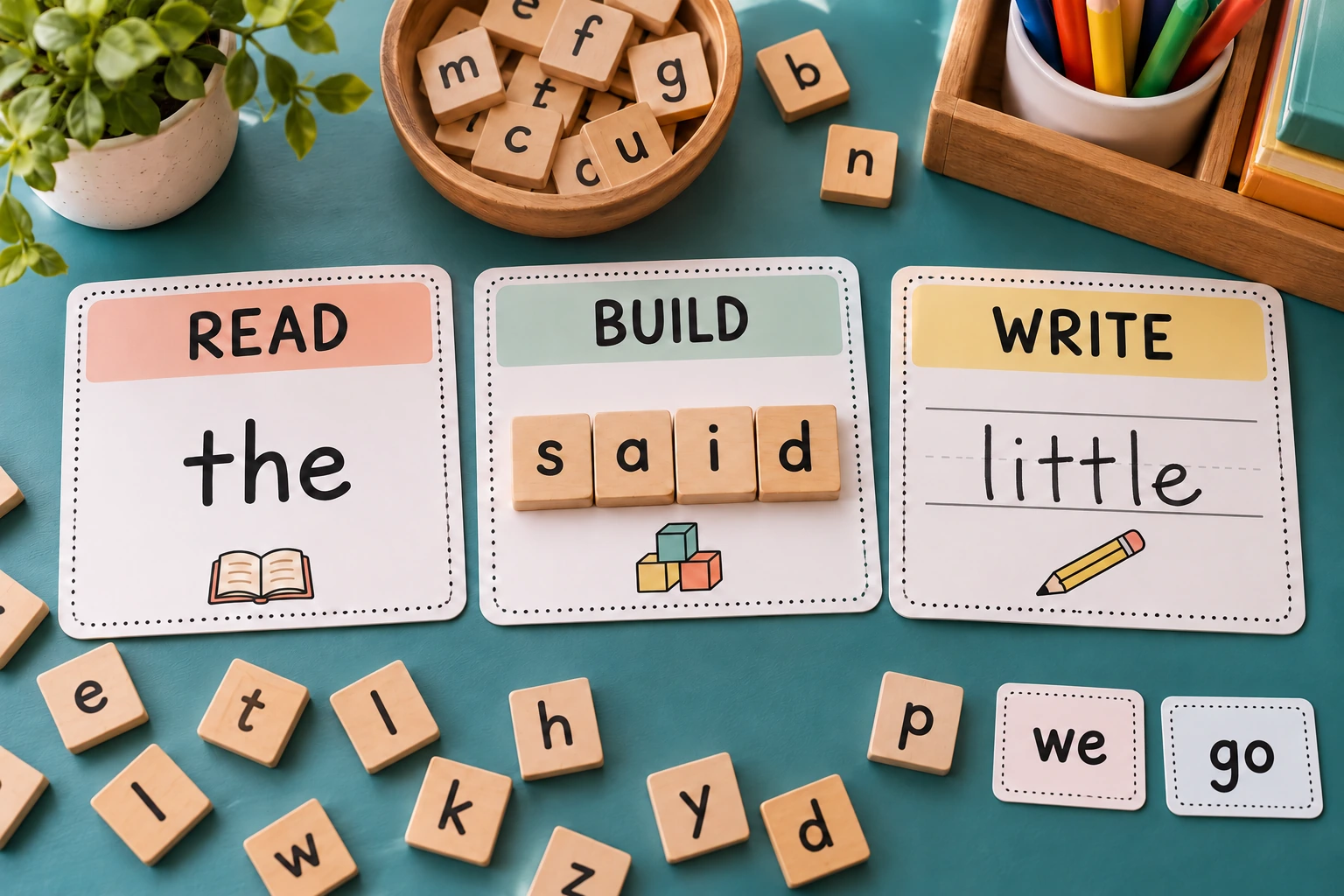
The filled READ, BUILD and WRITE station illustration suggests several ways to engage with print. Sight Word Starter Pack does not require those exact materials. Familiar paper, an adult's clear model and a comfortable pencil can support a useful short encounter.
Purchase Sight Word Starter Pack and choose pages for printing
The Sight Word Starter Pack price is $5 USD for one twenty-page digital PDF. Use the package purchase control, complete the website's checkout and download through the authorised purchaser account. This paid collection is distinct from the individual pages' clean membership attachments; the package itself does not offer a free full-pack PDF.
The downloaded Sight Word Starter Pack has no worksheet watermarks, website/domain branding or embedded advertisements. Website advertising remains outside the printable. Select the pages you want in the print dialog, check the US Letter portrait view and retain all activity borders when choosing scaling. There is no need to print the entire collection for a first visit.
For related practice, browse the separate eat word activity, a leg word-reading page or short-vowel phonics work. Adults can also consult UFLI's high-frequency-word resources and Reading Rockets' word-teaching discussion while coordinating practice with the learner's existing reading instruction.
Popular Worksheets
Printable resources families and teachers are downloading now.
 Free
 Free
 Free
 Free